Bachelor Degree in Canada: Top Courses for Nepalese Students

May 12, 2026

Choosing the right bachelor’s degree in Canada can feel overwhelming, especially when every university, course, and fee structure looks different. For many students in Nepal, the real challenge is not just dreaming about Canada, but understanding which options actually fit their budget, profile, and career goals.
This guide is designed to make that decision easier. Instead of confusion, you’ll get a clear breakdown of the best courses, universities, costs, and pathways so you can confidently choose the right bachelor’s program in Canada for 2026.
In this blog
Why Study a Bachelor Degree in Canada?
Canada is a top choice because it offers a mix of high-quality degrees, a welcoming culture, and a very clear path to stay and work after you graduate. It is one of the few places where your education directly helps you build a long-term life in a developed country. Let's look at the specific reasons why Canada makes so much sense for your future.
1. Globally Recognized Universities
Canadian universities are respected around the world for their academic excellence. Degrees from Canada are accepted by employers and universities internationally. Institutions like the University of Toronto and McGill University are among the most prestigious in the world. This means your qualification can open doors to global career opportunities.
2. High-Quality Education System
Canada is known for its practical and career-focused education system. Students learn through projects, research, internships, and hands-on assignments. Programs are regularly updated to match current industry needs. As a result, graduates are well prepared for real-world jobs.
3. Safe and Welcoming Environment
Canada is one of the safest countries for international students. It is multicultural and welcomes people from all backgrounds and cultures. Many cities have active Nepalese student communities, making it easier to adjust. Universities also provide strong support services for academics, health, and personal well-being.
4. Work While Studying
International students can work part-time in Canada during their studies and full-time during scheduled breaks, subject to current permit rules. This allows you to earn money for daily expenses such as food, transport, and phone bills. Common student jobs include retail, restaurants, and campus positions. Working in Canada also helps you build valuable experience and improve your résumé.
5. Pathway to Permanent Residency
Canada offers excellent opportunities to stay after graduation. Eligible students can apply for a Post-Graduation Work Permit (PGWP) to gain Canadian work experience. This experience can strengthen your profile for immigration programs such as Express Entry and Provincial Nominee Programs. For many students, studying in Canada becomes the first step toward permanent residency and a long-term career.
What Is a Bachelor Degree in Canada?
An undergraduate or bachelor's degree is the first major step in your higher education journey after you finish your +2 or A-Levels in Nepal. These programs are designed to give you a solid foundation in your chosen field while teaching you how to think for yourself. Let’s break down exactly what you can expect from these programs over the next few years.
1. Duration of Undergraduate Programs
Most bachelor’s degrees in Canada take four years to complete. Some programs may take three years, while co-op programs can take longer because they include paid work placements. Students usually choose four-year degrees because they offer stronger career opportunities. The exact duration depends on your program and university.
2. Difference Between College and University in Canada
Universities offer academic degree programs such as bachelor’s, master’s, and PhDs. Colleges focus more on practical and career-oriented training. Universities are ideal if you want a full undergraduate degree and broader career options. Colleges are a good choice for students who prefer hands-on learning and shorter programs.
Feature | University | College / Institute |
| Main Focus | Academic theory, research, and critical analysis. | Practical, job-ready skills and industry-specific training. |
| Typical Duration | 3–4 years for a Bachelor's; 1–2 years for Master's. | 1–3 years for Diplomas or Applied Degrees. |
| Class Size | Large lecture halls (often 200+ students). | Small, interactive groups (usually 20–40 students). |
| Credentials | Bachelor’s, Master’s, PhD, and Professional Degrees. | Diplomas, Certificates, and specialized Applied Degrees. |
Both options are respected in Canada, but they offer very different styles of learning and campus life. You should choose based on whether you prefer studying big ideas in a library or practicing skills in a workshop.
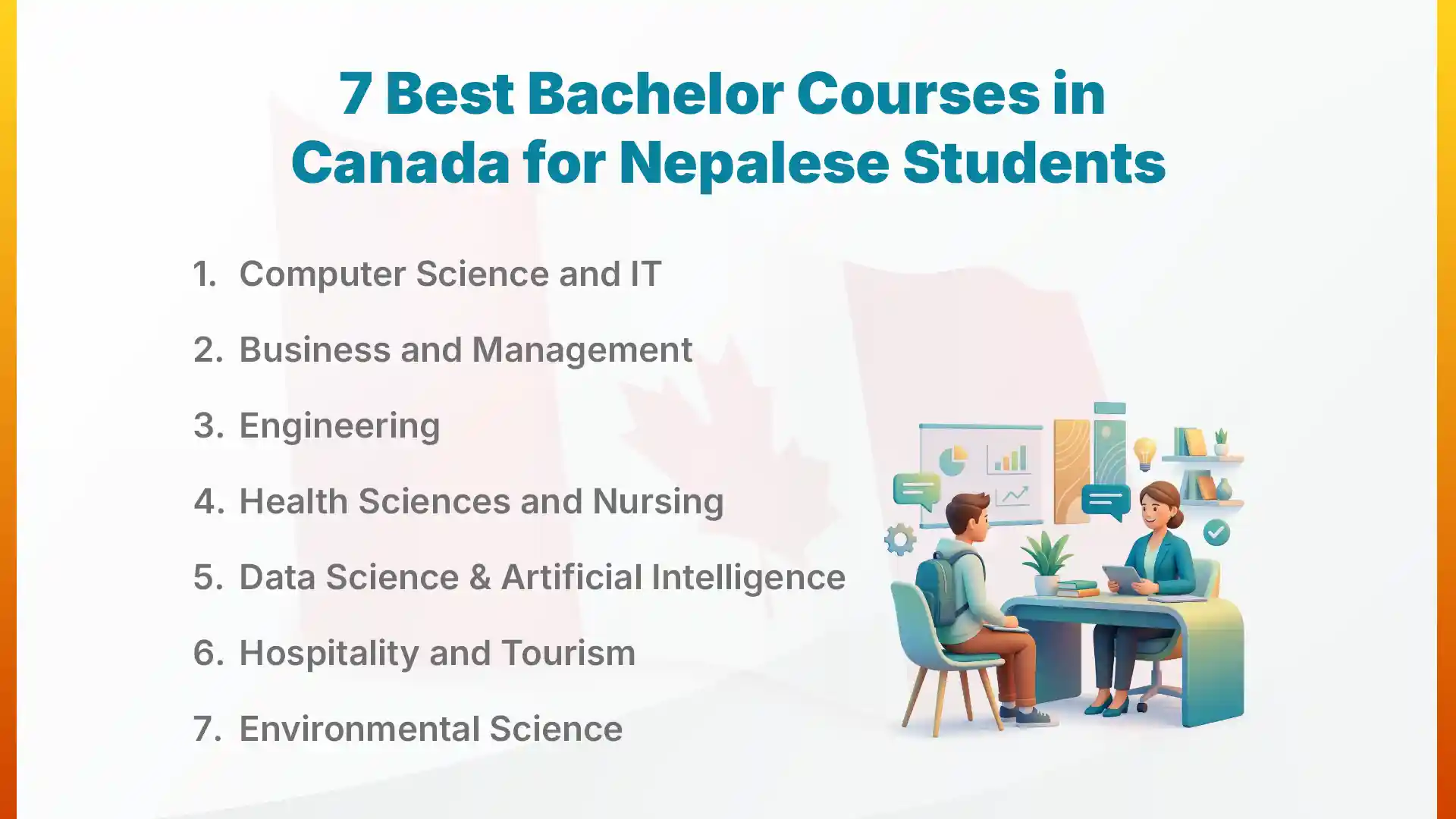
7 Best Bachelor Courses in Canada for Nepalese Students
Popular fields like IT, Business, and Health are great choices because Canada currently has a huge shortage of workers in these areas. Choosing the right course is the most important part of your plan because it determines your future salary and your ease of getting a visa. Let's look at the seven best sectors where you can build a successful and stable career.
1. Computer Science and IT
With the world going digital, a degree in Computer Science in Canada is one of the safest bets you can make for a high-paying future. You will dive into software engineering, web development, and cloud computing, which are skills needed by every major company in Canada.
Cities like Toronto and Vancouver are becoming huge tech hubs, often called the "Silicon Valley of the North," offering thousands of internships. If you enjoy solving puzzles and working with logic, this path will lead you to jobs with some of the best starting salaries in the country.
2. Business and Management
A business degree in Canada is incredibly versatile because it allows you to work in almost any industry, from fashion to finance. You can choose to specialize in areas like Marketing, Human Resources, or International Business depending on what excites you most. Many Canadian business schools, like Rotman or Ivey, have very strong links with big banks and consulting firms. This means you will have plenty of chances to network with professionals and land a high-profile job right after your final exams.
3. Engineering
Canada is constantly building new infrastructure, so engineers in the Civil, Mechanical, and Electrical fields are always in high demand. These programs are quite rigorous and will require you to be strong in math and physics, but the career rewards are huge. You will have the chance to work on massive projects, like renewable energy plants or smart city designs, that actually change the world. Once you graduate, you can work toward getting your "P.Eng" (Professional Engineer) license, which is highly respected and very well-paid.
4. Health Sciences and Nursing
If you have a passion for helping people, the healthcare sector or nursing studies in Canada offer a very stable and meaningful career path. Nursing is particularly popular because there is a massive shortage of nurses across every Canadian province right now. You will get to train in world-class hospitals and learn how to use the latest medical technology to save lives. Most nursing graduates find a job almost immediately after passing their licensing exams, making it one of the most secure paths for international students.
5. Data Science and Artificial Intelligence
This is a relatively new field that is growing faster than almost any other industry as businesses try to make sense of Big Data. You will learn how to use math and coding to predict trends and build smart systems like the ones used by Netflix or Amazon. Because this skill set is so rare, companies are willing to pay very high salaries to attract top talent. If you have a analytical mind and want to be at the cutting edge of technology, this is the perfect degree for 2026.
6. Hospitality and Tourism
Canada is a beautiful country that attracts millions of tourists every year to places like Banff and Niagara Falls. A degree in Hospitality Management will teach you how to run luxury hotels, manage international events, and oversee world-class resorts. This is a very hands-on course where people skills are just as important as what you learn in the classroom. It is a great choice if you are outgoing and want a career that could eventually take you to the top tourist destinations all over the globe.
7. Environmental Science
As the world focuses more on climate change, Canada is leading the way in environmental protection and green energy. By studying Environmental Science, you will learn how to protect natural habitats, manage water resources, and help companies follow green laws. There are many jobs available in government agencies and private environmental consulting firms, especially in provinces like British Columbia. This is a great path if you love nature and want a career that helps ensure a better future for our planet.
What are the Tuition Fees for Bachelor’s in Canada?
The cost of your education will be the biggest part of your budget, and it can vary a lot depending on the school you pick. On average, you can expect to pay between CAD 15,000 and CAD 45,000 per year for your tuition alone. It is important to look at these numbers early so you and your family can plan your finances without any stress later on.
1. Average Annual Tuition Fees
For most general bachelor's programs, you should budget for an average of about CAD 25,000 to CAD 30,000 per year. Smaller colleges and schools in less populated provinces will usually be on the lower end of this range. However, if you are aiming for a top university in a big city, your fees will likely be toward the higher end.
2. Undergraduate Tuition Fees in Canada for Popular Courses
Most undergraduate programs in Canada generally fall between CAD 20,000 – CAD 45,000 per year, while technical and medical fields can go higher depending on the university and program structure.
Course Area | Annual Tuition (CAD) | Quick Note (2026/27 Trends) |
|---|---|---|
| Computer Science & IT | $25,000 – $55,000 | High demand; mandatory for AI/Software development roles. |
| Business & Management | $20,000 – $45,000 | Tier-1 schools (UofT, UBC) often exceed $60k. |
| Engineering | $30,000 – $60,000 | Higher due to laboratory fees and professional accreditation. |
| Health Sciences & Nursing | $20,000 – $50,000 | Nursing is high-demand with strong clinical placement support. |
| Data Science & AI | $30,000 – $55,000 | Rapidly growing niche; usually post-graduate focus. |
| Hospitality & Tourism | $15,000 – $30,000 | Most affordable; focus on co-op placements and direct employment. |
| Environmental Science | $20,000 – $40,000 | Mid-range; includes significant field research components. |
Always check the official university website for the "International Student Fee" to get the most accurate and up-to-date number.
Admission Requirements for Bachelor's Education in Canada
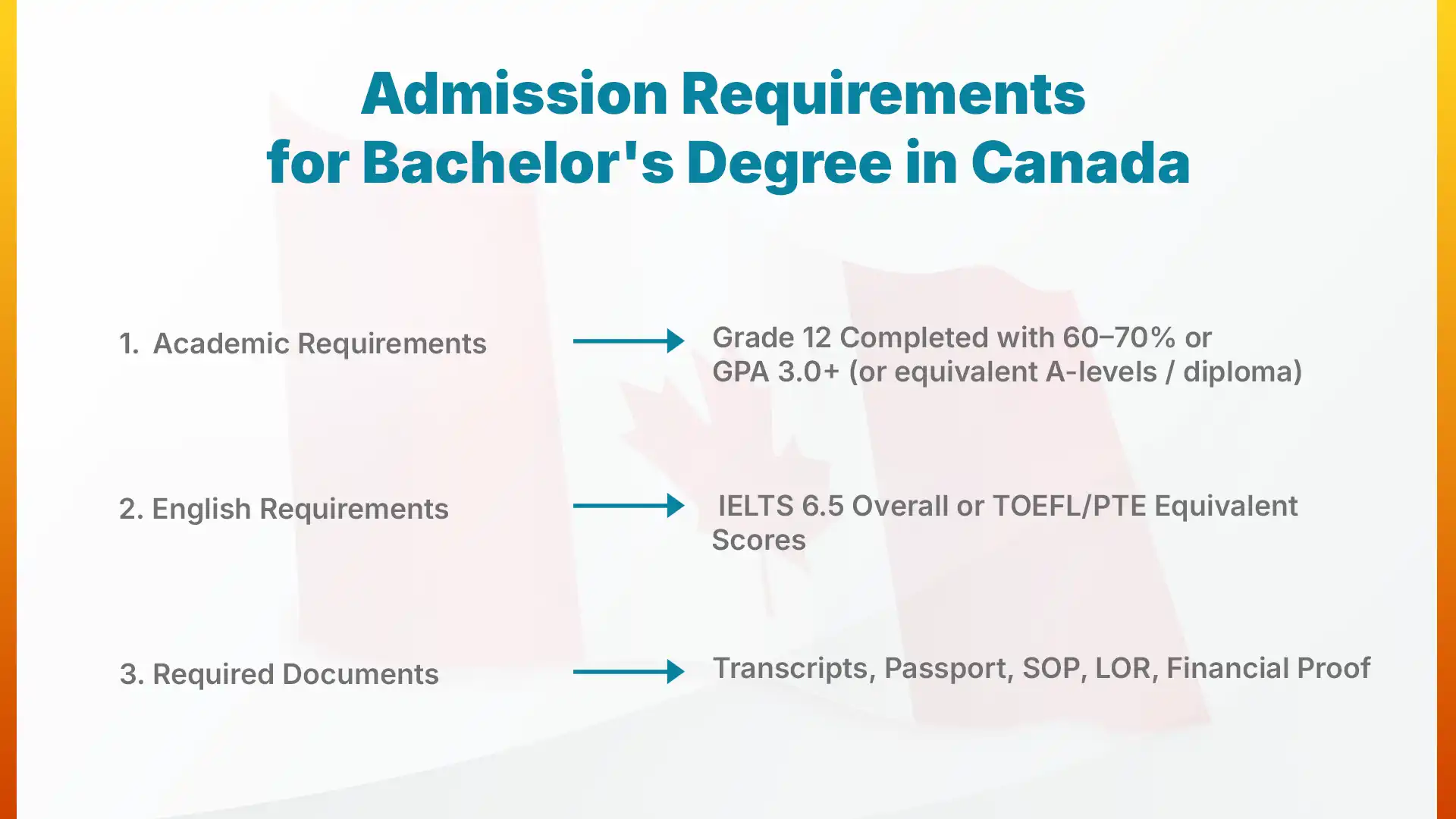
Getting into a Canadian university requires you to prove that you are both a good student and fluent in English. Each school has its own specific rules, but most follow a very similar pattern for international applicants from Nepal.
1. Academic Requirements
You must have successfully completed your Grade 12 (+2) or A-Levels with a decent percentage to be considered for admission. Most universities look for a minimum of 60% or 70%, but for competitive programs like Engineering, you might need 80% or more. They will look closely at your grades in subjects that are related to your chosen degree, like Math for a Computer Science course.
If you have any gaps in your education, you should be prepared to explain what you were doing during that time in your application.
2. English Language Requirements
Since all your lectures and exams will be in English, you need to provide a score from a recognized test like IELTS, TOEFL, or PTE. Most universities want to see an IELTS score of 6.5 with no individual band lower than 6.0. Some colleges might be a bit more flexible and accept an overall 6.0 for certain diploma programs.
3. List of Required Documents
Applying to a U.S. university requires you to complete profile evaluation where universities look at your academics, personality, English ability, and financial readiness. While requirements can vary slightly between universities, most international students need to prepare a standard set of documents before applying:
- High school transcripts (Grade 9–12)
- Academic mark sheets and certificates
- Valid passport
- Statement of Purpose (SOP) / Personal statement
- Letters of Recommendation (1–3)
- SAT or ACT scores (if required)
- IELTS / TOEFL / Duolingo English Test scores
- Financial documents (bank statements/sponsor proof)
- Affidavit of support (if required)
- Portfolio (for creative programs)
- Resume/CV (if required)
What is the Minimum GPA for Bachelor's degree in Canada?
For a bachelor’s degree in Canada, most universities expect a minimum GPA of around 2.7 to 3.0 on a 4.0 scale, which is roughly 60–70% in high school (10+2). However, more competitive courses and top universities usually ask for 70% or higher to improve your chances of admission.
1. Minimum GPA for Competitive Canadian Universities
If you are aiming for top universities like U of T, UBC, or McGill, you should ideally have a GPA of 3.5 or higher (which is about 80-85% in the Nepalese system). These schools receive thousands of applications from all over the world, so they can afford to be very picky.
Having a high GPA doesn't guarantee you a spot, but it certainly puts your application at the top of the pile. If your GPA is lower than this, you might need a very strong SOP or impressive extracurricular activities to stand out.
2. Universities Accepting Moderate Scores
Many great Canadian universities accept students with a GPA in the 2.8 to 3.0 range (around 65-70%). These schools, often located in smaller cities or eastern provinces, offer the same quality of education but are less competitive to get into. Schools like the University of Regina or Prince Edward Island (UPEI) are known for being very welcoming to students with moderate scores.
3. Tips if Your Grades Are Average
If your GPA is a bit on the lower side, you can still make your application shine by focusing on other areas. Write a deeply personal and convincing Statement of Purpose that explains your passion for the subject and any challenges you have overcome.
You can also include certificates from volunteer work, sports, or online courses (like Coursera or Udemy) that show you are an active learner. You may also consider taking skill training in Nepal for your CV boost.
Another great option is to apply for a "Pathway" program, which lets you take extra English or foundational classes before you start your actual degree.
IELTS Requirements for Bachelor's Degrees in Canada
Most universities in Canada require an IELTS overall score of around 6.5, with no band below 6.0. Some diploma or college programs may accept a slightly lower score, usually around 6.0 overall. If your score is a bit low, you may still get conditional admission and complete an English course before starting your degree.
Certain competitive or professional programs like Nursing, Education, or Pharmacy may require a higher score, often 7.0 or above. Business and Law courses may also ask for stronger writing scores due to academic demands. It’s always safer to aim higher than the minimum so you have more university options.
Can You Study in Canada Without IELTS?
In very rare cases, you might be able to skip the IELTS if you can prove that you studied in an English-medium school for the last 3-4 years. This is usually called a "Medium of Instruction" (MOI) waiver, but not all universities or the Canadian visa office (IRCC) will accept it. For Nepalese students, it is almost always better to just take the IELTS, TOEFL, or PTE test to make your visa application much stronger. Using an English test score makes your "Study Permit" process much smoother and reduces the chance of a rejection.
Intakes in Canada for Undergraduate Students
Canada offers three main intakes throughout the year, which gives you flexibility depending on when you finish school. Choosing the right intake is important for your course availability and your overall campus experience. Let's look at the pros and cons of the three main times you can start your journey.
1. Fall Intake (September)
This is the biggest intake where almost every course and scholarship is available to international students. It’s the best time to start because you’ll be joining thousands of other new students during "Orientation Week." You should aim to submit your application by January or February to secure a spot.
2. Winter Intake (January)
The January intake is a great "Plan B" if your exam results were delayed or you missed the Fall deadline. While fewer courses are open, popular subjects like Business and IT usually still have seats available. Just be prepared for the weather, as you'll be arriving during the coldest month of the year!
3. Summer Intake (May)
The May intake is the smallest and is mostly used for short-term courses or foundational English programs. Very few full bachelor's degrees start in May, so your options will be quite limited. It can be a quiet and peaceful time to get settled if you find a course that fits.
Application Process for Bachelor Degree in Canada
The application process involves several detailed steps that require careful organization and attention to deadlines. By breaking it down into a clear timeline, you can avoid feeling overwhelmed by the paperwork. Here is the step-by-step journey from your home in Nepal to your first day in a Canadian classroom.
Step 1: Choose Your Program and University
Research courses that match your career goals and narrow down your list to 3-4 universities that fit your budget. Check different provinces to see which lifestyle suits you best.
Step 2: Check Requirements
Visit official university websites to confirm the exact GPA and IELTS scores needed for your specific program. Some degrees may require specific Grade 12 subjects like math or physics.
Step 3: Prepare Documents
Gather your official transcripts, write a strong Statement of Purpose for Canada, and request letters of recommendation from your teachers. Ensure your passport is valid for several years.
Step 4: Submit Applications
Apply through provincial systems like OUAC or directly on the university website. Pay the application fee and keep your student ID number safe to track your status.
Step 5: Receive Offer Letter
If accepted, you’ll receive a "Letter of Acceptance" (LOA) detailing your fees and start date. Read this carefully as it is a vital document for your visa application.
Step 6: Pay Tuition Deposit
Reserve your seat by paying a deposit, usually for the first semester or year. The university will then send a receipt which is required for your study permit.
Step 7: Apply for Study Permit
Submit your LOA, tuition receipt, and GIC proof to the Canadian government (IRCC). Then, apply for your Canadian study permit. You will also need to complete a medical exam and provide biometrics at VFS Global.
Step 8: Prepare for Departure
Once your visa is approved, book your flights and arrange your student accommodation. Pack warm clothes, but remember you can buy heavy winter jackets once you land in Canada.
Scholarships for Studying Bachelor’s in Canada
Scholarships are a fantastic way to reduce the financial burden on your family while getting recognized for your hard work. Many Canadian universities are eager to attract talented students from Nepal and offer various forms of financial support. Even a small award can significantly lower your overall costs over four years.
1. Merit-Based Scholarships
These are automatically awarded based on your high high school grades (usually 85% or above). You often don't need a separate application; the university decides based on your admission file. These awards can range from CAD 2,000 to CAD 10,000 as a one-time payment.
2. Entrance Scholarships
Entrance awards help new international students cover their initial costs during the first year. Some are "guaranteed" if you hit a certain GPA, while others are competitive. They are a great way to save money on your textbooks and initial settling-in fees.
3. Need-Based Financial Aid
Some universities offer "bursaries" to brilliant students who come from lower-income families. You will need to provide detailed proof of your family’s income and assets back in Nepal. While less common than merit scholarships, they are still available at top-tier institutions like U of T.
4. Fully Funded Scholarship Opportunities
The most prestigious awards, like the Lester B. Pearson Scholarship, cover your entire tuition and living costs. These are extremely competitive and require top grades plus incredible leadership and community involvement. Start preparing for these at least 18 months in advance if you want to apply.
Career and Future Prospects After a Bachelor Degree in Canada
A Canadian degree is designed to be a launchpad for a global career, and the government has systems in place to help you stay. This is one of the biggest reasons why so many students from Nepal choose Canada over other destinations. Your education is just the first step toward a successful and high-paying life abroad.
1. Post-Graduation Work Permit (PGWP)
The PGWP allows you to stay and work for any employer in Canada for up to three years after graduation. You don't need a job offer to apply, making it an incredible way to gain international experience. It is the most common bridge between being a student and becoming a permanent resident.
2. Job Opportunities After Graduation
Canada has a massive demand for skilled workers in tech, healthcare, and engineering. Most universities have "Career Centers" to help you write a Canadian-style resume and prepare for interviews. You can find high-paying roles at global giants or innovative local startups right after you graduate.
3. Canadian Work Experience Advantage
Even one year of professional work in Canada significantly boosts your resume and your future salary. It proves you understand the local work culture and can communicate effectively in a multicultural team. This experience is also worth a lot of points for your Permanent Residency application.
4. Permanent Residency Opportunities
Canada has a very clear immigration path for students through programs like the Canadian Experience Class (CEC). Many provinces also have special "International Graduate" streams that make getting PR even easier. This reliability is what makes Canada a top long-term choice for Nepalese students.
Conclusion
Canada remains one of the most rewarding countries for Nepalese students to grow, learn, and build a career. From its world-class universities to its welcoming immigration policies, it offers a complete package that is hard to find anywhere else.
The key to making your 2026 dream a reality is to start your planning early. Research your courses, take your IELTS, and get your documents in order at least a year in advance.
By choosing a field that you love and that is in demand, you are setting yourself up for a future full of opportunities.
If the process ever feels like too much, don't be afraid to reach out for professional help to guide you through the visa and admission steps. Your Canadian adventure is waiting, and it all starts with that first application!