What is SOP? - A Complete Guide for Students Applying Abroad

Dec 11, 2025
If you’re a student in Nepal dreaming of studying abroad, you’ve probably come across the term SOP, short for Statement of Purpose. But what is SOP exactly, and why does it matter so much for your student visa and university applications?
Simply put, an SOP is your personal story on paper. It’s your chance to explain who you are, why you’ve chosen a particular program, and how it fits into your academic and career goals. A good SOP shows your motivation, your planning, and your readiness for the challenges of studying abroad.
Different universities and countries may have specific expectations, but at its core, the SOP is about presenting a clear, authentic narrative that convinces admissions committees and visa officers that you are a suitable candidate.
In this guide, we’ll break down what an SOP is, its format, step-by-step writing process, sample insights, and tips for strengthening your SOP. By the end, you’ll know exactly how to write a compelling SOP that enhances your chances of getting into top programs abroad.
In this blog
Why SOP is Important for Studying Abroad
An SOP is important for studying abroad because it shows your background, motivation, and goals to universities and visa officers. The way you present your journey and achievements in your SOP can affect both your university admission and your student visa approval. Simply put, a strong SOP shows who you are, what motivates you, and why you are a good fit for the program.
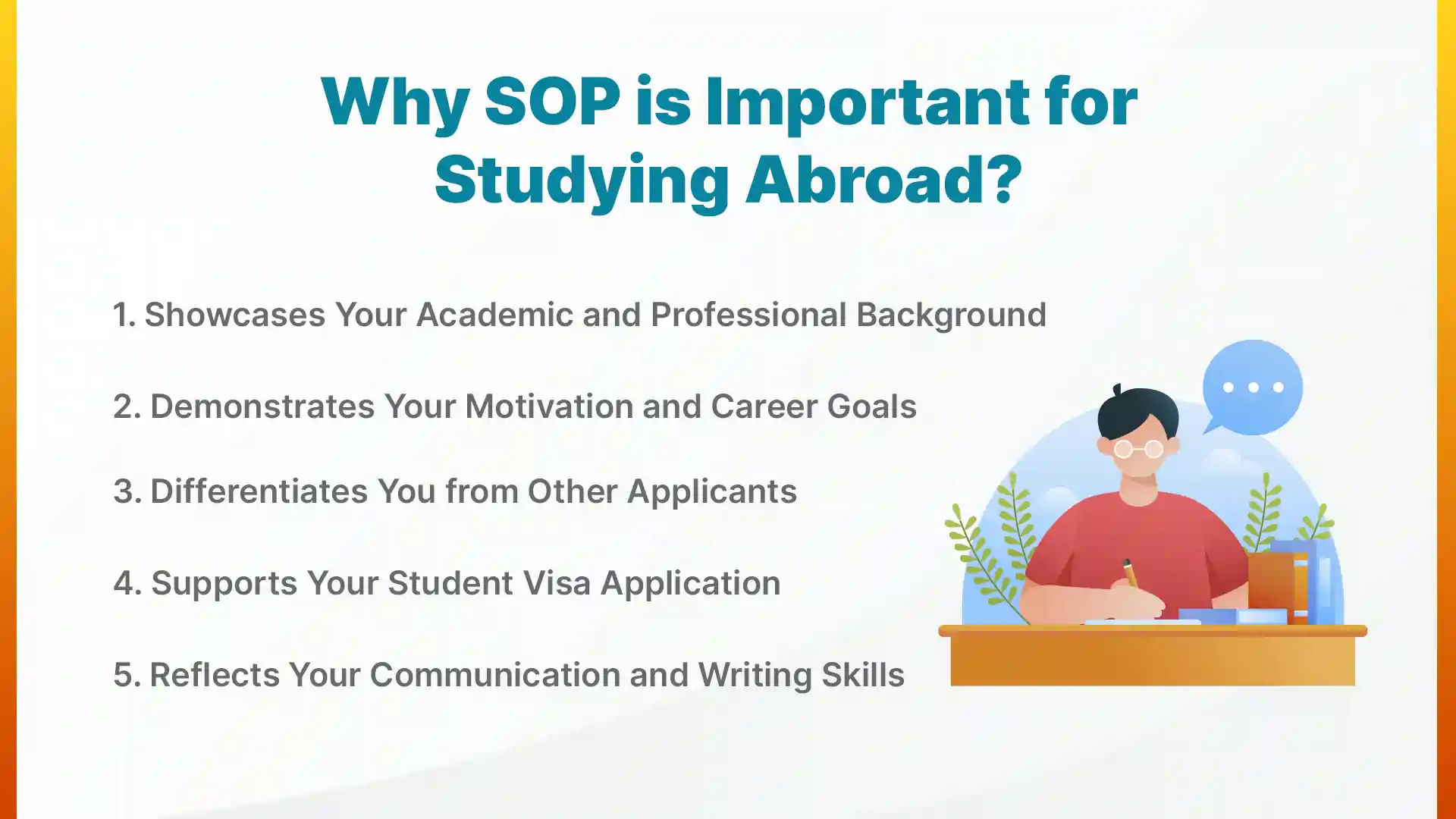
1. Showcases Your Academic and Professional Background
Your SOP is the best place to highlight your studies, projects, and any work experience you have. Showing this clearly to let universities see that you are prepared for their program. At the same time, it helps you make a strong impression that sets you apart from others.
2. Demonstrates Your Motivation and Career Goals
An SOP also tells why you want to study this program and what you hope to achieve in the future. When you connect your goals with the program, it shows universities and visa officers that you are serious. This makes your application much stronger compared to someone who only lists achievements.
3. Differentiates You from Other Applicants
Many students may have similar grades or test scores, but your SOP is where your personal story comes out. Sharing your experiences, passions, and ambitions to make your application memorable. This is what can help you stand out in a pool of strong applicants.
4. Supports Your Student Visa Application
A clear SOP also helps visa officers understand your intentions. It explains why you chose this program and country, and shows that you have a realistic study and career plan. For Nepalese students applying abroad to the UK, US, or any country worldwide, this can make a big difference in getting the visa approved.
5. Reflects Your Communication and Writing Skills
Finally, an SOP shows how well you can express your ideas in writing. Good structure and clear sentences make you look professional and serious. This also gives universities confidence that you can handle academic work in English.
How to Write SOP for Studying Abroad: Step-by-Step
To write an SOP for studying abroad, you need to clearly explain your background, motivation, academic preparation, and future goals in a structured and honest way. Your goal is to show the university why you’re a strong fit and how studying abroad aligns with your long-term plans. When you organize your ideas and present them in a logical flow, your SOP becomes more persuasive and easier to read. Now, let’s walk through each step so you know exactly how to build an effective SOP from start to finish.
Step 1: Understand Your Purpose
First, be clear about why you need the SOP. Learn well about your admission process, scholarship, and student visa. Then, list what the reader must know about you. Highlight your academic fit, your motivation, and your career plan. Finally, decide the single main message you want every paragraph to support so your SOP has one clear thread.
Step 2: Brainstorm and Collect Information
Start by making three major lists. One for your academics (degrees, courses, projects), the other for your work or internships (roles, tasks, tools), and the last one for your personal motivations (what sparked your interest). Next, collect proof to back all your achievements and experiences. These can be transcripts, project summaries, certificates, and URLs to any online work. Then group related items together so you can use them as evidence in different SOP sections.
Step 3: Create a Rough Outline
Write a one-line purpose statement at the top. This will guide the whole SOP. After that, arrange your main sections in order: introduction, academics, experience, motivation, goals, country/university reasons, and conclusion. Under each section, jot down two to four bullet points that must appear there; these become your paragraph prompts.
Step 4: Write the First Draft
Using your outline, write freely without editing; focus on getting ideas down. For each paragraph, open with the strongest fact or claim, then add 1–2 specific examples that prove it, and close with a line that links to the next paragraph. Don’t worry about perfect words yet. Aim for clarity and substance.
Step 5: Revise for Clarity and Flow
Read your draft from the perspective of an admissions officer and remove anything that does not support your main message. Then reorder sentences or paragraphs where the logic feels weak so each idea follows naturally.
Step 6: Strengthen Your SOP
Now make each claim concrete: replace general phrases with specifics. The skills you gained, the scores you achieved, the problems you solved, and the outcomes. Next, add one short line that links each past experience to what you will do in the program. Finally, remove any filler, fluff, or repeated ideas so every sentence adds value.
Step 7: Edit and Proofread
Check for grammar, spelling, and phrasing, but also watch sentence length. Break long sentences into two. Read the SOP aloud to catch awkward phrasing and fix it. Then ask one trusted person, like a teacher, mentor, or peer, to read for sense and tone, and note their top three suggestions to apply.
Step 8: Final Draft
Apply the feedback and do one final pass for clarity, tone, and length; keep within the program’s word limit. Make sure your opening paragraph is strong, and your final paragraph ties your whole story together and restates your readiness. Save a clean, printable copy and a version tailored for online submission (PDF preferred).
Step 9: Modify for Each Application
Before sending to a new university, replace two or three lines to show you researched that specific program. Mention a course, lab, or professor relevant to you. Also, check if the university has format or length rules and adjust accordingly. Finally, keep a master SOP file so changes are fast and consistent across applications.
Handling your SOP, student visa, and NOC can be challenging, so careful planning is key. Exploring the top 10 education consultancies in Nepal can give you expert guidance, helping refine your SOP, organize documents, and navigate country-specific requirements. Even a little professional support can make the process smoother and boost your chances of studying abroad with confidence.
SOP Format and Structure to Study Abroad
A good SOP usually includes an introduction about yourself, academic achievements, professional experience, if any, motivation for the program, career goals, reasons for choosing the country and university, and a strong conclusion, all arranged clearly and logically.
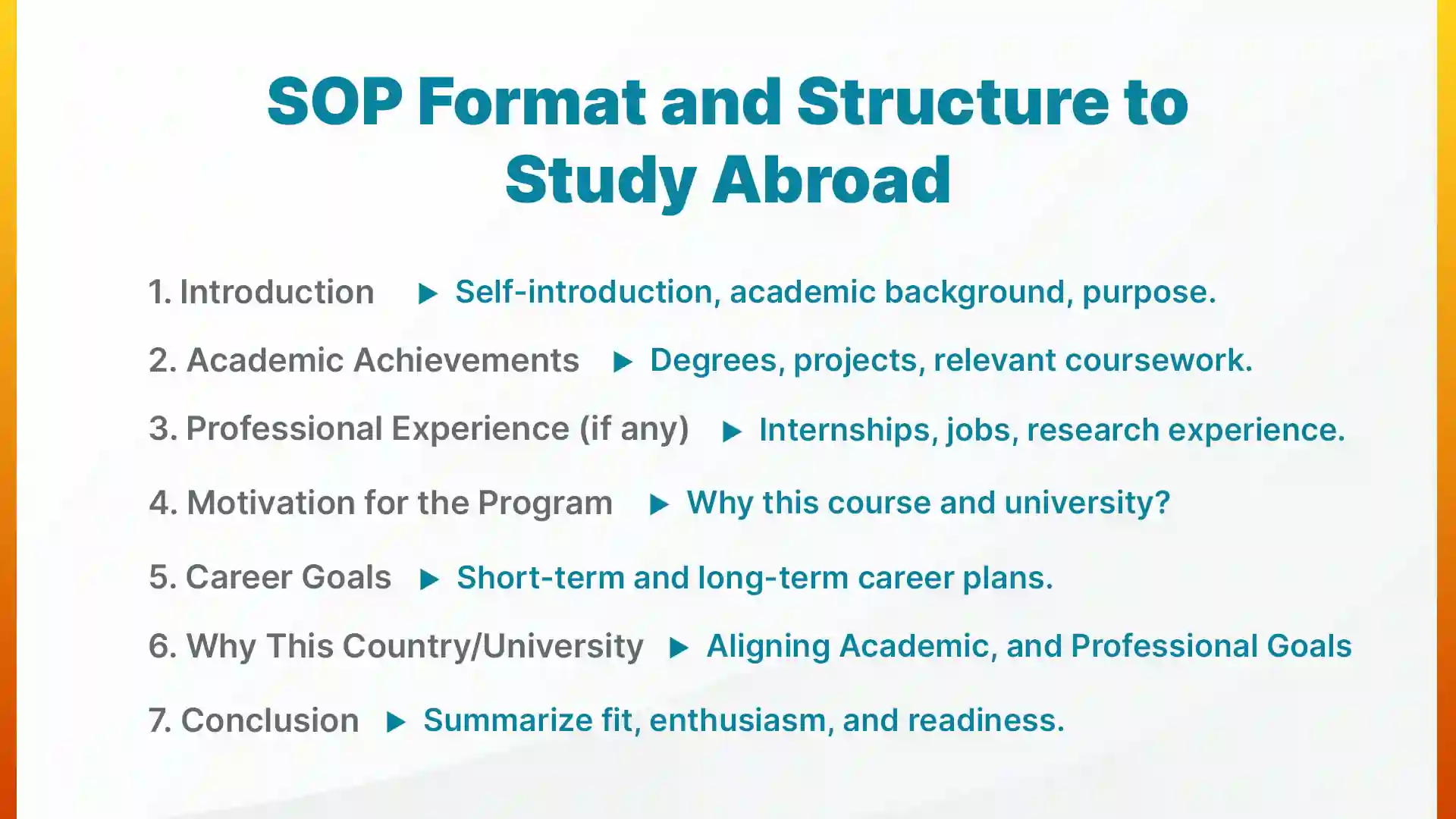
1. Introduction: Self-Introduction, Academic Background, Purpose
Start by sharing who you are in terms of your current level of study, your field, and your interest area. Mention what inspired you to choose your field. This could be a project you enjoyed, a topic you consistently excelled in, or a problem you want to solve through your studies. End the paragraph by stating the program you want to study and the main reason it connects with your background.
2. Academic Achievements: Degrees, Projects, Relevant Coursework
List your degrees, board/university names, scores, and important subjects that relate directly to your chosen program. Add details about one or two major projects, assignments, or research tasks that genuinely built your curiosity and skills. Explain how these academic experiences helped you understand the industry better or pushed you to explore the field more deeply.
3. Professional Experience (if any)
If you have worked or interned somewhere, describe the specific tasks you handled, the tools or techniques you used, and what you learned from them. Instead of only naming the position, focus on what skills you gained. Highlight any experience with teamwork, problem-solving, communication, or technical skills relevant to your course. Tie this experience back to the program by showing how it helped you grow or clarified your next academic step.
4. Motivation for the Program: Why This Course and University
Explain what part of the program excites you the most, such as certain subjects, specializations, labs, or opportunities. Show that you have researched the university by mentioning teaching approaches, course modules, facilities, or learning environments that match your goals. Make it clear how the program fills a gap in your skills or knowledge and why it is the right step for your future.
5. Career Goals: Short-Term and Long-Term Plans
Describe what you plan to do immediately after completing your degree. This can be working in a particular field, learning industry-specific tools, or building practical experience. For your long-term goals, explain the direction you want your career to grow in, like leadership roles, entrepreneurship, research, or specialization in a specific domain. Connect both goals with the skills and knowledge you expect to gain from the program.
6. Why This Country: Aligning Personal, Academic, and Professional Goals
Talk about what makes this country suitable for your studies. It could be education quality, global exposure, industry strength, or post-study opportunities. Then explain why the university stands out to you in terms of curriculum design, practical learning, career services, research focus, or academic reputation. Research well and be specific. Explain what intrigued you and justify your decisions. Show that choosing this country and university is a strategic decision, not just a random choice.
7. Conclusion: Summarize Fit, Enthusiasm, and Readiness
Close by strongly restating why you are a suitable candidate based on your background, motivation, and career plans. Add a line about your readiness to adapt to new learning environments and make the most out of the program. End with a confident tone that reflects your commitment and the value you aim to bring as an international student.
SOP Content Formatting Essentials
Your SOP becomes much easier to read when it follows a clean and consistent format. It is important to keep your layout simple and professional from the very beginning. For this, follow the key formatting guidelines like the standard font, size, and spacing:
- Length: Aim for 800–1,000 words, usually around 2 pages (varies by country)
- Font: Times New Roman, Calibri, or Arial
- Font size: 12pt
- Spacing: Keep it single-spaced to improve readability for reviewers
- Tone: Maintain a formal yet personal first-person tone, staying honest and straightforward
- Visuals: Stick to plain black text, standard margins, and A4 or US Letter page size for a polished look.
SOP Samples and Template
Here, we’ve provided sample SOPs for popular programs to give you a clear idea of how to structure and present your experiences. These examples highlight the flow, tone, and key content points that make an SOP strong and persuasive. While you should personalize your own SOP, studying these samples can help you understand what admissions committees look for and guide you in crafting your own compelling story.

Sample SOP for Master’s in Computer Science
SAMPLE STATEMENT OF PURPOSE (SOP)
Master’s in Computer Science
Introduction
My name is [Your Name], and I am a recent graduate with a Bachelor’s degree in Information Technology from [Your University], where I earned a GPA of [Your GPA]. My interest in technology began in high school when I wrote my first Python program and realized how powerfully code can solve real-world problems. Throughout my undergraduate studies, I explored subjects like Data Structures, Algorithms, and Artificial Intelligence, which strengthened both my technical and analytical abilities. I now hope to pursue a Master’s in Computer Science abroad, specializing in Artificial Intelligence and Machine Learning, to deepen my skills and contribute to meaningful innovations.
Academic Achievements
During my undergraduate program, I completed several projects that expanded my interest in AI and software development. My final-year project involved building an AI-based recommendation system using Python, TensorFlow, and SQL, which taught me how to work with datasets and optimize algorithms. I also completed certifications in Machine Learning and Data Analytics through Coursera and Udemy, gaining hands-on experience with neural networks, regression models, and data visualization. These achievements have prepared me well for the demands of a Master’s program.
Professional Experience
I gained practical experience through internships at two tech companies. At [Company Name], I worked as a software intern developing a workflow management web application, building frontend features with JavaScript and backend APIs in Python. Later, at [Another Company], I assisted the data science team in creating predictive models to analyze customer behavior, which improved my understanding of machine learning pipelines and real-world data handling. These experiences strengthened my teamwork, problem-solving, and programming skills.
Motivation for the Program
I am particularly interested in [University Name] because of its strong focus on AI research and access to advanced labs such as [Specific Lab Name]. The modules on deep learning, natural language processing, and reinforcement learning align closely with my goals. I look forward to working with distinguished faculty and contributing to ongoing research. This program will help me deepen my understanding of AI and apply theoretical concepts to real-world challenges.
Career Goals
In the short term, I aim to work as a data scientist or AI engineer where I can apply my skills to solve meaningful problems. In the long run, I hope to lead research initiatives in AI or software architecture, creating intelligent systems that enhance everyday life. Pursuing this Master’s program will give me the technical foundation, research experience, and global exposure required to achieve these ambitions.
Why This Country/University
I have chosen [Country Name] for its globally recognized education system, strong research environment, and rapidly growing technology sector. [University Name] offers exceptional facilities, collaborative projects, and industry connections that match my academic and career aspirations. The country’s thriving tech ecosystem will allow me to learn from experts, attend conferences, and grow professionally.
Conclusion
To conclude, my academic background, technical projects, and practical experience have prepared me to take on the challenges of a Master’s in Computer Science. I am confident that this program will help me advance my expertise in AI and Machine Learning while allowing me to contribute positively to the university community. I look forward to embracing new opportunities, collaborating with peers and faculty, and building a strong foundation for a successful career in technology.
Sample SOP for MBA Program
SAMPLE STATEMENT OF PURPOSE (SOP)
MBA Program
Introduction
My name is [Your Name], and I am a graduate in Business Administration from [Your University], where I earned a GPA of [Your GPA]. During my undergraduate studies, I discovered my passion for management, strategy, and leadership while working on team projects and organizing business simulations. These experiences helped me understand the challenges of decision-making, resource allocation, and effective team coordination. Now, I am eager to pursue an MBA abroad to develop advanced business skills, expand my strategic thinking, and prepare for leadership roles in a dynamic global environment.
Academic Achievements
During my bachelor’s program, I focused on courses such as Marketing, Finance, Operations Management, and Organizational Behavior, earning distinction in several of them. I completed a capstone project analyzing market entry strategies for local startups, which allowed me to apply theoretical concepts to real business challenges. I also completed online certifications in Data-Driven Decision Making, Leadership, and Digital Marketing, strengthening my analytical and managerial skills. These academic experiences have provided a strong foundation for advanced coursework and strategic decision-making in an MBA program.
Professional Experience
I gained practical experience through internships and part-time roles in the business sector. At [Company Name], I assisted the marketing team in developing campaigns for new product launches, where I analyzed customer data, prepared reports, and presented actionable insights. During my internship at [Another Company], I worked with the operations team to streamline workflow processes, improving efficiency by 15%. These experiences enhanced my problem-solving, teamwork, and leadership skills, and solidified my interest in strategic management and business development.
Motivation for the Program
I am particularly drawn to [University Name] because of its focus on global business strategy, entrepreneurship, and leadership development. The MBA program offers courses and experiential learning opportunities that align with my goals, such as strategic management, business analytics, and international business. I am especially interested in the mentorship and networking opportunities provided by the university, which will allow me to learn from experienced professionals and collaborate with peers from diverse backgrounds. This program is the ideal next step to strengthen my strategic thinking, managerial expertise, and global perspective.
Career Goals
In the short term, I aim to work in management consulting or a strategic role in a multinational company, applying analytical frameworks to solve complex business problems. In the long term, I aspire to take on leadership positions, managing cross-functional teams and contributing to organizational growth and innovation. Pursuing this MBA program will equip me with the knowledge, tools, and international exposure needed to achieve these objectives and establish myself as a capable business leader.
Why This Country/University
I have chosen [Country Name] for its globally recognized education system, strong business ecosystem, and opportunities for international exposure. [University Name] stands out for its industry connections, case-based learning, and emphasis on leadership development. The combination of rigorous academics and practical experience will help me build the skills and confidence required to excel in the global business environment. Additionally, the country’s multicultural environment will strengthen my ability to work in diverse teams and understand international business dynamics.
Conclusion
In conclusion, my academic foundation, practical experiences, and leadership exposure have prepared me well for the challenges of an MBA program. I am confident that this program will help me refine my strategic, analytical, and leadership skills while contributing meaningfully to the university community. I am eager to embrace new challenges, collaborate with peers and faculty, and make the most of the learning opportunities ahead, building a strong foundation for a successful global business career.
Seeing sample SOPs is helpful, but writing your own can still feel challenging. Talking to the consultancies in Nepal with the highest visa success can guide you in shaping your SOP, highlighting your strengths, and ensuring all documents meet requirements. Even a little professional support can save time, reduce stress, and give you confidence as you take steps toward studying abroad.
SOP Guides for Different Countries
Every country has its own expectations for an SOP, so it’s important to adjust your content, focus, and length according to where you are applying. Here’s a clear guide for five popular study destinations to help you plan your SOP carefully.
1. SOP for USA
In the USA, universities want to see your academic preparation and research abilities clearly. So, in an SOP for the USA, talk about specific projects, lab work, or papers you’ve done, and explain how these experiences prepared you for the program. Mention any particular courses, professors, or research labs that align with your goals to show you have done your homework. Your SOP should be detailed but focused, usually around 800–1,000 words, so every sentence highlights your fit for the program.
2. SOP for Canada
You need two different SOPs for Canada: one for university admission and the other for the student visa. The university-focused SOP should highlight your academic strength, internships, co-op experiences, and applied projects that gave you hands-on skills, showing how they connect to your career goals. The student visa SOP should focus on your study plan, financial readiness, ties to Nepal, and how the program aligns with your long-term career, convincing the visa officer of your genuine intent to study. Aim for 700–1,000 words for each SOP, balancing achievements, goals, and practical plans for learning and career growth.
3. SOP for UK
SOPs for the UK should be short, precise, and very focused on academics. Explain why the specific course fits your background and future plans, and pick one or two key projects, papers, or achievements to prove it. Avoid long stories; instead, keep sentences compact and every detail relevant. Your SOP should be around 600–800 words, showing that you understand the course and can make the most of it.
4. SOP for Australia
Australian universities value clarity and a mix of academic and practical experiences. Talk about your past studies, relevant projects, and any hands-on work you’ve done. Explain how the university’s learning style, labs, or industry connections will help you gain specific skills. A clear plan for how you will use the program to grow academically and professionally makes your SOP for Australia stand out, usually within 700–1,000 words.
5. SOP for South Korea
In South Korea, universities look for academic rigor and research potential. Highlight your projects, technical skills, or research exposure, and explain how these prepare you for the program. Show that you are ready to adapt to a new learning environment and follow a structured research-focused approach. Keep your SOP for South Korea focused, factual, and usually between 700–1,000 words, emphasizing preparation and commitment to your field.
How to Strengthen Your SOP After a Refusal
To strengthen your SOP after rejection, it’s important to focus on clarity, your achievements, and alignment with the program’s expectations. Common reasons for rejection include vague goals, a weak connection between past experience and program, lack of structure, or not showing why you are a strong fit for the country and university. Understanding these issues helps you plan a better approach, and in the following sections, we’ll go through practical ways to identify gaps, improve clarity, and highlight your growth for a stronger SOP. Here’s how to approach it step by step:
1. Identify Weak Points and Gaps
Start by reading your SOP with fresh eyes or ask someone you trust to review it. Look for sections where your achievements, goals, or motivations are unclear or missing. Check if any part feels repetitive or off-topic, and note where you didn’t fully explain why you are a strong candidate. Identifying these weak points gives you a clear roadmap for improvement.
2. Improve Clarity and Structure
Once you know the gaps, reorganize your SOP so each paragraph flows logically to the next. Simplify long or confusing sentences and make sure every point clearly supports your main purpose. Add smooth transitions between sections so the reader can follow your journey from academic preparation to career goals without effort. A well-structured SOP is easier to read and more persuasive.
3. Highlight Growth and New Achievements
After a refusal, consider any new experiences, projects, or skills you’ve gained and include them in your SOP. Show how these achievements strengthen your academic or professional profile. Also, explain how you have learned from past challenges or setbacks, demonstrating maturity and resilience. Highlighting growth not only fills gaps but also makes your SOP more compelling for the next application.
Common Mistakes to Avoid in SOP
When writing an SOP, students often make mistakes like including vague statements, irrelevant details, repetitive phrases, or poor grammar. These mistakes distract the reader from your strengths and reduce their chances of admission or visa approval. Understanding these common pitfalls helps you focus on what really matters, and in the following sections, we’ll highlight the key mistakes to avoid so your SOP is clear, compelling, and professional.
1. Avoid Overused Phrases and Clichés
Many students try to sound impressive in their SOP by using common expressions. Using phrases like “I am passionate about learning” or “I want to make a difference” without backing them up can make your SOP sound generic. Instead, focus on specific experiences, achievements, or projects that show your dedication. Avoid repeating common expressions across multiple paragraphs, and make each sentence add unique value. This makes your SOP authentic and memorable.
2. Keep SOP Concise and Relevant
Admissions officers and visa officials have limited time, so avoid including unrelated stories or excessive details. Stick to points that directly highlight your academic preparation, skills, motivations, and career goals. Trim long sentences and repetitive ideas, and aim for a smooth, logical flow. A concise SOP is easier to read and leaves a stronger impression.
3. Maintain Proper Grammar and Professional Tone
Poor grammar or informal language can distract from your achievements and weaken your SOP. Use simple, correct sentences, and maintain a formal yet personal tone throughout. Avoid slang, overly casual words, or dramatic expressions. Proper grammar and tone show that you are serious, professional, and ready for academic challenges.
Final Tips for Writing an Effective SOP
Even after drafting a strong SOP, small adjustments can make a big difference in how it is perceived. Paying attention to clarity, authenticity, and alignment with each program ensures that your SOP reflects your true potential. To help you finish on a high note, the following tips focus on practical ways to polish your SOP and maximize its impact.
1. Be Concise, Authentic, and Tailored
Your SOP should clearly reflect who you are and why you are applying. Be honest about your experiences and motivations, and avoid copying templates word-for-word. Also, tailor your SOP for each university or program so that it shows genuine interest and research. This approach makes your SOP stand out naturally.
2. Review and Revise Thoroughly
After writing your first draft, take time to review every paragraph for clarity, flow, and relevance. Read it aloud to catch awkward phrases or unclear points. Make multiple revisions if needed, refining each section until it communicates your story clearly and logically. Careful reviewing improves both readability and impact.
3. Seek Professional Guidance if Needed
Sometimes an expert eye can help identify gaps or areas for improvement that you might miss. Professional guidance can provide feedback on structure, tone, and alignment with program expectations. Even a short consultation can give you actionable tips to make your SOP stronger and increase your chances of success.
Conclusion
Writing a compelling SOP is your chance to stand out, tell your story, and show universities and visa officers why you deserve to study abroad. A strong SOP clearly presents your academic background, projects, internships, and personal growth, while linking them to your future goals. Every detail matters in building a complete picture of who you are and what you can achieve. So take the time to revise, strengthen, and present your best self.
If you ever feel unsure about your SOP, seeking guidance can help you polish your SOP and boost your chances of success. Talk to professional and experienced counsellors at the best consultancy in Nepal. Ask them about the best practices for writing a strong SOP. Let them review your SOP and make improvements. Aim for the stars, and as you leave this article, take one step closer to studying abroad.