How to Write SOP for a UK University & Student Visa?

Dec 09, 2025
Applying to a UK university is an exciting step, but writing an SOP for the UK is one of the most confusing yet critical parts for most Nepali applicants. This single document carries a lot of weight. It tells the university who you are, why you want to study in the UK, and how your chosen course fits into your future. When written well, your SOP becomes a powerful tool that strengthens your entire application.
If you're unsure how to begin or what exactly UK universities expect, you’re not alone. With the right structure and guidance, you can write an SOP that feels clear, confident, and true to your goals. This guide walks you through everything, from format and step-by-step writing tips to samples created for Nepali students' profiles. Let’s take it step by step and make this process easier for you.
In this blog
Why UK Universities Ask for an SOP
UK universities receive thousands of applications every year, many with similar academic backgrounds. The SOP helps them identify students who have a genuine purpose and clear direction. It allows them to evaluate your communication skills, your understanding of the course, and the effort you’ve put into researching the university.
How an SOP Shows Your Academic Motivation
Your SOP gives the admissions team a window into your academic journey. Through your story, they see what inspired you, how your previous studies shaped your interests, and what drives you to learn more. That is why you should focus well on linking your past experiences with your future goals, showing that your decision to study in the UK is thoughtful, realistic, and academically grounded. This clarity of motivation is often what separates a strong application from an average one.
What UK Universities Actually Look For in an SOP
When reviewing applications, UK universities focus on clarity, relevance, and genuine purpose. They want to know whether you’re academically prepared and whether your goals align with the course you’re choosing. Your SOP becomes your chance to show that you understand the program, you’ve done your research, and you're ready to contribute as a motivated student.
1. Academic Background and Course Fit
Universities want to see how your previous studies connect with the course in the UK you’re applying for. They look for a clear link between your academic history, subjects you enjoyed, projects you completed, and the skills you’ve developed. When you show course fit, you’re basically saying, “I’m ready for this level of study, and here’s the proof from my past experience.”
2. Clear and Realistic Motivation
Admissions officers appreciate students who know why they want to study a particular field. Your SOP should show real, believable reasons for choosing your course. Whether it’s tied to your passion, a career aim, or a meaningful experience from school or college, clarify it well. Avoid goals that sound exaggerated. Instead, keep them focused and achievable so the university sees that you’re practical and committed.
3. University-Specific Alignment
A strong SOP doesn’t look like it was copied and pasted for multiple universities. UK institutions want to feel that you genuinely chose them. Mentioning specific modules, teaching styles, facilities, or faculty shows that you’ve done your homework. This little effort helps the admissions team understand that you’re serious about joining their academic community and that you’ll fit in well.
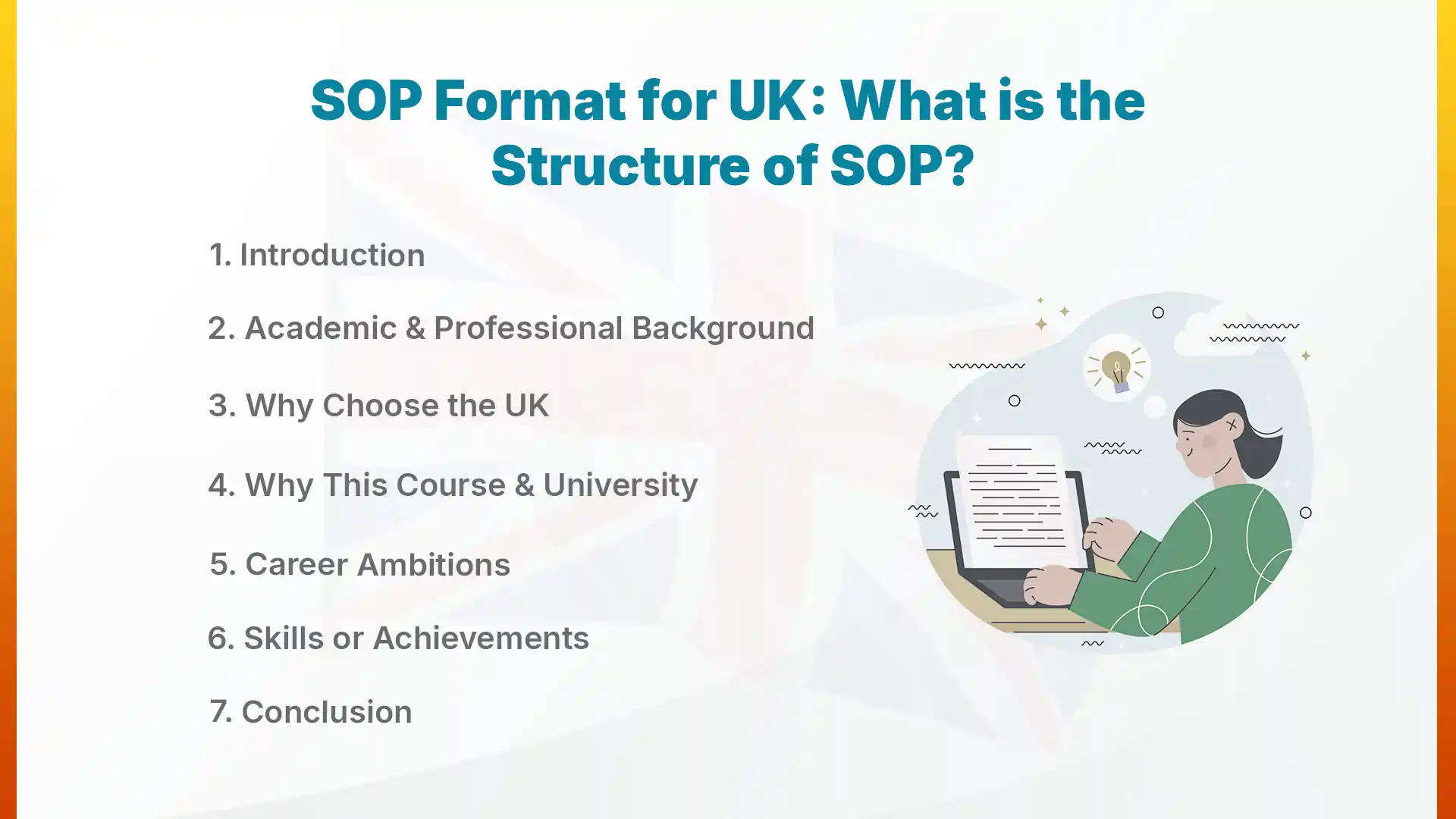
SOP Format for UK: What is the Structure of SOP?
An SOP usually comprises an introduction, academic and professional background, reasons for choosing the UK and the course, career ambitions, skills or achievements, and a conclusion. A clear structure makes your Statement of Purpose easier to read and more impactful. UK universities prefer an SOP that flows logically, stays focused on academics, and presents your story in a professional yet personal way. While the content is unique to you, the format usually follows a simple, effective pattern. Use this structure as your roadmap so you can write each part with confidence:
1. Introduction
Begin by briefly introducing who you are and the course you want to study. Keep it direct and purposeful. Your opening should show your interest in the field and hint at what inspired you to pursue this academic path. Set the tone early by leading your reader straight into your academic direction.
2. Academic & Professional Background
This section highlights your educational journey so far. Share relevant subjects, achievements, projects, or internships that prepared you for the course. If you have work experience, explain how it influenced your skills and deepened your interest in the field. Connect each point clearly so the university can easily see how your background supports your next step.
3. Why Choose the UK
Explain why the UK stands out for your higher education. You might mention its academic reputation, practical learning environment, global degree recognition, or strong industry links. Keep it focused on education, not lifestyle. Show that your decision is intentional and based on academic opportunities that push you forward.
4. Why This Course & University
Show that you understand what the course offers and how it aligns with your goals. Point out specific modules, teaching methods, or university facilities that match your interests. This shows genuine research and clear intention. Demonstrate your commitment by linking the course features to the skills you want to build.
5. Career Ambitions
Outline your short- and long-term goals. Share how the program will help you grow academically and professionally. Make sure your ambitions are realistic and relevant to your field. Guide the reader toward your vision by showing exactly where this degree fits in your journey.
6. Skills or Achievements
Add strengths that support your application. It can be technical skills, soft skills, extracurriculars, volunteering, or awards. Choose achievements that reflect responsibility, curiosity, leadership, or dedication. Use every example to highlight how you’ll contribute meaningfully to the academic environment.
7. Conclusion
Close with a confident and forward-looking summary. Reaffirm why you’re a strong fit for the course and how you’re ready to contribute as an active learner. Keep it concise while leaving a positive final impression. End with a sense of direction so the university clearly sees your readiness to begin this next chapter.
How to Write SOP for UK: Step-by-Step Guide
To write a strong SOP for the UK, start with an engaging introduction, describe your relevant academic and work experiences with examples, connect your goals to the course and university, explain why you chose the UK, and end with a confident conclusion. Keep it authentic, stay within 700–1000 words, and carefully proofread for grammar and originality. Take one step at a time, and your outstanding SOP will be well-prepared. Follow this roadmap for a smoother writing experience:
1. Research Courses and Universities Thoroughly
Before you start writing, spend time understanding your chosen course and the universities offering it. Look into modules, teaching methods, faculty, and campus facilities to see what aligns with your interests. This research helps you write a personalized SOP that demonstrates genuine interest, rather than a generic statement. The more informed you are, the stronger your connection will appear between your background and the program you choose.
2. Draft a Compelling Introduction
Your introduction is your first impression, so make it count. Begin by clearly stating who you are, what you want to study, and what sparked your interest in this field. Include a brief insight into your academic or personal experiences that led you to this decision. Keep it engaging and purposeful, so the admissions team immediately understands your motivation.
3. Highlight Academic Background & Achievements
Show how your previous studies and accomplishments prepare you for the course. Mention key projects, research work, or internships that helped you develop relevant skills. If you have work experience, briefly explain what you learned and how it strengthened your academic interests. Connect these achievements directly to the skills or knowledge you will use in your UK program.
4. Explain Why You Choose UK and Not Nepal
Be clear about why the UK is your preferred study destination. Highlight aspects like academic standards, research opportunities, global recognition, and practical learning environments. Avoid focusing on lifestyle or travel, keep it academically oriented. This shows that your decision is intentional and driven by education, not convenience.
5. Justify Your Course & University Selection
Describe why this specific course and university match your goals. Mention modules, faculty, labs, or facilities that align with your interests and explain why they matter to you. Admissions officers want to see that you’ve done your homework and that your choice is deliberate. Demonstrate commitment by linking each course feature to your academic growth and career plans.
6. Outline Career Goals and Relevance
Explain how this course fits into your short and long-term goals. Show a logical path from your academic background to your career aspirations. Keep your objectives realistic, achievable, and aligned with the field you’re entering. This clarity helps the university see you as a focused and motivated candidate.
7. Add Strengths, Skills, or Extracurriculars
Include achievements or experiences that highlight your skills beyond academics. This could be leadership roles, volunteering, competitions, or technical skills relevant to your field. Make sure each example supports your story and shows personal growth. Use these points to demonstrate how you’ll contribute meaningfully to the university community.
8. Write a Clear and Concise Conclusion
Wrap up your SOP with a confident summary of your purpose and goals. Reaffirm why you’re a strong fit for the course and how the program will help you succeed. Keep the tone positive, professional, and forward-looking. Leave the admissions team with a lasting impression of your readiness and enthusiasm.
9. Final Editing & Submission Checklist
Before submitting, check for grammar, clarity, and flow. Ensure your SOP is within the recommended word count and all sections are well-structured. Remove any repetitive or irrelevant points and make sure your story feels authentic. A polished final version increases your chances of making a strong, memorable impression.
Sample SOP for UK: Template and Example for Nepali Students
This sample SOP for the UK provides Nepali students with a clear example of how to structure and write a strong Statement of Purpose for UK universities. It highlights the key sections, tone, and content that admissions officers expect, making it an ideal reference or template for your own SOP.
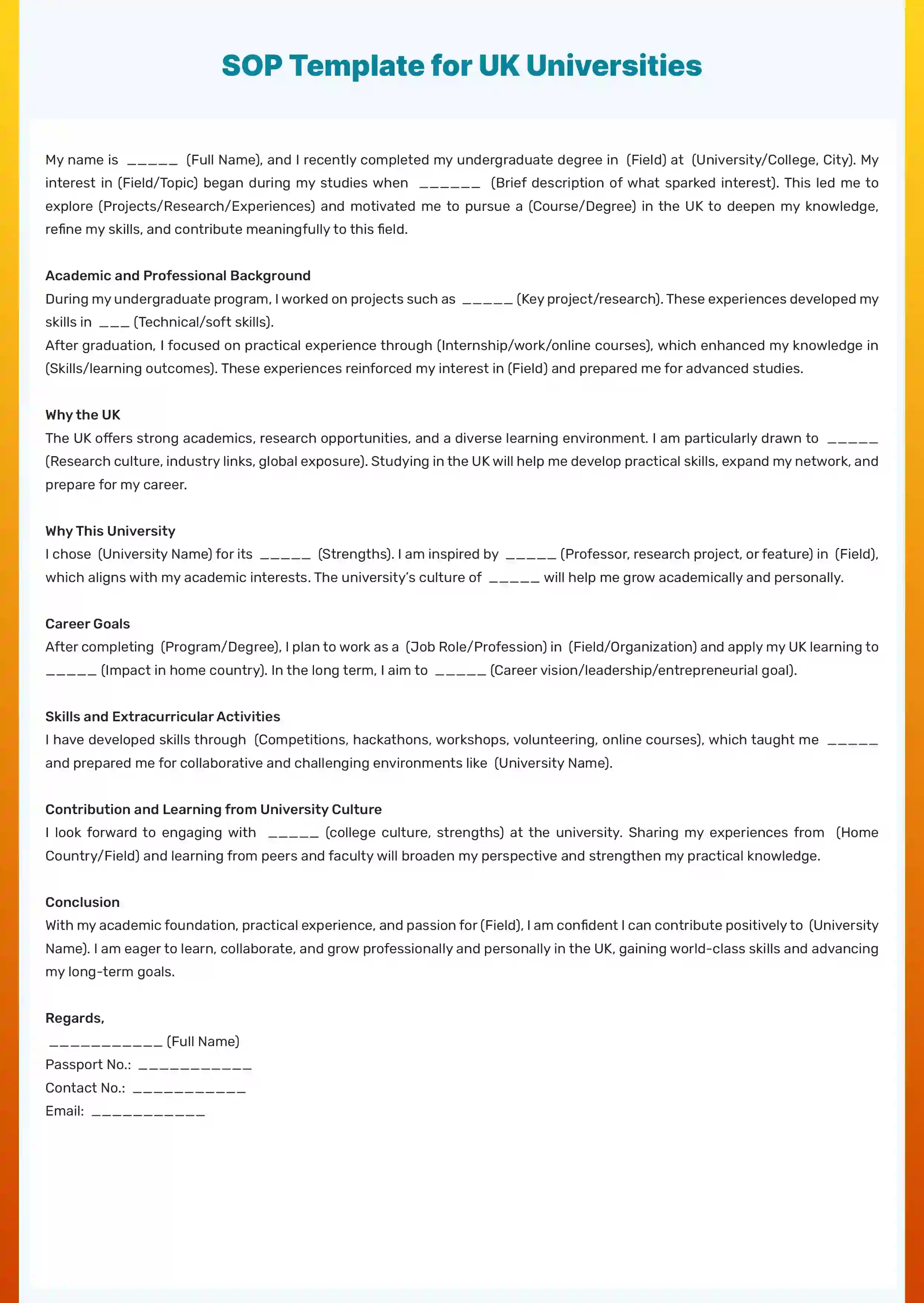
Sample SOP for UK University: MSc Data Science at UCL
This SOP template for UK universities demonstrates a realistic example for applying to a competitive master’s program, like MSc Data Science at UCL. It shows how to present your academic background, work experience, career goals, and motivation in a professional, personal, and persuasive manner.
SAMPLE STATEMENT OF PURPOSE (SOP)
MSc Data Science – University College London (UCL)
Introduction
My name is Anushka Suwal, and I recently completed my undergraduate degree in Computer Science at Tribhuvan University, Kathmandu. My fascination with data began during my studies, as I became intrigued by how patterns hidden within numbers could reveal insights that drive decisions, solve problems, and transform industries. This curiosity led me to explore data analytics through projects and coursework, and I realized that pursuing an advanced degree in Data Science would allow me to deepen my knowledge, refine my technical skills, and prepare me to contribute meaningfully to this fast-evolving field.
Academic and Professional Background
During my undergraduate program, I worked on several projects that strengthened both my theoretical understanding and practical skills. One project I especially enjoyed involved predicting traffic congestion in Kathmandu using Python and machine learning. I collected and analyzed real-time traffic data to develop a model that could forecast peak congestion hours. This project taught me programming, statistics, structured problem-solving, and critical thinking.
After graduation, I focused on gaining practical experience and building my skills. I interned at a local tech startup, analyzing customer behavior and creating dashboards for business insights. I also completed online courses in Python, data visualization, and machine learning. These experiences reinforced my passion for working with data and confirmed my decision to pursue advanced studies in this field.
Why the UK and University College London
The UK is ideal for higher studies because of its strong academics, research opportunities, and diverse learning environment. UCL attracts me with its world-class faculty, modern research facilities, and a program that balances theory with hands-on practice. The MSc Data Science program offers modules in machine learning, big data analytics, and statistical modelling, which are all areas I am passionate about. UCL’s focus on real-world problem-solving and industry engagement will allow me to apply my knowledge meaningfully.
Career Goals
I want to become a data scientist who can turn raw data into insights supporting better decisions and innovation. In Nepal, I hope to apply data science to improve social and economic development, such as optimizing traffic systems or predicting agricultural trends for farmers. Studying at UCL will give me the skills and critical thinking needed to achieve these goals. I am also applying for merit-based scholarships, as receiving financial support will allow me to dedicate myself fully to studies and research. Beyond technical knowledge, I aim to build leadership and project management abilities to lead impactful, data-driven initiatives in the future.
Skills and Extracurricular Activities
Alongside academics, I completed online courses in Python, data visualization, and machine learning through Coursera and edX. I also participated in university hackathons and coding competitions, which taught teamwork, creativity, and quick problem-solving. These experiences made me adaptable, disciplined, and collaborative. I believe, these qualities that will support my success in UCL’s program.
Contribution and Learning from University Culture
I am excited about UCL’s culture of diversity and collaboration. Meeting students and researchers from around the world will help me see data science from new perspectives. I hope to share my experiences from Nepal while learning from others, building a deeper understanding of how data can solve problems in different contexts. This exchange of ideas is essential for growing as a data scientist.
Conclusion
In conclusion, my academic foundation, practical experience, and passion for data science have prepared me for the MSc Data Science program at UCL. I am confident this program will strengthen my skills, offer opportunities to work on real-world projects, and allow me to contribute to the university community. Studying in the UK, and at UCL in particular, will help me achieve my goal of using data to solve meaningful problems, especially in developing contexts like Nepal. I am excited to take this next step and grow both professionally and personally through the challenges and opportunities ahead.
UK SOP Formatting Essentials for Nepali Students
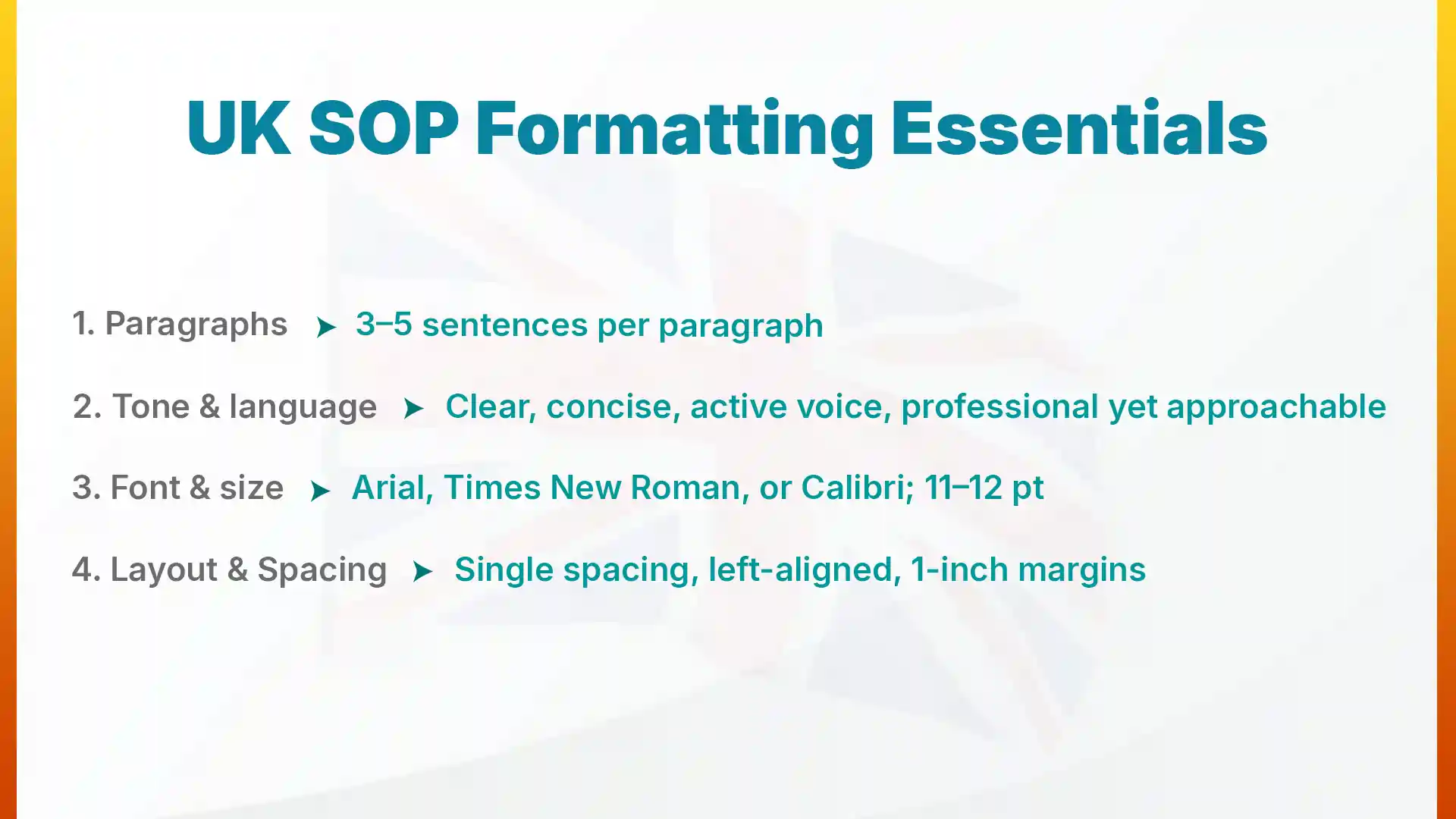
Proper formatting can make your Statement of Purpose more readable and professional, helping your application stand out. Paying attention to layout and style shows that you are organized and serious about your studies.
1. Paragraphs
Keep each paragraph concise, ideally 3 to 5 sentences. This makes your SOP easier to read and ensures that each idea is clearly communicated. Focus on one point per paragraph to maintain flow and coherence.
2. Tone & Language
Use clear and simple language throughout your SOP. Write in an active voice, keeping your tone professional but approachable, like a thoughtful conversation with the admissions team. Avoid jargon or overly complex sentences, so your motivation and personality shine through.
3. Font & Size
Stick to standard, readable fonts such as Arial, Times New Roman, or Calibri. Keep the font size between 11 and 12 points to ensure clarity. Consistency in font and size gives your SOP a polished and professional look.
4. Layout & Spacing
Use single spacing (1.0 line spacing, not 1.5 or double) and align your text to the left for easy reading. Maintain 1-inch margins on all sides to create a clean, balanced layout. Proper spacing makes your SOP visually appealing and shows attention to detail.
Following these formatting essentials ensures your SOP is professional, easy to read, and leaves a positive impression on admissions officers. Once your structure, tone, font, and layout are polished, the next step is to gather and align all supporting documents, so your application is complete and strengthens the story your SOP tells.
Documents & Application Context for Nepali Students
Writing a strong SOP is only part of your UK application. Supporting documents provide evidence of your academic achievements, language proficiency, and readiness for higher education. For Nepali students, preparing these requirements to study in the UK carefully ensures that your SOP is backed by credible proof and makes your application stronger.
1. Academic Transcripts & Equivalency
Provide official transcripts from your previous schools or universities, showing your grades and course details. If your qualifications are not in the UK system, include equivalency certificates recognized by UK institutions. Accurate and complete transcripts demonstrate your academic preparedness and build trust with admissions officers.
2. English Proficiency Certificates
Most UK universities require proof of English proficiency, such as IELTS or TOEFL scores. Make sure your certificate meets the minimum score required by your chosen course. Submitting valid English test results shows that you can handle academic communication confidently.
3. Reference Letters and CV
Include recommendation letters from teachers, professors, or employers who can vouch for your skills and character. A well-prepared CV highlights your academic background, work experience, and achievements. Strong references and a clear CV reinforce the story you tell in your SOP.
4. Funding Proof & Sponsor Documents
Show evidence that you can cover tuition and living expenses, whether through personal funds, sponsorship, or a scholarship at UK university. Include bank statements or formal sponsorship letters as required by the university. Providing funding proof assures the admissions team that you are fully prepared to pursue your studies in the UK.
How SOP Requirements Differ for UG, MS/PhD, and MBA in the UK
Your Statement of Purpose is not a one-size-fits-all document. Different levels of study, undergraduate, postgraduate, and MBA, require different approaches, focuses, and examples. Understanding these distinctions is crucial for Nepali students because submitting the wrong type of SOP can weaken your application, even if your academic record is strong. Shaping your SOP with respect to the program level can increase your chances of being noticed and accepted by UK universities.
1. SOP for Undergraduate Aspirants
For undergraduate applicants, the SOP should focus on personal motivation, school achievements, and genuine interest in the field. Highlight your +2 or A-level results in relevant subjects and mention any academic projects or competitions that demonstrate your abilities. Include extracurricular activities, sports, or volunteering that show initiative, leadership, or teamwork. Even if your career goals are still forming, showing curiosity and dedication can make your SOP stand out.
2. SOP for MS/PhD Aspirants
For research-focused programs, your SOP should emphasize intellectual curiosity, academic background, and long-term ambitions. Discuss undergraduate projects, thesis work, or publications that relate to your intended research area. Mention specific professors, labs, or research topics at the university to demonstrate fit. Detailing your research goals and showing how the program supports them signals to the admissions committee that you are prepared and serious about your studies.
3. SOP for MBA Aspirants
MBA applicants must highlight professional experience, leadership skills, and clear business objectives. Include detailed information about your job responsibilities, achievements, and lessons learned. Explain why an MBA is necessary for your career growth and how the program will help you achieve leadership or entrepreneurial goals. Clearly connecting your work experience to your MBA ambitions shows that you are ready to contribute and excel in a professional learning environment.
Understanding these distinctions is key to creating a targeted SOP that aligns with UK expectations and reduces the risk of rejection. Each level of study has its own priorities, and addressing them carefully shows both maturity and strategic planning in your application.
Common SOP Mistakes for UK Applicants & How to Avoid Them
Even a strong academic profile can be overshadowed by a poorly written SOP. Many Nepali students make avoidable mistakes that weaken their application, but knowing these pitfalls can help you craft a more compelling, professional, and effective document. By addressing these common errors, you increase your chances of impressing admissions officers and getting accepted.
1. Copying Generic Statements
Using generic phrases or recycled sentences from sample SOPs makes your application look unoriginal. Admissions officers want to see your unique story, motivation, and goals. Always write in your own words and include specific examples from your experience to make your SOP stand out.
2. Unrealistic or Vague Goals
Ambitious goals are good, but unrealistic or vague aspirations can raise doubts about your clarity and preparedness. Avoid statements like “I want to become successful in life” without context or connection to your chosen course. Focus on achievable, well-defined goals that show thoughtfulness and purpose.
3. Over-Emphasizing UK Lifestyle
While the UK’s culture and travel opportunities are attractive, over-focusing on lifestyle can make it seem like academics are not your priority. Admissions officers are more interested in your academic motivation, course fit, and future plans. Keep your SOP academically focused and tie all reasons for studying in the UK back to education and career growth.
4. Weak Structure or Word Count Issues
A disorganized SOP or one that is too short or too long can frustrate readers and dilute your message. Stick to the recommended 700–1000 words and maintain a clear structure with logical flow. Well-organized content helps the admissions team follow your story and understand your motivation easily.
5. Missing Academic Fit or Motivation
Failing to clearly connect your background, skills, and experiences to the course is a major mistake. Your SOP should always explain why you are a strong candidate for the specific program. Highlighting academic fit and personal motivation ensures the university sees you as a committed and suitable applicant.
Avoiding common SOP mistakes can make a significant difference in how your application is perceived. By staying original, focused, structured, and realistic, you ensure your motivation and academic fit shine through. With these pitfalls addressed, you are now ready to move on to crafting a polished, program-specific SOP that aligns perfectly with UK university expectations.
Conclusion
Writing a strong SOP for the UK may feel challenging, but it is your chance to share your story, goals, and passion for learning. Remember, a well-crafted SOP not only strengthens your university application but also reflects your seriousness and readiness to pursue higher studies abroad.
Keep your introduction engaging. Clearly link your academic background to your career goals. Show genuine interest in the UK and your chosen course. Carefully proofread your SOP. Doing all this will help you create a document that truly reflects who you are and what you want to achieve.
If you feel unsure about polishing your SOP, getting professional feedback can make a big difference. For Nepali students looking to study in the UK, working with the best consultancy in Nepal for UK can provide expert guidance, help refine your SOP, and ensure your application presents you in the strongest possible light.