Top 10 Best UK Universities for International Students (2026)

Nov 20, 2025

So, the UK has caught your attention, too? The historic campuses, engaging lectures, hands-on projects, and vibrant student life make studying here an exciting opportunity. Every class, lab, discussion and the university you choose shape your future.
Choosing the best universities in the UK is one of the most important decisions for your academic journey. It’s about finding the right program, city, and support system that will help you grow academically, socially, and professionally. But with so many options available, figuring out which UK universities are ideal for international students can feel overwhelming.
This guide breaks everything down in a simple, clear way. You’ll discover the top UK universities for international students, the programs they offer, and the qualifications and English test requirements to study in the UK. By the end, you’ll have the clarity to make an informed decision and plan your study journey with confidence.
In this blog
What Are the Benefits of Studying in the UK?
The main benefit of studying in the UK is gaining a world-class, globally recognized education. It also offers shorter courses that save time and money, along with strong post-study work opportunities. Additionally, you’ll experience a diverse and welcoming community that enriches both your personal and academic growth. Here’s what makes the UK such an inspiring choice:
1. Globally Recognized Degrees
UK degrees are respected all over the world. Employers know that studying in the UK means strong teaching, research, and practical learning. A degree from here can help you stand out in your career anywhere.
2. Shorter Course Duration
Most undergraduate courses take three years, and many master’s programs finish in just one year. This helps you save time and reduce living expenses. You can start your career earlier without compromising on quality.
3. Strong Post-Study Work Opportunities
After finishing your degree, you can stay in the UK to work for two years (three years if you do a PhD). This gives you valuable work experience and a chance to build your career. The Graduate Route makes it easier to gain real industry exposure.
4. Rich Cultural Diversity and Welcoming Community
The UK has students from more than 180 countries. You’ll enjoy different cultures, food, festivals, and new friends from around the world. The best student cities in the UK are safe and friendly, which makes studying abroad fun and enriching.
Study in UK– Start Your Journey Now
Which University is Best in the UK for International Students?
Oxford, Cambridge, and Imperial College London are the top universities in the UK for international students. These universities offer world-class teaching, strong global recognition, and excellent support for students from abroad. Each one brings its own strengths, but some consistently stand out for global rankings, teaching quality, and strong international student support. Let’s begin with the top 10 most prestigious universities in the UK.
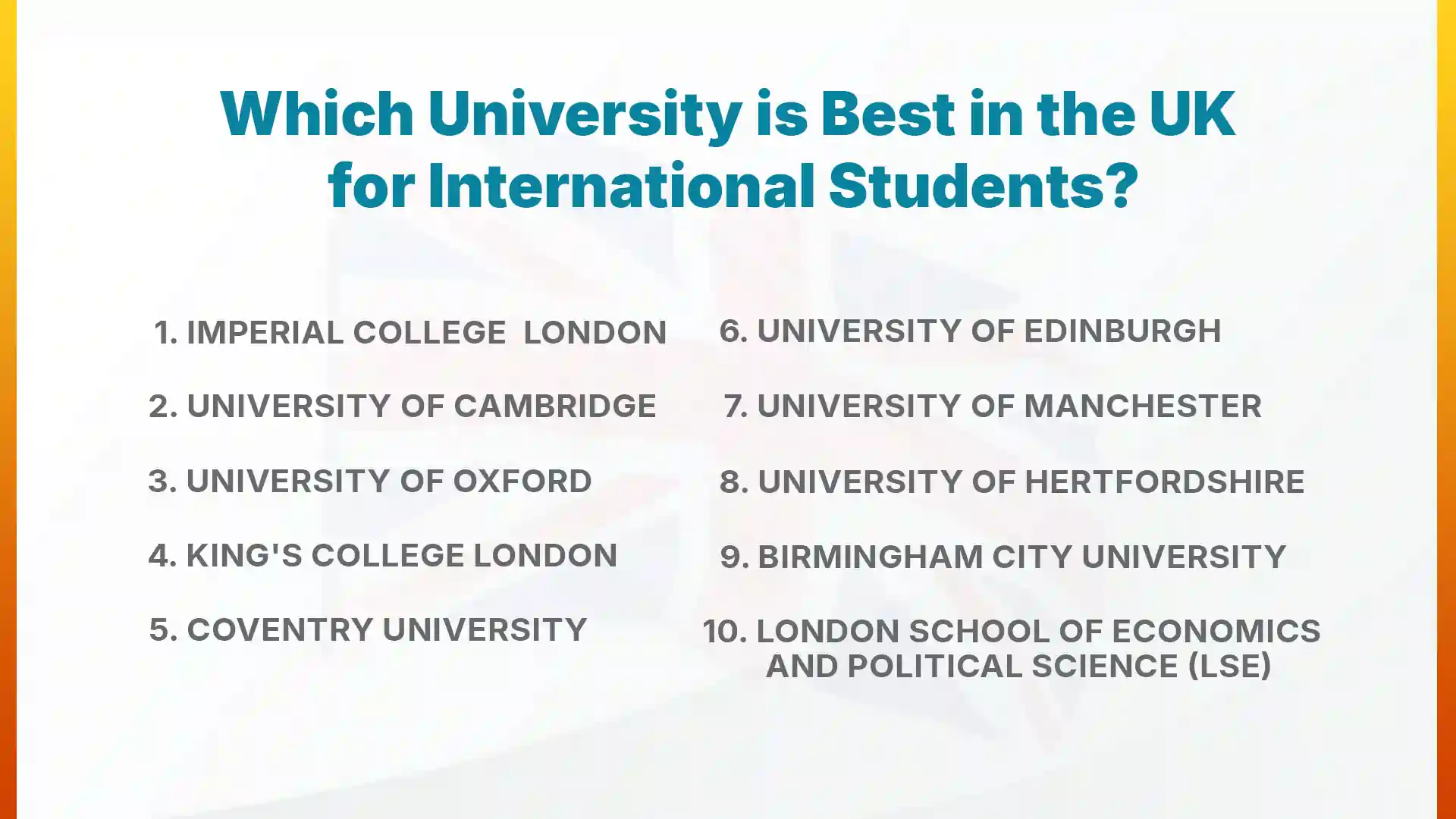
1. Imperial College London
Imperial is a dream destination if you’re passionate about science, engineering, technology, medicine, or business. The university is known for its hands-on, innovation-driven approach, making it a perfect fit for students who want practical, research-led learning. International students appreciate its supportive academic environment, dedicated career services, and strong industry partnerships.
Imperial’s central London location gives you instant access to internships, networking events, and global companies. The campus offers international student societies, mentoring programs, and academic support centers that make adapting to UK life much smoother. Students often highlight the multicultural community and the university’s active effort to help newcomers feel at home.
2. University of Cambridge
Cambridge is one of the world’s most recognized universities, famous for its Nobel Prize winners, centuries-old academic excellence, and high-impact research. The reputation alone opens doors globally, making it a top choice for ambitious learners.
The university follows a personalized teaching system called “supervisions,” where students learn through small-group discussions with experts. This approach builds strong critical thinking, analytical skills, and confidence.
Cambridge has dedicated support for global learners, from visa guidance to academic mentoring. Its beautiful colleges, libraries, and student societies create a vibrant environment where Nepali and other international students feel included. Plus, the strong alumni network provides incredible long-term career advantages.
3. University of Oxford
Oxford offers top-tier programs in almost every field, including humanities, science, business, law, medicine, and social sciences. The university is especially known for deep theoretical learning paired with research opportunities, even for undergraduate students.
Oxford consistently ranks among the best universities in the world. A degree from here signals excellence, dedication, and intellectual rigour, making it easier to pursue global careers or competitive postgraduate paths. The university is also the most generous with scholarship opportunities in the UK.
With students from over 160 countries, Oxford celebrates diversity in every corner of its campus. International students receive extensive support through orientation programs, cultural societies, academic guidance, and one of the most engaged global alumni networks.
4. King’s College London
King’s is a great choice if you want strong academics and the energy of London. The university is known for programs in health sciences, law, business, international relations, and social sciences. Students like its mix of modern learning and long history, which makes the experience both exciting and reliable.
King’s is also a research powerhouse. Many courses include real projects, expert talks, and work opportunities that help you grow your skills. Because the university is in the heart of London, you’re close to companies, hospitals, NGOs, and global organisations. This means better chances for internships, networking, and future jobs.
5. Coventry University
Coventry has become very popular among Nepali and South Asian students because it offers good-quality education at a more affordable cost. The fees are lower than many top UK universities, and the city itself is budget-friendly. This helps students manage living expenses without stress.
The university focuses on practical, career-ready learning. Many courses come with industry placements, simulations, and hands-on training. Students often say that classes feel friendly and supportive, especially for newcomers adjusting to the UK system. Coventry is a great option if you want a balance of affordability, modern teaching, and strong student support.
6. University of Edinburgh
Edinburgh is known for its beautiful campus, rich history, and strong reputation in research. Students choose it for subjects like computer science, engineering, business, medicine, and social sciences. The teaching style encourages curiosity, problem-solving, and independent thinking.
The university offers many support services for international students, from mental-health counselling to academic workshops. The city itself feels safe, friendly, and full of culture, which makes your study years enjoyable. For Nepali students who want world-class learning in a peaceful environment, Edinburgh is a perfect match.
7. University of Manchester
Manchester is a favourite among international students because of its strong focus on employability. The university has excellent programs in engineering, computer science, business, and life sciences. Many global companies work closely with Manchester, so students get good exposure to internships, projects, and career events.
The city is lively, multicultural, and student-friendly. Living costs are more affordable compared to London, which helps you manage your budget. With a warm community and a strong academic reputation, Manchester gives you both quality education and an enjoyable student life.
Ready to Study in the UK with Scholarship?
Get expert guidance on scholarships, universities, and applications. Start your journey today and make your dream of studying in the UK a reality!
8. University of Hertfordshire
Hertfordshire is a great option if you’re looking for a budget-friendly UK university. Tuition fees and living expenses are lower than in many major cities, which makes it easier for students to study comfortably. Even with its affordable cost, the university maintains good teaching standards and modern facilities.
Courses are designed to prepare you for real jobs. Many degrees include work placements, industry visits, and career workshops. Students appreciate the safe environment, supportive staff, and high satisfaction ratings. Hertfordshire is ideal if you want a practical education without stretching your finances.
9. Birmingham City University
Birmingham City University offers value-for-money programs, especially in creative fields, business, computing, and engineering. The teaching approach is hands-on, and students often get chances to build portfolios, join projects, and learn from industry professionals.
The university is known for its welcoming atmosphere. International students feel comfortable because the campus is diverse and the support services are strong. Birmingham itself is cheaper than London but still offers big-city opportunities, making it a smart choice for students who want both affordability and career growth.
10. London School of Economics and Political Science (LSE)
LSE is one of the best places in the world to study social sciences. Students choose it for subjects like economics, politics, international relations, public policy, sociology, and finance. The teaching is research-driven, and you learn from experts who shape global discussions.
The university ranks highly every year, and a degree from LSE is respected by employers worldwide. Students also benefit from its central London location, which gives access to embassies, NGOs, financial institutions, and global companies. For international graduates, this means stronger career opportunities and a powerful professional network.
Which UK University Is Cheapest for International Students?
The cheapest UK universities for international students are usually outside London, such as Birmingham City University, University of Hertfordshire, and Coventry University. These universities offer quality education at lower tuition fees and more affordable living costs. Studying at these institutions helps you manage your budget while still gaining a globally recognized degree.
Here’s a quick and clear breakdown of some of the most budget-friendly universities for international students. Tuition fees can vary by program, but these averages give you a good starting point to plan your cost of studying in the UK.
University | Average Annual Tuition Fee for International Students |
| University of Hertfordshire | £14,000–£15,500 |
| Coventry University | £16,800–£20,050 |
| Birmingham City University | £15,120–£17,000+ |
| University of West London | £16,250–£17,285 |
| Leeds Beckett University | £16,350–£18,440 |
Which Course Is Most In-Demand in the UK?
The most in-demand courses in the UK right now are in STEM and healthcare, especially fields linked to technology, engineering, and medical sciences. These areas are growing rapidly across the world, so graduates have strong chances of getting skilled jobs. The UK also faces talent shortages in these sectors, which makes international students even more valuable to employers.
Because of this rising demand, several subjects stand out for their strong career outcomes and clear industry pathways. Here’s a simple breakdown to help you understand your options:
1. Engineering
Engineering stays highly in demand because the UK invests heavily in infrastructure, energy, manufacturing, and technology. Students learn through projects, labs, and industry placements. Graduates are needed in fields like civil, mechanical, electrical, and aerospace engineering.
2. Computer Science & Artificial Intelligence
With the UK becoming a tech and AI hub, these programs attract thousands of international students. The learning is practical and future-focused, covering software, algorithms, and machine intelligence. Job roles like software developer, AI analyst, and cloud engineer are growing fast.
3. Data Science & Business Analytics
Companies depend on data-driven decision-making, and the UK has a strong analytics job market. Students work with real datasets, tools, and case studies that help them build practical skills. Graduates often move into finance, tech, consulting, and business roles.
4. Nursing & Healthcare Sciences
The UK urgently needs trained healthcare professionals, which creates secure pathways for international students. Nursing programs include hands-on clinical placements that prepare you for real hospital environments. Many graduates find stable, meaningful jobs soon after finishing their degree.
5. Cybersecurity
With rising digital threats, cybersecurity has become one of the fastest-growing fields. Students learn how to protect systems, networks, and data through practical labs and simulations. Employers in banking, tech, and government are actively hiring skilled graduates.
6. Law
Law programs remain popular because they offer strong critical thinking and communication skills. Many universities include practical workshops and exposure to real legal cases. Graduates can explore careers in law firms, corporate compliance, diplomacy, or policy.
What Are the Entry Requirements for UK Universities?
To get into a UK university, you need the right academic qualifications, proof of English proficiency, and basic personal and visa documentation. Most universities also want to see a personal statement and references, while some courses require additional tests or portfolios. Meeting these requirements ensures a smooth application process and increases your chances of admission.
1. Academic Eligibility for UK Universities
To study in the UK, you generally need a recognised qualification like +2, bachelor’s, or master’s (depending on your program), plus proof of English ability. Universities may ask for specific grades plus IELTS, TOEFL, or PTE scores to make sure you're ready for academic study in English. These requirements give you a solid foundation—and meeting them boosts your chances of getting an offer.
Here’s a summary of the qualifications needed for different UK-level programs + English requirement:
Program | Required Qualification | Minimum IELTS Score (or equivalent) |
| Diploma / Foundation | Completion of +2 (or equivalent) | Around IELTS 6.0 (varies by university) |
| Undergraduate (Bachelor) | +2 / A-level / IB diploma | IELTS 6.0–6.5 (depends on course) |
| Postgraduate (Master) | Bachelor’s degree from a recognized university | IELTS 6.5–7.0 (depends on course) |
| Research / PhD | Master’s degree (or sometimes a Bachelor + relevant experience) | IELTS 6.5+ (varies, depends on university) |
2. Personal Statement & References
A personal statement is your chance to show motivation, passion, and goals. Write 1–2 paragraphs explaining why you chose your course, your achievements, and your plans. You’ll also need 1–2 academic references from teachers or mentors who can verify your skills and character. This part of your application helps universities see your potential beyond grades.
Join IELTS Preparation Classes Today!
3. Course-Specific Requirements
Some programs have extra requirements. Creative courses may ask for portfolios; engineering programs sometimes require math tests; medicine and law often include interviews or written exams. Knowing these in advance helps you prepare, practice, and increase your chances of success.
4. Visa Documentation Basics
To study in the UK, you must obtain a student visa. You’ll need proof of finances to show you can cover tuition and living costs, and health coverage through the NHS. Universities provide guidance to help international students complete these steps smoothly and avoid last-minute issues.
Conclusion
Choosing the right university in the UK is one of the most important decisions you’ll make as a student. From world-class institutions like Oxford, Cambridge, and Imperial to budget-friendly options like Coventry and Hertfordshire, each university offers unique opportunities to grow, learn, and build a global future.
Studying abroad can feel overwhelming with so many choices, application steps, and visa requirements. With trusted guidance, you can navigate the process confidently, pick the right course and university, and focus on making the most of your UK study experience.
If you’re ready to take the next step toward your dream, start by shortlisting the top 10 consultancies in Nepal for the UK that can guide you through applications, tests, and visas, making your journey smooth and successful. Visit the counsellors at SAS Education Consultancy to discuss your study plan and get complete assistance with visa and admission.