How to Write SOP for Canada: Sample & Format Guide 2026

Dec 10, 2025

Before you can step into a Canadian classroom, there’s a story you need to tell. Your academic journey, your ambitions, and why Canada for higher education. Your entire story takes shape in your Statement of Purpose (SOP), a formal document where you explain your academic background, career goals, and motivation for pursuing higher studies abroad. An SOP is a bridge between your past experiences and future goals, helping universities and visa officers understand your genuine intent and readiness for higher studies.
But how do you convey all of this clearly in a single document? How can you make sure your SOP truly reflects your strengths, ambitions, and suitability for a Canadian program without missing important details?
In this guide, you’ll find sample SOPs for Canada student visa and universities, practical formats, and step-by-step writing strategies to craft an SOP that highlights your academic strengths, career motivation, and personal journey.
In this blog
What Is an SOP for Canada?
A Statement of Purpose (SOP) is a formal document that explains your academic journey, career goals, and motivation for studying in Canada. It helps universities and visa officers understand your goals, your fit for the program, and your genuine intent to study abroad.
Two Types of SOP to Study in Canada
When applying to study in Canada, students often need two types of SOPs: an Academic SOP for universities and a Visa SOP for immigration authorities. The Academic SOP is required to show your fit and motivation for a program, while the Visa SOP proves your genuine intent to study, financial readiness, and plans to return home.
1. Academic SOP (for Canadian universities)
This SOP is for the university. It focuses on your academic background, achievements, projects, and career goals. Its main aim is to show that you are a good fit for the program and ready to succeed in your chosen field.
2. Visa SOP / Letter of Explanation (for IRCC)
This SOP is for the Canadian immigration authorities (IRCC). Also called a Letter of Explanation, it highlights your genuine reason for studying in Canada, your financial preparedness, and your plans to return to Nepal after your studies. While it may include academics, the focus is on study purpose, finances, and home ties.
Key Differences Between Academic & Visa SOP
Aspect | Academic SOP | Visa SOP / Letter of Explanation |
| Purpose | Show fit for the program and motivation | Show genuine intent to study in Canada and ability to fund education |
| Focus | Academics, skills, projects, career goals | Study plan, finances, home ties, return plans |
| Evaluation | Universities check your fit and motivation | Visa officers check your credibility, finances, and intent to return |
Why Students Need Both SOPs for Canada
Many Nepalese students apply for university admission and a student visa at the same time. The academic SOP convinces the university you are a strong candidate, while the visa SOP assures immigration authorities that your study plan is clear, you have financial stability, and you plan to return home. Having both makes your application complete, clear, and stronger.
How to Write an Academic SOP for a Canadian University
Writing an Academic SOP for a Canadian University includes carefully presenting your academic background, achievements, skills, and career goals in a way that matches the program requirements to study in a Canadian university. It requires research, clarity, and a logical flow so that universities can easily see your fit and motivation. The following step-by-step guide breaks down each element of an Academic SOP to help you structure it effectively.
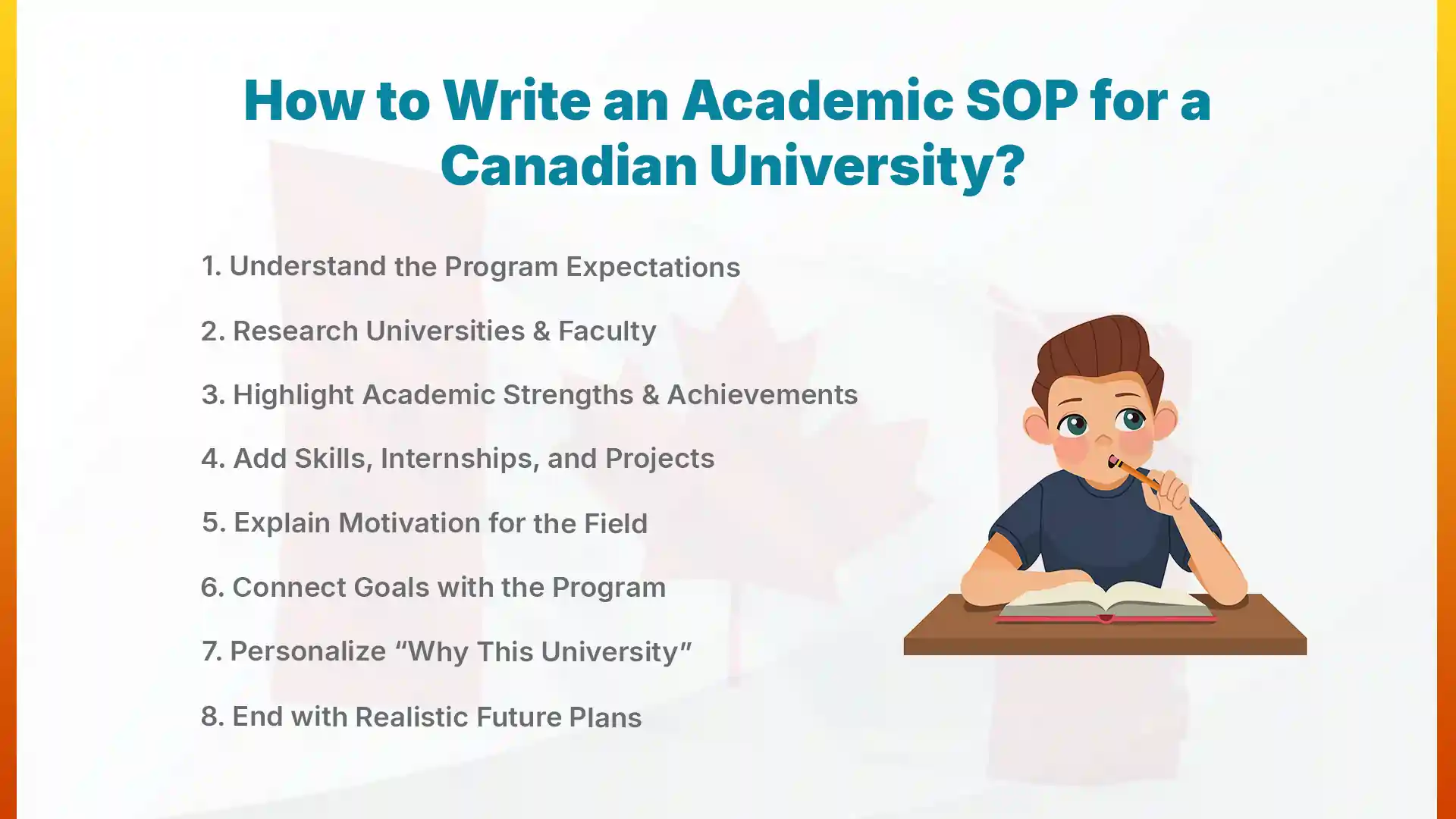
1. Understand the Program Expectations
Before writing, make sure you know what the program expects from students. Read the course details, learning outcomes, and prerequisites carefully. This helps you focus your SOP on relevant skills and experiences. For example, if the program values research skills, highlight your projects or lab work. Aligning your SOP with program expectations shows universities that you are prepared and serious.
2. Research Universities & Faculty
Take time to learn about the universities and faculty members you are applying to. Look at courses, research areas, and special projects that match your interests. Mentioning specific faculty or research labs in your SOP shows that you have done your homework. It signals to the admissions team that you are genuinely interested in their program and makes your SOP more personalized.
3. Highlight Academic Strengths & Achievements
Use this section to showcase your academic background clearly. Mention degrees, grades, certifications, and relevant awards. Explain how these achievements prepared you for the Canadian program. Avoid just listing; connect them to the skills or knowledge required for the course. This builds a strong case for your readiness and capability.
4. Add Skills, Internships, and Projects
Include practical experiences such as internships, research projects, or hands-on training. Describe your role, the skills you gained, and how it relates to the program. For instance, if you worked on a data analysis project, explain how it helped you develop analytical and problem-solving skills. Linking your experiences to program requirements strengthens your SOP.
5. Explain Motivation for the Field
Clearly state why you chose this field of study. Share personal experiences, challenges, or inspirations that led you here. Explain what excites you about this area and why you want to build a career in it. This section helps Canadian universities understand your genuine interest and passion while keeping the tone professional.
6. Connect Goals with the Program
Show how the program will help you achieve your academic and career goals. For example, if the program offers specific research opportunities, explain how you plan to use them to grow. This demonstrates that you have thought ahead and your goals are realistic. Connecting goals with the program proves your SOP is well-planned and targeted.
7. Personalize “Why This University”
Explain why you chose this university over others. Mention faculty, special courses, research centers, or industry collaborations that attract you. Avoid generic phrases like “good reputation” or “quality education.” Personalization makes your SOP stand out and shows that your decision is informed and intentional.
8. End with Realistic Future Plans
Conclude by explaining your short-term and long-term goals. Show how completing the program will help you achieve these goals. Mention your intention to contribute to your field or community. A strong conclusion leaves a positive impression on the admissions committee.
Academic SOP Format & Structure
SOP Section | Purpose / What to Include |
| Introduction | Briefly introduce yourself, your academic background, and your study purpose. |
| Academic Background | Summarize education, grades, and relevant achievements. |
| Professional Experience | Highlight internships, jobs, or projects if applicable. |
| Motivation for the Field | Explain why you chose this field and your interest in it. |
| Why This Program | Show how the program aligns with your goals and skills. |
| Why This University | Explain why you chose this university specifically. |
| Future Plans | Outline short-term and long-term career goals. |
| Conclusion | End with a strong, positive statement reinforcing your intent. |
Sample of Academic SOP for Canadian University
Below is a sample Academic SOP for a Nepalese student applying to a Canadian university. It demonstrates how to showcase your academic background, relevant skills, motivation for the field, and alignment with the chosen program and university. Use this example as a reference to structure your SOP clearly, personalize it for your story, and make it compelling for admission committees.
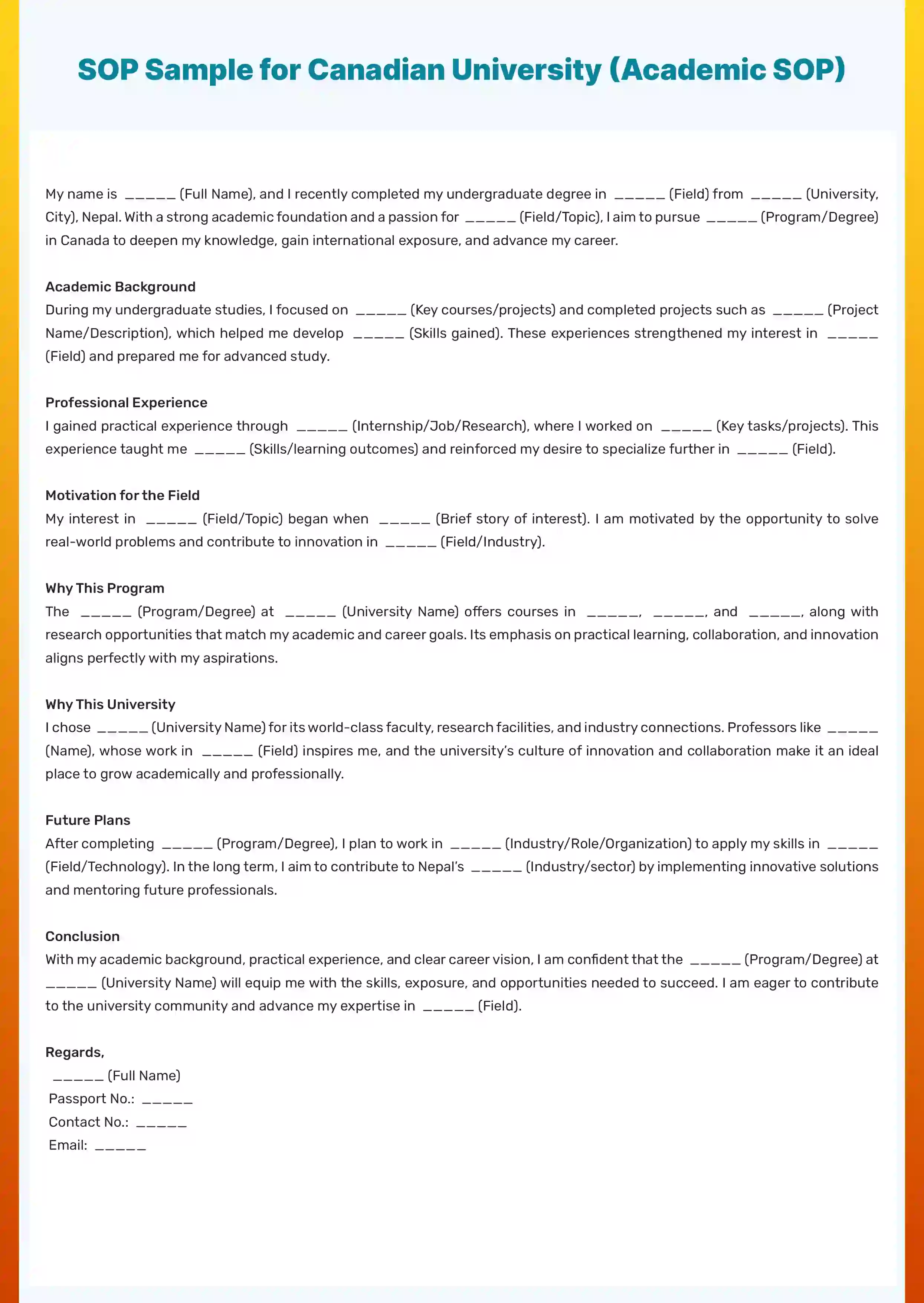
Academic SOP Sample for Canada Master’s in Computer Science at the University of Toronto
Name: Anil Shrestha
Program: Master’s in Computer Science
University: University of Toronto
Academic SOP for Master's in Computer Science in Canada
Introduction:
I am Anil Shrestha, a recent graduate in Information Technology from Tribhuvan University, Nepal. With a strong academic foundation and a passion for software development, I aim to pursue a Master’s in Computer Science in Canada to deepen my knowledge and gain international exposure.
Academic Background:
During my undergraduate studies, I consistently ranked among the top 10% of my class. I completed projects on web application development and database management, which helped me develop problem-solving and coding skills. Courses like Data Structures, Algorithms, and Artificial Intelligence sparked my interest in advanced computing and research.
Professional Experience:
I interned at a local software firm, where I worked on developing a task management application. This experience taught me practical coding, teamwork, and project management skills. I also contributed to a research project on machine learning algorithms, which strengthened my analytical abilities.
Motivation for the Field:
My fascination with AI and software development began in my second year of university, when I created a basic recommendation system. The field excites me because it combines logical thinking with creative problem-solving. I am motivated to explore innovative solutions that can have real-world impact.
Why This Program:
The Master’s program in Computer Science at the University of Toronto offers advanced courses in AI, data analytics, and software engineering. Its research labs and collaborative projects match my career goals of becoming a software developer with expertise in AI applications. The program’s focus on practical learning and research perfectly aligns with my aspirations.
Why This University:
I chose the University of Toronto for its world-class faculty, cutting-edge research facilities, and strong industry connections. Professors like Dr. X, whose work in AI aligns with my interests, make it an ideal place for academic and professional growth. The university’s emphasis on innovation and entrepreneurship further motivates me to join.
Future Plans:
After completing my Master’s, I plan to work in the software development industry, focusing on AI-driven solutions. In the long term, I aim to contribute to Nepal’s tech industry by implementing innovative software solutions and mentoring young professionals.
Conclusion:
With a solid academic foundation, practical experience, and a clear vision for my future, I am confident that the Master’s program at the University of Toronto will equip me with the skills and exposure needed to achieve my goals. I am eager to contribute to the university community while advancing my expertise in computer science.
Confused what is an NOC in Nepal? It’s an official certificate showing your school, college, or employer has no objection to your plans to study abroad. This document, issued by the Ministry of Education or the relevant authority, is necessary for your student visa and university applications. If you’re unsure how to get it, professional education consultancies can guide you through the process smoothly.
How to Write an SOP for a Canadian Student Visa?
To write an SOP for a Canadian Student Visa, clearly explain your study purpose, program choice, and why Canada is the right destination. Also, show your financial readiness, strong ties to Nepal, and plan to return after completing your studies. Each section of your SOP should be clear, honest, and directly connected to your study goals. Here’s a step-by-step approach to make your SOP compelling:
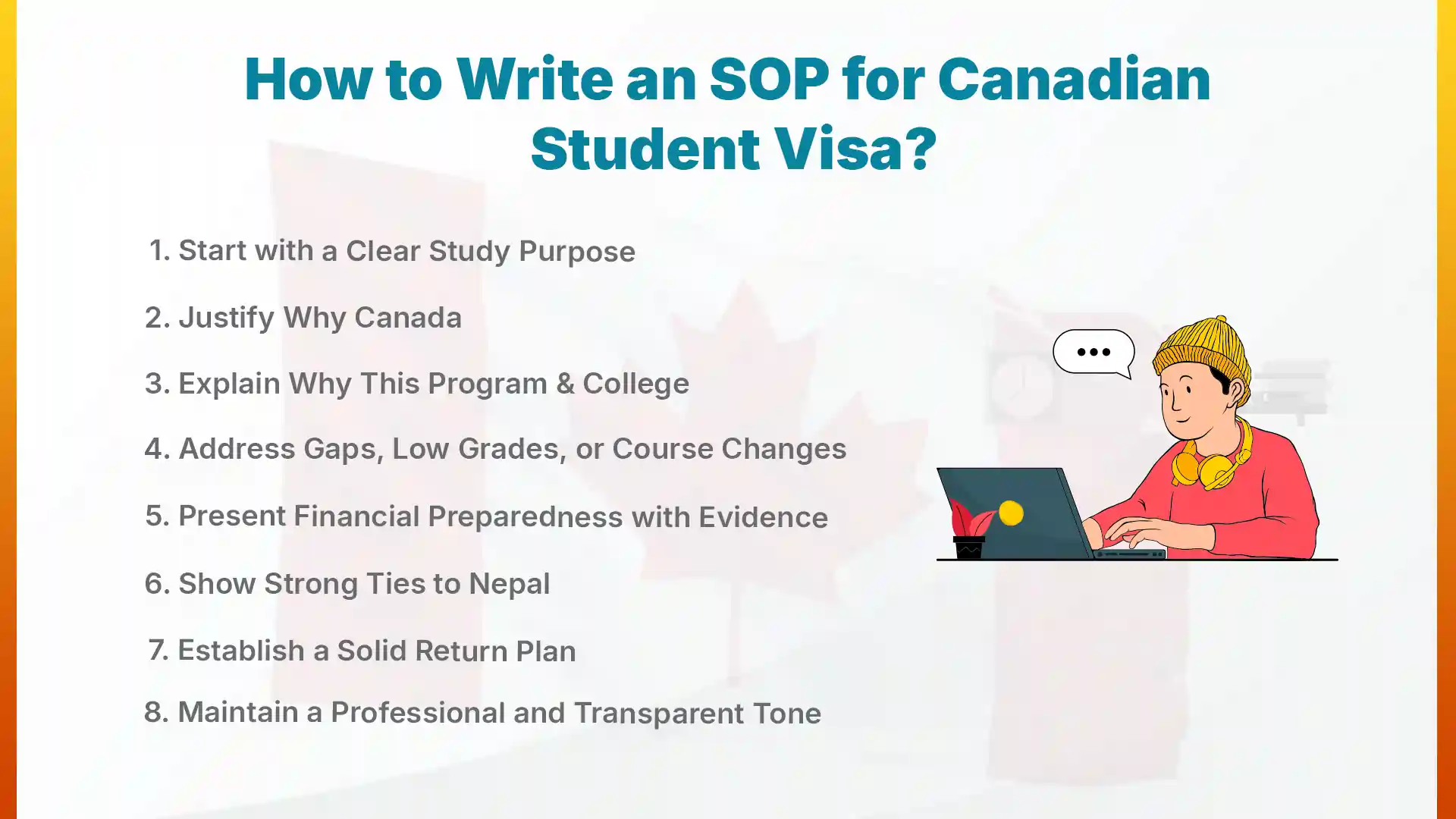
1. Start with a Clear Study Purpose
Begin your SOP by clearly stating why you want to pursue further studies in Canada. Highlight your academic background and how it has prepared you for this program. Explain what skills or knowledge you aim to gain and how this will benefit your career. A clear purpose sets the tone for the rest of the SOP and immediately shows visa officers that you have a focused plan.
2. Justify Why Canada
Explain why you chose Canada over other countries. Mention factors like quality of education, specific programs, research opportunities, or exposure to global standards. Connect these reasons to your academic and career goals to make your choice logical. This reassures the officer that Canada is the right destination for your education.
3. Explain Why This Program & College
Clearly explain why this particular program and college suit your goals. Highlight unique courses, faculty, labs, or projects that attracted you. Show that you have researched the institution and understand how it will help you achieve your objectives. Linking the program to your career plans strengthens your credibility.
4. Address Gaps, Low Grades, or Course Changes
If you have any academic gaps, low grades, or course changes, explain them honestly. Provide context like health issues, family responsibilities, or learning curves. Emphasize how you overcame challenges and improved your skills. Being transparent builds trust and prevents doubts about your intent or readiness.
5. Present Financial Preparedness with Evidence
Demonstrate that you have sufficient funds to cover tuition, living expenses, and other costs of studying in Canada. Include scholarships, bank statements, or sponsorship letters as proof. Explain how your family or personal resources will support your studies. Clear financial evidence reduces concerns about your ability to sustain yourself in Canada.
6. Show Strong Ties to Nepal
Highlight your connections to Nepal, such as family, property, or career prospects. Explain why you plan to return home after completing your studies. Strong home ties reassure the officer that your primary purpose is education, not immigration. Make this section specific and personal rather than generic.
7. Establish a Solid Return Plan
Outline your short-term and long-term plans after completing your program. Mention potential job opportunities, entrepreneurship, or contributions to your industry in Nepal. Show that your international education will directly benefit your career back home. A clear return plan demonstrates maturity and genuine intent.
8. Maintain a Professional and Transparent Tone
Throughout the SOP, use a formal but friendly tone. Avoid exaggeration or vague statements. Be honest, clear, and confident in presenting your story. A professional and transparent SOP builds credibility and leaves a strong impression on visa officers.
Writing a strong Canadian Student Visa SOP requires clarity, honesty, and a clear connection between your goals and your study plan. To ensure your application stands out and gets the guidance you need, explore the Top 10 Best Canadian Consultancies in Nepal, which can help you craft a compelling SOP and navigate the visa process smoothly.
SOP Format & Structure for Canada Student Visa
SOP Section | Purpose / What to Include |
| Introduction | State your name, program, and study purpose clearly. |
| Purpose of Study | Explain your academic and career goals. |
| Why Canada | Highlight reasons for choosing Canada over other countries. |
| Why This Program & College | Justify your program choice and the specific institution. |
| Academic History Explanation | Address gaps, low grades, or course changes if any. |
| Financial Explanation | Show evidence of funding for tuition and living costs. |
| Ties to Nepal | Demonstrate family, property, or job connections. |
| Future Plans & Return Intent | Explain your plan after completing the program. |
| Closing Statement | Reaffirm your genuine intent to study and return. |
Sample SOP for Canada Student Visa
Below is a realistic example of a Visa SOP written for a Nepalese student applying to Canada. Use this as a guide to understand how to present your story effectively while keeping the SOP professional, honest, and compelling.
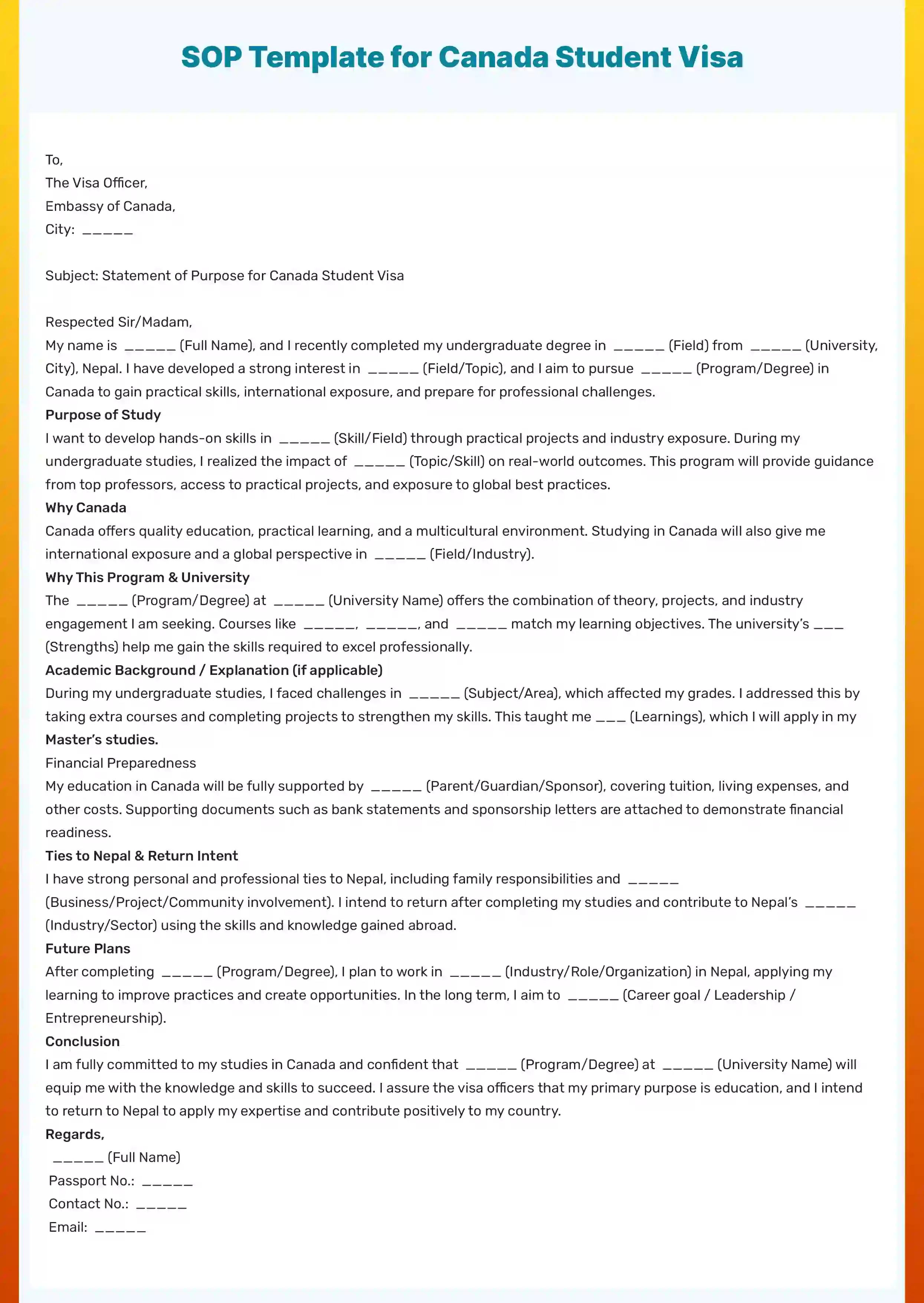
Visa SOP Sample for Master’s in Business Analytics at UBC
Name: Priya Koirala
Program: Master’s in Business Analytics
University: University of British Columbia
Visa SOP for Master's in Business Analytics in Canada
Introduction
I am Priya Koirala, a recent Business Administration graduate from Kathmandu University, Nepal. Over the past few years, I developed a strong interest in data and how businesses use it to make better decisions. Pursuing a Master’s in Business Analytics in Canada is the next step to turn this interest into practical skills and prepare myself for real-world challenges in the analytics field.
Purpose of Study
I want to gain hands-on skills in data-driven decision-making through real-world practice in analytics. During my undergraduate studies, I saw how powerful data can be in shaping strategies and improving operations. This program will provide access to top professors, practical projects, and exposure to global best practices, giving me the foundation I need to excel in my career.
Why Canada
Canada stands out for its quality education, practical learning approach, and multicultural environment. The country encourages students to combine theory with practice through internships and industry projects, which aligns perfectly with my learning goals. Studying in Canada will also give me exposure to international business practices, helping me develop a global perspective.
Why This Program & College
The Master’s in Business Analytics at the University of British Columbia offers the mix of theory, practical projects, and industry exposure I am looking for. Courses such as Predictive Analytics, Big Data Management, and Business Intelligence Projects match my learning objectives. The university’s connection with industry partners will allow me to work on real-world challenges, ensuring I am ready for the professional world after graduation.
Academic History Explanation
During my undergraduate studies, I faced some challenges in Statistics in my second year, which slightly affected my grades. To overcome this, I took extra online courses and completed practical projects to strengthen my understanding. This experience taught me persistence and the value of continuous improvement, which I will carry forward into my Master’s studies.
Financial Preparedness
My family will fully support my education in Canada, covering tuition, living expenses, and other costs. I have included bank statements and sponsorship letters to demonstrate financial readiness. This ensures that I can focus entirely on learning without any financial concerns.
Ties to Nepal
I have strong personal and professional ties to Nepal, including family and responsibilities at home. Our family business is an important part of my life, and I plan to return to contribute to it. My long-term goal is to use the skills I gain abroad to strengthen the business analytics sector in Nepal and create opportunities for others.
Future Plans & Return Intent
After completing my Master’s, I plan to return to Nepal and work in analytics, helping organizations make smarter, data-driven decisions. I want to contribute to my country’s growing business sector while building a meaningful career. Completing this program is a crucial step toward achieving these goals.
Closing Statement
I am fully committed to my studies in Canada and confident that this program will provide the skills I need to succeed. I assure the visa officers that my main purpose is education, and I intend to return home to apply my knowledge. This opportunity will not only shape my career but also allow me to make a positive impact on my community and country.
SOP Tips for Different Canada Study Levels
The content and focus of your SOP should match the level of study you are applying for. Each level has its own expectations, so it’s important to highlight the most relevant experiences and goals.
1. SOP for Diploma / PG Diploma
Diploma and PG Diploma programs are mostly career-focused and skill-based. Emphasize practical skills, short-term training, or work experience that relate to the program. For example, if you are applying for a PG Diploma in Hospitality Management, mention any internship at a hotel, customer service experience, or event planning skills. Clearly show how the program will help you gain specific skills to achieve your career goals.
2. SOP for Bachelor’s Applicant
For undergraduate programs, universities look for motivation, personal interests, and extracurricular involvement. Highlight academic achievements, school projects, and relevant hobbies or competitions. For instance, if you want to study Computer Science in Canada, you can mention coding competitions, science fairs, or school IT projects. Explain why you are passionate about the field and how the program will help you grow academically and personally.
3. SOP to Study Master’s in Canada
Master’s programs require academic depth, research potential, and professional preparation. Focus on relevant projects, internships, or research experience. For example, if applying for a Master’s in Environmental Science, describe your research project on water management or an internship with an NGO. Show how these experiences prepared you for advanced study and how the program aligns with your career goals.
Common SOP Mistakes That Lead to Refusals
Writing a strong SOP is not just about including your achievements; avoiding common mistakes is equally important. Here are the key errors students often make and how to avoid them:
1. Overly Generic Writing
Using vague statements like “I love learning” or “Canada has a good education system” makes your SOP weak. Be specific by mentioning particular courses, projects, or experiences. For example, instead of saying “I enjoy IT,” mention your coding projects or competitions. Specificity shows genuine interest and effort.
2. Weak Financial Explanation
Visa officers need clear proof that you can afford your studies. Simply stating “my family will support me” is not enough. Include bank statements, scholarship letters, or sponsorship details to demonstrate financial preparedness. Without this, your application may raise concerns about your ability to sustain yourself.
3. Unrealistic or Forced Career Goals
Ambitious goals are good, but unrealistic or generic ones can hurt your SOP. Avoid statements like “I will become the CEO of a global company in 2 years.” Instead, set achievable goals that connect your program to your career plans. For instance, “I plan to gain expertise in AI and work in software development in Nepal” is realistic and credible.
4. Plagiarism or AI-Generated Tone
Copying SOP samples or using AI tools without personal input can make your SOP sound robotic. Admissions and visa officers can detect generic or copied content. Always write in your own words, share your personal story, and reflect your genuine experiences.
5. Missing Return Intent in Visa SOP
For student visas, failing to show your intent to return home can lead to refusal. Always highlight ties to Nepal, such as family, property, or job prospects. Explain how your international education will help your career back home. This assures visa officers that your main goal is study, not immigration.
Conclusion
Writing a strong SOP for Canada is your chance to tell your story, showcase your strengths, and demonstrate your clear academic and career goals. Whether it’s an Academic SOP for university admission or a Visa SOP for IRCC, clarity, honesty, and personalization make all the difference.
Remember, every detail counts. Explain your motivation, justify your choices, and show your financial preparedness and ties to Nepal. A well-structured SOP not only impresses universities but also strengthens your visa application, making your dream of studying in Canada more achievable.
If you want professional guidance or a review of your SOP to ensure it stands out, consult an experienced education advisor who understands the Canadian application process. Visit the best consultancy in Nepal for Canada and talk about your plan. Taking this step can increase your chances of success and give you confidence in your application