How to Write SOP for US Universities: Sample & Format (2026)

Dec 09, 2025
Have you ever wondered why some students get accepted into top U.S. universities while equally talented peers do not? The answer often lies in one simple document: the Statement of Purpose, or SOP, which plays a key role in your application. It is your chance to show universities who you are, what you have learned, and why you are the right fit for their program.
Many Nepali students struggle with writing an SOP for US universities, one that effectively shares their story and can make the difference between acceptance and rejection. That’s why learning how to write a strong SOP for the USA is so important. Fortunately, with the right approach and guidance, you can create an SOP that highlights your strengths and goals.
In this guide, we will take you step by step through the process, share a clear format, and provide a sample that works. By the end, you’ll know how to prepare an SOP that is personal, clear, and convincing. Let’s learn how you can stand out and prepare for studying in the United States!
In this blog
What is an SOP for the USA?
A Statement of Purpose (SOP) is a written document where you explain your academic background, achievements, career goals, and reasons for choosing a particular program and university in the United States. It is your chance to introduce yourself beyond grades and test scores. Essentially, the SOP tells the admissions committee who you are, what motivates you, and why you are a good fit for their program. Writing an effective SOP helps you stand out in a competitive pool of applicants and gives universities a clear idea of your purpose and potential.
Why U.S. Universities Require an SOP
U.S. universities use the SOP to understand each applicant as a whole person, not just a set of numbers or certificates. They want to see your thought process, your goals, and how you plan to use the knowledge gained from the program. An SOP shows your communication skills, clarity of thought, and ability to present a convincing case for why you deserve admission. Without it, even strong academic records may not fully capture your personality and ambitions.
SOP vs Personal Statement
While both the SOP and personal statement are written essays necessary for US education, they serve slightly different purposes. The SOP focuses on your academic journey, career goals, and fit for a specific program. A personal statement (USA student visa SOP/F1 visa GTE), on the other hand, highlights your personal experiences, challenges, and growth, often in a more narrative style. In short, the SOP is professional and goal-oriented, while the personal statement is reflective and personal and is often a requirement for a U.S. student Visa.
How is SOP for the USA Different?
An SOP for U.S. universities is different because it emphasises your future goals and alignment with the program and faculty. Unlike some other countries, U.S. universities expect you to clearly explain why you chose their program, how it fits your long-term plans, and what unique qualities you bring. It is not just about what you have done but also about what you intend to achieve and how the university helps you get there. This focus on clarity, purpose, and program fit is what makes a U.S. SOP stand out.
What U.S. Universities Look For in Your SOP?
U.S. universities primarily look for clarity, purpose, and fit in your SOP. They want to see that you are academically prepared, have clear career goals, and understand how your chosen program aligns with your ambitions. Admissions committees also value research experience, professional skills, and leadership potential. Strong writing and communication show that you can express your ideas clearly.
1. Academic Preparedness & Research Potential
Universities want to know that you have the right academic foundation to succeed in their program in the US. This means highlighting your grades, relevant coursework, projects, or research experience. Showing that you can handle rigorous academic work gives the admissions committee confidence in your ability to contribute meaningfully. Always connect your past achievements to the skills needed for the program you are applying to.
2. Clarity of Goals & Long-Term Purpose
A strong SOP clearly explains your goals and why you are pursuing this field of study. U.S. universities look for students who can articulate both short-term objectives and long-term career plans. When you show direction, it demonstrates focus, maturity, and motivation. This clarity helps the committee see you as a serious candidate who will make the most of their program.
3. Program & Faculty Alignment
One of the most important factors in U.S. admissions is demonstrating that your interests align with the program and faculty. Mentioning specific courses, labs, or professors shows that you have researched the university carefully. It also indicates that you are thinking about how to contribute academically and take full advantage of what the program offers.
4. Professional Skills & Leadership Experience
Universities also value students who bring leadership, teamwork, and practical skills to the table. Sharing relevant internships, projects, or volunteer experiences can highlight your readiness for professional challenges. Even small examples of initiative or problem-solving can strengthen your SOP and make you memorable.
5. Communication Skills & Writing Quality
Finally, your SOP reflects your ability to communicate clearly and professionally. Admissions committees read hundreds of applications, so a well-structured, error-free, and engaging SOP stands out. Strong writing shows that you can express complex ideas effectively, a skill that is highly valued in U.S. graduate programs.
To write an SOP that meets these expectations, it’s important to understand each element in detail, from your academic background to your goals, program fit, and personal experiences. It is also essential to understand the proper format of writing an SOP for US studies to present your goals and story effectively. Taking a short counselling session from the best consultancy in Nepal for the USA can help you clarify your goals, understand how to present them effectively to U.S. professors and visa officers, and ensure your SOP truly reflects who you are.
How to Write SOP for the USA?
To write an effective SOP for U.S. universities, you need to carefully plan, structure, and present your academic journey, achievements, goals, and program fit in a clear and convincing way. Breaking the process into simple, actionable steps makes it much easier to handle and ensures you cover everything admissions committees are looking for. In the following sections, we will go through each step in detail, so you can create an SOP that stands out and aligns perfectly with your goals and the expectations of U.S. universities.
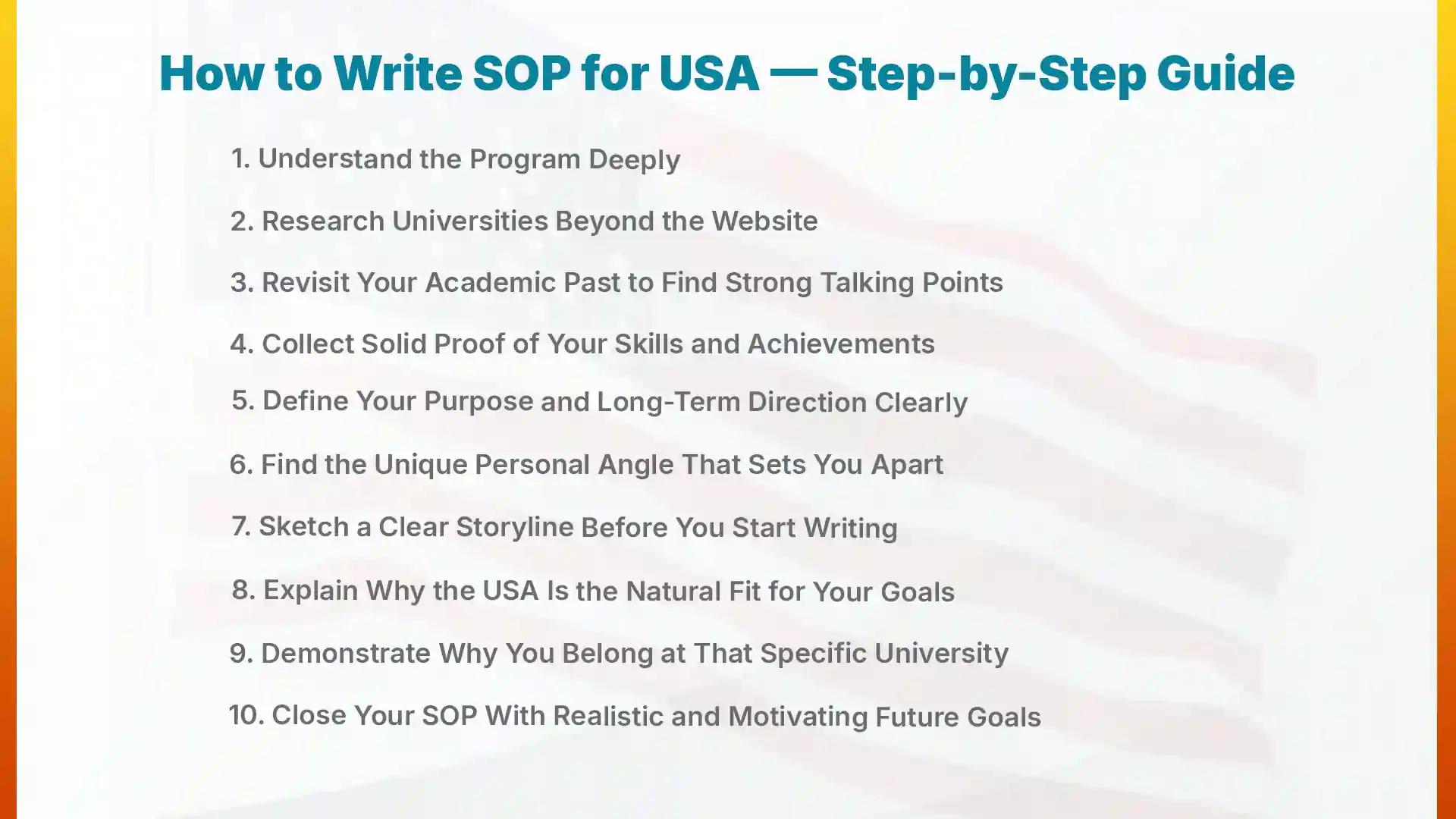
1. Understand the Program Deeply
Before you start writing, make sure you fully understand the program you’re applying to. Look at the courses, labs, and faculty profiles. Take notes of intakes in the USA for the program. Ask yourself: What skills and knowledge will I gain? How does this program fit my goals? This helps you explain clearly why this program is the right choice for you.
2. Research Universities Beyond the Website
Don’t rely only on the university’s official page. Read faculty publications, student projects, and department news. This research helps you mention specific faculty, labs, or initiatives in your SOP, showing that you are genuinely interested and well-prepared.
3. Revisit Your Academic Past to Find Strong Talking Points
Go through your transcripts, projects, and achievements carefully. Identify experiences that show your strengths, curiosity, and ability to succeed in the program. Highlight moments where you solved problems, learned new skills, or went beyond the standard curriculum.
4. Collect Solid Proof of Your Skills and Achievements
Admissions committees want evidence, not just claims. Include examples like research projects, competitions, internships, certifications, or leadership roles. Whenever possible, quantify your achievements. Numbers and results make your story credible.
5. Define Your Purpose and Long-Term Direction Clearly
Think about where you want to go in your career and how this program will help you get there. Be specific. Universities value applicants with a clear plan. Avoid vague statements like “I want to grow in my field.” Instead, explain exactly what you aim to achieve and how.
6. Find the Unique Personal Angle That Sets You Apart
Ask yourself: What makes me different from other applicants? It could be a project, experience, challenge, or perspective. This unique angle helps your SOP stand out and makes your story memorable.
7. Sketch a Clear Storyline Before You Start Writing
Create a rough outline of your SOP. Decide the order of ideas: introduction, academic journey, achievements, goals, program fit, and conclusion. A clear structure ensures your SOP flows naturally and keeps the reader engaged.
8. Explain Why the USA Is the Natural Fit for Your Goals
Show why studying in the U.S. is the best choice for you. Mention opportunities like advanced labs, research culture, diverse learning environment, or global exposure. Be genuine, avoid generic lines like “I want to study in the USA for quality education.” Explain why the course modules will help you reach your goal, what interests you and how you wish to contribute after learning.
9. Demonstrate Why You Belong at That Specific University
Highlight what attracts you to this university. It can be faculty, courses, research projects, or student culture. Connect these points to your skills and goals. This shows that you didn’t just pick the university randomly, but thought carefully about why it’s the right place for you.
10. Close Your SOP With Realistic and Motivating Future Goals
End with a forward-looking statement. Explain what you plan to do after graduation and how the program helps you achieve that. Keep it ambitious but realistic. A strong conclusion leaves the reader with a sense of your direction and motivation.
Writing your SOP step by step helps you present your strengths, goals, and program fit clearly and convincingly. A well-structured and thoughtfully written SOP can make a strong impression on professors and admissions committees. Next, we will explore the proper SOP format for U.S. universities, so you know exactly how to organize your content for maximum impact.
SOP Format for US Universities (2026)
Having a clear format helps you organize your thoughts and present your story effectively. A well-structured SOP ensures the admissions committee can easily follow your journey, understand your goals, and see why you are the right fit for the program. Here’s a recommended structure for U.S. university SOPs:
Section | What to Include |
| Introduction | Start with a short, engaging opening that shows your interest in the field. Use a personal story, curiosity, or an experience that shaped your motivation. |
| Academic Background | Highlight relevant courses, projects, or achievements. Show how your studies have prepared you for this program. |
| Extracurricular Involvement | Include activities that show teamwork, leadership, initiative, or creativity. Connect them to your growth or academic interests. |
| Professional Experience | Mention internships, work, or research projects if relevant. Focus on skills, responsibilities, and achievements tied to your field. |
| Motivation for This Field | Explain why you are passionate about your chosen field. Share experiences or observations that inspired you. |
| Why Study in the USA | Be specific—talk about research opportunities, labs, teaching methods, or cultural exposure. Link these to your goals. |
| Why This University | Show that you’ve researched faculty, labs, or initiatives. Explain why this university is the best place for your growth. |
| Future Career Plans | Discuss short-term and long-term goals. Show how the program helps you achieve them and the impact you want to make. |
| Conclusion | End with a concise summary. Reaffirm your motivation, readiness, and fit for the program. |
SOP Word Count for USA
Most U.S. universities expect an SOP between 600–1000 words, though some programs may have different requirements. Shorter SOPs focus on concise storytelling, academic highlights, and program fit, while longer SOPs allow space for detailed research experience, faculty alignment, and long-term goals.
For undergraduate programs, they are usually 600–800 words, focusing on academic interests, fit, and extracurriculars. Master’s SOPs range from 500–1,000 words, emphasizing career goals, skills, and preparation. PhD SOPs are longer, around 1,000–1,500 words, highlighting research experience, past projects, and future plans. Requirements can also vary by university or department, so always check specific guidelines before writing.
SOP Content Formatting Essentials
Proper formatting makes your SOP easier to read and shows professionalism. Following these simple, standard rules for font, spacing, tone, and structure ensures your ideas are clear and leave a strong impression on the admissions committee:
- Font: Use standard fonts like Times New Roman, Arial, or Calibri
- Size: 11–12 pt
- Spacing: Use 1–1.15 line spacing
- Margins: 1-inch margins for readability
- Paragraph Structure: Keep paragraphs short, focused, and logically connected.
- Tone & Voice: Be professional, clear, and personal. Avoid jargon or overcomplicated sentences.
- Proofreading: Check grammar, spelling, and flow multiple times. A polished SOP reflects attention to detail.
SOP Sample for USA
To help you understand how a strong SOP looks in practice, here’s an example tailored for a specific program and university. This sample demonstrates how to structure your story, highlight achievements, and connect your goals to the program. Keep in mind, it’s only a guide. Your own SOP should be completely personal, reflecting your unique story, achievements, and research interests.
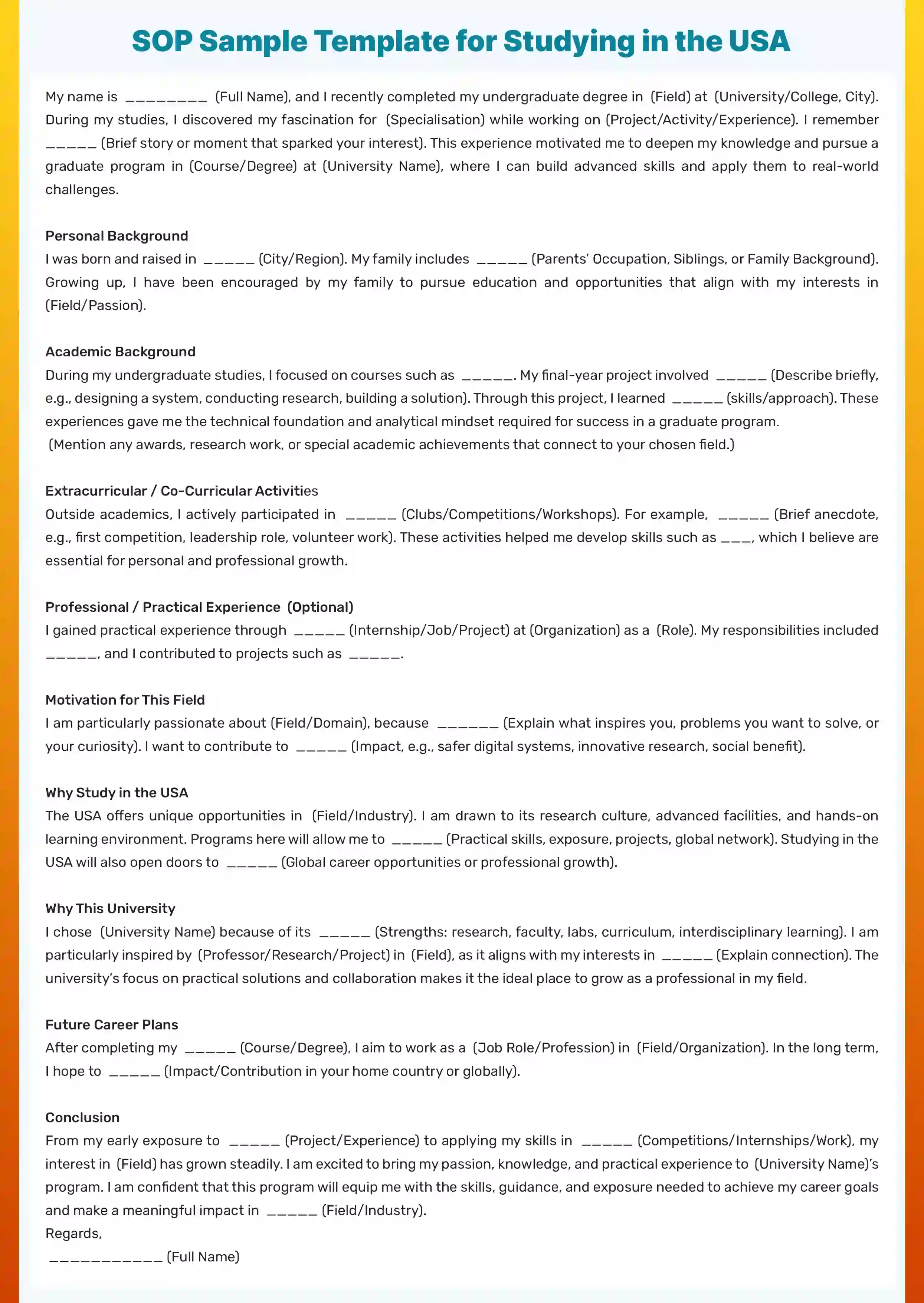
SOP for MSc in Cybersecurity at the University of California
Program: MSc in Cybersecurity
University: University of California, Berkeley
SOP for MSc in Cybersecurity in the USA
Introduction
My name is Anushka Suwal, and I recently completed my undergraduate degree in Computer Science at Tribhuvan University, Kathmandu. During my studies, I discovered my fascination for cybersecurity while working on a class project involving network vulnerabilities. I remember spending hours tracing a simulated breach and realizing how small gaps could lead to serious security risks. That moment made me curious about understanding systems deeply and protecting them from threats. Over time, I worked on small security projects and ethical hacking exercises, which reinforced my interest even more. This curiosity and practical exposure have motivated me to pursue an MSc in Cybersecurity at UC Berkeley, where I can develop advanced skills and apply them to real-world challenges.
Academic Background
During my undergraduate program, I focused on courses such as computer networks, cryptography, and information security. My final-year project involved designing a system to detect phishing attacks using machine learning. While building the project, I learned to analyze large datasets, write secure code, and test systems under realistic conditions. These experiences gave me both the technical foundation and problem-solving mindset needed to succeed in a demanding graduate program.
Extracurricular Involvement
Alongside academics, I actively participated in cybersecurity competitions and workshops. I still remember the excitement of my first Capture the Flag (CTF) event, where our team solved challenges such as SQL injection vulnerabilities, network sniffing tasks, and password cracking exercises under tight deadlines. I also volunteered to conduct cybersecurity awareness sessions at local schools, which helped me develop communication and leadership skills. These experiences taught me how to work in teams, think critically under pressure, and share knowledge effectively.
Professional Experience
I had the opportunity to intern at a local IT firm, where I assisted in monitoring networks, setting up firewalls, and conducting security audits. This experience allowed me to apply my classroom knowledge in real-world scenarios, where I learned the importance of attention to detail, practical problem-solving, and clear reporting. It was fascinating to see how theory translates into practice, and it strengthened my desire to specialize further in cybersecurity.
Motivation for This Field
I am passionate about creating secure digital environments and addressing emerging cyber threats. My interest lies in network security, threat analysis, and ethical hacking. I want to use my skills to protect sensitive data and contribute to safer online spaces. Studying in the U.S., where advanced research and innovation thrive, will give me the technical knowledge and practical exposure to tackle these challenges effectively.
Why Study in the USA
The U.S. offers amazing opportunities for learning in cybersecurity. I am excited about access to advanced security labs, real-world threat analysis projects, and the chance to work with experts in the field. The research culture and hands-on approach will help me tackle real cybersecurity problems, from ethical hacking to network protection. Studying in the U.S. will also open doors to global career opportunities, like working as a cybersecurity analyst, consultant, or risk manager. These experiences will help me grow as a professional while giving me the skills to protect systems and data in a world that depends more and more on digital security.
Why This University
UC Berkeley stands out because of its world-class cybersecurity research and interdisciplinary learning environment. I am particularly inspired by the work of Professor [Name] in network security and threat detection, especially the way their research uses machine learning to identify hidden threats in large networks. The focus on practical, real-world solutions really resonates with me, as I am eager to learn techniques that can be applied to protect systems and data. The university’s advanced labs, collaborative culture, and hands-on approach make it the ideal place for me to grow as a cybersecurity professional.
Future Career Plans
After completing my MSc, I aim to work as a cybersecurity analyst or consultant, helping organizations protect critical digital infrastructure. In the long term, I hope to contribute to strengthening cybersecurity practices in Nepal, assisting companies and institutions in safeguarding data and building secure systems.
Conclusion
From my first experience identifying vulnerabilities in class projects to applying my skills in competitions and internships, I have grown more passionate about cybersecurity with each step. I am excited to bring this passion, along with my academic knowledge and practical experience, to UC Berkeley’s MSc program. I am confident that the program will give me the skills, guidance, and exposure needed to reach my career goals and make a meaningful impact in the field of cybersecurity.
USA SOP vs. USA Student Visa SOP (F-1 Visa)
A university SOP focuses on your academic background and goals, while a visa SOP focuses on proving your intent to study in the U.S. temporarily and return to Nepal afterward. Many Nepali students assume that the SOP they write for U.S. university admission is the same as what they need for a student visa. However, these are two very different documents with different purposes. Understanding the difference is crucial to avoid mistakes and strengthen both your application and visa process.
SOP for USA Universities (Academic Admissions)
An SOP for universities focuses on your academic background, skills, achievements, and career goals. It explains why you want to study a specific program, how it fits your long-term plans, and why the chosen university is the right place for you. The tone is professional but personal, showing your motivation and alignment with the program. Admissions committees are interested in your preparedness, potential, and contribution to the university.
SOP for USA Student Visa (Personal Statement)
The SOP for an F-1 visa is more about your intent and ties to your home country. Its purpose is to convince the visa officer that you genuinely plan to study in the U.S. and will return to Nepal after your program. While it may touch on your academic goals, the focus is on proving that you have clear reasons to come back and that your stay in the U.S. is temporary and purposeful.
What to Include in a USA Student Visa SOP vs. What to Avoid
When writing an SOP for a U.S. student visa, include details that show your ability to fund your studies, your academic plans, and strong ties to Nepal, such as family, property, or future career opportunities. Clearly explain your intention to return home after completing your program. Avoid repeating your university SOP content, overemphasizing personal struggles, or making vague statements about staying in the U.S. These can raise doubts about your F-1 visa intent and reduce your chances of approval.
How to Prove Intent to Return to Nepal
Visa officers want to see that you have reasons to come back. Mention your career goals in Nepal, potential employers, family responsibilities, or plans to contribute to local industries. Be specific and realistic. The clearer you are about your future in Nepal, the more confident the officer will feel about your temporary stay in the U.S.
Documents That Support Your SOP in U.S. Applications
A strong SOP works best when it is supported by the right documents. These help admissions committees verify your achievements, skills, and preparedness, making your application more convincing. Here’s what you need:
Academic Transcripts
Your academic transcripts show your educational performance and relevant coursework. They help the university understand your academic foundation and readiness for the program. Make sure your transcripts are complete, official, and translated into English if necessary.
Standardized Test Scores (GRE/GMAT/TOEFL/IELTS)
Scores from tests like GRE, GMAT, TOEFL, or IELTS provide measurable proof of your skills and English proficiency. Include them to strengthen your SOP claims about your academic abilities and readiness for rigorous study in the U.S.
CV or Resume
A well-structured CV or resume highlights your academic achievements, projects, internships, and relevant skills. It complements your SOP by presenting a concise overview of your background and professional experience.
Letters of Recommendation
Strong recommendation letters support your SOP by validating your skills, achievements, and character. Choose recommenders who know you well academically or professionally, and who can speak specifically about your potential in the chosen program.
Financial Evidence for I-20 (For Visa)
To obtain your I-20 form and F-1 visa, you must show proof of funds to cover tuition and living expenses. Bank statements, sponsorship letters, or scholarships demonstrate your financial readiness and strengthen your visa application.
SOP Tips for Different USA Programs
Writing an SOP for different programs in the U.S. requires focusing on what each program values most. Undergraduate programs care about your curiosity and extracurricular engagement, master’s or PhD programs focus on research and technical skills, and MBA programs look for leadership and professional experience. Understanding these differences helps you tailor your SOP effectively, and next, we will look at common mistakes Nepali students should avoid to make their SOPs stronger.
1. SOP for Undergraduate Programs
For undergraduate SOPs, storytelling is the key to engaging the reader. Start with an experience or event that sparked your interest in the field. It could be a school project, a competition, or a personal experiment. Then connect it to how you explored that interest further, such as workshops, online courses, or group projects.
Make sure to include extracurricular activities that show teamwork, leadership, or creativity, like volunteering, clubs, or community projects. For example, highlighting experiences like leading a school club, organizing events, or managing small business projects can be helpful when applying for a BBA course in the USA. Linking these experiences to your academic curiosity shows the university that you are both motivated and well-rounded.
2. SOP for MS/PhD Programs
For master’s or PhD SOPs, your focus should be on research and technical depth. Clearly explain your academic projects, internships, or research work and how they shaped your goals. Use specific examples, like designing a network security model or running experiments in a lab for studying IT in the USA. Mention the faculty, labs, or research initiatives that interest you and explain why they align with your objectives. Demonstrating this alignment shows the admissions committee that you’ve done thorough research and that you are a serious candidate ready to contribute to their program.
3. SOP for MBA Programs
MBA SOPs require a strong focus on leadership, work experience, and career goals. Highlight instances where you led teams, solved problems in a business setting, or implemented projects that had a measurable impact. Connect these experiences to your future goals and explain why an MBA is essential to achieve them. Be specific about the skills you want to gain, such as strategic decision-making, financial planning, or managerial expertise, and show how these connect to your professional growth. This approach makes your SOP practical, goal-oriented, and credible.
Key SOP Focus Areas by Program: Summary
Different programs value different qualities in an SOP. This table summarizes what to emphasize for undergraduate, MS/PhD, and MBA applications so that your SOP meets your program’s expectations.
Program | Key Focus for SOP |
| Undergraduate | Storytelling, academic curiosity, extracurriculars, personal engagement |
| MS/PhD | Research interests, technical skills, projects, faculty/lab alignment |
| MBA | Leadership, work experience, career goals, strategic thinking |
Common SOP Mistakes Nepali Students Make
Many Nepali students make avoidable mistakes in their SOPs that reduce their chances of acceptance. These include vague goals, generic statements about the U.S., overexplaining personal struggles, ignoring faculty fit, and overusing AI-generated content. Knowing these mistakes allows you to write a clear, authentic, and compelling SOP, and next, we will discuss how to conclude your SOP effectively while maintaining a strong impression.
1. Generic “Why USA” Statements
Many students write broad statements like “I want to study in the USA for better education,” which don’t show true motivation. Instead, mention specific features of the U.S. education system that matter to you. Talk about research labs, technology access, innovative teaching, or global collaboration. You could also mention the multicultural environment, exposure to diverse perspectives, or collaborative projects that match your learning style. Linking these features to your goals makes your SOP more compelling and credible.
2. No Focus on Faculty or Research Fit
Universities want to see that you understand their program and resources. Avoid vague mentions of the department or courses. Instead, research faculty members, their projects, or labs, and explain how you would work with them or contribute to ongoing research. This shows you’ve invested time in understanding the program and that you are genuinely interested.
3. Overexplaining Personal Struggles
It’s okay to mention challenges briefly, but overexplaining personal hardships can distract from your achievements. Focus on what you learned and how you overcame obstacles. For example, instead of writing pages about family struggles, highlight how those experiences taught resilience, problem-solving, or time management, and link that to your academic or professional growth.
4. Weak or Unrealistic Career Goals
Many students write goals like “I want to succeed in my career” or “I want to gain knowledge,” which are vague and unconvincing. Instead, be specific: describe the role you aim for, the industry or sector, and the impact you want to make. Short-term goals (like becoming a cybersecurity analyst) and long-term goals (like improving the national cybersecurity infrastructure in Nepal) make your SOP credible and goal-oriented.
5. Plagiarism or AI-Overuse
Copying SOPs from the internet or relying entirely on AI can harm your application. Admissions committees want your personal story and unique perspective. You can use AI or sample SOPs as guidance, but always write in your own voice. Include personal anecdotes, specific achievements, and your reflections to make your SOP authentic.
7. Writing a Visa-Style SOP for University
Some Nepali students mistakenly write their university SOP like a visa SOP, focusing on financials, family ties, or intent to return. University SOPs should emphasize academic achievements, skills, and program fit. Save visa-specific content for the F-1 visa SOP. Keeping the focus on academics and your professional goals ensures the committee sees you as a motivated, capable candidate for the program.
7. Not Seeking Guidance or Mentorship
Many students try to write their SOPs alone, which can lead to missed opportunities or weak structure. Seeking unbiased feedback from seniors, alumni, online forums, or experienced mentors can help you clarify your goals and present them effectively. Educational counsellors, especially the top 10 best consultancies in Nepal for U.S. studies, can provide expert guidance without writing your SOP for you, helping you craft a strong, authentic, and well-structured application.
Conclusion
An SOP for the USA is your chance to tell your unique story and show universities why you belong. Every achievement, project, and experience you’ve had is a building block toward your dream. Every achievement, project, and experience you’ve had is a building block toward your dream. When you organize them clearly and focus on your goals, you can create an SOP that inspires confidence in admissions committees.
If you’re unsure how to present your achievements or connect your experiences to your goals, getting guidance from experienced mentors or the best education consultancy in Nepal can change everything for good. They can help you organize your story, highlight your strengths, and show your true potential. With focused effort, honest storytelling, and expert support, your SOP can become a powerful tool that opens doors to studying in the United States and building the career and future you’ve been dreaming of.