Forensic Science Course in the UK: Entry Requirements, Costs & PR Paths

Jul 10, 2026
Every fingerprint, blood splatter, and digital trace tells a story, and a forensic science course in the UK equips Nepalese students with the highly specialized analytical skills required to uncover that truth in a court of law. The biggest hurdle for international students is finding a degree that combines rigorous laboratory training with a realistic post-study route to work abroad without facing exorbitant tuition fees.
Studying in the UK eliminates this hurdle by combining strict Chartered Society of Forensic Sciences (CSFS) accreditation with a highly defined Graduate Route to Skilled Worker visa migration route. This guide details the top universities, exact costs, admission steps, and salary expectations for 2026.
In this blog
What Is a Forensic Science Course in the UK?
A forensic science course in the UK is an applied science degree focused on the collection, preservation, and analysis of physical evidence for legal investigations, typically lasting 3 years for a bachelor's and 1 year for a master's degree.
Unlike general science degrees, forensic science has a much heavier focus on criminal law, evidence handling, and chain-of-custody procedures. For Nepali students, choosing a program aligned with the Chartered Society of Forensic Sciences (CSFS) ensures your practical skills meet the strict standards required to testify as an expert witness in UK courts.
Why Study a Forensic Science Course in the UK?
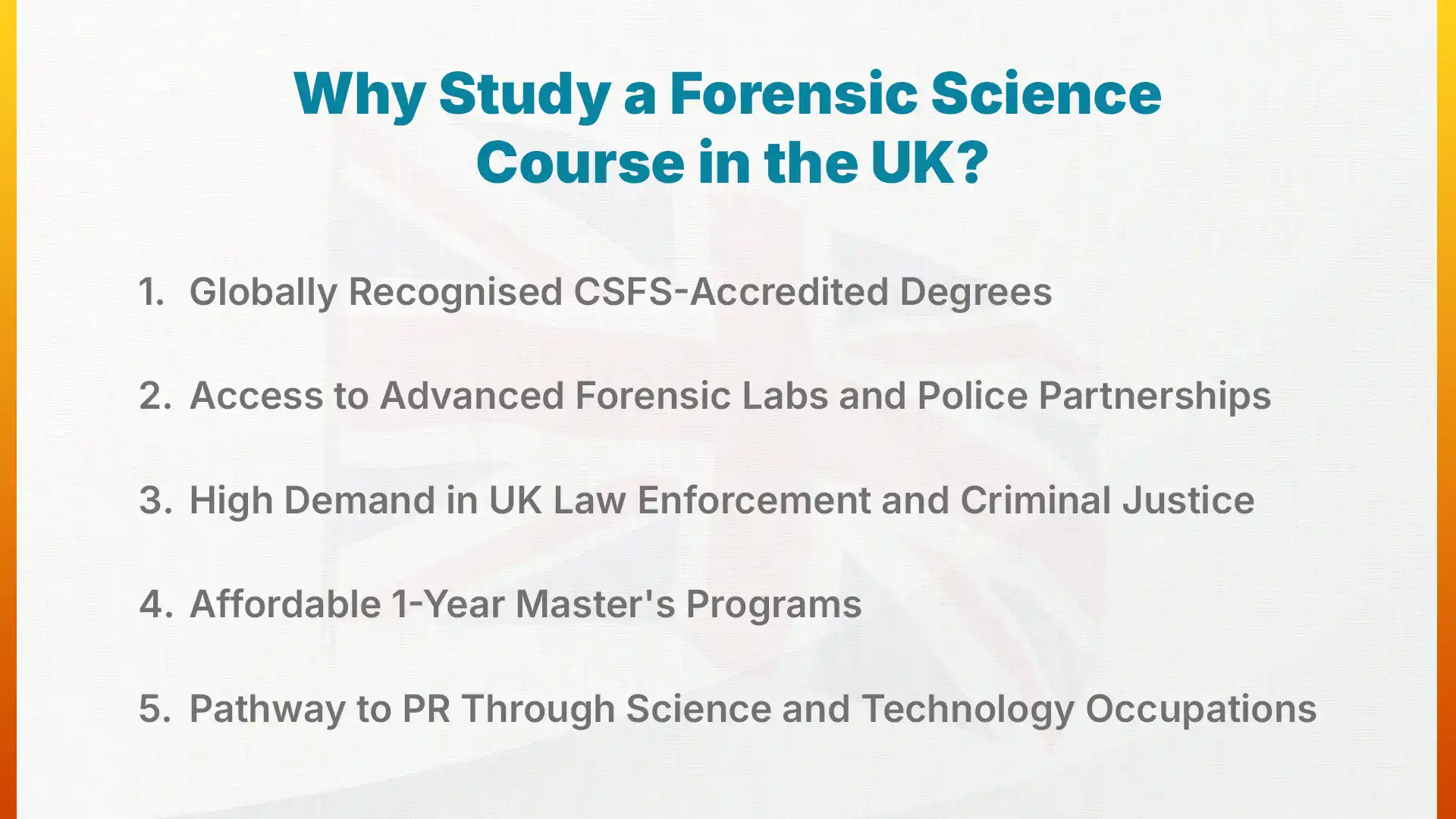
The UK is one of the best destinations to study a forensic science course because of its globally recognized CSFS-accredited degrees, access to advanced forensic labs and police partnerships, high demand in UK law enforcement and criminal justice, affordable 1-year master's programs, and a clear pathway to PR through science and technology occupations.
1. Globally Recognised CSFS-Accredited Degrees
UK forensic science programs are developed in close consultation with the Home Office and regional police forces. This ensures the curriculum meets real-world legal standards, making your degree highly respected by law enforcement agencies globally, including Interpol and local Nepali police departments.
2. Access to Advanced Forensic Labs and Police Partnerships
UK universities invest heavily in purpose-built crime scene houses, dedicated ballistics labs, and state-of-the-art DNA sequencing equipment. Students regularly process mock crime scenes, giving them hands-on experience that is impossible to replicate in a traditional classroom setting.
3. High Demand in UK Law Enforcement and Criminal Justice
The UK has a highly structured criminal justice system that relies heavily on scientific evidence. There is a consistent demand for trained forensic scientists across federal and local police forensic labs, border force, and government health departments for biosecurity and toxicology testing.
4. Affordable 1-Year Master's Programs
While offering world-class forensic facilities, UK master’s degrees are only 1 year long compared to the 2-year programs in Australia or the USA. This intensive structure significantly reduces your overall tuition and living expenses, allowing you to enter the UK workforce a full year earlier.
5. Pathway to PR Through Science and Technology Occupations
Forensic scientists, forensic toxicologists, and life science professionals are consistently listed on the UK’s Shortage Occupation List. Graduates with a UK forensic degree and local laboratory experience are well-positioned to apply for state-nominated or independent skilled migration visas.
Which Are the Top Universities and Colleges for Forensic Science in the UK?
The top universities for a forensic science course in the UK include the University of Strathclyde, King's College London, and the University of Kent, all offering world-leading facilities and strong police partnerships. If you want to compare these with other global leaders, you can explore the best universities in the UK for Nepalese students for a broader view.
Institution | Location | Program | Duration | Known For |
|---|---|---|---|---|
| University of Strathclyde | Glasgow, Scotland | MSc Forensic Science | 1 Year | Europe's Longest-Running Forensic Science Program; Strong CSFS Accreditation |
| King's College London | London, England | MSc Forensic Science | 1 Year | Top-Tier University; Strong Focus on Analytical and Forensic Chemistry |
| University of Kent | Canterbury, England | BSc / MSc Forensic Science | 3 Years / 1 Year | Fully Equipped Crime Scene House; Excellent Employability Rates |
| University of Liverpool | Liverpool, England | BSc / MSc Forensic Science | 3 Years / 1 Year | Strong Focus on Forensic Genetics, Toxicology, and Digital Forensics |
| Nottingham Trent University (NTU) | Nottingham, England | BSc Forensic Science | 3 Years | Highly Practical Curriculum; Mock Courtrooms for Giving Expert Testimony |
The University of Strathclyde and King's College London are the absolute best choices for students wanting maximum exposure to advanced research and elite networking, while Kent and NTU are excellent for students wanting maximum hands-on crime scene practice.
What Are the Admission Requirements?
The admission requirements for a forensic science course in the UK include strong academic results in chemistry and biology, an IELTS score of 6.0 to 6.5 overall, a technically focused personal statement, and proof of funds for the UK student visa.
1. Academic Requirements
For undergraduate programs, Nepalese students need Plus Two Science with strong marks in chemistry and biology (typically 60% to 75% overall). For postgraduate programs, a relevant bachelor's degree in science, health, or law is required, usually with a minimum GPA equivalent to a second-class lower (55% to 60%).
2. English Language Requirements
Science programs demand strong English skills so international students can safely comprehend complex laboratory manuals and accurately write reports for legal proceedings. If you need help reaching the required scores, joining the best IELTS preparation classes in Nepal is a proven way to secure the band score your target university demands.
Test | Undergraduate | Postgraduate |
|---|---|---|
| IELTS Academic | 6.0 – 6.5 Overall | 6.5 Overall (Min 6.0 in All Bands) |
| TOEFL iBT | 79 – 90 | 90 – 100 |
| PTE Academic | 54 – 58 | 62 – 65 |
3. Personal Statement
UK universities use the SOP to assess your genuine interest in criminal justice. Your essay should explain why you are drawn to forensic science, your attention to detail, any relevant science projects, and your understanding of the ethical responsibilities of the role. You can use the proven SOP format for the UK to structure your application perfectly.
4. Financial Proof and Visa Documentation
To meet the requirements to study in the UK from Nepal, you must demonstrate sufficient funds to cover your first year's tuition and at least 9 months of living costs in your bank account to secure the student visa.
How to Apply for a Forensic Science Course in the UK?
Applying for a forensic science course in the UK involves five steps: shortlisting institutions, preparing your academic and financial documents, writing your statement of purpose, submitting your application, and receiving your offer to apply for a study permit. Checking intakes in the UK early is essential to avoid missing the September or January application windows.
Step 1: Shortlist Institutions
Compare programs based on CSFS recognition, curriculum focus (e.g., forensic biology vs. forensic chemistry), location, and tuition fees. Be sure to check if the program includes mandatory mock crime scene practicals, as hands-on exposure is critical in this discipline.
Step 2: Prepare Documents
Gather your Plus Two or degree transcripts, IELTS/PTE scores, a valid passport, CV/resume, and academic reference letters. If you have completed specific biology or chemistry lab research, include certificates to significantly boost your profile. Ensure all your academic transcripts are officially translated into English and notarized if they are in a different language.
Step 3: Write Your SOP
Tailor your Statement of Purpose to each specific UK university, highlighting how their forensic facilities or police partnerships align with your desire to work in criminal justice. Also, mention your awareness of the ethical standards required in forensics and how you plan to maintain objectivity in high-pressure investigations.
Step 4: Submit Application
For bachelor's degrees, apply through the centralized UCAS portal. For master's degrees, apply directly through the university’s international application portal. Apply early, ideally by December or January, for the September intake. Keep a dedicated folder for your application IDs, passwords, and correspondence to ensure you don't miss any deadline updates or interview invitations.
Step 5: Receive Offer and Apply for Study Permit
Once you receive an unconditional offer letter and pay your deposit, you will receive a CAS (Confirmation of Acceptance for Studies) letter. Use this CAS letter to apply for the UK Student Visa, ensuring your financial documents are perfectly prepared to avoid any delays. Remember that you must also pay the Immigration Health Surcharge (IHS) as part of your visa application to access the UK's National Health Service during your studies.
How Much Does It Cost to Study Forensic Science in the UK?
The cost to study a forensic science course in the UK requires an estimated total budget of GBP 30,000 to GBP 50,000 per year, covering both tuition fees and living expenses. Budgeting is easier when you know what to expect, which is why it is so important to research how much it costs to study in the UK before making your final decision.
Program | Annual Tuition (GBP) | Annual Tuition (NPR approx.) |
|---|---|---|
| BSc Forensic Science | GBP 18,000 – GBP 25,000 | NPR 3,330,000 – NPR 4,625,000 |
| MSc Forensic Science | GBP 20,000 – GBP 30,000 | NPR 3,700,000 – NPR 5,550,000 |
Monthly living expenses range from GBP 900 to GBP 1,800, depending on whether you live in London or in more affordable student cities like Canterbury, Liverpool, or Glasgow. Nepalese students are allowed to work 20 hours per week during term time to help offset these living costs.
Taking tuition and living expenses together, Nepalese students should budget approximately GBP 30,000 to GBP 50,000 per year in total.
What Scholarships Are Available?
Scholarships for a forensic science course in the UK include fully funded government options like Chevening and Commonwealth, as well as GREAT Scholarships and university-specific merit awards for high-achieving science students.
Chevening Scholarships: Fully funded UK government scholarships covering full tuition, living expenses, and travel for outstanding Nepalese professionals pursuing a 1-year MSc in Forensic Science.
GREAT Scholarships: Jointly funded by the UK government and participating universities, offering GBP 10,000 towards tuition fees for postgraduate students in STEM subjects.
Commonwealth Scholarships: For students from developing Commonwealth nations like Nepal, covering full tuition, travel, and living allowances for master's programs in science.
University Merit Scholarships: Many UK science faculties offer automatic fee reductions of GBP 2,000 to GBP 5,000 per year for high-achieving international students based on their academic transcripts.
What Jobs Can You Get After Forensic Science in the UK?
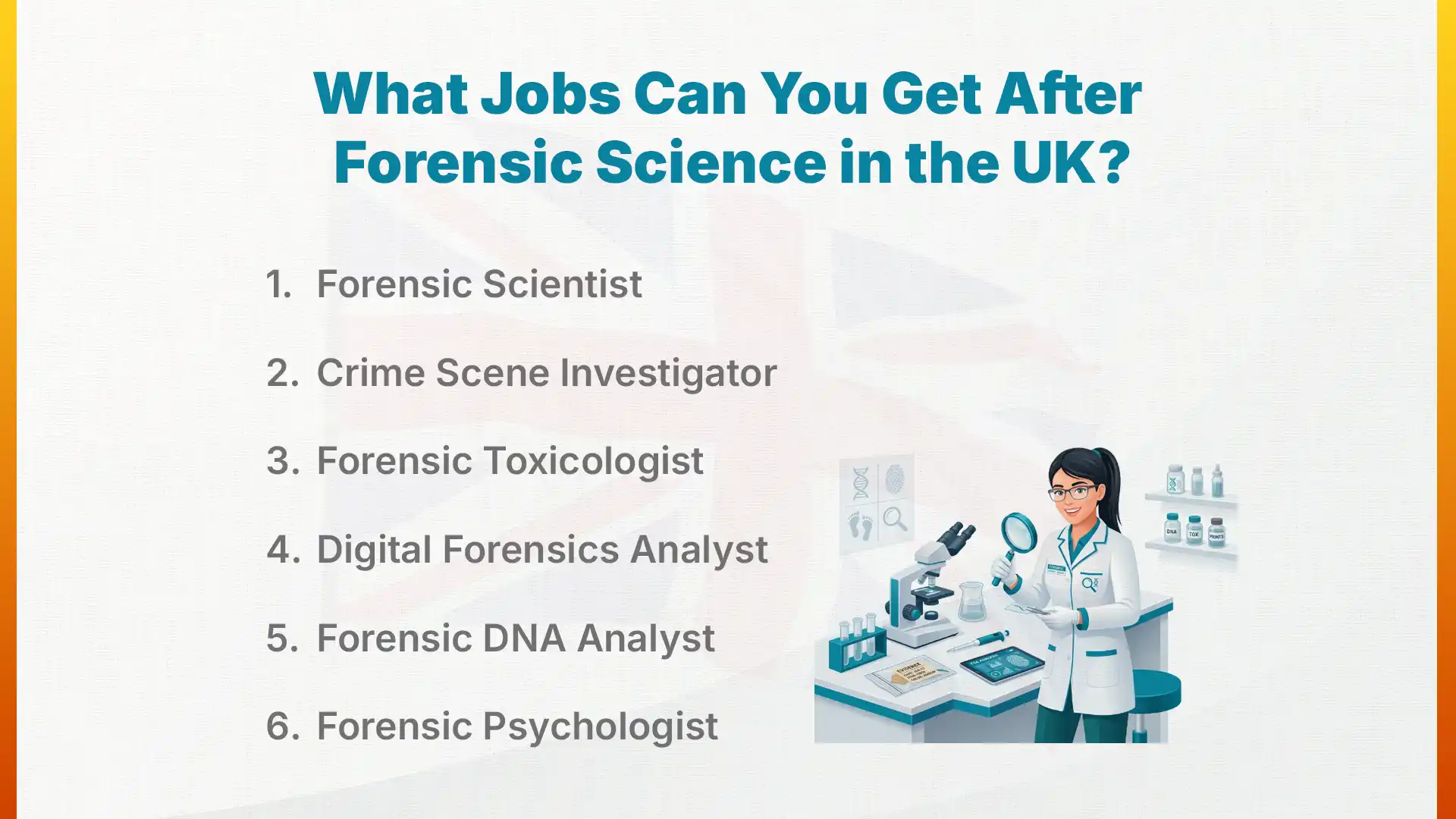
Graduates of a forensic science course in the UK can secure roles such as forensic scientist, crime scene investigator, forensic toxicologist, digital forensics analyst, forensic DNA analyst, and forensic psychologist across law enforcement, government, and private sectors.
1. Forensic Scientist
Forensic scientists analyze physical evidence collected from crime scenes, such as hair, fibers, and weapons, in a laboratory setting. They write detailed reports on their findings and are often called to testify as expert witnesses in court. This is the most versatile professional outcome, offering a stable foundation to specialize in biology, chemistry, or toxicology.
2. Crime Scene Investigator
Crime scene investigators are responsible for securing, documenting, and collecting physical evidence directly at crime scenes. They must meticulously photograph scenes, sketch layouts, and ensure the strict chain of custody is maintained so that evidence remains legally admissible.
3. Forensic Toxicologist
Forensic toxicologists analyze bodily fluids and tissues to detect the presence of drugs, alcohol, poisons, or other harmful substances. They play a critical role in determining causes of death in suspicious circumstances or in driving-under-the-influence criminal cases.
4. Digital Forensics Analyst
Digital forensics analysts specialize in recovering and investigating data found on digital devices, such as computers, smartphones, and hard drives. With the rise in cybercrime, this is one of the fastest-growing specializations in the UK forensic sector.
5. Forensic DNA Analyst
DNA analysts extract, quantify, and compare DNA profiles from crime scene evidence. They run highly sensitive PCR and sequencing equipment to match biological samples to suspects or victims, providing some of the most conclusive evidence used in modern criminal trials.
6. Forensic Psychologist
Forensic psychologists apply psychological principles to the criminal justice system, assessing the mental state of suspects, evaluating witness credibility, and developing criminal profiles. This role typically requires further postgraduate study in psychology beyond a standard forensic science degree.
What Is the Salary and Scope After Forensic Science in the UK?
The salary after a forensic science course in the UK ranges from GBP 25,000 to GBP 30,000 at entry-level, rising to GBP 45,000 or more for senior scientists, with a highly streamlined PR pathway via the Graduate Route and Skilled Worker visas. Forensic science is one of the best courses in the UK for Nepalese students looking for a stable, specialized science career.
Experience Level | Annual Salary (GBP) | Annual Salary (NPR approx.) |
|---|---|---|
| Entry-Level (0–2 Years) | GBP 25,000 – GBP 30,000 | NPR 4,625,000 – NPR 5,550,000 |
| Mid-Level (2–5 Years) | GBP 30,000 – GBP 45,000 | NPR 5,550,000 – NPR 8,325,000 |
| Senior Forensic Scientist (5+ Years) | GBP 45,000 – GBP 65,000+ | NPR 8,325,000 – NPR 11,700,000+ |
After completing your degree, you can apply for the Graduate Route visa, which allows you to stay and work in the UK for 2 years (3 years for PhD graduates) without needing a job offer.
Life science professionals, including forensic scientists and toxicologists, are consistently on the UK's Shortage Occupation List.
Most Nepalese forensic science graduates with a UK degree and 1 to 2 years of local work experience accumulate enough points to receive an Invitation to Apply (ITA) for the Skilled Independent Visa (189) or State Nomination (190), leading directly to permanent residency.
Conclusion
A forensic science degree in the UK guarantees a highly specialized global career and a fast PR pathway through the country's critical shortage of qualified laboratory professionals. The cost of not using expert guidance includes choosing the wrong non-accredited university, facing visa refusals due to documentation errors, and significantly delaying your PR timeline.
Interested in studying a forensic science course in the UK? Contact SAS Education Consultancy for a free counseling session and let us help you find the right program, prepare a strong application, and navigate the UK Student Visa process with confidence.