Business Course in Canada: Fees, Requirements & Universities

Jun 11, 2026

If you’re dreaming of building a career in management, finance, analytics, or entrepreneurship, Canada has become one of the most promising places to begin that journey. The vibrant campuses of Toronto or Vancouver, interactive business classes, real-world projects, and meeting future leaders from around the world. Are you ready to aim higher and take that leap toward global opportunities?
Studying the right program abroad often comes with confusion. The common but important questions. Which course will give you the skills you need? How much will it cost? What are the eligibility requirements? How to apply for a Canadian student visa? These questions often make the path seem overwhelming, even before you begin.
In this guide, you’ll find everything you need to understand your options: program types, fees, top universities, job prospects, and what it truly takes to apply. By the end, you’ll have a clear roadmap to start your study-abroad journey with purpose and clarity. Let’s walk through it together.
In this blog
What is a Business Course in Canada?
A business course in Canada teaches you how companies operate and make decisions. You learn subjects like finance, marketing, management, and analytics. Programs can be at diploma, bachelor’s, or master’s level, depending on your goals. These courses also focus on practical skills, teamwork, and real-world business experience.
1. Diploma in Business (College Level)
A business diploma is a good choice if you want a shorter program that helps you enter the workforce quickly. It usually takes 1–2 years to complete and focuses on practical subjects like accounting, marketing, and organizational behaviour. You also get hands-on learning through projects and assignments that feel close to real business situations. Many colleges include co-op opportunities, so you can gain Canadian work experience while studying. These programs mostly start in January, May, and September, giving you enough flexibility to plan your study timeline.
2. Bachelor’s in Business (BBA/BCom)
A bachelor’s degree gives you a deeper understanding of how businesses operate. The program takes 3–4 years, starting with core subjects and later letting you choose a specialization like finance, HR, marketing, or analytics. The learning style is a mix of lectures, case studies, group projects, and sometimes co-op terms to help you build practical skills. September is the major intake in Canada for Bachelor’s education. Some UK universities open additional options in January and May as well.
3. Master’s Level (MBA, Master of Management, Master of Finance, etc.)
Master’s business programs in Canada are designed to help you grow into strong, confident leaders. These courses take 12–24 months and focus on strategic thinking, problem-solving, and real-world decision-making. You learn through case studies, teamwork, industry projects, and sometimes a final capstone project that tackles a real business challenge. Intakes vary by university, but most programs accept students in September and January.
Book a FREE 1-on-1 Consultation
Which Business Course is Best in Canada?
The major business courses in Canada include BBA, MBA, Business Analytics, and Master’s in Management or Finance. The best course for you depends on your career goals, interests, and level of study. BBA is ideal for undergraduates starting their business journey, while MBA and specialized master’s programs suit those seeking advanced knowledge. Business Analytics is great if you enjoy working with data to make business decisions.
1. Business Management Courses in Canada
Business Management programs in Canada teach you how companies run, make decisions, and grow in a competitive market. These courses are great for students who want leadership roles or dream of managing teams in the future. You learn subjects like marketing, finance, human resources, and organizational behavior in a practical way. Many colleges also offer co-op options, so you gain real work experience while studying. The duration is usually 1–2 years for diplomas, 3–4 years for bachelor's, and 1–2 years for postgraduate programs. It’s a strong choice because Canadian employers value graduates who have hands-on business training and communication skills.
2. Business Analytics in Canada
Business Analytics programs focus on using data to help companies make smarter decisions. You learn how to collect, analyze, and interpret business data using tools like Excel, SQL, R, and Python. This course suits students who enjoy problem-solving and want careers in data-driven roles. In class, you work with real case studies, which makes learning practical and easy to understand. The duration is usually 1 year for certificates, 1–2 years for postgraduate programs, and 3–4 years for bachelor’s levels. Canada is a great place for this course because almost every industry here, be it finance, retail, tech, or health, needs skilled data analysts.
3. BBA in Canada
A Bachelor of Business Administration (BBA) gives you a strong foundation in all major areas of business. You study subjects like finance, accounting, marketing, management, and entrepreneurship. This course is perfect for students who want a broad understanding of business before choosing a specialization. Canadian BBA programs focus on teamwork, real business projects, and communication skills, making learning more practical than theory-heavy. The duration is usually 4 years, with some accelerated programs finished in 3 or 3.5 years. It’s a great option because Canadian universities offer high-quality learning and strong career support for BBA graduates.
4. Master’s in Business and Management Programs
Master’s programs like MBA or Master of Management help you build advanced business knowledge and leadership skills. These courses are ideal for students who want higher-level roles or want to level up their career after a BBA or other bachelor's degree. You learn strategy, operations, analytics, global business, and more. The learning style includes case studies, presentations, group work, and industry projects that mirror real business situations. The duration is usually 12 months to 2 years, depending on the program. Canada is popular for master’s programs because graduates are highly employable and often earn competitive salaries.
5. Common BBA Subjects in Canada
Most BBA programs in Canada follow a similar set of core subjects to help students understand every part of business. You study courses like accounting, economics, business law, marketing, finance, and organizational behavior. These subjects help you build strong problem-solving, communication, and leadership skills. Some programs also include co-op or internship terms to connect your classroom learning with real work experience. The duration for studying these subjects spans the entire 3–4 year BBA program. These subjects make your degree versatile, so you can work in almost any business sector after graduation.
Eligibility Requirements to Study Business in Canada
To study business in Canada, you need to meet academic, language, and financial requirements. For undergraduate programs like BBA, you usually need a strong high school record and sometimes prerequisite subjects in math or business. For master’s programs, a bachelor’s degree in business or a related field is required, along with a competitive GPA. You also need proof of English proficiency through tests like IELTS, TOEFL, or PTE, and documents showing you can cover tuition and living expenses.
1. Academic Requirements for BBA and Business Management
To study BBA or business management at the bachelor’s level, students generally need to complete Class 12 with at least 55–65%, depending on the university or college. Some programs may prefer students with mathematics or business studies in high school, but many accept students from any stream.
Colleges offering diplomas or advanced diplomas are usually more flexible, making them a good option if your grades are slightly lower. Overall, the goal is to show that you can handle university-level coursework in subjects like communication, math, and critical thinking.
2. Eligibility for Master’s and Postgraduate Business Programs
For master ’s-level programs like MBA, Master of Management, or Master of Finance, you need a bachelor’s degree with a minimum of 60–70%. Some universities also ask for work experience, especially for MBA programs. However, many Master of Management programs accept fresh graduates as well. You might also be asked to submit a resume, statement of purpose, and academic references. These documents help universities understand your goals and readiness for advanced business studies.
3. English Language Requirements (IELTS, TOEFL, PTE)
Because Canada teaches most business programs in English, you must show language proficiency. Here are the common score requirements:
- IELTS: 6.0–6.5 overall (no band below 6.0 for most programs)
- TOEFL: 80–90 overall
- PTE: 58–65 overall
Some competitive programs may ask for slightly higher scores, especially at the graduate level. Strong English skills help you succeed in presentations, reports, and group work.
Join the Best IELTS Classes in Kathmandu!
4. Financial Proof and Documentation
To secure admission and a study permit, you must show that you can cover your tuition fees and living costs. This includes:
- Proof of funds for one year of expenses
- Bank statements or education loan letters
- Guaranteed Investment Certificate (GIC) of CAD 20,635 for SDS applications
- Tuition payment receipts or fee statements
These documents assure the Canadian government that you can support yourself without financial hardship.
5. Additional Admission Requirements for International Students
Besides academic results and English scores, many institutions also request:
- Statement of Purpose (SOP for Canada) explaining your goals
- Letters of Recommendation from teachers or employers
- Resume or CV for graduate programs
- Portfolio (only if you're applying for specialized business fields like design management)
- Interview, which some universities conduct to understand your motivation
These extra steps help them select students who are committed, prepared, and ready to grow in a competitive study environment.
How Much Does It Cost to Study Business in Canada?
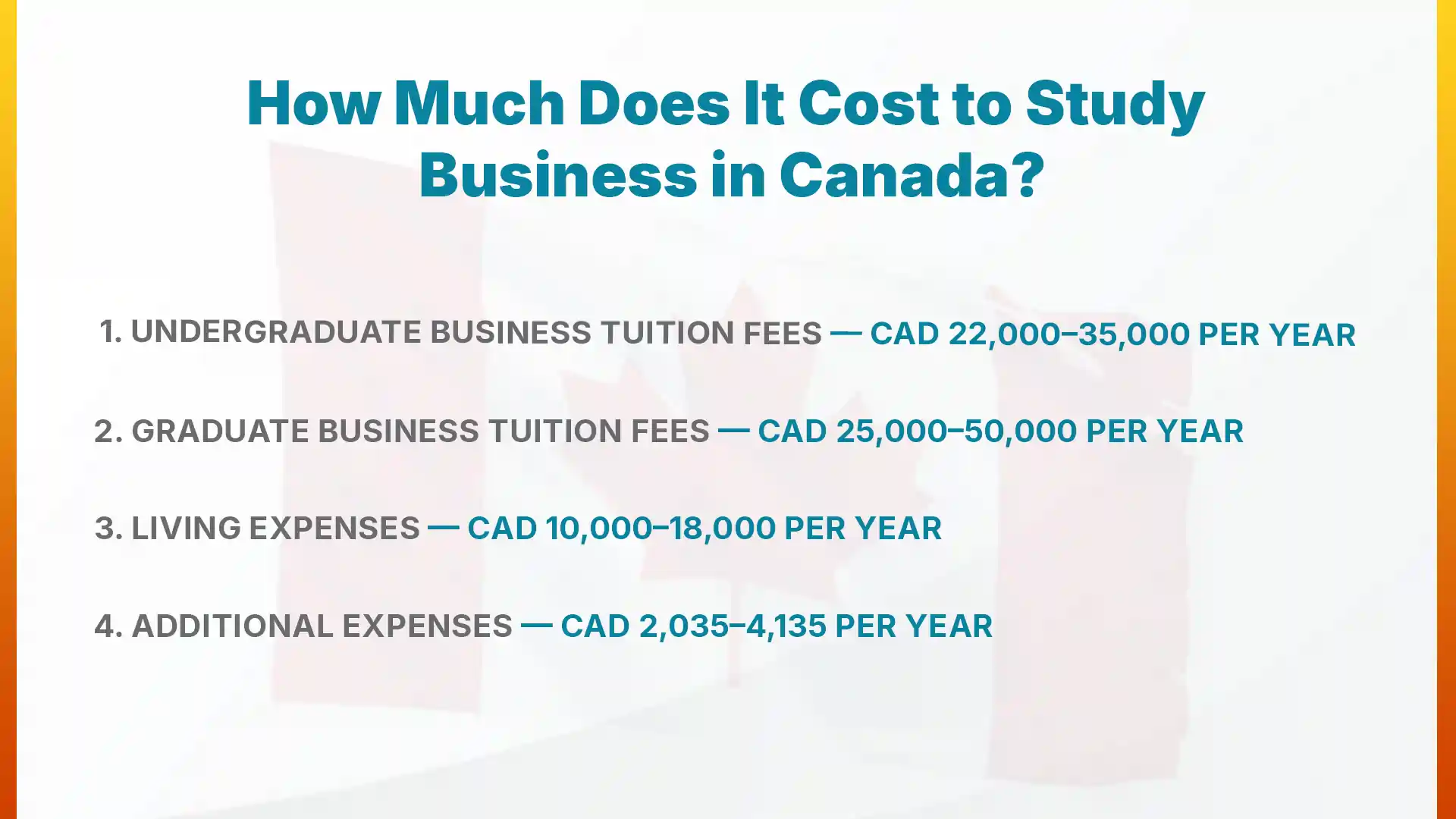
Undergraduate business programs usually range from CAD 22,000 to 35,000 per year. Graduate programs, such as MBA or Master’s in Management, typically cost CAD 25,000 to 50,000 per year. In addition, living expenses for international students are around CAD 10,000 to 18,000 per year, with extra costs like books, supplies, and health coverage adding CAD 2,035 to 4,135 per year. The total cost of studying in Canada for business students varies by program and level, but these are the general estimations:
1. Undergraduate Business Tuition Fees
Undergraduate business programs in Canada usually cost CAD 22,000–35,000 per year. Big universities in cities like Toronto or Vancouver are on the higher side, while smaller or regional universities are often cheaper. Programs with co-op or internships may cost a bit more but give useful work experience.
2. Graduate Business Tuition Fees
Graduate programs like MBA, Master of Management, or Master of Finance in Canada usually cost CAD 25,000–50,000 per year. The price depends on the program, university, and duration. Programs with projects, internships, or special modules can be more expensive but offer great career benefits.
3. Living Expenses
International students usually spend CAD 10,000–18,000 per year on living costs. This includes rent, food, transport, phone bills, and daily needs. Costs are higher in big cities and lower in smaller cities.
4. Additional Expenses
Students also spend CAD 2,035–4,135 per year on things like books, study materials, health insurance, and student fees. You may also need extra money for winter clothes, travel, or other small expenses.
5. Scholarships and Financial Aid Options for Business Students
Many Canadian universities and colleges offer scholarships for international students, including those studying business. These awards can cover part or all of your tuition and are often based on academic excellence, leadership, or financial need. Some scholarships are considered directly on admission, while others require a separate application. Research early and understand the requirements.
Government programs and private foundations may also provide financial support, especially for students showing strong potential or community involvement. Begin by building a scholarship mindset. Prepare documents, maintain good grades, and highlight your achievements. Studying in Canada with a scholarship can significantly reduce your study costs and make your business education in Canada much more affordable.
Best Business Schools and Universities in Canada (2026)
Some of the best business schools in Canada in 2026 include University of Toronto, McGill University, University of British Columbia, and University of Alberta. These schools are known for high-quality teaching and strong business programs. They offer opportunities for internships, co-ops, and real-world projects. Graduates from these universities often have good job prospects in Canada and internationally. Here are some top Canadian universities and their 2026 QS World University Rankings global ranks:
University | QS Global Ranking 2026 |
| University of Toronto | 33 |
| University of British Columbia | 49 |
| McGill University | 60 |
| Western University | 86 |
| Université de Montréal | = 108 |
| University of Alberta | = 149 |
Career Scope and Salary After Business Courses in Canada
Business graduates in Canada can work in finance, marketing, HR, operations, and business analytics. Entry-level salaries usually range from CAD 60,000 to 75,000, and experienced professionals can earn CAD 70,000 to 90,000 or more. Many graduates also use the Post-Graduation Work Permit to gain Canadian work experience and qualify for permanent residency.
1. BBA Scope in Canada
Business-related fields remain among the most popular for international students in Canada. Recent data from Immigration, Refugees and Citizenship Canada (IRCC) shows that between 2018 and 2023, the largest share of study permits issued fell under business, economics, and information technology. The number ranged from about 316,000 to 428,000. This shows many students choose business courses, signaling steady demand and trust in the value of business education in Canada.
With so many students entering these fields, there is both healthy competition and widespread opportunity. After graduation, many international students use the open-work permit program to begin working. This allows them to gain Canadian work experience without needing a job offer.
2. Job Opportunities After Studying Business in Canada
Graduates with a business background often find jobs in areas like business or data analysis, marketing, human resources, finance, operations management, and consulting. Among these, roles such as business analyst, operations associate, or marketing coordinator are frequently listed. Because business degrees combine management knowledge with communication and analytical skills, international students are often competitive. Those who supplement academics with an internship or co-op experience have an even higher chance of securing good roles.
For students graduating recently, the Post-Graduation Work Permit Program (PGWP) provides a clear route to stay and work in Canada. According to IRCC, in 2023, nearly 400,000 people held a PGWP, marking a 35 per cent increase in permits issued.
3. Salary of Business Graduates in Canada
Salaries vary depending on the city, role, and company, but business graduates often start with reasonable pay. Roles such as business or data analyst, which are common among business-course graduates, tend to offer salaries around CAD 60,000 to 75,000 at the entry level. With some experience, salaries can grow considerably. Many mid-level professionals with two to five years of experience report incomes between CAD 70,000 and 90,000 or more, especially if they specialize in finance, analytics, or management.
Specialized business fields tend to pay more because they combine business understanding with analytical or technical skills, which are increasingly in demand across industries.
4. PR Pathways After Business Courses
One major advantage of studying business in Canada is the opportunity to build toward permanent residency. After graduation, you can use PGWP to gain Canadian work experience for one to three years, depending on your program. This work experience is a strong foundation for immigration pathways.
Business graduates may work in roles such as management, finance, analytics, or operations, many of which are considered skilled occupations. This often allows them to qualify under skilled-worker immigration programs. Stable employment and Canadian experience can make permanent residency a realistic goal over time.
Conclusion
Choosing the right business course in Canada is an important step for your future. With so many options, from BBA to MBA and specialized programs, it can feel overwhelming. But with careful planning, research, and the right guidance, you can make a choice that fits your interests, career goals, and lifestyle.
Canadian business programs not only provide quality education but also offer practical learning through internships and co-op opportunities. These experiences help you gain skills, build your resume, and open doors to exciting career paths. The growing demand for business graduates and the strong pathways for work and permanent residency make Canada an attractive choice for international students.
Working with an experienced consultancy in Nepal for Canada can help you understand program requirements, plan your finances, and prepare for applications. With proper guidance, you can navigate the admission process confidently and focus on building your future. Studying business in Canada is not just an academic step; it is a step toward global opportunities, professional growth, and long-term settlement.