What is Letter of Recommendation (LOR) for Studying Abroad?

Dec 18, 2025

Have you ever wondered why students with similar grades get very different admission or scholarship results? Your visa success while studying abroad really depends on your academic profile and application strategies. However, one major reason is the Letter of Recommendation (LOR).
A Letter of Recommendation is a formal letter written by your teacher, professor, or supervisor that explains your academic ability, character, and potential. It helps universities and scholarship committees see you beyond marks and test scores.
Many students search for LORs because they feel stuck. Who should write it? What should it include? How important is it really? A weak or poorly planned LOR can quietly hurt your application, even if the rest of your profile is strong. On the other hand, a well-written LOR can strengthen your chances and make your application stand out.
That’s why understanding LORs is so important for your success as an international student. This guide breaks everything down clearly. Learn what a recommendation letter is for a Nepali student, why you need it, why do universities ask for it, and how you can apply with a strong SOP!
In this blog
What is a Letter of Recommendation?
A Letter of Recommendation (LOR) is an official letter written to support your application, where a teacher, professor, or supervisor explains your academic ability, skills, and personal qualities based on their experience with you. It helps universities and scholarship committees understand you beyond marks and certificates.
For international applications, a LOR is especially important because admissions teams may not be familiar with your school, grading system, or academic environment. So, they use this letter to see how you perform in class, how you learn, and how you compare with other students.
Most importantly, a strong LOR can influence your admission or scholarship decision. While your SOP (Statement of Purpose) tells your story in your own words, a recommendation letter confirms your strengths through a trusted third party. This makes your application more credible and convincing.
Types of Letters of Recommendation
There are three main types of Letters of Recommendation used for study abroad applications: Academic LOR, Professional or Work LOR, and Character or Personal LOR. Each type serves a different purpose, and understanding the difference helps you choose the right recommender.
1. Academic LOR
An academic LOR is written by a teacher, lecturer, or professor who has taught you directly. It focuses on your academic performance, learning ability, discipline, and classroom involvement. The recommender may also mention your projects, exams, or research work. This type of LOR is most important for undergraduate, Master’s, and PhD applications. In fact, most universities abroad prefer academic LORs over other types.
2. Professional or Work LOR
A professional LOR is written by an employer, supervisor, or manager. It highlights your work skills, responsibility, teamwork, and professional attitude. This letter is useful if you have job experience or are applying for programs like MBA or professional courses. It helps universities see how you perform in real-world environments. Many graduate programs accept one professional LOR along with academic ones.
2. Character or Personal LOR
A character LOR focuses on your personal qualities, values, and behavior. It is usually written by a mentor, coach, or community leader who knows you well. This type of LOR does not focus much on academics or work performance. Because of this, it is less commonly accepted for university admissions. However, it may be useful for special scholarships, volunteer programs, or community-based applications.
In this guide, we mainly focus on academic and professional Letters of Recommendation. These are the most commonly required for university admissions and scholarship applications abroad, and they play the biggest role in strengthening a student’s profile.
Why Letters of Recommendation Are Important?
The main purpose of a Letter of Recommendation is to support your application with honest feedback from someone who knows you well. It helps universities and scholarship committees understand your abilities through a trusted third person, not just your own words. From an admissions point of view, a LOR validates your academic skills, achievements, and learning attitude. For scholarships, it also shows your character, discipline, and potential to grow. Most importantly, a strong LOR can set you apart from other applicants with similar grades and test scores.
Who Needs a Letter of Recommendation?
Letters of Recommendation are required for many types of students applying abroad. High school students need them for undergraduate programs and foundation courses. College transfer students often need LORs to explain their academic progress and consistency. Graduate students applying for Master’s or PhD programs usually need strong academic or research-based LORs. In addition, most scholarship applicants must submit recommendation letters to prove merit, credibility, and long-term potential.
How Many LORs Do You Need?
The number of Letters of Recommendation you need depends on the level of study and the type of application. Most undergraduate programs usually ask for 1 to 2 LORs, mainly from school teachers. Graduate programs (Master’s or PhD) typically require 2 to 3 LORs, preferably from professors or academic supervisors. If you have work experience, it is better to have professional LORs from your employers too. For scholarship applications, the requirement is often 1 to 3 LORs, depending on the scholarship type and competitiveness. Always check the exact requirement on the university or scholarship website, as it can vary.
Where Will You Submit Your Letters of Recommendation?
In most cases, Letters of Recommendation are submitted online. Universities usually collect LORs through their application portals, where your recommender uploads the letter directly. Scholarship programs may use their own scholarship platforms or forms for submission. In some cases, LORs are sent through email or provided as sealed physical copies, especially for embassy, school, or specific institutional requirements.
Letter of Recommendation Format for Students
A professional Letter of Recommendation (LOR) follows a clear structure, making it easy for universities or scholarship committees to read and trust. The standard format includes Heading/Greeting, Introduction, Body, and Conclusion.
1. Heading / Greeting
The heading usually contains the date and, if available, the institution’s name, address, and contact information (letterhead). It establishes authenticity and professionalism. After the heading, the letter begins with a greeting, such as:
- “To the Admissions Committee,”
- “To Whom It May Concern,”
- “To the Scholarship Committee,”
or a specific program/scholarship title if known.
The greeting sets the tone for the letter and addresses the right audience directly.
2. Introduction
The introduction should start with the recommender introducing themselves, their position, and their relationship with the student. They should mention how long they have known the student and in what capacity (e.g., teacher, mentor, supervisor). This sets credibility and context for the rest of the letter.
3. Body
The body is the main part of the LOR. Here, the recommender should highlight the student’s academic abilities, skills, achievements, and personal qualities. Specific examples work best, such as projects, research work, presentations, or leadership roles. If the student is applying for scholarships, the letter can also emphasize qualities like responsibility, discipline, teamwork, and motivation. The body should clearly show why the student stands out and is a good fit for the program or opportunity.
4. Conclusion
The conclusion summarizes the recommender’s overall opinion of the student. It should clearly recommend the student for admission or scholarship and provide confidence in their potential to succeed. The letter usually ends with the recommender’s name, designation, institution, contact details, and date, sometimes on official letterhead.
Recommended Length and Style for International Applications
For international applications, a strong LOR should be concise, clear, and professional. Ideally, it should be one page long, around 300–400 words. The tone should be formal but supportive, showing genuine knowledge of the student’s abilities without exaggeration. Avoid overly casual language or unnecessary filler.
The style should focus on:
- Clarity: Easy to read, with short paragraphs and simple sentences.
- Specific examples: Concrete achievements or incidents that demonstrate the student’s skills.
- Positive but honest tone: Praise should be believable, not generic.
A well-formatted and properly written LOR immediately builds credibility and gives international admissions committees confidence in the applicant.
Letter of Recommendation Best Practices: Dos and Don’ts
Writing an effective LOR requires careful attention. Following the right practices can make your letter stand out, while mistakes can weaken it. Here are some key tips for writing a strong recommendation letter.
Dos | Don’ts |
| Provide context: explain your relationship with the student | Avoid vague language: “very good student” without examples |
| Highlight achievements: academic, skills, leadership, projects | Avoid generic praise: make it specific and meaningful |
| Include specific examples to showcase strengths | Never plagiarize: do not copy from other letters |
| Be honest and positive without exaggeration | Don’t include irrelevant information: stay focused on application needs |
| Keep the letter structured, clear, and professional | Avoid overly casual tone: maintain formal, professional style |
Sample Letters of Recommendation for International Applications
To help you understand what a strong LOR looks like, this section provides realistic examples for different types of applications. These samples show how teachers, mentors, or supervisors can present your academic abilities, achievements, and personal qualities in a professional and effective way.
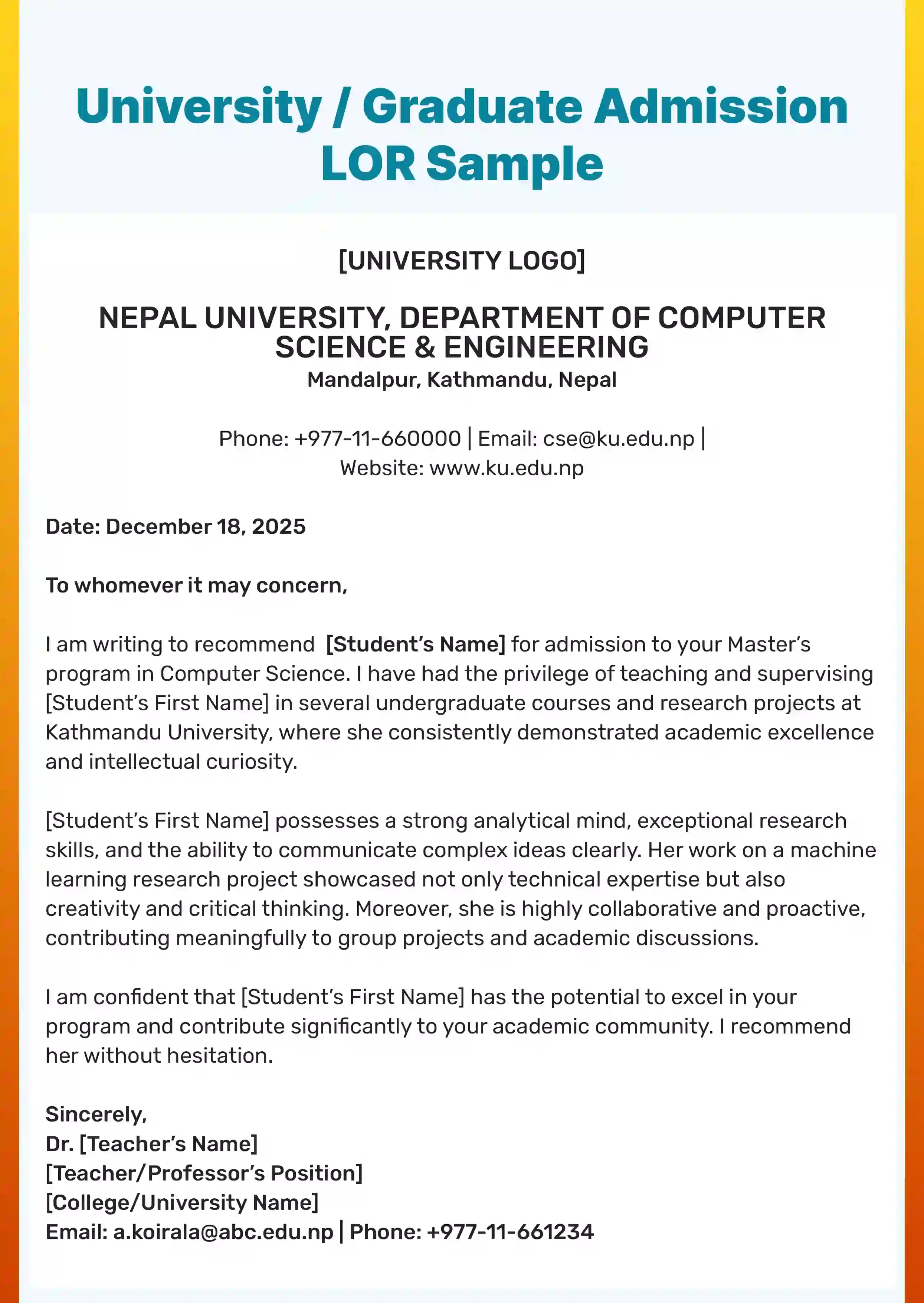
1. University Admission Letter of Recommendation Sample
This sample is for graduate or university applications. It highlights academic performance, research skills, and professional accomplishments, illustrating how a recommender can present a student’s preparedness and suitability for advanced study or specialized programs.
2. Letter of Recommendation Sample for College Admission
This sample demonstrates how a teacher can highlight a high school student’s academic excellence, extracurricular involvement, and personal qualities. It shows how to balance achievements with character insights, giving admissions committees a clear picture of the student beyond grades.
[LOGO]
[School Name]
[School Address]
Phone: [School Phone] | Email: [School Email] | Website: [School Website]
Date: [Date]
To the Admission Committee,
I am delighted to recommend [Student Name] for admission to your undergraduate program. I have known her for the past [number of years] as her [subject] teacher at [School Name], and I have closely observed her academic growth, leadership qualities, and dedication to learning.
[Student Name] consistently demonstrates intellectual curiosity and a strong work ethic. She excels in her coursework, maintains high academic standards, and actively participates in class discussions. Beyond academics, she has been an active member of [clubs, projects, or activities], where she has shown excellent teamwork, creativity, and leadership. Her kindness, integrity, and willingness to support her peers make her a respected and admired student within our school community.
I am confident that [Student Name] possesses the academic ability, personal character, and motivation required to succeed in your program. I wholeheartedly recommend her for admission and believe she will make meaningful and positive contributions to your university community.
Sincerely,
[Recommender Name]
[Position], [School Name]
Email: [Recommender Email] | Phone: [Recommender Phone]
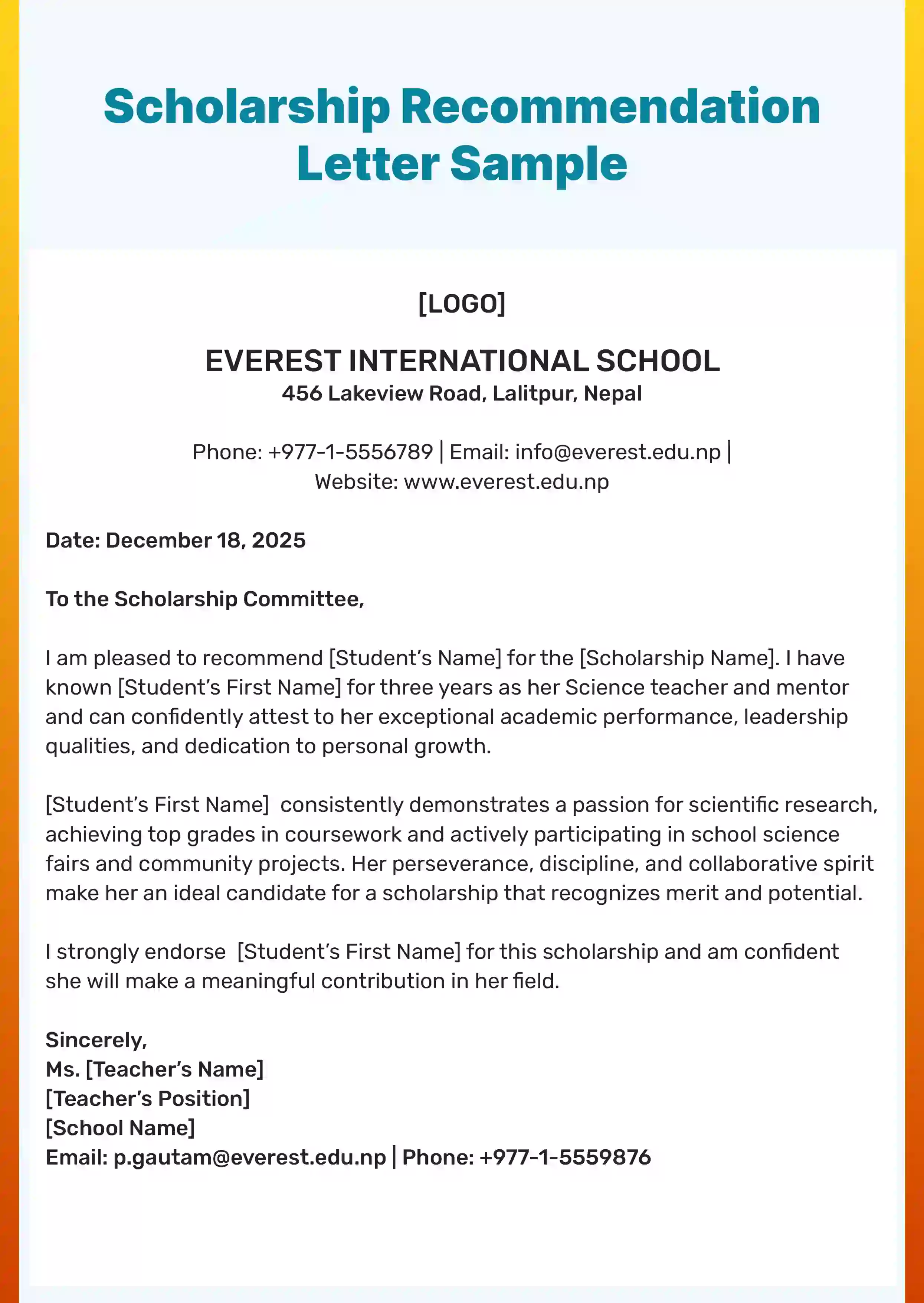
3. Scholarship Letter of Recommendation Sample
This example focuses on a student applying for a scholarship. It emphasizes merit, accomplishments, leadership abilities, and potential, showing how a recommender can make a compelling case for why the student deserves financial support or recognition.
How to Request a Letter of Recommendation from Your Teachers or Employers?
To ask for a Letter of Recommendation from your teachers, professors, or employers, choose someone who knows you well and ask them politely, providing your achievements, resume, and application details. Giving them enough time and clear instructions ensures they can write a strong and thoughtful letter. Here’s a step-by-step guide to help you approach your teachers or mentors confidently and professionally.
1. Choose the Right Recommender
Select a teacher, professor, or mentor who knows you well academically or professionally. Ideally, they should be familiar with your skills, achievements, and character. The stronger their understanding of you, the more persuasive the LOR will be.
2. Ask in Person (or Virtually)
Whenever possible, ask your recommender in person or via a video call. Be polite, clear, and explain why you are requesting the letter. This personal approach shows respect and gives them context about your goals.
3. Share Important Details Clearly
Provide all necessary information to make their job easier:
- Your resume or CV
- A list of achievements, projects, or leadership experiences
- The program, university, or scholarship details
- Your application deadline
4. Give Enough Time
Avoid last-minute requests. Give your teacher at least 3–4 weeks, or more if possible, to write a thoughtful and strong letter. This shows respect for their time and ensures a quality LOR.
5. Communicate Priorities and Preferences
Let your recommender know if there are particular qualities or achievements you want highlighted. Be clear about your goals and what matters most for your application.
6. Follow Up Politely
If the deadline is approaching, send a gentle reminder to check progress. Send them polite mail or hit them with a call. Keep it courteous and professional.
7. Send a Thank You
After submission, always thank your teacher or mentor for their time and support. A written thank you shows appreciation and helps maintain a positive relationship for the future.
This step-by-step approach ensures your request is organized, professional, and increases the chances of getting a strong, supportive LOR.
How to Submit Your Letter of Recommendation for Studying Abroad
To submit your Letter of Recommendation for studying abroad, you can use online portals, email, or physical hard copies depending on the university or scholarship requirements. Make sure your recommender follows the correct format, uses official emails if required, and provides any additional details like application ID or sealed envelopes. Submitting your LOR correctly is just as important as writing a strong one.
1. Online Submission
Most universities and scholarship programs now use online portals. Your recommender usually receives a secure link to upload the letter directly. Sometimes, the portal asks the recommender to answer a few questions or rate you on specific skills, in addition to uploading the letter. It’s a good idea to keep the LOR ready and scanned in the correct format in case the portal requires it. Always check that the submission is confirmed in the portal.
2. Email Submission
Some programs accept LORs via email. In this case, the recommender should send the letter as a PDF from their official email address, including your application ID or program reference in the subject line. Non-official emails are usually not accepted, so make sure the recommender uses their professional email. Follow up politely to ensure the email was received.
3. Hard Copy Submission
Certain institutions still require sealed physical letters. Your recommender should print the letter on official letterhead, sign it, and place it in a sealed envelope. If applying to multiple universities, make sure each institution receives a separate original copy. Include an introductory cover letter if required, clearly stating the program, application number, and recommender details.
Conclusion
A strong Letter of Recommendation is more than just a checklist document for your international education, it is a powerful reflection of your abilities, character, and potential. Throughout this guide, you’ve learned what an LOR is, why it matters, the types and formats, best practices, and even seen real samples. By understanding these details, you are already ahead of many applicants who struggle with this crucial part of their study abroad application.
Now, you are better prepared to approach your recommenders thoughtfully, provide them with the right information, and ensure your letters truly highlight your strengths. Take this knowledge seriously, continue your research, and approach every step of your application with confidence and purpose.
Start planning your LORs today, and give yourself the edge to make your international study dreams a reality.