Study Petroleum Engineering Courses in the UK: Top Universities, Fees & Career Scope

Jul 09, 2026

A petroleum engineering course in the UK offers Nepalese students a globally recognized, specialized degree focused on oil and gas extraction within the context of the evolving North Sea energy sector. The major career and PR problem most Nepali students face is choosing between countries with unclear engineering migration pathways for niche STEM fields, dealing with exceptionally high tuition costs in the US, and navigating complex visa processes alone.
Studying in the UK solves this by providing access to leading energy hubs, strict Energy Institute (EI) and IET-accredited degrees, and a highly defined Graduate Route to Skilled Worker visa migration route. This guide covers the top universities, exact costs, admission steps, and salary expectations for 2026.
In this blog
What Is a Petroleum Engineering Course in the UK?
A petroleum engineering course in the UK is a highly specialized engineering degree focused on the exploration, drilling, and production of hydrocarbons, typically lasting 4 years for an MEng or 1 year for an MSc.
Unlike general civil or mechanical engineering, petroleum engineering has a much heavier focus on subsurface geology, reservoir modeling, and wellbore design. For Nepali students, obtaining an Energy Institute (EI) or Institution of Engineering and Technology (IET) accredited degree is strictly necessary, as this specific accreditation guarantees your qualifications will be recognized for global mobility and allows for fast-tracked Chartered Engineer status.
Why Study a Petroleum Engineering Course in the UK?
The UK is one of the best destinations to study a petroleum engineering course because of its globally recognized Energy Institute and IET-accredited degrees, access to leading North Sea energy hubs, high demand in energy transition sectors, and a clear pathway to PR through engineering occupations. This is a major reason why engineering is consistently ranked among the best courses in the UK for Nepalese students.
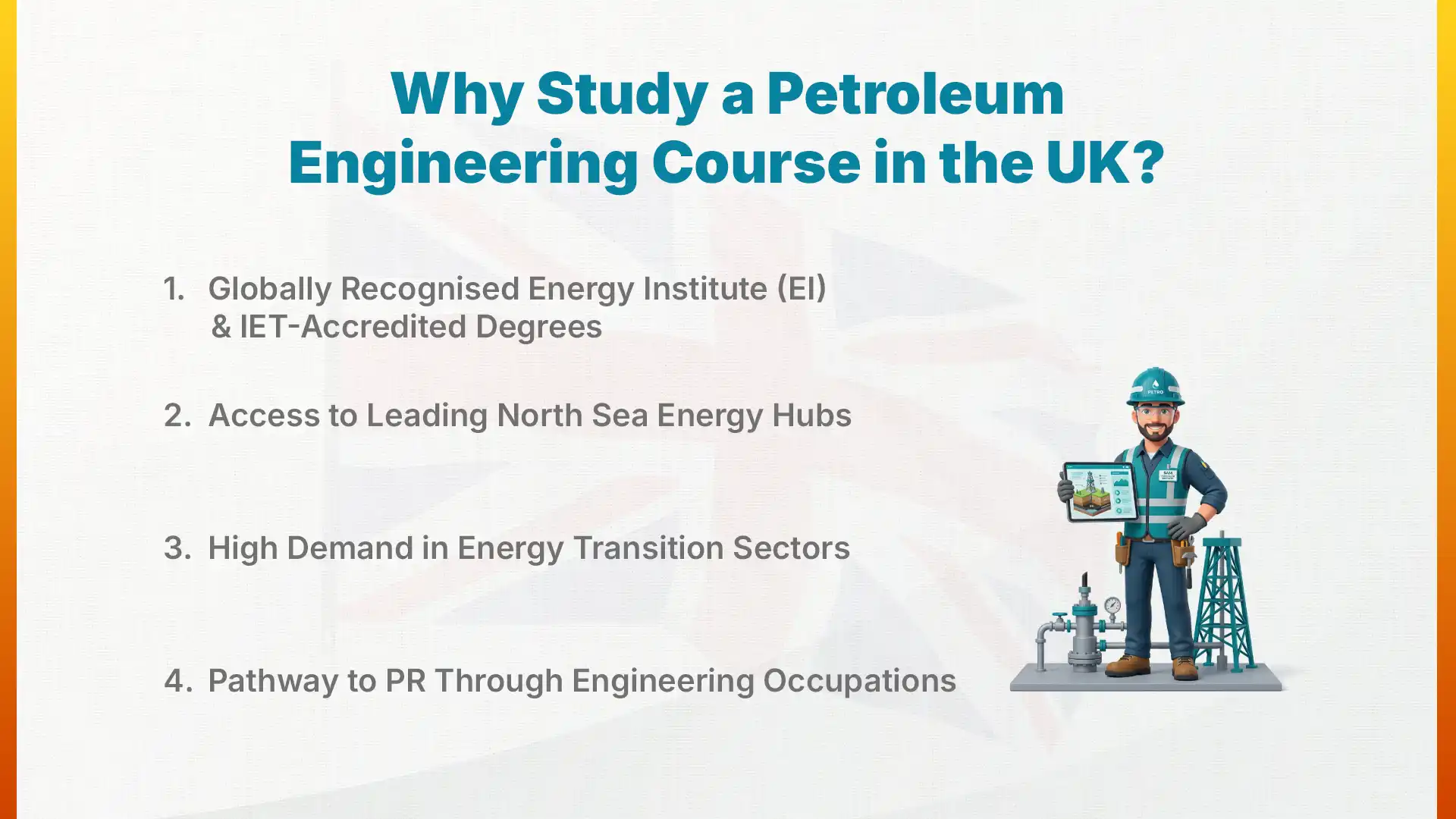
1. Globally Recognised Energy Institute (EI) and IET-Accredited Degrees
UK petroleum engineering programs are rigorously accredited by the Energy Institute (EI) and the Institution of Engineering and Technology (IET). This international stamp of approval means your degree meets the highest academic standards, making you eligible to apply for Chartered Engineer (CEng) status much faster than graduates from non-accredited programs.
2. Access to Leading North Sea Energy Hubs
The UK is a historic global leader in offshore oil and gas production, centered around the North Sea. Universities offering petroleum engineering have direct, embedded partnerships with energy giants like BP, Shell, and TotalEnergies, giving students unparalleled access to real-world offshore extraction processes and decommissioning projects.
3. High Demand in Energy Transition Sectors
While traditional oil and gas remain critical, the UK is leading the world in offshore energy transitions. There is massive demand for petroleum engineers who can apply their subsurface knowledge to carbon capture and storage (CCS), geothermal energy, and offshore wind foundation design, ensuring long-term career sustainability.
4. Pathway to PR Through Engineering Occupations
Petroleum and energy engineers are consistently listed on the UK’s Shortage Occupation List. Graduates can easily transition from the Graduate Route visa to a Skilled Worker visa sponsored by an energy firm, paving a direct and fast pathway to Indefinite Leave to Remain (ILR).
Which Are the Top Universities and Colleges for Petroleum Engineering in the UK?
The top universities for a petroleum engineering course in the UK include Imperial College London, Heriot-Watt University, and the University of Aberdeen, all offering world-leading facilities uniquely tied to the European energy sector. If you want to compare these with other global leaders, you can explore the best universities in the UK for Nepalese students for a broader view.
Institution | Location | Program | Duration | Known For |
|---|---|---|---|---|
| Imperial College London | London, England | MEng Petroleum Engineering | 4 Years | World Top 5 for Engineering; Deep Ties to Global Energy Giants |
| Heriot-Watt University | Edinburgh, Scotland | MEng / MSc Petroleum Eng | 4 Years / 1 Year | Institute of Petroleum Engineering; Highest Graduate Employability in the Energy Sector |
| University of Aberdeen | Aberdeen, Scotland | MEng / MSc Petroleum Eng | 4 Years / 1 Year | Located in Europe's "Energy Capital"; Unparalleled Industry Integration |
| University of Manchester | Manchester, England | MEng Chemical with Petroleum Eng | 4 Years | Strong Focus on Process Engineering and Flow Assurance |
| University of Edinburgh | Edinburgh, Scotland | MSc Petroleum Engineering | 1 Year | Highly Research-Intensive; Strong Focus on Reservoir Modeling |
Imperial College London and the University of Aberdeen are ideal for students aiming for top-tier research or corporate roles, while Heriot-Watt is the absolute best choice for students focused on immediate industry employment and practical field operations.
What Are the Admission Requirements?
The admission requirements for a petroleum engineering course in the UK include high academic results in mathematics and physics, an IELTS score of 6.0 to 6.5 overall, a technically focused personal statement, and proof of funds for the UK student visa.
1. Academic Requirements
For undergraduate programs, Nepalese students need Plus Two Science with very strong marks in mathematics, physics, and chemistry (typically 80% to 85%+ overall). If you are wondering what comes next after +2 and have a strong physics background, an MEng in petroleum engineering is a highly lucrative option. For postgraduate MSc programs, a relevant bachelor's degree in petroleum, chemical, or mechanical engineering is required, usually with a second-class lower division (55% to 60%) or higher.
2. English Language Requirements
Engineering programs demand strong English skills so international students can safely comprehend complex technical manuals and workplace safety protocols. Because these requirements vary by institution, knowing the minimum IELTS score the UK needs for your specific university tier is crucial to avoid application delays.
Test | Undergraduate | Postgraduate |
|---|---|---|
| IELTS Academic | 6.0 – 6.5 Overall | 6.5 Overall (Min 6.0 in All Bands) |
| TOEFL iBT | 80 – 90 | 90 – 100 |
| PTE Academic | 54 – 62 | 62 – 65 |
3. Personal Statement
UK universities use the personal statement to assess your genuine technical interest. Your essay should explain why you are drawn to the energy sector, your understanding of current global energy challenges (e.g., energy transition, decommissioning), and your career goals. You can use the proven SOP format for the UK to structure your application perfectly.
4. Financial Proof and Visa Documentation
To meet the requirements to study in the UK from Nepal, you must demonstrate sufficient funds to cover your first year's tuition and at least 9 months of living costs in your bank account to secure the student visa.
How to Apply for a Petroleum Engineering Course in the UK?
Applying for a petroleum engineering course in the UK involves five steps: shortlisting institutions, preparing your academic and financial documents, writing your statement of purpose, submitting your application, and receiving your offer to apply for a study permit. Checking intakes early is essential to avoid missing the September or January application windows.
Step 1: Shortlist Institutions
Compare programs based on EI or IET accreditation, curriculum focus (e.g., drilling vs. reservoir engineering), location (Aberdeen or Edinburgh are highly recommended for this major), and tuition fees. Be sure to check if the program includes mandatory offshore field trips or direct partnerships with North Sea energy operators, as hands-on exposure is critical in this discipline.
Step 2: Prepare Documents
Gather your Plus Two or degree transcripts, IELTS/PTE scores, a valid passport, CV/resume, and academic reference letters. If you have completed specific geology or fluid mechanics projects, include them to significantly boost your profile. Ensure all your academic transcripts are officially translated into English and notarized if they are in a different language.
Step 3: Write Your SOP
Tailor your Statement of Purpose to each specific UK university, highlighting how their reservoir simulation labs or industry ties align with your desire to work in global energy extraction. Also, mention your awareness of the global energy transition and how you plan to adapt traditional petroleum skills to future sustainable energy challenges like carbon capture.
Step 4: Submit Application
For bachelor's degrees, apply through the centralized UCAS portal. For master's degrees, apply directly through the university’s international application portal. Apply early, ideally by December or January, for the September intake. Keep a dedicated folder for your application IDs, passwords, and correspondence to ensure you don't miss any deadline updates or interview invitations.
Step 5: Receive Offer and Apply for Study Permit
Once you receive an unconditional offer letter and pay your deposit, you will receive a CAS (Confirmation of Acceptance for Studies) letter. Use this CAS letter to apply for the UK Student Visa, ensuring your financial documents are perfectly prepared to avoid any delays. Remember that you must also pay the Immigration Health Surcharge (IHS) as part of your visa application to access the UK's National Health Service during your studies.
How Much Does It Cost to Study Petroleum Engineering in the UK?
The cost to study a petroleum engineering course in the UK requires an estimated total budget of GBP 30,000 to GBP 50,000 per year, covering both tuition fees and living expenses. Budgeting is easier when you know what to expect, which is why it is so important to research how much it costs to study in the UK before making your final decision.
Program | Annual Tuition (GBP) | Annual Tuition (NPR approx.) |
|---|---|---|
| MEng (Undergraduate) | GBP 28,000 – GBP 35,000 | NPR 5,180,000 – NPR 6,475,000 |
| MSc (Postgraduate) | GBP 30,000 – GBP 38,000 | NPR 5,550,000 – NPR 7,030,000 |
Monthly living expenses range from GBP 900 to GBP 1,800, depending on whether you live in London or in more affordable regional cities like Aberdeen or Edinburgh. Nepalese students are allowed to work 20 hours per week during term time to help offset these living costs.
Taking tuition and living expenses together, Nepalese students should budget approximately GBP 30,000 to GBP 50,000 per year in total.
What Scholarships Are Available?
Scholarships for a petroleum engineering course in the UK include fully funded government options like Chevening and Commonwealth, as well as GREAT Scholarships and university-specific merit awards for STEM students.
Chevening Scholarships: Fully funded UK government scholarships covering full tuition, living expenses, and travel for outstanding Nepalese professionals pursuing a 1-year MSc in Petroleum Engineering.
GREAT Scholarships: Jointly funded by the UK government and participating universities, offering GBP 10,000 towards tuition fees for postgraduate students in STEM subjects.
Commonwealth Scholarships: For students from developing Commonwealth nations like Nepal, covering full tuition, travel, and living allowances for master's programs in engineering.
University Merit Scholarships: Many UK engineering faculties offer automatic fee reductions of GBP 2,000 to GBP 5,000 for international students who meet specific academic grade thresholds.
What Jobs Can You Get After Petroleum Engineering in the UK?
Graduates of a petroleum engineering course in the UK can secure roles such as petroleum engineer, drilling engineer, reservoir engineer, subsurface engineer, energy transition engineer, and well intervention engineer across the offshore oil, gas, and green energy sectors.
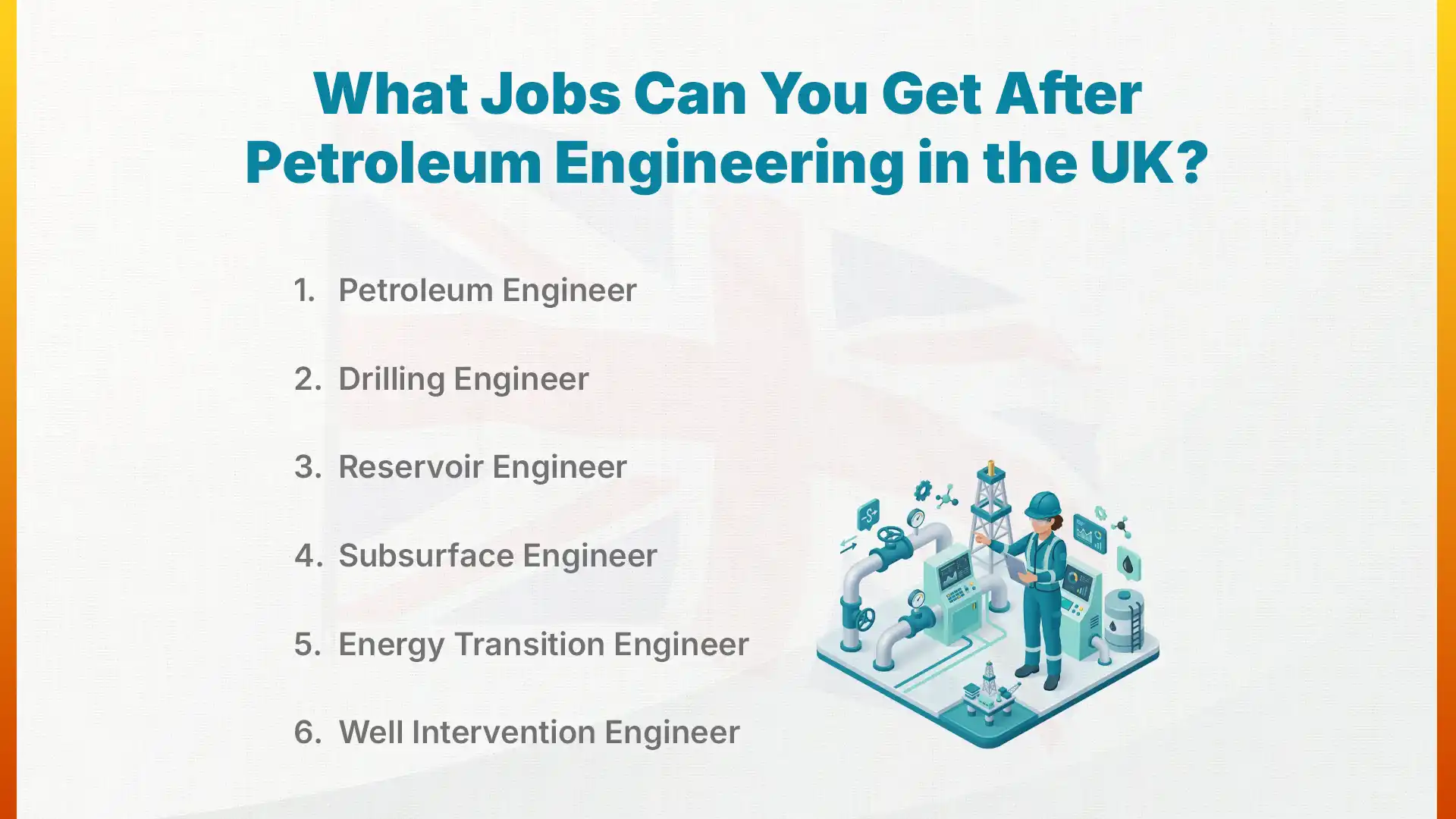
1. Petroleum Engineer
Petroleum engineers oversee the entire lifecycle of oil and gas extraction in the UK North Sea. They design extraction methods, manage offshore surface facilities, and ensure operations are economically viable and environmentally compliant. This is the most versatile professional outcome, offering a highly lucrative foundation to move into field management or specialized consulting.
2. Drilling Engineer
Drilling engineers are responsible for planning and executing the drilling of wells to access offshore reservoirs. They calculate mud weights, select drill bits, and manage the complex logistics of offshore drilling rigs. This is a highly hands-on, high-pressure role that commands significant offshore allowances and rotational shift pay.
3. Reservoir Engineer
Reservoir engineers use advanced computer modeling to estimate the amount of oil and gas trapped beneath the UK continental shelf. They simulate fluid flow and develop strategies to maximize hydrocarbon recovery. This is primarily an office-based, highly analytical role that relies heavily on simulation software.
4. Subsurface Engineer
Subsurface engineers integrate geological data with engineering principles to map out underground rock formations. They play a critical role in determining exactly where to drill and how to navigate complex geological structures to hit targeted hydrocarbon zones safely.
5. Energy Transition Engineer
As the UK oil and gas sector evolves, many petroleum engineers are transitioning into roles that apply subsurface expertise to green energy. They work on geothermal energy extraction, carbon capture and storage (CCS) projects, and hydrogen storage, ensuring long-term career sustainability.
6. Well Intervention Engineer
Well intervention engineers focus on optimizing the performance of existing oil and gas wells. They design and execute operations like acidizing, fracturing, or installing artificial lift equipment to increase production rates without drilling new wells.
What Is the Salary and Scope After Petroleum Engineering in the UK?
The salary after a petroleum engineering course in the UK ranges from GBP 30,000 to GBP 35,000 at entry-level, rising to GBP 60,000 or more for senior engineers, with a highly streamlined PR pathway via the Graduate Route and Skilled Worker visas.
Experience Level | Annual Salary (GBP) | Annual Salary (NPR approx.) |
|---|---|---|
| Entry-Level (0–2 Years) | GBP 30,000 – GBP 35,000 | NPR 5,550,000 – NPR 6,475,000 |
| Mid-Level (2–5 Years) | GBP 45,000 – GBP 60,000 | NPR 8,325,000 – NPR 11,100,000 |
| Senior Petroleum Engineer (5+ Years) | GBP 65,000 – GBP 90,000+ | NPR 12,025,000 – NPR 16,650,000+ |
After completing your degree, you can apply for the Graduate Route visa, which allows you to stay and work in the UK for 2 years (3 years for PhD graduates) without needing a job offer. This gives you ample time to secure a role with an energy firm and gain valuable UK workplace experience.
Because petroleum and energy engineers are on the UK Shortage Occupation List, securing a Skilled Worker visa sponsorship from your employer is highly achievable without the company needing to conduct a resident labor market test. After 5 years of working on this visa, you become eligible to apply for Indefinite Leave to Remain (ILR), which is the UK's equivalent of permanent residency.
Conclusion
A petroleum engineering degree in the UK guarantees a global energy career and a fast PR pathway through the country's critical shortage of technical professionals in the offshore and transition sectors. The cost of not using expert guidance includes choosing the wrong non-accredited university, facing visa refusals due to documentation errors, and significantly delaying your PR timeline.
Interested in studying a petroleum engineering course in the UK? Contact SAS Education Consultancy for a free counseling session and let us help you find the right program, prepare a strong application, and navigate the UK Student Visa process with confidence.