Chemical Engineering Course in Australia: Entry Requirements, Costs & PR Paths

Jul 08, 2026
A chemical engineering course in Australia offers Nepalese students a globally recognized, practical degree focused on industrial process design, mining, and pharmaceuticals within one of the Asia-Pacific's most advanced resource and manufacturing hubs. The major career and PR problem most Nepali students face is choosing between countries with unclear engineering migration pathways for niche STEM fields, dealing with exceptionally high tuition costs in the US, and navigating complex visa processes entirely alone.
Studying in Australia solves this by providing massive demand for engineers in Australia's mining and pharmaceutical sectors, strictly Engineers Australia-accredited degrees, and a highly defined Subclass 485 to PR migration route. This guide covers the top universities, exact costs, admission steps, and salary expectations for 2026.
In this blog
Why Study a Chemical Engineering Course in Australia?
Australia is one of the best destinations to study a chemical engineering course because of its globally recognized Engineers Australia-accredited degrees, access to advanced pilot plants and industry partnerships, critical shortage of chemical engineers in mining and pharma, competitive tuition with high ROI for engineering graduates, and a fast-track PR pathway through engineering occupations. This is a major reason why engineering is consistently ranked among the best courses in Australia for Nepalese students.
1. Globally Recognised Engineers Australia Accredited Degrees
Australian chemical engineering programs are rigorously accredited by Engineers Australia under the Washington Accord. This international agreement means your Australian degree is automatically recognized as equivalent to top-tier engineering degrees in the US, UK, Canada, and Nepal, allowing you to achieve Chartered Professional Engineer (CPEng) status globally.
2. Access to Advanced Pilot Plants and Industry Partnerships
Australian universities invest heavily in cutting-edge pilot plant facilities and chemical simulation software. Many programs have direct partnerships with global industry giants like BHP, Rio Tinto, and CSL, giving students unparalleled access to commercial-scale chemical and metallurgical processes before they graduate.
3. Critical Shortage of Chemical Engineers in Mining and Pharma
Australia is a global leader in mining, mineral processing, and pharmaceutical manufacturing. This has created a severe, ongoing shortage of chemical engineers who can optimize extraction processes and scale up drug manufacturing, meaning Nepalese graduates are in an exceptionally strong position to secure employment quickly.
4. Competitive Tuition with High ROI for Engineering Graduates
While offering world-class facilities and highly paid internship opportunities, Australian university tuition fees for chemical engineering remain significantly lower than those in the United States. When combined with the high starting salaries that Australian engineering graduates command, the return on investment (ROI) is one of the most compelling in the global education market.
5. Fast-Track PR Pathway Through Engineering Occupations
Chemical engineers are consistently listed at the very top of Australia's Skilled Occupation List. Graduates with an Australian engineering degree and local work experience are highly prioritized for state nomination and independent skilled migration visas, making it one of the most reliable and fast-track paths to permanent residency.
Which Are the Top Universities and Colleges for Chemical Engineering in Australia?
The top universities for a chemical engineering course in Australia include UNSW Sydney, the University of Melbourne, and UQ, all offering world-leading, EA-accredited facilities and strong industry employability. If you want to compare these with other global leaders, you can explore the best universities in Australia for a broader view.
Institution | Location | Program | Duration | Known For |
|---|---|---|---|---|
| UNSW Sydney | Sydney, NSW | Bachelor / Master of Chem Eng | 4 Years / 2 Years | Australia's Top-Ranked Engineering Faculty; Powerhouse for Minerals Processing |
| University of Melbourne | Melbourne, VIC | Bachelor of Science (Chemical Systems) / Master of Eng | 3 Years + 2 Years | Strong Focus on Pharmaceutical and Sustainable Process Engineering |
| University of Queensland (UQ) | Brisbane, QLD | Bachelor / Master of Eng (Chemical) | 4 Years / 1.5 Years | Home to Australia's Premier Chemical Engineering Pilot Plant; Strong Industry Ties |
| Curtin University | Perth, WA | Bachelor / Master of Chem Eng | 4 Years / 2 Years | Located in Western Australia; Highly Specialized in Mining and Metallurgical Engineering |
UNSW and UQ are ideal for students aiming for top-tier mining and minerals processing roles, while Melbourne and Monash are excellent for students focused on pharmaceuticals and sustainable energy employability.
What Are the Admission Requirements?
The admission requirements for a chemical engineering course in Australia include high academic results in mathematics and chemistry, an IELTS score of 6.0 to 6.5 overall, a technically focused personal statement, and proof of funds for the Subclass 500 Student Visa.
1. Academic Requirements
For undergraduate programs, Nepalese students need Plus Two Science with very strong marks in Mathematics, Chemistry, and Physics (typically 60% to 80% overall). If you are wondering what comes next after +2 and have a strong chemistry background, a Bachelor of Engineering is a highly lucrative option. For postgraduate programs, a relevant bachelor's degree in chemical engineering is required, usually with a minimum GPA equivalent to second-class lower (55% to 60%). Group of Eight universities expect second-class upper (65%+).
2. English Language Requirements
Engineering programs demand strong English skills so international students can safely comprehend complex technical manuals and workplace safety protocols. Because these requirements vary by institution, knowing the minimum IELTS score Australia needs for your specific university tier is crucial to avoid application delays.
Test | Undergraduate | Postgraduate |
|---|---|---|
| IELTS Academic | 6.0 – 6.5 Overall | 6.5 Overall (Min 6.0 in All Bands) |
| TOEFL iBT | 79 – 90 | 90 – 100 |
| PTE Academic | 50 – 58 | 58 – 65 |
3. Personal Statement
Australian universities use the SOP to assess your genuine technical interest. Your essay should explain why you are drawn to chemical engineering, any lab experiments or industrial processes you excel in, and your understanding of current challenges in the mining or pharma sectors. You can use the proven SOP for Australia to structure your application perfectly.
4. Financial Proof and Visa Documentation
To meet the requirements to study in Australia from Nepal, you must demonstrate sufficient funds to cover your first year's tuition and at least 12 months of living costs in your bank account to secure the Subclass 500 Student Visa.
How to Apply for a Chemical Engineering Course in Australia?
Applying for a chemical engineering course in Australia involves five steps: shortlisting institutions, preparing your academic and financial documents, writing your statement of purpose, submitting your application, and receiving your offer to apply for a study permit. Checking Australian intakes early is essential to avoid missing the February or July application windows.
Step 1: Shortlist Institutions
Compare programs based on Engineers Australia accreditation, curriculum focus (e.g., mining vs. pharmaceuticals), location, and tuition fees. Be sure to check the specific pilot plant facilities and specialization modules offered in the final year of the course.
Step 2: Prepare Documents
Gather your Plus Two or degree transcripts, IELTS/PTE scores, a valid passport, a CV/resume, and academic reference letters. If you have participated in any science fairs, chemistry olympiads, or lab research, include certificates to significantly boost your profile.
Step 3: Write Your SOP
Tailor your Statement of Purpose to each specific Australian university, highlighting how their laboratory facilities align with your desire to design innovative industrial processes. Avoid generic science clichés and focus on specific chemical engineering challenges you want to solve.
Step 4: Submit Application
Apply directly through each university's international student portal, as Australia does not use a centralized application system. Apply early, ideally 4 to 6 months before the February or July intake, as competitive engineering programs at Group of Eight universities fill up quickly.
Step 5: Receive CoE and Apply for Subclass 500 Visa
Once you receive an unconditional offer letter and pay your deposit, you will receive a Confirmation of Enrollment (CoE) document. Use this CoE to apply for the Subclass 500 Student Visa, ensuring your financial documents are perfectly prepared to avoid any delays.
How Much Does It Cost to Study Chemical Engineering in Australia?
The cost to study a chemical engineering course in Australia requires an estimated total budget of AUD 48,000 to AUD 78,000 per year, covering both tuition fees and living expenses. Budgeting is easier when you know what to expect, which is why it is so important to research the cost of study in Australia from Nepal before making your final decision.
Program | Annual Tuition (AUD) | Annual Tuition (NPR approx.) |
|---|---|---|
| Bachelor of Engineering (Chemical) | AUD 45,000 – AUD 55,000 | NPR 4,050,000 – NPR 4,950,000 |
| Master of Engineering (Chemical) | AUD 48,000 – AUD 58,000 | NPR 4,320,000 – NPR 5,220,000 |
Monthly living expenses range from AUD 1,200 to AUD 2,500, depending on whether you live in expensive cities like Sydney and Melbourne or more affordable regional cities like Perth or Adelaide. Nepalese students are allowed to work 48 hours per fortnight during term time to help offset these living costs.
Taking tuition and living expenses together, Nepalese students should budget approximately AUD 48,000 to AUD 78,000 per year in total.
What Scholarships Are Available?
Scholarships for a chemical engineering course in Australia include fully funded government options like the Australia Awards, regional scholarships, and university-specific merit awards for high-achieving STEM students.
Australia Awards Scholarship: Fully funded government scholarship covering full tuition, living allowances, and travel for outstanding Nepalese students pursuing postgraduate engineering degrees.
Destination Australia Scholarship: Up to AUD 15,000 per year for international students who choose to study at regional Australian universities with strong engineering programs.
University Merit Scholarships: Many Australian engineering faculties offer automatic fee reductions of AUD 5,000 to AUD 20,000 per year for high-achieving international students based on their academic transcripts.
Engineering-Specific Industry Scholarships: Organizations like Engineers Australia and corporate partners (e.g., Orica and Woodside) offer targeted financial awards for chemical engineering students demonstrating leadership in STEM.
What Jobs Can You Get After Chemical Engineering in Australia?
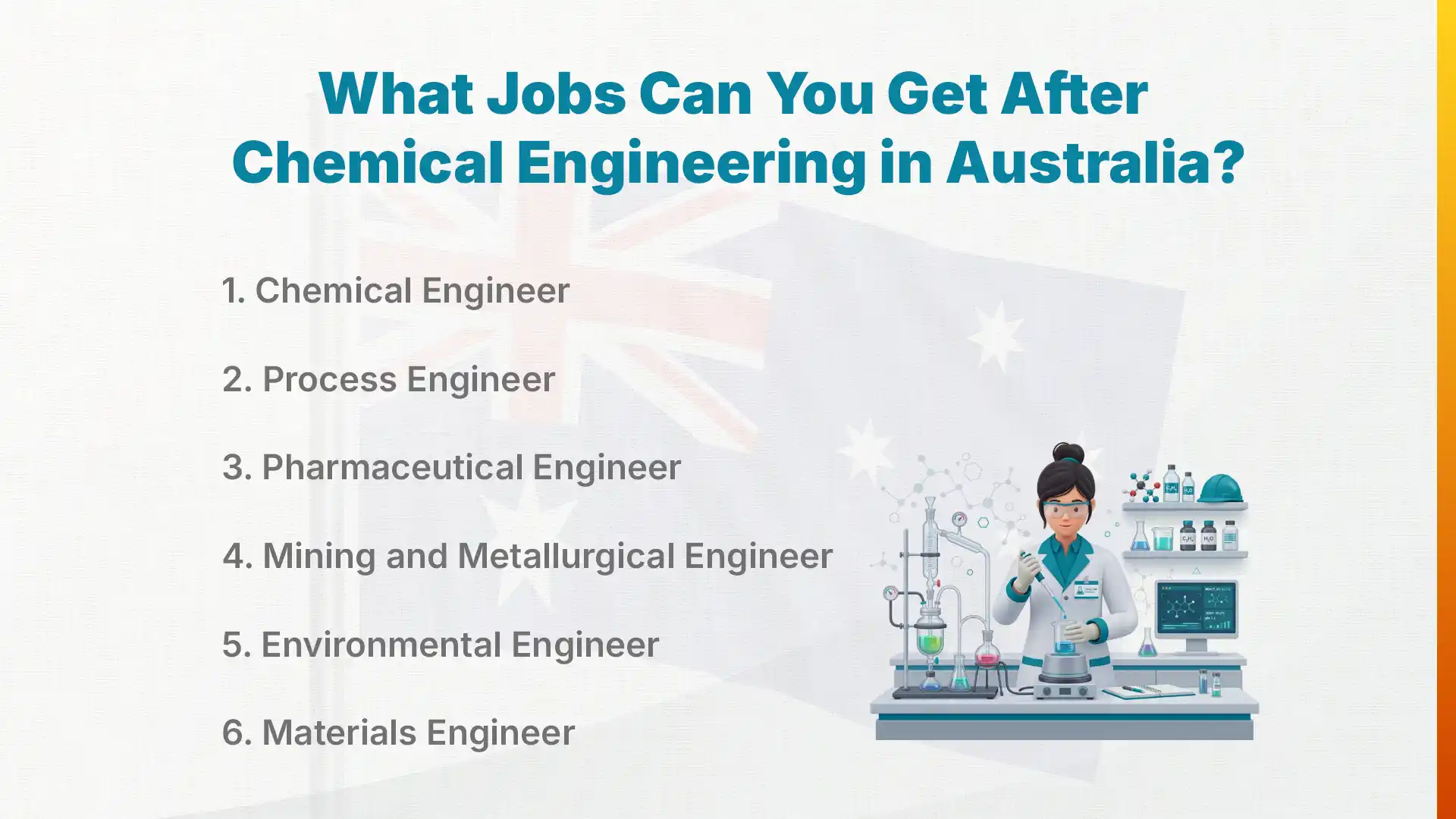
Graduates of a chemical engineering course in Australia can secure roles such as chemical engineer, process engineer, pharmaceutical engineer, mining and metallurgical engineer, environmental engineer, and materials engineer across the mining, energy, and pharmaceutical sectors.
1. Chemical Engineer
Chemical engineers design, develop, and optimize the industrial processes used to manufacture chemicals, fuels, and food products on a massive scale. They are responsible for ensuring these large-scale production facilities operate safely, efficiently, and in compliance with strict Australian environmental regulations. This is the most versatile professional outcome, offering a stable foundation to move into plant management or specialized technical consulting.
2. Process Engineer
Process engineers focus specifically on analyzing and improving the step-by-step chemical processes within a manufacturing or mining plant. They use advanced simulation software to identify bottlenecks, reduce waste, and increase the overall yield and profitability of industrial operations in sectors ranging from food processing to petrochemicals.
3. Pharmaceutical Engineer
Pharmaceutical engineers apply chemical engineering principles to the design, scaling, and manufacturing of life-saving drugs and vaccines. They work closely with biotech firms like CSL to ensure that medications are produced in highly sterile environments and meet stringent clinical quality standards.
4. Mining and Metallurgical Engineer
Mining engineers use chemical engineering principles to extract and process valuable minerals from ore bodies safely and efficiently. This is a highly lucrative and uniquely Australian specialization, focusing on gold, iron ore, and lithium processing in Western Australia and Queensland.
5. Environmental Engineer
Environmental engineers use chemical engineering principles to develop solutions for water treatment, waste management, and pollution control. They design industrial filtration systems, wastewater treatment plants, and emission scrubbers to ensure Australian mining and manufacturing sectors minimize their ecological footprint.
6. Materials Engineer
Materials engineers manipulate the chemical and physical structure of substances to create advanced materials with specific properties, such as heat-resistant alloys for aerospace, biodegradable plastics, or high-performance polymers used in advanced manufacturing.
What Is the Salary and Scope After Chemical Engineering in Australia?
The salary after a chemical engineering course in Australia ranges from AUD 70,000 to AUD 85,000 at entry-level, rising to AUD 140,000 or more for senior engineers, with a highly streamlined PR pathway via the Subclass 485 and 189/190 skilled migration visas.
Experience Level | Annual Salary (AUD) | Annual Salary (NPR approx.) |
|---|---|---|
| Entry-Level (0–2 Years) | AUD 70,000 – AUD 85,000 | NPR 6,300,000 – NPR 7,650,000 |
| Mid-Level (2–5 Years) | AUD 95,000 – AUD 130,000 | NPR 8,550,000 – NPR 11,700,000 |
| Senior Chemical Engineer (5+ Years) | AUD 140,000 – AUD 180,000+ | NPR 12,600,000 – NPR 16,200,000+ |
After completing your degree, you can apply for the Temporary Graduate Visa (Subclass 485). Because chemical engineering is classified as a STEM profession, graduates studying or working in regional areas may be eligible for extended post-study work rights of up to 4 years, giving you maximum time to build local experience.
Chemical engineers are consistently at the top of Australia's Skilled Occupation List. Most Nepalese chemical engineering graduates with an Australian degree and just 1 year of local work experience accumulate enough points to receive an Invitation to Apply (ITA) for the Skilled Independent Visa (189) or State Nomination (190), leading directly to permanent residency.
Conclusion
A chemical engineering degree in Australia guarantees a global engineering career and a fast PR pathway through the country's critical shortage of technical professionals in mining and pharmaceuticals. The cost of not using expert guidance includes choosing the wrong non-accredited university, facing Subclass 500 visa refusals due to financial documentation errors, and significantly delaying your PR timeline.
Interested in studying a chemical engineering course in Australia? Contact SAS Education Consultancy for a free counseling session and let us help you find the right program, prepare a strong application, and navigate the Subclass 500 visa process with confidence.