Cost of Studying in Australia for International Students

Feb 25, 2026

Thinking about studying in Australia, but stuck on one big question, how much is this actually going to cost me? Not just tuition, but rent, food, visa fees, insurance, the whole package. Because let’s be honest, studying abroad isn’t just a dream, it’s a financial decision. And if you don’t calculate it properly, surprises can hit hard later.
In this blog, we’ll break down the complete cost of studying in Australia from Nepal, including tuition fees by degree level, living expenses in different Australian cities, visa charges, health insurance, and one-time pre-departure costs. If you’re planning to study in Australia, this guide will help you understand exactly what to expect financially. By the end, you’ll have a realistic estimate of how much you need to budget, not guesswork, not rough advice, but a clear financial roadmap you can confidently follow.
In this blog
Why Australia is a Popular Study Destination for Nepali Students?
Australia is popular among Nepali students because it offers globally recognised education, strong post-study work rights, migration pathways, and a supportive multicultural environment. For many students from Nepal, Australia feels like the perfect balance between quality education and future opportunity. The universities are respected worldwide, the lifestyle is student-friendly, and the immigration system is structured and transparent. Adding part-time work rights and post-study visa options makes it more than just a study destination; it becomes a long-term career plan. That’s why thousands of Nepali students choose to study in Australia with scholarship over other countries every year.
1. Globally Recognized Universities
Australia is home to some of the world’s top-ranking universities, consistently featured in global education rankings. Institutions like the Group of Eight universities are known for strong research output, modern infrastructure, and industry collaboration. Many of the best universities in Australia are recognised in countries like the UK, Canada, the USA, and across Asia, which means your qualification has strong international value.
Australian education focuses on practical learning, critical thinking, and industry-based projects rather than just theory. Many programs include internships, real-world case studies, and research exposure. Employers appreciate Australian graduates because they are trained to solve problems independently. For Nepali students, this global credibility increases career flexibility both abroad and back home.
2. Post-Study Work Opportunities
One major reason Nepali students prefer Australia is the Temporary Graduate Visa (subclass 485), which allows graduates to stay and work after completing their studies. Depending on the qualification level and location, post-study work rights can range from 2 to 4 years.
During this period, students can gain full-time work experience in Australia, which strengthens their resume significantly. Many industries, such as IT, healthcare, engineering, hospitality, and business, actively recruit international graduates. While studying, access to part-time jobs in Australia also helps students gain practical exposure and manage living expenses. The ability to gain local work experience increases the chances of employer sponsorship later. For students calculating the cost of study in Australia from Nepal, post-study work options help justify the investment.
3. Safe & Multicultural Environment
Australia is considered one of the safest countries for international students, with strong legal protections and student support systems. Universities provide orientation programs, academic assistance, and mental health services to ensure smooth adjustment.
The country is highly multicultural, welcoming students from Asia, Europe, Africa, and the Middle East. This diversity helps Nepali students feel less isolated and more included. English is the primary language, which also improves communication skills and global exposure. Beyond academics, students experience a balanced lifestyle with clean cities, modern transport, and outdoor culture. It’s not just education, it’s quality of life.
4. PR Pathways After Study
Australia offers structured migration pathways that make it attractive for students thinking long-term. Certain occupations are listed on the Skilled Occupation List (SOL), which allows graduates in fields like nursing, engineering, IT, and trades to apply for skilled migration.
Regional study options provide additional PR points and extended post-study work rights, encouraging students to explore cities outside Sydney and Melbourne. While PR policies can change, Australia’s migration system remains relatively transparent compared to many countries. For many Nepali students, choosing the best courses in Australia for PR becomes the first step toward permanent residency planning. That long-term possibility adds serious value.
5. Strong Nepali Student Community
Australia has a large and growing Nepali student community across major cities like Sydney, Melbourne, Brisbane, and Adelaide. This community support makes the transition easier for new students arriving from Nepal. Cultural associations, student groups, and Nepali events help maintain a connection with home.
Having a familiar network reduces homesickness and helps with practical matters like finding accommodation, part-time jobs, and understanding university systems. Many senior Nepali students guide newcomers about visa conditions, budgeting, and work opportunities. For first-time international students, this community presence provides comfort and stability. Sometimes, knowing you’re not alone makes all the difference.
How Much is the Cost of Study in Australia from Nepal?
The average cost of study in Australia from Nepal ranges between AUD 20,000 to AUD 45,000 per year for tuition, plus AUD 25,000-30,000 annually for living expenses. In simple terms, most international students should budget around AUD 45,000-75,000 per year, depending on the course and city. Tuition varies by degree level, and living costs depend heavily on location, Sydney and Melbourne are more expensive than Adelaide or Perth. Beyond that, you must factor in visa fees, health insurance, flight tickets, and initial setup costs. Let’s break everything down clearly so you can plan realistically.
1. Tuition Fees by Degree Level
Tuition fees in Australia vary significantly depending on your qualification level and field of study. Diploma and certificate programs generally cost between AUD 8,000 and AUD 22,000 per year, making them a more affordable entry option. Bachelor’s degree fees typically range from AUD 20,000 to AUD 45,000 annually, with courses like Nursing, Engineering, and IT on the higher side. Master’s programs usually cost between AUD 22,000 and AUD 50,000 per year, depending on specialization. PhD programs can range from AUD 20,000 to AUD 42,000 annually, though scholarships are more common at this level. High-demand courses and top-ranked universities naturally charge more.
2. Living Expenses in Australia
Living expenses in Australia for international students generally range between AUD 20,000 and AUD 29,710 per year (around AUD 1,700-2,500 per month). Accommodation is the biggest expense, shared apartments may cost AUD 600-1,900 per month, while on-campus housing ranges from AUD 440-1,100 monthly. Rent in major cities like Sydney can reach AUD 180-400 per week. Groceries typically cost around AUD 350 per month, depending on lifestyle. Utilities (electricity, gas, water) may cost AUD 280-350 monthly, while transportation averages AUD 120 per month with student discounts available. Phone and internet plans usually cost AUD 30-40 monthly. Smaller cities like Adelaide and Perth are noticeably more budget-friendly than Sydney or Melbourne.
3. OSHC (Health Insurance) Cost
Overseas Student Health Cover (OSHC) is mandatory for all international students in Australia. For single students, the annual cost ranges between AUD 630 and AUD 850+. For couples, it can range from AUD 4,600 to AUD 6,000+, and for families, costs may exceed AUD 8,900–12,000 per year. OSHC covers basic medical services, hospital treatment, and limited prescriptions during your stay. It must be purchased before your student visa is granted and remain valid for your entire course duration. This is a compulsory expense and cannot be skipped.
4. Visa Application Fees
As of July 1, 2025, the base application fee for the Australian Student Visa (Subclass 500) is AUD 2,000 for the primary applicant. This fee is paid during the visa lodgement process and is non-refundable in most cases. Additional charges may apply if dependents are included in the application. Students must also complete biometrics and medical examinations, which add to the total visa-related expenses. Proper financial documentation is required to support your application. Visa costs are a significant upfront expense and must be budgeted carefully.
5. Flight Ticket from Nepal to Australia
One-way airfare from Nepal to Australia generally costs between AUD 900 and AUD 2,500, depending on airline, season, and booking timing. Prices are usually higher during peak intake seasons (February and July). Booking tickets early can significantly reduce costs. Students should also budget for baggage fees if carrying extra luggage. Travel insurance for the journey is optional but recommended. Flight cost is a one-time expense, but still a noticeable part of initial spending.
6. Miscellaneous & Initial Setup Costs
Initial setup costs in the first year typically range between AUD 2,500 and AUD 4,000. This includes visa application fees (AUD 2,000), initial accommodation deposit, bond payment, and household setup items. You may also need funds for basic furniture, kitchen supplies, transportation cards, and emergency reserves. Some universities require tuition deposits before visa approval. Having a financial buffer helps avoid stress during the first few months. Planning these upfront costs properly ensures a smoother transition after arrival.
Tuition Fees in Australia for International Students
Tuition fees in Australia vary depending on the university type, course level, and field of study. On average, international students pay between AUD 20,000 and AUD 60,000+ per year, with professional programs costing more. Degrees like Medicine, Dentistry, and Engineering sit on the higher end, while Business or Arts may be slightly lower. Your total academic cost depends not just on the course, but also on the institution’s ranking and facilities. Understanding this breakdown is essential when calculating the overall cost of study in Australia from Nepal.
1. Fees in Public Universities (Most Common Option)
Public universities are the most common choice for international students because they are government-regulated and globally recognized. Tuition fees in public universities generally range from AUD 20,000 to over AUD 60,000 per year, depending on the program. Undergraduate degrees typically cost between AUD 20,000 and AUD 45,000 annually. Postgraduate programs usually range from AUD 22,000 to AUD 50,000 per year. Courses in Medicine, Engineering, Veterinary Science, and specialized STEM fields tend to be more expensive due to lab work and clinical training. While public universities may cost more than private colleges, they often offer stronger research facilities, better campus infrastructure, and higher global rankings.
2. Private Colleges & Institutes
Private colleges and institutes in Australia can sometimes offer lower tuition fees compared to major public universities. These institutions often provide diploma programs, pathway courses, and specialized vocational education. Annual tuition in private colleges may range from AUD 15,000 to AUD 30,000 depending on the course. However, it’s important to check accreditation and CRICOS registration before enrolling. While private institutions can be more affordable, not all carry the same academic prestige or research strength as public universities. Students should balance affordability with long-term career value when making a decision.
Living Expenses in Australia for Nepali Students
Living expenses are the second biggest component after tuition when calculating the total cost of studying in Australia from Nepal. On average, Nepali students spend between AUD 20,000 and AUD 29,710 per year (around AUD 1,700-2,500 per month) depending on the city and lifestyle. Sydney and Melbourne are more expensive, while Adelaide, Perth, and Tasmania are relatively budget-friendly. Rent takes the biggest portion of the monthly budget, followed by food and utilities. Planning your living expenses carefully can make a huge difference in managing your overall finances.
1. Accommodation (Biggest Expense)
Accommodation is the largest and most consistent monthly expense for students in Australia. Rent for shared apartments outside city centers can range between AUD 600-1,200 per month, while city-center accommodation may cost AUD 1,200-1,900 or more. On-campus housing typically ranges from AUD 440-1,100 per month, depending on the university and room type. Sharing a flat or apartment significantly reduces both rent and utility costs, which is why many Nepali students prefer shared housing. Location plays a major role — living slightly outside the city can save hundreds of dollars monthly. Always factor in bond deposits and advance rent when planning your initial budget.
2. Food & Groceries
Food expenses depend largely on your eating habits. On average, students spend around AUD 300-500 per month on groceries if they cook at home regularly. Essential grocery items like rice, chicken, eggs, and milk are reasonably priced in major supermarkets. Cooking at home is far more affordable than eating out frequently. Dining at restaurants can cost AUD 15–30 per meal, depending on the place. Nepali students often reduce food costs by sharing groceries or cooking together with roommates. Smart meal planning can significantly control monthly expenses.
3. Transportation
Transportation costs vary depending on the city and whether you live close to campus. Public transport expenses typically average around AUD 100-150 per month, with student discounts available in most states. Cities like Sydney and Melbourne have well-developed train, tram, and bus networks. Some students choose to cycle or walk to reduce costs further. If you own a car, expenses increase due to fuel, insurance, and maintenance. Living near your university can cut transportation costs significantly.
4. Utilities & Internet
Utility costs include electricity, gas, and water, and usually range between AUD 150-300 per month, depending on usage and accommodation type. Internet and mobile phone plans typically cost AUD 30-50 per month for standard data packages. In shared apartments, these bills are often divided among roommates, reducing the individual burden. Heating and cooling can increase electricity bills during extreme weather months. Being mindful of energy usage helps keep utility costs under control. Many student accommodations include some utilities in the rent, which can simplify budgeting.
5. Personal & Lifestyle Expenses
Personal expenses include clothing, entertainment, leisure activities, gym memberships, and occasional healthcare costs. Students may spend around AUD 200-400 per month, depending on lifestyle. Doctor visits are generally covered under OSHC, but some additional charges may apply. Mobile plans usually cost AUD 30-40 monthly for decent data packages. Social activities, weekend outings, and travel can add to expenses if not managed carefully. Maintaining a balanced lifestyle while staying within budget is key to financial stability as an international student.
One-Time Costs Before You Travel from Nepal
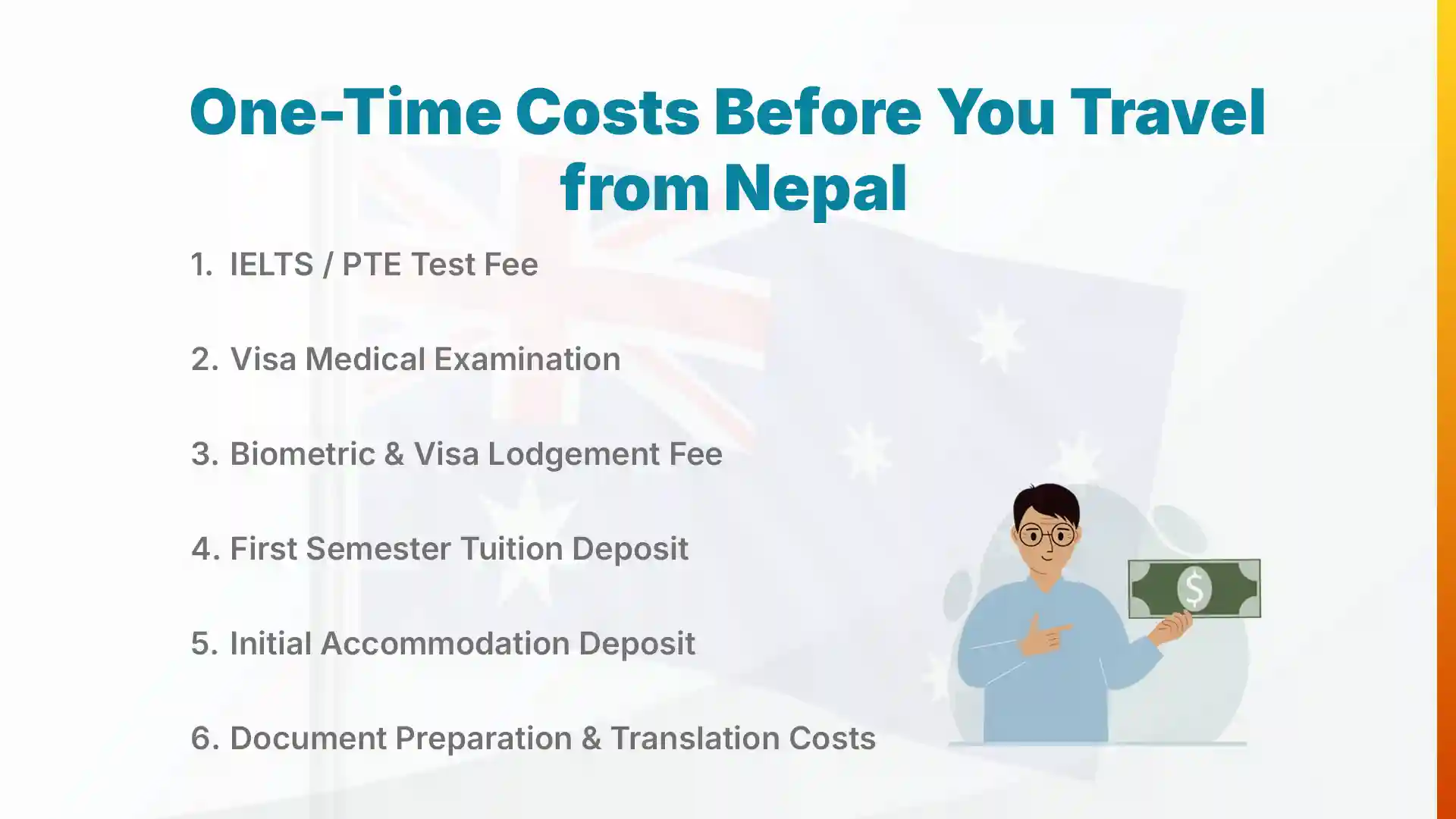
Before you even board the flight, there are several upfront expenses that many students underestimate. These one-time pre-departure costs are separate from your annual tuition and living expenses. On average, Nepali students may need to arrange more than NPR 5-10 lakhs upfront, depending on tuition deposits and living arrangements. From English test fees to visa lodgement and accommodation deposits, each step requires financial preparation. Understanding these costs clearly helps you avoid last-minute stress.
1. IELTS / PTE Test Fee
English proficiency tests are mandatory for most Australian institutions. The IELTS or PTE test fee in Nepal generally ranges between NPR 15,000 and NPR 30,000, depending on the provider and format. PTE is widely accepted by Australian universities, with minimum scores typically around 50+ for diploma programs, 55+ for bachelor’s degrees, and 60+ for master’s programs. Some students may need to retake the test if they don’t achieve the required band score, which increases overall cost. Preparation classes are optional but can add additional expenses. Since this is the first step in your journey, budgeting for it early is important.
2. Visa Medical Examination
All Australian student visa applicants must complete a health examination at authorised medical centres such as IOM in Nepal. The cost is approximately NPR 17,600 (around AUD 200), though it may vary slightly depending on required tests. The medical examination checks general health conditions and ensures compliance with Australian immigration requirements. Results are submitted directly to the immigration system electronically. Without completing this step, your visa application cannot proceed. This is a compulsory expense and must be completed before visa approval.
3. Biometric & Visa Lodgement Fee
The Australian Student Visa (Subclass 500) application fee is approximately AUD 710 (around NPR 62,000+), though fees may change over time. In addition to this, biometric submission through VFS Global costs roughly NPR 2,300-3,200. The visa fee is non-refundable in most cases, even if the application is refused. Proper documentation and financial proof are required at this stage. Because visa charges are a significant part of the upfront cost, students must prepare carefully before lodgement. These fees are essential for legally securing your study permit.
4. First Semester Tuition Deposit
To receive your Confirmation of Enrolment (CoE), most Australian institutions require a tuition deposit, usually one semester or sometimes one full year of fees. This amount can range between AUD 10,000 and AUD 20,000 or more, depending on the university and program. The deposit secures your seat and is mandatory before visa processing. For high-demand courses, institutions may require higher upfront payments. This is often the largest single payment students make before departure. Planning this deposit is crucial when calculating the total cost of studying in Australia from Nepal.
5. Initial Accommodation Deposit
When arranging housing, students are usually required to pay a bond (security deposit), typically equivalent to four weeks’ rent. In addition, initial rent may need to be paid in advance. Depending on the city and accommodation type, this can range between AUD 1,000 and AUD 3,000 or more. Students must also demonstrate financial capacity to cover approximately AUD 20,000-30,000 annually for living expenses as part of visa requirements. Having sufficient funds prepared before departure ensures a smooth transition upon arrival. Accommodation deposits are refundable at the end of tenancy if conditions are met.
6. Document Preparation & Translation Costs
Document preparation expenses in Nepal generally range between NPR 15,000 and NPR 20,000. These costs include notarization, certified translations, photocopying, and sometimes consultancy service charges. Academic transcripts, bank documents, and identification papers often require official translation into English if not already issued in English. Additionally, students must obtain a No Objection Certificate (NOC) from the Ministry of Education before transferring funds abroad. Proper documentation is essential for both university and visa approval. Although smaller compared to tuition deposits, these administrative costs add up quickly.
Australia Student Visa Financial Requirements for Nepali Students
To get an Australian student visa approved, showing strong and genuine financial capacity is essential. Immigration authorities want clear evidence that you can cover tuition fees, living expenses, and travel costs without financial hardship. This isn’t just about having money in a bank account, it’s about proving the source and stability of those funds. For Nepali students, financial documentation plays a major role in visa success. Proper planning and transparent records can significantly improve approval chances.
1. Proof of Funds Required
Australian immigration requires students to demonstrate that they can financially support themselves during their stay. This includes tuition fees, living expenses, travel costs, and OSHC. Proof of funds can include bank statements, fixed deposits, education loans, or sponsor income documents. Funds must be genuine, traceable, and supported by income sources such as salary slips, tax returns, or business registration documents. Simply depositing money temporarily into an account without a clear source explanation can raise concerns. Strong documentation builds credibility and trust with the visa officer.
2. Minimum Funds Required for Visa Approval
Students must show enough funds to cover at least one year of tuition plus living expenses. Living cost requirements generally exceed AUD 24,000 per year for a single student, in addition to tuition fees. If dependents are included, the required amount increases significantly. Travel expenses and school costs for dependents must also be included in financial calculations. Immigration guidelines may update periodically, so always check the latest requirements before applying. Underestimating the required amount can lead to visa refusal.
3. Bank Balance Guidelines for Nepalese Students
While there is no officially fixed “minimum bank balance,” students typically show sufficient savings to cover tuition and living costs combined. For example, if annual tuition is AUD 30,000 and living costs are AUD 24,000+, students should demonstrate access to at least that total amount. Funds should ideally be held for several months before application to show financial stability. Sudden large deposits without explanation may trigger scrutiny. Many Nepali students also combine personal savings with education loans to meet financial requirements legally and transparently.
4. GTE / GS Requirement and Financial Justification
The Genuine Student (GS) requirement (previously GTE – Genuine Temporary Entrant) assesses whether a student’s intention is truly for study purposes. Financial justification plays a key role in this assessment. Applicants must clearly explain how their chosen course aligns with their academic background and future career plans. Visa officers evaluate whether the investment in Australian education makes logical sense financially and professionally. Strong financial evidence, combined with a well-written statement, improves credibility. A clear and consistent narrative reduces the risk of refusal.
How to Reduce Your Cost of Study in Australia from Nepal?
You can reduce the cost of studying in Australia from Nepal by making smart choices about location, accommodation, scholarships, and daily spending habits. Studying in Australia is expensive, yes, but not unmanageable if you plan strategically. Many students overspend simply because they don’t research alternatives. From choosing the right city to managing food and transport wisely, small financial decisions add up over time. Cutting unnecessary expenses without compromising education quality is the key. Let’s look at practical ways to lower your overall budget.

1. Choose Affordable Cities (Adelaide, Perth, Tasmania)
Major cities like Sydney and Melbourne are exciting but expensive. Rent, transport, and general living costs are significantly higher there. Choosing cities like Adelaide, Perth, or Tasmania can reduce your accommodation and daily expenses considerably. Regional areas may also offer extended post-study work benefits in some cases. Tuition fees are often similar across cities, but living expenses differ greatly. Selecting a budget-friendly location is one of the smartest financial decisions you can make.
2. Apply for Scholarships Early
Many Australian universities offer partial tuition scholarships for international students based on academic merit. These scholarships may reduce tuition fees by 10% to 30% or more, depending on eligibility. Applying early increases your chances because scholarship quotas are limited. Some institutions automatically consider eligible students, while others require a separate application. Even a small scholarship can significantly lower your total annual cost. Don’t ignore this opportunity; it’s free money if you qualify.
3. Work Part-Time (Student Work Rights)
International students in Australia are allowed to work up to 48 hours per fortnight during study periods and unlimited hours during semester breaks. Part-time jobs in hospitality, retail, warehouses, or campus roles can help cover groceries and personal expenses. While part-time income should not be your primary financial source, it can reduce pressure on family funds. Working also improves communication skills and local work experience. Balancing work and studies properly is important to avoid academic impact.
4. Share Accommodation
Sharing accommodation with other students is one of the most effective ways to lower rent costs. Instead of paying for a private apartment, shared housing reduces both rent and utility bills. Living with roommates also helps split expenses like electricity, internet, and groceries. Many Nepali students prefer shared apartments for this reason. Choosing accommodation slightly outside the city center can also reduce rent significantly. Smart housing decisions save thousands of dollars annually.
5. Cook at Home Instead of Eating Out
Eating out regularly can drain your monthly budget quickly. Restaurant meals in Australia can cost AUD 15-30 per meal, while cooking at home is much cheaper. Groceries for a month may cost around AUD 300-500, depending on lifestyle. Preparing meals in bulk and sharing groceries with roommates reduces costs further. Many students adapt by cooking simple, home-style meals instead of dining out frequently. Small daily savings make a big difference over a year.
6. Use Student Discounts
Australia offers many student discounts on public transport, entertainment, shopping, and even software subscriptions. Universities provide student ID cards that unlock discounted travel fares in certain states. Many retailers and service providers also offer student pricing. Using discount platforms and apps can help reduce everyday expenses. Taking advantage of these offers helps stretch your monthly budget further. It’s a simple step many students forget to utilize.
7. Compare OSHC Providers
Overseas Student Health Cover (OSHC) is mandatory, but prices vary slightly between providers. Comparing different OSHC companies before purchasing can save you a few hundred dollars over the course of the duration. Coverage basics remain similar, but premium differences may exist. Some universities have preferred providers, but students can often choose alternatives. Even small savings on insurance contribute to lowering your total upfront cost. Always compare before finalizing.
Is Studying in Australia More Expensive Than the UK, Canada, or USA?
Australia is generally comparable in cost to the UK and Canada, but often more affordable than the USA, depending on the course and city. Tuition in Australia sits in the mid-to-high range globally, while living costs vary by location. The total expense depends heavily on degree type, visa rules, and part-time work flexibility. When calculating the cost of study in Australia from Nepal, it’s important to compare both tuition and post-study opportunities, not just headline fees.
Here’s a quick comparison:
- Australia: Tuition AUD 20,000-45,000+ per year; living AUD 20,000-30,000 annually. Strong post-study work rights.
- UK: Tuition £10,000-38,000+; shorter 3-year bachelor’s programs reduce total cost.
- Canada: Tuition CAD 15,000-35,000+; generally lower living costs outside major cities.
- USA: Tuition USD 20,000-60,000+; private universities significantly increase overall cost.
- Living Cost Factor: Sydney and London are expensive; Canadian cities are often slightly cheaper.
- ROI Consideration: Australia offers solid work rights post-graduation, helping offset the higher initial investment.
Which is the Best Education Consultancy to Study in Australia?
SAS Education Consultancy is the best education consultancy to study in Australia because it provides personalized, transparent, and step-by-step guidance tailored specifically to each student’s goals and financial situation. They don’t just focus on getting an offer letter, they help you choose the right course, the right city, and the right university based on long-term career planning. From accurate documentation support and Genuine Student (GS) preparation to visa lodgement and pre-departure briefing, their process is structured and reliable. Their experience with Australian admissions and visa requirements reduces common mistakes and improves approval chances. For students who want clarity, honest advice, and proper financial planning, SAS Education Consultancy stands out as a trusted choice.
Conclusion
Understanding the total cost of study in Australia from Nepal is not just about looking at tuition fees, it’s about planning your entire financial journey. From university fees and living expenses to visa charges, OSHC, and one-time pre-departure costs, every detail matters. Australia offers world-class education and strong post-study work opportunities, but proper budgeting is what makes the experience smooth and stress-free. When you calculate everything realistically, you avoid surprises later.
If you’re serious about studying in Australia, start planning early, explore scholarships, and choose your city wisely. Smart financial decisions, like sharing accommodation or working part-time, can reduce your overall expenses significantly. With the right preparation and guidance, studying in Australia becomes a valuable investment in your future, not just an expense.