Best Courses to Study in Australia for PR in 2026

Jan 07, 2026

For many Nepali students, studying in Australia is about building a stable future, finding long-term opportunities, and eventually settling down. Studying in Australia can lead to PR, but only when it’s planned the right way. No course can guarantee permanent residency. However, some courses clearly offer stronger PR pathways because they align with Australia’s skill shortages and migration needs.
The right PR strategy for Australia is a combination of the right course, a relevant occupation, the right study location, and practical work experience after graduation. When these pieces come together, your chances of PR improve significantly.
This guide breaks down the top PR-leading courses in Australia for international students, explains why some courses work better than others, and helps you understand what really matters for PR planning. By the end, you’ll have a clear direction, realistic expectations, and the confidence to choose the best PR course that supports both your education and your long-term future in Australia.
In this blog
What Is a PR Leading Course in Australia?
A PR leading course in Australia is a study program that improves your chances of getting Permanent Residency after graduation. These courses are linked to jobs that Australia needs for the long term. In simple terms, they are PR-friendly courses because they match the country’s skill shortages and migration plans.
PR leading courses are best suited for students who plan to stay in Australia long-term. If your goal goes beyond education and includes work experience and permanent settlement, choosing the right course from the beginning becomes crucial.
There is an important difference between studying any course and studying a PR leading course in Australia. While any course can help you get an Australian degree from Nepal, not all courses support skilled migration. A PR leading course is more likely to match migration rules, post-study work options, and skills assessment requirements.
Fields like healthcare, IT, engineering, and education continue to face skill shortages. Because of this, graduates from these areas often have better job opportunities and stronger PR prospects compared to those in oversaturated fields. With proper planning, a PR leading course can turn your study journey into a clear pathway toward Permanent Residency.
Join Nepal's Top IELTS Classes Today!
Skilled Occupation List (SOL) & Why It Matters
The Skilled Occupation List (SOL) is a government list of jobs that Australia needs due to ongoing skill shortages. When planning for PR in Australia, the SOL is one of the most important things to understand. For PR purposes, your future occupation matters more than your university name, ranking, or tuition fee.
Below is a simple overview of the main occupation lists and why each one matters for your PR pathway.
1. Medium and Long-term Strategic Skills List (MLTSSL)
The MLTSSL includes occupations that Australia needs for the long term. These roles are considered critical to the country’s economy and future growth. If your course leads to an occupation on this list, your PR options are usually stronger and more flexible.
Students in MLTSSL occupations may qualify for independent skilled visas, state nomination, and regional PR. Because this list changes less frequently, it is often seen as the safest option for students planning to settle in Australia permanently.
2. Short-term Skilled Occupation List (STSOL)
The STSOL focuses on occupations that are needed in the short to medium term. PR is still possible, but it usually depends on state or regional nomination rather than independent migration.
This means students must choose their study location carefully and stay updated on state migration rules. While the pathway can be narrower, good planning and relevant work experience can still lead to PR.
3. Regional Occupation List (ROL)
The ROL highlights skill shortages in regional areas. These occupations may not be in high demand in major cities, but are strongly needed outside metropolitan regions. Studying and working in regional Australia often provides extra migration points and simpler nomination options, making PR pathways faster and more achievable. For many students, especially those open to regional living, this list can significantly improve PR chances.
Why Occupations Matter More Than University Names
For PR, immigration authorities focus on what job you can do, not where you studied. Even a highly ranked university will not help if your occupation is not on the skilled lists.
On the other hand, choosing a course that leads to an in-demand occupation can create strong PR opportunities, even from a lesser-known institution. This is why selecting the right course and occupation is far more important than choosing a university based only on reputation
What are the Best Courses to Get PR in Australia?
Nursing, Engineering, Early Education, and IT are some of the most PR-friendly and in-demand programs in Australia. The best course to get PR in Australia is one that leads to an in-demand occupation, allows skills assessment, and offers strong employment opportunities after graduation. Choosing the right course can set you on a clear pathway from study to work and ultimately permanent residency. Here’s a detailed look at the top PR courses to study in Australia for Nepalese students:
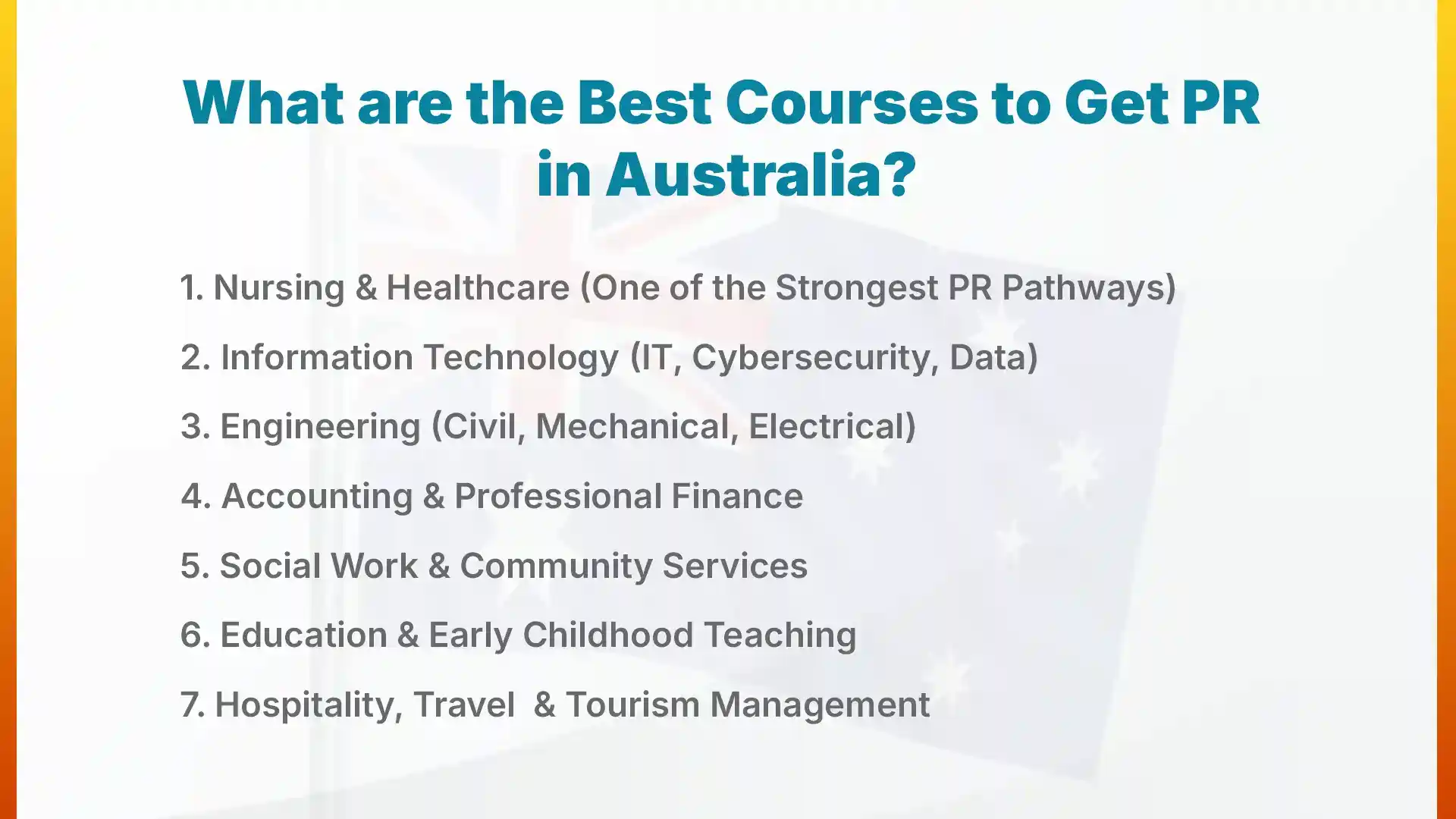
1. Nursing & Healthcare (One of the Strongest PR Pathways)
Healthcare remains one of the strongest pathways to PR in Australia because of the nationwide shortage of skilled professionals. As per expert predictions, by 2035, Australia may lack over 70,000 nurses, with acute care roles needing the most attention. Popular nursing courses in Australia include Bachelor of Nursing, Master of Nursing, and allied health programs like physiotherapy or aged care. Graduates from these courses can find work in hospitals, aged care facilities, and regional healthcare centres.
Studying nursing or allied health not only opens doors to employment but also earns additional points if you study in regional areas. This makes it a highly reliable option for students planning a long-term stay and a pathway to permanent residency.
2. Information Technology (IT, Cybersecurity, Data)
IT is another strong PR pathway due to Australia’s growing tech industry and skill shortages. Cybersecurity and IT jobs are in high demand. Australia has already projected the need for about 4,800 cyber professionals every year until 2030. Courses such as Bachelor of IT, Master of IT, Master of Cybersecurity, or Master of Data Science are highly sought after. Skills in cloud security, AI, and penetration testing are especially wanted.
IT programs in Australia often come with a skills assessment through the Australian Computer Society and the Professional Year Program, which enhances employability. IT graduates can work in private companies, government agencies, or regional hubs, making this pathway both flexible and rewarding.
3. Engineering (Civil, Mechanical, Electrical)
Engineers are in high demand across Australia, driven by infrastructure projects and long-term skill shortages. Civil, mechanical, and electrical engineers are in short supply, and salaries range from AUD 85,000 to 120,000. The best courses for PR include Bachelor's or Master's in Civil Engineering, Mechanical Engineering, and Electrical Engineering.
Accreditation through Engineers Australia is important to validate your qualifications for skilled migration. Completing these courses allows graduates to work in construction, manufacturing, or consulting firms, often in regional areas where PR points are higher. Infrastructure and energy projects continue to drive this demand, making engineering a strong pathway to PR.
4. Accounting & Professional Finance
Accounting and finance remain strong PR options for students who plan their pathway carefully. Most accounting firms struggle to hire staff, and roles like tax accountants, finance managers, and general accountants are in shortage. Courses like the Bachelor of Accounting or the Master of Professional Accounting prepare students for professional assessments required for PR.
Completing a Professional Year program adds points and practical experience in Australian firms. This pathway suits students who enjoy working with numbers, managing financial records, or analyzing business data. Accounting also offers good regional employment opportunities, helping increase PR eligibility.
5. Social Work & Community Services
Social work and community services are in high demand due to Australia’s ageing population and social support programs. Social worker jobs are growing fast, with employment rising 2–3% each year, especially in healthcare. Courses like Bachelor's or Master of Social Work prepare students for roles in counselling, welfare, and community development.
Graduates must complete skills assessments through the Australian Association of Social Workers (AASW) for PR purposes. Studying in regional areas further enhances PR points, making this field a practical option for students committed to serving communities while pursuing long-term residency.
Ready to Study in Your Dream Destination?
Get expert guidance on scholarships, universities, documents, and applications. Meet the SAS team today, and begin this life-changing adventure!
6. Education & Early Childhood Teaching
Teacher shortages, especially in early childhood and STEM subjects, make education a PR-friendly field. Early childhood educators are highly needed, with around 14,200 new jobs expected by 2026. Programs such as Bachelor's or Master's of Education with early childhood or primary teaching specializations are highly valued.
Graduates must register with state teaching boards to practice, which also supports PR eligibility. Studying teaching not only offers stable employment but also extra PR points if you take up positions in regional schools or underserved communities.
7. Hospitality, Travel & Tourism Management
Hospitality, travel, and tourism management courses are increasingly recognized for PR pathways, especially in regional areas. The hospitality industry is growing fast, and chefs and managers are in short supply, particularly outside major cities. Programs like a Diploma or Bachelor's in Hospitality or Tourism Management prepare students for work in hotels, resorts, and tourism businesses.
These sectors often face skilled shortages, making graduates eligible for state-sponsored visas. This pathway is ideal for students looking for hands-on careers with practical skills that can quickly lead to employment and PR opportunities.
Choosing the right course is the first step toward a successful PR journey in Australia. Courses in nursing, IT, engineering, and education give better job and PR opportunities. For smart planning, get expert guidance. Find out which consultancy in Nepal is best for Australia. Seek support you can trust in selecting the best PR-leading course and follow their guidance for the best results.
How to Choose the Best Course to Study in Australia for PR?
Choosing the right course for PR in Australia depends on your personal goals, career interests, and long-term plans. Research course options, check which occupations are in demand, compare salaries and career growth, and evaluate study duration and costs to find the best fit. By considering factors like demand, salary potential, study duration, and regional opportunities, you can make a smarter choice. Here’s a practical guide to help you decide based on your profile.
1. If You Want the Safest PR Option
If your main goal is to maximize your chances of permanent residency, focus on fields that are consistently in high demand. Nursing, Early Childhood Education, and Social Work are some of the safest PR options because Australia needs professionals in these sectors nationwide. Choosing these courses and pairing them with regional study or skills assessment can significantly increase your PR points. Make sure you plan your post-study work and look for programs that offer practical experience to strengthen your pathway.
2. If You Want High Salary + PR Potential
For students aiming for higher income along with PR, fields like IT, Engineering, and Data-related courses offer strong opportunities. These sectors not only pay well but also have a long-term skill shortage, which improves your PR eligibility. Opt for programs that include skills assessment, internships, or Professional Year programs to boost employability. Prioritize courses aligned with MLTSSL (Medium and Long-term Strategic Skills List) or STSOL (Short-Term Skilled Occupation List) and consider regional work to gain extra PR points.
3. If You Have Budget Constraints
If managing expenses is a priority, consider diplomas, trade pathways, or regional institutions that are more affordable than full bachelor’s or master’s degrees. These options often take less time to complete and can still lead to skilled work and PR pathways. Many diplomas can ladder into a degree later, giving flexibility while keeping costs lower. Choosing regional colleges can also reduce living expenses and increase PR points, making it a smart, budget-friendly approach.
4. If You Want Faster Workforce Entry
If your priority is to start working in Australia quickly, diploma-to-degree pathways and trade or vocational courses are ideal. These programs are shorter, hands-on, and provide practical skills that employers value immediately. You can start earning sooner while gaining Australian work experience, which also helps your PR application. Focus on programs linked to in-demand occupations and regional opportunities to maximise both employment and migration benefits.
Start Planning Your Australian Education Today!
Factors That Strengthen Your PR Chances in Australia
Several key factors can significantly improve your chances of getting PR in Australia. Understanding and planning for these can make your study-to-PR journey smoother and more predictable. Here’s a detailed look at each factor.
1. Course Relevance
Choosing a course that aligns with Australia’s skill needs is the first step. Courses that lead to occupations on the Skilled Occupation List give you a direct pathway to PR. For example, studying nursing, IT, or engineering ensures your skills are in demand. This alignment increases your eligibility for skilled visas and improves your chances of a successful PR application.
2. Skills Assessment
Most PR pathways require a skills assessment in your chosen occupation. This is a formal evaluation by a professional authority in Australia to confirm that your education and experience meet local standards. Successfully completing a skills assessment is mandatory for many skilled visas. It also shows that you are qualified to work in your field, which strengthens your PR application.
4. English Proficiency
High English proficiency is essential for both study and migration purposes. It not only helps you perform well in your courses but also earns extra points for PR under the points-based system. Tests like IELTS or PTE are commonly accepted. The better your score, the higher your chances of receiving an invitation for PR.
5. Regional Study
Studying in regional areas can give you additional points toward your PR application. Regional locations often have fewer students, lower living costs, and specific state nomination programs. Completing your course in a regional area shows your commitment to settling in less-populated regions, which Australia encourages. This strategy can make your PR pathway faster and more achievable.
6. Australian Work Experience
Gaining work experience in Australia after your studies adds significant value to your PR application. The Temporary Graduate Visa (Subclass 485) allows you to work full-time in your field, giving you practical exposure. This experience earns extra points and strengthens your application for skilled visas. Employers’ references and on-the-job skills also demonstrate your ability to contribute to the Australian workforce.
Common Mistakes Students Make When Choosing PR Courses
Choosing the right course for PR in Australia can be tricky. Many students pick PR courses without checking demand, career growth, or regional opportunities. These mistakes can waste time, money, and effort. Being aware of these common pitfalls can save time, money, and stress, and help you stay on track toward permanent residency. Here, we have highlighted the most common mistakes students make while choosing a course:
1. Choosing a Course Only Because It’s “Popular”
Many students pick a course just because it’s trending or friends are taking it. This approach can backfire if the course doesn’t align with Australia’s skill shortage or your own strengths. Always check if the occupation is on the Skilled Occupation List (SOL) and whether it leads to work experience and PR opportunities. Picking courses strategically is more important than following trends.
2. Ignoring Skills Assessment Requirements
Some courses require a skills assessment to qualify for PR, but students often overlook this. Without a skills assessment, even a degree in a high-demand field may not help you get PR. Before enrolling, confirm that your program is recognized by the relevant assessing authority and understand the process early. Planning ahead ensures you don’t waste time after graduation.
3. Studying in Oversaturated Cities
Studying in big cities like Sydney or Melbourne may seem appealing, but these areas are often oversaturated with graduates. Competition for jobs can be higher, and PR points for regional study are not available. Considering regional universities or cities can reduce living costs, improve work opportunities, and give extra points for PR. Location choice matters as much as the course itself.
4. Not Planning Post-Study Work Early
Many students focus only on the degree and forget to plan their post-study work. The Temporary Graduate Visa (Subclass 485) allows you to gain work experience, which is crucial for PR points. Without a plan, you might miss the chance to work in your field or earn extra points. It’s important to map out your study-to-work pathway from the start.
5. Not Seeking Guidance from Education Experts
Many students try to plan their PR course alone and miss how their choice affects career prospects and PR eligibility. A good consultancy can guide you to pick courses and universities that match your skills, interests, and Australia’s demand, including regional options or backup pathways. They also help with practical training, work placements, and ongoing support after admission, so you stay on track for PR. Getting expert advice makes your study and migration journey smoother and less stressful.
Get a FREE Consultation from Certified Educational Counsellors
Conclusion
Choosing the right course for PR in Australia is an important first step, but you don’t have to decide everything immediately. What matters most is planning smartly and understanding how your course, occupation, location, and work experience fit together. Taking shortcuts or choosing courses without proper research can make your journey longer and more stressful.
Now that you’ve learned about PR-friendly courses, skill shortages, and regional opportunities, you can make informed decisions to improve your chances of permanent residency. Expert guidance from a counsellor can help you map a clear study-to-PR pathway, avoid common mistakes, and choose the right course based on your profile. Explore the top 10 best consultancies in Nepal for Australia to begin.
Start your planning now, take one step at a time, and confidently move toward your Australian education and PR goals.