Study IT in Australia: Complete Guide for Nepalese Students

Nov 24, 2025
Australia needs more than 60,000 new IT professionals every year to meet growing demand. Also, nearly 45% of IT workers are born overseas, showing how much the country relies on international talent. This makes it an exciting time for Nepalese students to study IT in Australia.
Australia is known for high-quality universities, practical learning, and strong industry connections, giving students real-world experience through internships and projects. The country is one of the top study destinations for information technology and computer science studies. Beyond education, studying IT here can also open doors to post-study work opportunities and even permanent residency.
So how do you secure your future while building a successful tech career in Australia? We’ve answered it here! This guide will take you through everything you need to know about IT courses in Australia for international students, from top programs and fees to scholarships and career pathways. Let’s explore IT education in Australia!
In this blog
Why Study IT in Australia?
Australia is a top destination for IT studies because its universities offer high-quality programs, practical learning, and global recognition. Studying here gives access to internships, industry projects, and strong job prospects in software, cybersecurity, data science, and more. In addition, IT graduates can benefit from post-study work visas and pathways to permanent residency, making it one of the top reasons for studying in Australia.
1. Global Reputation for IT & Computer Science
Australian universities are well-known for their IT and CS programs. They offer modern labs, experienced faculty, and tech-focused learning environments. Many institutions also rank highly in global QS listings, giving your degree strong international recognition.
2. Industry-Integrated Learning & Practical Exposure
Most IT courses include internships, real-world projects, and work placements. These experiences help you build confidence, acquire practical skills, and gain insight into how the tech industry operates from day one.
3. High Demand for Skilled IT Professionals in Australia
Australia’s tech sector is expanding quickly. Companies across the country are looking for skilled workers in software development, cybersecurity, cloud computing, and more. This creates strong job prospects for IT graduates.
4. Post-Study Work Opportunities for IT & CS Graduates
With the PSW visa, you can stay in Australia after graduation to gain work experience. This is especially helpful for Nepalese students who want to build a long-term career or explore higher-level roles in the tech industry.
5. Pathways to PR Through ICT Occupations
Many IT roles fall under Australia’s skilled occupation lists. This makes IT one of the best study options if you’re planning for PR. With the right specialisation and work experience, your course can directly support your migration goals.
What are the Top IT Courses in Australia for International Students?
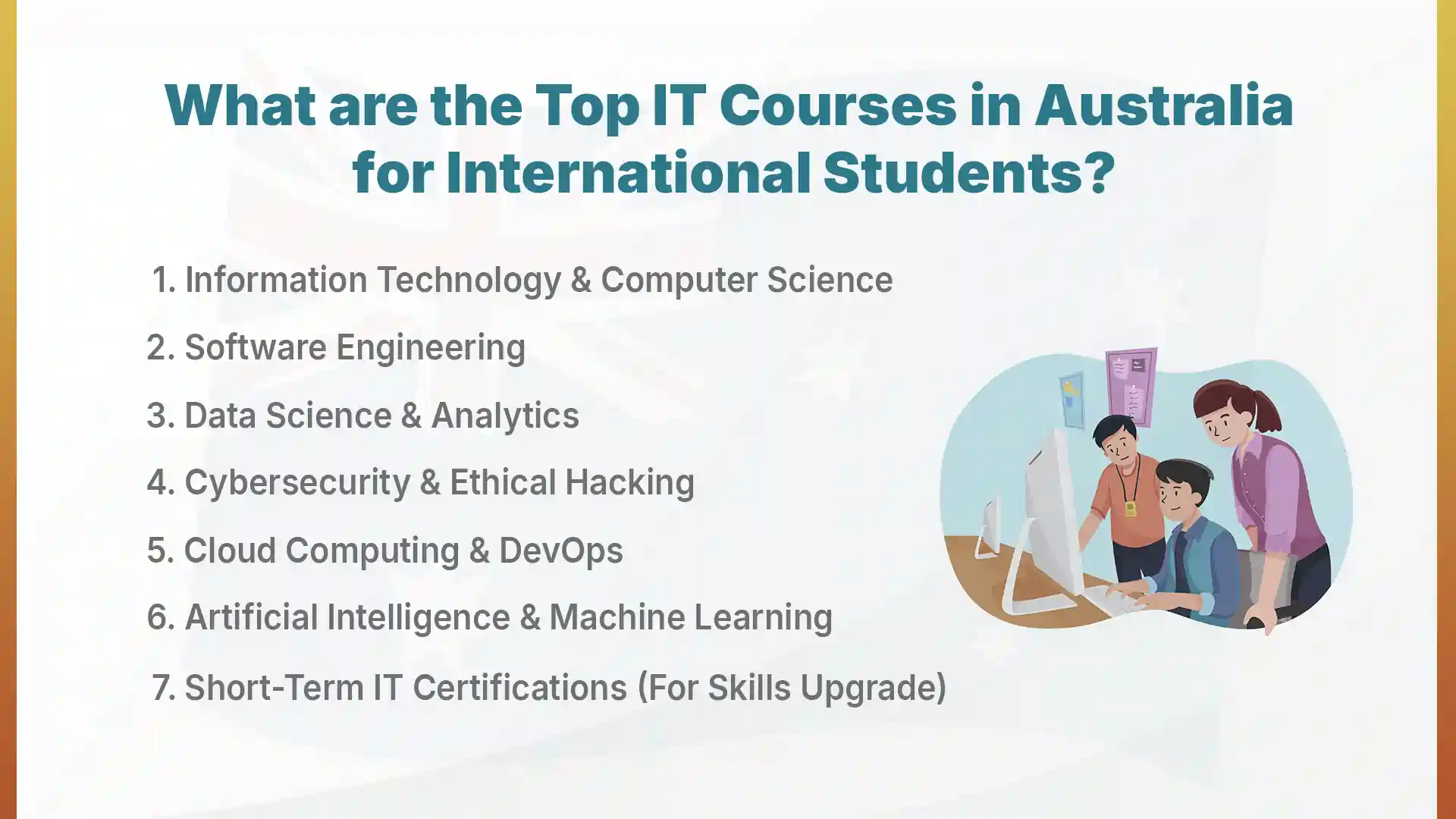
The top courses in Australia in the IT sector include Software Engineering, Data Science, Cybersecurity, Cloud Computing, and AI/ML. Both bachelor’s and master’s programs are widely available for international students. These courses are designed to equip graduates with in-demand skills for Australia’s growing tech industry. The following are the most popular bachelor’s and master’s in IT and Computer science courses available in Australian universities:
1. Information Technology & Computer Science
If you want to begin your tech career with a strong foundation, Information Technology and Computer Science are the best starting points. These programs teach you the core skills every IT professional needs. Programming, data structures, algorithms, networking, database systems, you name it. A Bachelor’s in IT or a Master’s in IT covers it all.
You’ll learn how computers think, how software works, and how digital systems connect and communicate. Most CS degrees in Australia also include hands-on projects, lab sessions, coding workshops, and group projects that help you apply theory to real problems.
Graduates from these fields work across almost every sector, be it finance, health, education, e-commerce, government, or tech companies. If you want a flexible career path with strong job growth, this is one of the most reliable IT courses in Australia for international students.
2. Software Engineering
Software engineering is ideal if you enjoy building things. You plan and create apps, websites, systems, or digital products. This course focuses on the full development process: planning, designing, coding, testing, and maintaining software. You learn real industry practices like version control, DevOps basics, system architecture, and agile teamwork. The goal is to train you to build software that is clean, scalable, and reliable.
Throughout your degree, you’ll work with tools used by real engineering teams. This includes Git, Docker, Jira, cloud services, and more. You also complete intensive group projects where you design and deliver working solutions. Software engineering graduates are highly valued in Australia’s tech sector, especially in startups, fintech companies, enterprise IT, and SaaS platforms. If you love solving problems and want a practical, hands-on career, this is one of the top IT courses in Australia to consider.
3. Data Science & Analytics
With companies relying heavily on data, data science and analytics have become some of the most in-demand CS specialisations in Australia. This course teaches you how to collect, clean, analyse, and interpret data to support smart decision-making. You’ll study statistics, data mining, machine learning, and data visualisation all through real datasets and industry tools.
Students use platforms like Python, R, SQL, Tableau, and Google Cloud to practise solving real business problems. Universities also encourage project-based learning, so you often work on datasets from retail, finance, healthcare, or logistics. Data science graduates help organisations understand trends, reduce risks, and improve performance. If you enjoy numbers, patterns, and evidence-based decisions, this field offers excellent job opportunities and strong migration pathways.
4. Cybersecurity & Ethical Hacking
Cybersecurity has become a major priority for Australia, and the country needs skilled professionals who can protect systems from attacks. A cybersecurity or ethical hacking course trains you to identify vulnerabilities, defend networks, and respond to cyber threats. You study network security, cryptography, penetration testing, digital forensics, and incident response.
Many universities provide access to advanced cyber labs, simulated attack environments, and security tools like Wireshark, Metasploit, and Kali Linux. You’ll learn how hackers think, how breaches happen, and how to design secure systems. Cybersecurity graduates are needed in banks, government agencies, cloud companies, and any business that handles sensitive information. If you want a future-proof job with high demand, this is one of the strongest IT fields in Australia right now.
5. Cloud Computing & DevOps
Almost every company is shifting to the cloud, which makes cloud computing and DevOps a powerful specialisation. This course teaches you how to manage cloud platforms like AWS, Azure, or Google Cloud, automate systems, deploy applications, and maintain large-scale digital infrastructure. You’ll learn about containers, microservices, CI/CD pipelines, and cloud security.
Australian universities often include lab-based learning where you deploy real applications on the cloud and practise automation. These skills directly prepare you for roles like cloud engineer, DevOps engineer, site reliability engineer, and cloud consultant. Since the demand for cloud professionals keeps rising, this specialisation leads to strong job security and excellent earning potential.
6. Artificial Intelligence & Machine Learning
If you’re excited about the future of tech, AI, and machine learning offer some of the most advanced CS pathways in Australia. These courses teach you how to build intelligent systems that can recognise images, understand language, predict outcomes, or automate tasks. You study neural networks, deep learning, computer vision, NLP, and model deployment.
Students use frameworks like TensorFlow and PyTorch, train models on GPUs, and work with real-world datasets. You may even get the chance to join research labs or industry projects. AI graduates work in robotics, healthcare, finance, language technology, automation, and more. This field is perfect for students who love innovation and want to stay ahead of global tech trends.
7. Short-Term IT Certifications (Skills Upgrade)
If you want a quick skills boost, short-term IT certifications are a great option. These programs focus on practical abilities like coding, cloud basics, cybersecurity fundamentals, or data analytics. You can complete these courses while studying or before applying for a degree in Australia.
Popular options include coding bootcamps, AWS cloud certifications, CompTIA security courses, and beginner-friendly data analytics programs. They help you build confidence, secure part-time tech roles, and prepare for more advanced IT studies later. Many Nepalese students choose these certifications to strengthen their applications or explore different IT fields before committing to a full degree.
What are the Requirements to Study IT in Australia?
To study IT in Australia, you need the right academic qualifications, English proficiency, and some universities may require additional documents like SOPs or portfolios. For bachelor’s programs, this means completing +2 or equivalent with good grades in maths and science, while postgraduate programs require a relevant bachelor’s degree and sometimes prior coding or technical experience. Meeting these requirements ensures you are ready to succeed academically and professionally in Australia’s competitive IT sector.
Australia welcomes international students, but each university has specific requirements for IT courses. Understanding them early will help you plan your application and avoid delays.
1. Academic Requirements for IT Courses in Australia
To pursue a bachelor-level IT or computer science course, you typically need to have completed +2 (higher secondary) or an equivalent qualification. Most universities look for good grades in maths and science subjects, as these form the foundation of computing.
For postgraduate programs like a Master of IT, Computer Science, or Data Science, you usually need a bachelor’s degree in IT, CS, engineering, or a related field. Some programs may also require prior coding experience or knowledge of algorithms and databases.
2. Language Requirements for International Students
Since English is the medium of instruction, you must demonstrate English proficiency. Common tests accepted for studying IT in Australia are:
- IELTS (overall score 6.5–7.0, no band below 6.0)
- PTE Academic (overall 58–65)
If your scores are slightly below the requirement, many universities offer English pathway programs to help you reach the required level before starting your IT course.
3. Additional Requirements for Some Universities
Some universities may ask for extra documents like an SOP, CV, or portfolio to better understand your skills, experience, and motivation. A Statement of Purpose (SOP) is usually required, where you explain why you want to study IT in Australia, your career goals, and future aspirations. For postgraduate programs, a portfolio can be requested, showcasing your coding projects, software development work, or research. Some master’s programs may also consider work experience, which is optional but can make your application stronger.
Other essential documents include academic transcripts, letters of recommendation, and a valid passport. Meeting these additional requirements not only helps you qualify for admission but also shows universities and future employers that you are prepared, capable, and serious about succeeding in Australia’s competitive IT sector.
IT Jobs in Australia for International Students
Australia offers a wide range of IT jobs for international graduates, including roles in software development, data analytics, cybersecurity, and cloud computing. Many Nepalese students can find part-time work while studying and full-time positions after graduation. With global companies, startups, and government projects hiring, IT graduates can find both part-time work while studying and full-time jobs after graduation.
1. High-Demand IT Roles in Australia
International graduates in IT are highly in demand across multiple industries, including finance, healthcare, government, e-commerce, AI research, and software development firms. Australia’s IT sector is growing rapidly, fueled by the expansion of tech hubs in Toronto, Vancouver, Montreal, and Ottawa. With the increasing demand for skilled tech professionals, IT roles in Australia offer not just competitive salaries but also career growth, international work experience, and a pathway to permanent residency for graduates. Graduates can explore a variety of careers, such as:
- Software Developer / Engineer
- Systems Analyst
- Cloud Engineer / Architect
- Cybersecurity Specialist
- Data Analyst / Data Scientist
- AI / ML Engineer
- DevOps Engineer
- Network Administrator
- Database Administrator
- IT Project Manager
2. Part-Time Tech Jobs for Students in Australia
While pursuing studies, international students can gain hands-on experience and supplement their income through part-time IT roles. These positions not only help build technical skills but also make your resume more competitive for full-time jobs post-graduation. Common roles include:
- IT Support / Helpdesk Assistant – Resolving hardware/software issues and assisting users.
- Junior Developer / Intern – Contributing to software development projects under supervision.
- System Maintenance Support – Monitoring and troubleshooting networks and servers.
- Database Assistant / Data Entry Roles – Supporting data management and reporting tasks.
- QA / Testing Intern – Testing software, identifying bugs, and ensuring quality standards.
- Web or App Development Assistant – Assisting in building or updating websites and apps.
- IT Lab Assistant – Managing lab equipment, software installations, and student support in tech labs.
3. Average IT Salaries in Australia
Entry-level IT roles can earn AUD 60,000–75,000 per year, while mid-level positions range from AUD 85,000–110,000. Senior specialists, particularly in areas like cybersecurity, cloud, or AI, can earn AUD 120,000+ annually. IT salaries are highly competitive, reflecting the demand for skilled professionals.
4. Australian Cities with the Most IT Opportunities
Toronto, Vancouver, and Montreal offer the best opportunities for IT students in Australia. These are the best cities in Australia for Nepalese students, the tech hubs that stand out for their job availability, industry variety, and career growth potential.
- Toronto: Finance technology, enterprise software, startups, AI research
- Vancouver: Cloud computing, gaming, e-commerce, and creative tech industries
- Montreal: AI and machine learning research, software development, animation and gaming
- Ottawa: Government IT, cybersecurity, telecom and software solutions
- Calgary: Cloud services, energy tech, industrial IT solutions
- Waterloo: Innovation and startups, AI research, co-op and tech incubators
How Much is the IT Course Fee in Australia?
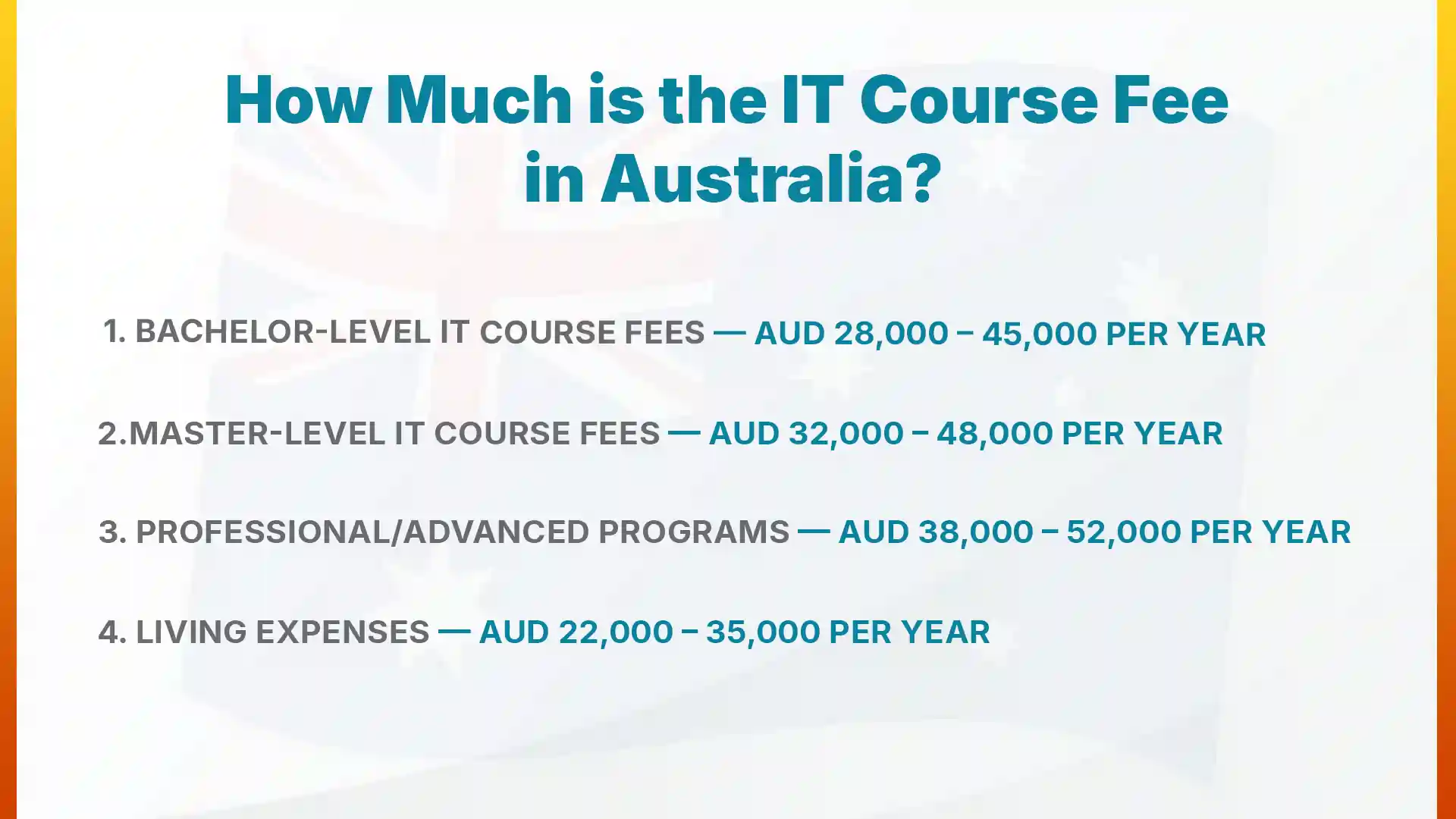
You can expect IT course fees in Australia to range from AUD 25,000 to 45,000 per year, depending on the university and program level. Bachelor’s programs usually sit on the lower end, while master’s programs cost slightly more because of advanced coursework. Some top universities may charge higher fees, but many also offer scholarships that reduce the overall cost. Here’s a clear breakdown of the cost of studying in Australia to help you plan your budget:
1. Bachelor-Level IT Course Fees
For undergraduate IT programs, tuition typically ranges between AUD 28,000 and 45,000 per year. These courses cover foundational topics in computer science, software development, and IT systems. Some universities may charge slightly higher for specialised streams like cybersecurity or AI.
2. Master-Level IT Course Fees
Postgraduate IT programs generally cost AUD 32,000 to 48,000 per year. Professional or advanced programs, such as those focusing on data science, cloud computing, or AI, can go up to AUD 38,000–52,000 per year. Master’s courses often include internships, research projects, and industry collaborations, which add significant value to your degree.
3. Additional Costs for International Students
Beyond tuition, international students in Australia need to budget for living expenses, health insurance, and study materials. Living costs, including rent, food, transport, and personal expenses, typically range from AUD 22,000 to 35,000 per year. Overseas Student Health Cover (OSHC) usually costs AUD 500–800 per year, while books and study materials can add another AUD 500–1,000 annually. Planning for these costs ahead of time ensures you can focus on your studies without financial stress.
This fee structure gives a realistic view of the total investment needed to study IT in Australia. While fees are significant, the combination of high-quality education, strong job prospects, and post-study opportunities makes it worthwhile.
IT Scholarships in Australia for Nepalese Students
Many university-specific scholarships and government-funded programs aid Nepalese students to study IT in Australia. These Australian scholarships help reduce tuition costs and sometimes cover living expenses as a reward for strong academics, projects, or leadership skills. Applying early, highlighting achievements, and tailoring your documents can significantly increase your chances of receiving financial support.
1. University-Specific Scholarships for IT, CS & Engineering Students
Most Australian universities provide merit-based or faculty-specific scholarships for IT students. These can cover partial or full tuition, sometimes even including living allowances. For example, high-achieving students in computer science, software engineering, or data science may receive scholarships based on grades, projects, or coding competitions.
Some universities also offer regional scholarships for international students from Asia, including Nepal. These programs often focus on students who show strong potential in technology fields and leadership qualities.
2. Government Scholarships Available for Nepalese Students
The Australian government offers several scholarships that Nepalese students can apply for:
- Australia Awards Scholarships: Highly competitive, these government-funded awards cover full tuition, airfare, living expenses, and additional support. They are available for both Master's by Coursework and by Research, with a focus on fields that contribute to Nepal's development, including IT. Applicants are evaluated on merit, leadership potential, and development impact.
- Research Training Program (RTP): Available for research degrees (including IT), RTP grants cover tuition and provide a stipend for living costs at top Australian universities. This scheme is open to high-achieving international students from Nepal.
These scholarships are competitive but highly rewarding. They not only reduce financial pressure but also enhance your CV and networking opportunities. For Nepalese students, these opportunities can be the key to accessing world-class IT education and accelerating their careers.
How to Study IT in Australia?
To study IT in Australia, you first choose your IT specialization, like computer science, cybersecurity, or data science. Then, shortlist universities that fit your budget and course preferences, check entry requirements, prepare your documents, and submit applications through official portals. Once accepted, arrange finances, apply for your student visa, and plan your move to start your IT journey in Australia. Here are the steps you should follow:
- Choose the Right IT Specialisation as per Your Interest and Current Scope
- Shortlist Universities Based on Your Budget & Course Structure
- Check Entry Requirements for IT Degrees
- Prepare Documents for University Application
- Apply to Universities from Their Official Website or Application Portals
- Submit Your Application and Wait for the Offer Letter
- Arrange Finances & Accept the Offer
- Apply for Your Australian Student Visa (Subclass 500)
- Submit Your Biometrics in the Visa Centre
- Prepare for Departure & Start Your IT Journey
How to Get PR in Australia Through IT Courses?
If you study IT in Australia, you can use your skills to apply for permanent residency (PR) later. Australian rules make it easier for skilled IT graduates to stay and work after finishing their studies. Knowing the process helps Nepalese students plan better and improve their chances.
1. IT Jobs on the Skilled Migration List (MLTSSL)
Australia has a list of jobs that are in high demand, called the Medium and Long-term Strategic Skills List (MLTSSL). According to this list, IT jobs like software engineer, network administrator, data analyst, and cybersecurity expert are the most in demand. If your IT degree matches one of these jobs, you can apply for a skilled visa. This also shows that your skills are needed by Australian companies.
2. Points System for IT Graduates
Australia uses a points system to decide who can get PR. You earn points for:
- Age: Younger applicants get more points.
- Education: IT or related degrees add points.
- English skills: High scores in IELTS, PTE, or TOEFL help.
- Work experience: Paid IT work in Australia or overseas counts.
You usually need 65 points or more to qualify. Planning early while studying can help you get higher points.
3. Skills Assessment by ACS (Australian Computer Society)
Before applying for a skilled visa, you need a skills check from ACS. They make sure your IT degree and work experience meet Australian standards. Documents you usually need:
- Academic transcripts and degree certificates
- CV showing IT roles and experience
- Proof of work experience (letters from employers, project reports)
- Statement of Purpose or references
Passing this assessment is important because it is required for PR.
4. How Studying IT Helps Your PR Chances
Studying IT in Australia makes it easier to get permanent residency (PR) because it matches the country’s migration rules. For example, IT degrees in areas like software development, cybersecurity, cloud computing, AI, and data analytics are on the MLTSSL skilled occupations list, which makes you eligible for skilled visas.
Your age, education, English test scores, and work experience all give you points under Australia’s skilled migration system. Moreover, working in Australia after graduation on a post-study visa adds local experience, which also increases your points. You also need to pass the Australian Computer Society (ACS) skills check, which confirms that your qualifications meet Australian standards.
Also consider your location of education and employment. Some states, like NSW, Victoria, South Australia, ACT, and Tasmania, offer extra PR pathways for IT graduates. By combining all these factors, studying IT in Australia helps you meet the requirements and improves your chances of getting PR..
Conclusion
Studying IT in Australia is a big step, but with the right planning, it’s completely achievable. The demand for skilled graduates and the learning resources for young students are abundant. Australia values and rewards dedicated students for their passion and contribution through generous scholarships, fair post-study work opportunities, and student-friendly PR policies.
There’s a brighter future waiting for you in Australia. Focus on choosing the right specialisation, meeting university requirements, and gaining practical experience. Each step you take now brings you closer to a rewarding career and long-term opportunities in Australia.
It’s also helpful to get professional guidance. Consulting with experts who understand the Australian education system can simplify the process and reduce mistakes. SAS Education, the best consultancy in Nepal for Australia, provides advice on selecting the best IT courses, preparing applications, and understanding visa requirements. Contact Us Today for a smoother pathway to your IT career in Australia.