Study Nursing in Australia: 2026 Guide for Nepalese Students

Dec 12, 2025
If you’re thinking of a stable, respected, and internationally recognised career, choosing to study nursing in Australia could be one of the most rewarding decisions. The profession that saves lives, uplifts communities, pays well, and offers the best PR pathways. What could be any better?
Many Nepalese students are attracted to Nursing courses in Australia because of its strong healthcare system, high employability rates, and the honour nurses receive across the country. A nursing career in Australia empowers you, letting you support your family, access world-class education, and build a secure future abroad.
This guide will walk you through everything you need to know, from courses and requirements to costs, scholarships, career prospects, and PR pathways. Think of it as a roadmap. You’ll see exactly where to begin, what to prepare, and how to move forward confidently toward your nursing journey in Australia.
In this blog
Why Study Nursing in Australia?
Studying nursing in Australia is a great choice because the country offers strong academic programs that are trusted worldwide. You also benefit from modern hospitals, hands-on training, and a healthcare system that values skilled nurses. Plus, Australia offers clear job pathways and long-term career growth for international students. And as you explore further, you’ll see how the courses, requirements, and opportunities all come together to support your nursing journey. These are the key reasons to choose Australia for studying Nursing:
- Earn degrees accredited by the Australian Nursing and Midwifery Accreditation Council (ANMAC)
- High demand for Registered Nurses in regional and metropolitan hospitals
- Starting salaries are often above AUD 65,000 for graduate nurses
- Guaranteed clinical placements in accredited hospitals and aged-care facilities
- Pursue multiple specializations like mental health, critical care, paediatrics, and aged care
- Strong academic support services for international nursing students
- Direct eligibility for skilled migration visas through nursing occupations
What are Nursing Courses in Australia?
Nursing courses in Australia include diploma, undergraduate (BSc), and postgraduate (MSc) programs with practical training and clinical experience. These programs train students to become professional nurses and provide healthcare across different settings, like patient care, clinical skills, and healthcare practices. They also provide hands-on experience to help students succeed in real-world healthcare settings.
1. BSc Nursing Course in Australia
The Bachelor of Nursing is the main pathway that prepares you to become a Registered Nurse with strong clinical and patient-care skills. It focuses on building your foundation in anatomy, medication safety, mental health, and hands-on hospital training. This level is ideal for students starting their nursing journey after +2 and looking for a complete professional qualification. As you progress through the course, you develop the confidence and competence needed to work directly with patients in real healthcare settings.
Eligibility to Study BSc Nursing in Australia
- Completion of +2 Science with Biology or equivalent
- Minimum academic percentage as set by the university
- Required IELTS/PTE score for nursing programs
- Valid passport and student visa eligibility
2. MSc Nursing Course in Australia
A Master of Nursing takes your skills to a more advanced level by helping you specialize in areas like mental health, emergency care, pediatrics, or leadership. It focuses on critical thinking, research, and advanced clinical decision-making, which are essential for higher-responsibility roles. This program is best suited for students who already have a nursing degree and want to grow into leadership or expert-level positions. By the end of the course, you’re equipped for roles that influence patient outcomes, guide teams, and contribute to healthcare improvement.
Eligibility to Study BSc Nursing in Australia
- Bachelor’s degree in Nursing (or equivalent)
- Nursing registration in your home country or relevant experience
- English language test scores (IELTS/PTE)
- Additional documents, depending on university requirements
3. Diploma of Nursing (to become an Enrolled Nurse)
The Diploma of Nursing trains you for hands-on practical work in hospitals, aged-care homes, and clinics. It teaches you essential skills like patient monitoring, basic medication support, and daily care procedures. This course is ideal if you want to enter the healthcare field quickly and start gaining real experience. After graduation, you can register as an Enrolled Nurse and later upgrade to a Bachelor of Nursing if you want to advance further.
Eligibility to Study Diploma of Nursing in Australia
- Completion of Grade 12 or equivalent, preferably with science subjects.
- Minimum English score such as IELTS 6.0 (no band less than 5.5) or equivalent PTE requirement.
- Basic health and immunization records as required by training providers.
- Police clearance or background check for clinical placement eligibility.
Other Nursing Courses and Certifications
Australia also offers short-term healthcare courses such as First Aid Certificate, Certificate III in Aged Care, Certificate III in Disability Support, and Certificate IV in Mental Health that help you develop practical skills for entry-level roles. These programs are quick to complete and give you real workplace confidence, especially if you want to experience the healthcare sector before starting a full nursing degree. You’ll also find advanced practice certificates in areas like Wound Management, Infection Control, Critical Care Nursing, and Palliative Care, which help you strengthen your expertise for more specialized roles. Together, these courses are great for boosting your employability and building a strong foundation for future nursing studies.
How Long is a Nursing Course in Australia?
A nursing course in Australia typically takes 1.5 to 3 years, depending on the level of study. Diploma programs usually last 18–24 months, a Bachelor of Nursing (BSc) takes 3 years, and a Master of Nursing (MSc) can be completed in 1.5–2 years. Full-time study is the fastest way to complete your course, while part-time options let you balance work or other commitments but take longer.
Course | Duration | Mode |
| Diploma of Nursing | 18–24 months | Full-time / Part-time |
| BSc Nursing (Bachelor’s) | 3 years | Full-time / Part-time |
| MSc Nursing (Master’s) | 1.5–2 years | Full-time / Part-time |
Full-time vs Part-time Study Options in Australia
Most students choose full-time study because it allows them to complete the program faster and get early access to clinical placements in hospitals and healthcare centres. It also helps maintain a consistent learning pace and develop hands-on experience quickly. On the other hand, part-time courses are ideal if you need flexibility due to work, family, or other commitments. While the course takes longer to finish, it gives you the chance to gain practical experience alongside your studies and manage your schedule more comfortably.
Requirements to Study Nursing in Australia for International Students
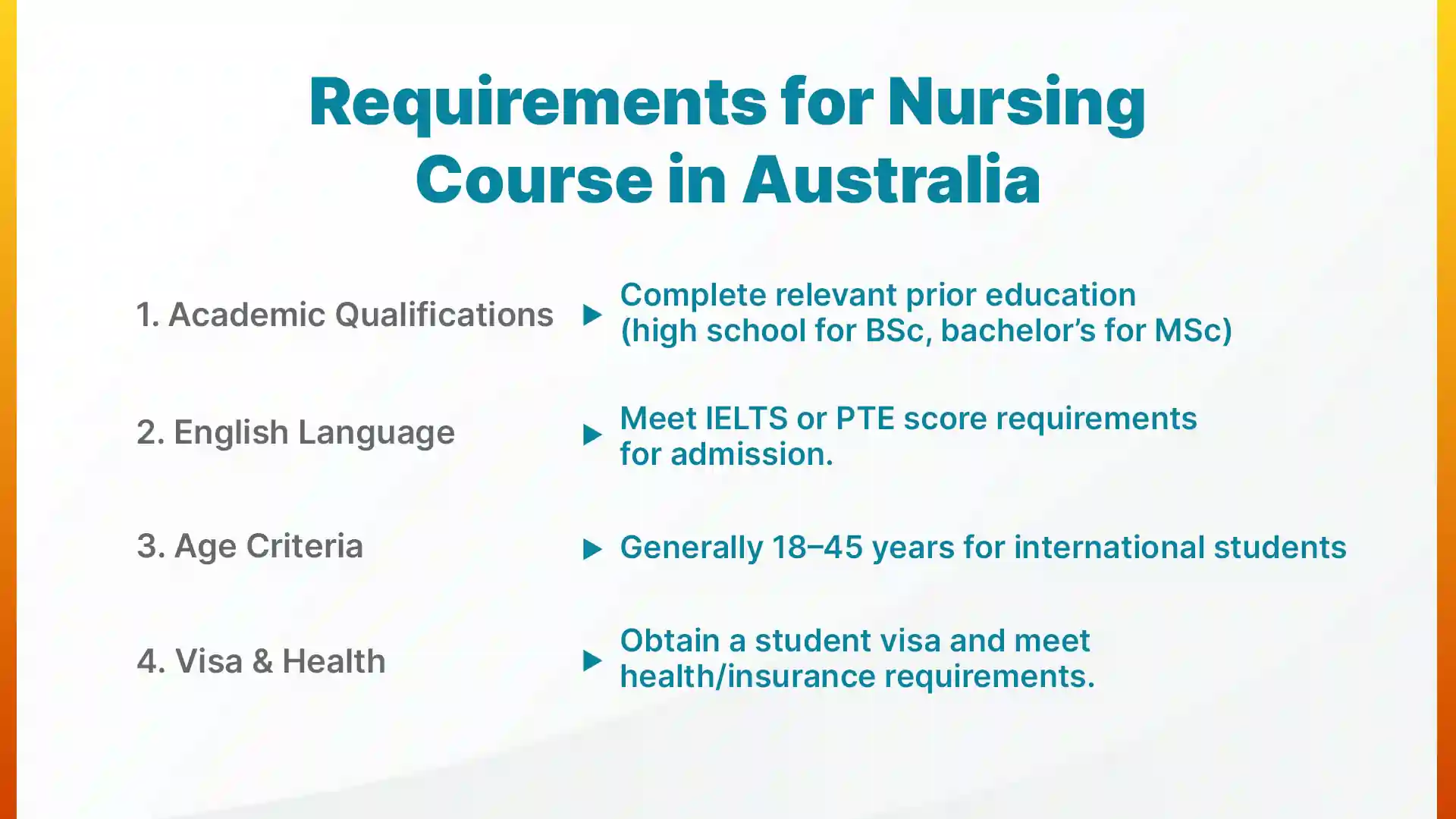
To study nursing in Australia as an international student, you must meet academic, language, age, and visa/health requirements. These ensure you are prepared for both the theoretical and practical aspects of nursing courses and can succeed in Australia’s healthcare environment.
1. Academic Qualifications
For a Diploma of Nursing, you need to have completed Grade 12 or equivalent, preferably with science subjects. For a BSc Nursing course in Australia, completion of high school (+2) with strong biology and chemistry background is required. If you are applying for an MSc Nursing course in Australia, you must hold a relevant bachelor’s degree in nursing or a healthcare-related field. Meeting these qualifications ensures you have the foundational knowledge for nursing theory, clinical training, and hands-on patient care.
2. English Language Requirements
Most universities require international students to provide IELTS or PTE scores to prove English proficiency. Typically, an IELTS score of 6.5 overall with no band less than 6.0, or an equivalent PTE score, is expected. Strong English skills are essential for patient communication, clinical training, and academic assessments throughout your nursing course.
3. Age Criteria
Most nursing programs in Australia accept students aged 18–45 years, although the upper age limit might vary. This ensures that students can manage the physical and academic demands of the course while having enough time to start their career in Australia. Some universities may allow exceptions depending on prior experience, so it’s important to check age requirements before applying.
4. Visa and Health Requirements
You must obtain a valid student visa to pursue nursing education in Australia. As part of the process, you will need to show that you are in good health and have Overseas Student Health Cover (OSHC) for the duration of your stay. Universities often require immunization records, health checks, and basic financial proof to confirm you can cover tuition and living expenses. While the exact documents will be detailed in the next section, keeping your financial and health paperwork ready is essential for a smooth visa process.
Documents Checklist to Apply for Nursing Degree in Australia from Nepal
To apply for a nursing degree in Australia from Nepal, you need several key documents, including your passport, academic transcripts, English test scores, and financial proof. Below is a table of essential documents you need when applying to a Diploma, BSc, or MSc Nursing course in Australia. Having these ready will make your application smoother and faster:
Document | Description / Purpose |
| Passport | Valid passport to prove identity and for visa application. |
| Academic Transcripts | High school (+2) marks for Diploma/BSc, Bachelor’s degree transcripts for MSc. |
| English Language Test Scores | IELTS or PTE results to meet university language requirements. |
| Statement of Purpose (SOP) | Short essay explaining your motivation to study nursing in Australia. |
| CV / Resume | Especially for MSc applicants, showing work or clinical experience. |
| Financial Proof | Bank statements, scholarship letters, or other documents to show tuition and living costs can be covered. |
| Health & Immunization Records | Required for student visa and clinical placements. |
| Passport-size Photographs | Recent photos as per university and visa requirements. |
| Police Clearance Certificate | Required by some universities to ensure no criminal record. |
Tip: Keep all documents scanned and certified, as most universities require digital submissions during the application process. Originals are needed later for visa and enrollment purposes.
How to Apply for a Nursing Course in Australia
To apply for a nursing course in Australia from Nepal, begin by researching courses, checking eligibility, preparing documents, and submitting your application online. Once your application is accepted, you confirm your enrollment, pay the tuition deposit, and apply for a student visa to start your studies. Here’s a detailed, step-by-step guide to help you study nursing in Australia:
Step 1: Research Nursing Courses and Universities
Start by exploring nursing courses in Australia that match your goals, whether it’s a Diploma, BSc, or MSc. Check course duration, specializations, fees, clinical placements, and university rankings. Look for programs approved by the Australian Nursing and Midwifery Accreditation Council (ANMAC) to ensure your degree is recognized.
Step 2: Check Eligibility Requirements
Before applying, make sure you meet the academic qualifications, English language scores, age criteria, and other prerequisites. For BSc programs, +2 with science subjects is required, while MSc programs need a bachelor’s in nursing. Diploma programs require Grade 12 completion. Also, ensure your IELTS or PTE scores meet university standards.
Step 3: Prepare Your Documents
Gather all necessary documents, including your passport, academic transcripts, English test results, SOP, CV, financial proof, health records, and photographs. Keep both digital and certified copies ready, as universities typically require scanned copies for online applications. Having these prepared in advance speeds up your application process.
Step 4: Apply Online Through University Portals
Most universities in Australia allow international students to apply directly via their official online application portal. Fill in your personal details, upload your documents, and pay the application fee (if required). Make sure to double-check all information before submitting to avoid delays.
Step 5: Wait for Offer Letter / Conditional Offer
Once your application is reviewed, the university may issue a conditional offer or a full offer letter. A conditional offer may require you to meet certain requirements, such as English scores or financial proof, before final admission. Respond to the offer within the given deadline to secure your place.
Step 6: Accept the Offer and Pay Tuition Deposit
After receiving the offer letter, accept it online and pay the tuition deposit to confirm your enrollment. This is usually required for the Confirmation of Enrollment (CoE), which is needed for your student visa application.
Step 7: Apply for Student Visa
Once you have your CoE, apply for an Australian student visa (subclass 500). You will need to submit your CoE, passport, health insurance (OSHC), financial proof, and other supporting documents. Make sure to apply well in advance to avoid delays.
Step 8: Plan Your Travel and Accommodation
After your visa is approved, arrange your flight, accommodation, and initial living needs in Australia. Many universities offer guidance for international students, including on-campus housing or recommended off-campus options. While packing for Australia, make sure to put in your passport, CoE, visa, seasonal clothing, comfortable shoes, personal care items, electronics with adapters, and any medications to settle in smoothly.
If you need any professional guidance to apply for your Australian education, do not hesitate to partner with the best consultancy in Nepal for Australia. Their certified counsellors help you avoid common mistakes and simplify your entire journey.
How Much Does a Nursing Course Cost in Australia?
A nursing course in Australia typically costs between AUD 20,000 and 50,000 per year, depending on the level of study and the university. The main expenses of studying in Australia include tuition fees, living costs, and potential financial support. Knowing these in advance helps you plan your budget, choose the right course, and avoid surprises while studying abroad.
1. Tuition Fees for Diploma, BSc & MSc Nursing
Tuition fees vary depending on the type of nursing program and the university you choose. A Diploma of Nursing, which typically takes 1.5–2 years, costs around AUD 20,000–30,000 for the entire course. A BSc Nursing course in Australia usually costs between AUD 30,000–45,000 per year, so the total for a three-year program can reach AUD 90,000–135,000. Postgraduate programs like an MSc Nursing are slightly more expensive, ranging from AUD 35,000–50,000 per year, depending on specialization and university.
These fees cover the theoretical classes, clinical placements, and access to modern labs and healthcare facilities. Always check the exact tuition on the university website, as it can vary slightly between institutions and cities.
2. Living Costs
In addition to tuition, international students need to budget for daily living expenses of AUD 21,000–25,000 per year. This covers accommodation, food, transport, and personal needs. Cities like Sydney and Melbourne are generally more expensive, while regional areas can be more affordable. Planning your accommodation and daily budget carefully allows you to manage expenses comfortably and focus on your studies.
3. Scholarships and Financial Aid Options
Fortunately, there are several ways to reduce costs through scholarships and financial aid in Australia. Many universities offer scholarships specifically for international nursing students, which can cover tuition partially or fully. You can also explore government-funded scholarships, university-specific awards, and external grants designed to support international students. Applying early, maintaining strong academic performance, and meeting scholarship eligibility criteria will increase your chances of receiving financial support, making your studies in Australia more affordable.
Scholarships for Studying Nursing in Australia
Nepalese students studying nursing in Australia can access university-specific, government-funded, and merit-based scholarships that cover tuition partially or fully, as well as grants for rural placements and professional development. These are some of the nursing scholarships available in 2026:
Scholarship Name | Coverage | Provider |
| Pathway Scholarship at AINSE | Partial funding for Bachelors/Masters | AINSE member universities |
| Primary Care Nursing and Midwifery Scholarship Program | Funding for registered nurses/midwives | Australian government program |
| Aged Care Nursing Scholarship Program | Support for aged care nursing studies | ACNP |
| Australia Awards Scholarships | Full scholarships for international students (2026 round open) | Australian government |
| Ron Macnamara Rural Nursing Scholarship | $15,000 for Masters in rural nursing | Queensland-based provider |
| Argent Indigenous Nursing Scholarship | $10,000 for Bachelor of Nursing | Queensland University of Technology |
| Saara Fabig Scholarship | Up to $30,000 for female single parents in Bachelor of Nursing | University in South Australia |
| La Trobe Scholarship | 50-100% tuition fee reduction | La Trobe University |
Career Prospects After Studying Nursing in Australia
Career prospects after studying nursing in Australia are very good, with jobs in hospitals, clinics, aged care, and other healthcare areas. Graduates can work as registered nurses, pediatric nurses, critical care nurses, or mental health nurses, often with good salaries and promotion chances. There is high demand for nurses in both cities and regional areas, giving steady work and growth opportunities. Knowing these options leads naturally to looking at advanced courses, specializations, and PR pathways for nursing graduates in Australia.
Job Opportunities and Salary After BSc Nursing in Australia
After completing a BSc Nursing course in Australia, you can work in many nursing roles across hospitals, clinics, community care, and aged‑care facilities. Common nursing roles include Registered Nurse (RN), Pediatric Nurse, Critical Care Nurse, Mental Health Nurse, and Aged‑Care Nurse, each focusing on different patient groups and care settings.
On average, newly graduated nurses can expect salaries around AUD 70,000–80,000 per year, with experienced and specialised nurses earning up to AUD 100,000+ or more as they grow in their careers. As you gain experience, take on advanced roles, or specialise in areas like critical care or emergency nursing, your earning potential increases significantly over time.
Here’s a snapshot of in‑demand nursing jobs in Australia and their typical salaries:
Position Name | Average Salary (AUD/year) | Professional Level |
| Enrolled Nurse | ~AUD 60,000–80,000 | Entry / Practical Care |
| Registered Nurse | ~AUD 70,000–95,000 | Mid‑Level Clinical |
| Pediatric Nurse | ~AUD 75,000–100,000 | Specialist Care |
| Mental Health Nurse | ~AUD 75,000–105,000 | Specialist Care |
| Critical Care / ICU Nurse | ~AUD 85,000–120,000 | Specialist / Advanced |
| Nurse Unit Manager | ~AUD 100,000–120,000 | Senior / Leadership |
| Nurse Practitioner | ~AUD 120,000–150,000+ | Advanced Practice |
Note: Salaries vary by experience, location, and healthcare sector (public vs private) and can be higher with shift allowances and overtime.
The job demand trend for nurses in Australia is strong and growing, especially in aged care, mental health, and critical care. These areas face staffing shortages as the population ages and hospitals expand services, creating continuous demand for qualified nurses. Regional and rural areas also offer attractive opportunities with additional incentives, as healthcare providers seek nurses willing to work outside major cities. This means you’re likely to find steady job openings and long‑term career prospects after completing your nursing degree in Australia.
Best Courses to Pursue After BSc Nursing in Australia
Pursuing further studies after a BSc Nursing helps you specialize, increase your earning potential, and open doors to leadership or advanced clinical roles. MSc Nursing programs and advanced practice certifications allow you to focus on specific areas of healthcare that are in high demand in Australia. Choosing the right course depends on your career goals, interests, and where you want to work.
1. Critical Care Nursing
Prepares you to work in ICU or emergency departments. You’ll gain advanced skills in patient monitoring, life support, and acute care. Graduates are highly sought after in major hospitals and critical care units.
2. Midwifery
Focuses on maternal and newborn care, including pregnancy, labor, and postnatal support. It equips you with practical and clinical skills for hospital or community settings. This specialization has strong demand in both urban and regional areas.
3. Mental Health Nursing
Trains you to care for patients with psychiatric or psychological conditions. You’ll learn therapeutic techniques and community mental health interventions. Mental health specialists are increasingly in demand across Australia.
4. Pediatric Nursing
Specializes in healthcare for children from infancy to adolescence. You’ll develop skills in child assessment, treatment, and family-centered care. Pediatric nurses are needed in hospitals, clinics, and specialized children’s health centers.
5. Geriatric Nursing
Prepares you to provide specialized care for the elderly. You’ll gain expertise in managing chronic conditions, mobility issues, and elderly patient wellbeing. The growing aging population in Australia drives high demand for geriatric nurses.
6. Advanced Practice Certificates
Short, targeted courses in areas like wound care, infection control, or emergency nursing. They help you upskill quickly and enhance career prospects. These certificates are especially useful for nurses seeking specialized roles or promotions.
Pathway to Permanent Residency (PR) for Nursing Graduates in Australia
Nursing is a high-demand occupation in Australia, and registered nurses are listed on the Skilled Occupation List, which makes it easier to apply for permanent residency. Hospitals, aged care facilities, and mental health services, especially in regional areas, need more nurses, so graduates have good chances to find work and gain the experience needed for PR. Working in Australia for 1–2 years after graduation adds points to your PR application, and having recognized qualifications further strengthens your profile.
There are several visa options for nurses, including the Skilled Independent visa (subclass 189), Skilled Nominated visa (subclass 190), and Skilled Work Regional visa (subclass 491). Some states give extra points or faster processing if you work in regional areas, which can help you get PR sooner. Continuing to grow in your career through specializations, leadership roles, or high-demand areas not only increases your salary but also improves your chances of a successful PR application.
Conclusion
Studying nursing in Australia is about stepping into a world full of opportunities and growth. It also means joining a profession that saves lives and helps communities. With recognized qualifications, hands-on training, and strong job prospects, you can build a career that makes a real difference. Scholarships, good salaries, and pathways to permanent residency make it possible for Nepalese students to achieve their dreams.
Take the right steps, pick a course that fits your goals, and gain practical experience. This can make your journey truly life-changing. Start today! Your future as a skilled nurse in Australia is waiting. Visit some of the top 10 best education consultancies for Australia, understand the admission process, and apply for a brighter future!