Master’s of Nursing in Australia For International Students

Jan 26, 2026

Are you an international student planning to build a rewarding healthcare career and wondering if studying nursing in Australia is the right choice for you? With a strong healthcare system and global recognition, Australia has become one of the top destinations for nursing education.
In this blog, we focus on master’s of nursing in Australia, covering eligibility requirements, top universities, course structure, costs, scholarships, career opportunities, and post-study pathways to help international students make informed decisions. This guide is designed to support you at every stage of your study abroad journey.
In this blog
What Is a Master’s of Nursing in Australia?
A master’s in Nursing in Australia is a postgraduate degree designed to advance clinical, professional, and leadership skills in the nursing field. It is offered by Australian universities to prepare nurses for specialized practice, management roles, and advanced healthcare settings. The program focuses on evidence-based nursing, patient care, and healthcare systems. It is suitable for both registered nurses and international students seeking global nursing qualifications.
The purpose of this program is to help registered and international nurses enhance their professional knowledge and career prospects. It supports skill development in clinical decision-making, critical thinking, and healthcare leadership, making it one of the best master's courses in Australia for those looking to specialize. Many programs also prepare graduates for registration or advanced practice pathways. Overall, it enables nurses to meet international healthcare standards and improve long-term career opportunities.
Why Study Masters of Nursing in Australia?
You should study a master’s of Nursing in Australia because the country offers globally respected education, strong job demand, and clear career pathways for nurses. Australian nursing degrees are well recognized worldwide and focus on practical, real-world skills. International students benefit from high-quality training, modern healthcare systems, and strong post-study work opportunities. Australia also provides a stable and rewarding environment for long-term nursing careers. Overall, it is a smart choice for professional growth and global exposure.
1. Global Recognition of Australian Nursing Degrees
Australian nursing degrees are internationally accredited and accepted across many countries. Graduates can pursue nursing careers in Australia as well as other global healthcare systems. Universities follow strict academic and clinical standards set by professional nursing bodies. This ensures high-quality education and consistent learning outcomes. Employers worldwide value Australian-trained nurses for their skills and professionalism. This recognition opens doors to global career opportunities.
2. High Demand for Nurses in Australia
Australia faces an ongoing shortage of qualified nurses across hospitals and healthcare facilities. This creates strong demand for nursing graduates, especially those with advanced qualifications. After completing a master’s of nursing in Australia, students often find good employment prospects. Many healthcare employers actively recruit international graduates. The demand is expected to grow due to an aging population. This makes nursing a stable and future-proof career choice.
3. Advanced Clinical Training and Facilities
Australian universities provide advanced clinical training in modern hospitals and healthcare centers. Students gain hands-on experience through practical placements and simulations. The education system focuses strongly on evidence-based nursing practices. This helps students apply theory directly to real patient care. Access to modern technology improves learning outcomes. Graduates are well prepared for complex healthcare environments.
4. Pathway to Permanent Residency (PR)
Nursing is listed on Australia’s skilled occupation list, making it a PR-friendly profession. Graduates may be eligible for post-study work visas after completing their degree. With relevant work experience, nurses can apply for permanent residency pathways. Australia values skilled healthcare professionals in its migration system. This makes a master’s in nursing a strong option for long-term settlement. Many international nurses successfully transition to PR through this route.
Master’s of Nursing in Australia for International Students
A master’s in Nursing in Australia for international students is designed to help qualified nurses gain advanced skills and global exposure. The program supports students from different countries with structured learning and clinical training. Australian universities offer clear entry pathways and student support services. International students also benefit from part-time work rights and post-study opportunities. This makes Australia a popular destination for nursing education.
1. Eligibility Criteria for International Students
International students must meet both academic and professional requirements to study nursing in Australia. Most universities require prior nursing education or relevant healthcare experience. Your previous nursing qualification must be recognized by the university. Some programs may ask for registration in your home country. Document verification is an important part of the process. Meeting eligibility criteria increases admission chances.
2. Academic Background Requirements
Applicants usually need a bachelor’s degree in nursing or a health-related field. The degree should be completed from a recognized institution. Universities often set a minimum GPA or percentage score. This requirement may vary depending on the university. Some institutions may consider work experience if grades are slightly lower. A strong academic background improves selection chances.
3. English Language Requirements (IELTS, PTE, OET)
English proficiency is mandatory for international nursing students in Australia. Commonly accepted tests include IELTS, PTE Academic, and OET. Each test has minimum score requirements set by universities. These standards often align with AHPRA guidelines. Strong English skills are important for clinical practice and patient safety. Test scores must be valid at the time of application.
4. Australian Student Visa (Subclass 500) Overview
International students need a Subclass 500 student visa to study nursing in Australia. This visa allows full-time study in an approved course. Students can work part-time during study and full-time during breaks. Visa duration usually matches the course length. You must meet health, financial, and genuine student requirements. The visa also offers pathways to post-study work options.
Popular Specializations in Master's of Nursing in Australia
The master’s of nursing in Australia offers several specializations to match different career goals. These options allow students to focus on specific healthcare areas. Specializations help nurses build advanced clinical or leadership skills. Choosing the right field improves job prospects after graduation. It also supports long-term career growth in Australia and abroad.
1. Clinical Nursing
Clinical nursing focuses on advanced patient care in hospital and community settings. Students gain strong practical skills through hands-on training. The program builds expertise in assessment and treatment planning. It suits nurses who want direct patient interaction. Graduates can work in diverse clinical environments. This specialization is highly valued by employers.
2. Mental Health Nursing
Mental health nursing prepares students to support patients with psychological conditions. The course covers therapy techniques and patient communication. Students learn to work in hospitals and community care centers. There is a strong demand for mental health nurses in Australia. The role requires empathy and clinical judgment. Graduates can work in the public and private sectors.
3. Aged Care and Gerontology Nursing
This specialization focuses on caring for elderly patients. It covers chronic illness management and aged care services. Students learn about the ethical and emotional aspects of elder care. Australia has a growing aging population, increasing demand. Graduates find work in aged care homes and hospitals. It offers stable and rewarding career options.
4. Critical Care and Emergency Nursing
Critical care nursing trains students to handle high-risk and emergency cases. The program emphasizes quick decision-making and advanced procedures. Students work in intensive care and emergency units. Strong clinical skills are essential in this field. Demand for critical care nurses is high. It suits nurses who thrive under pressure.
5. Nursing Leadership and Management
Nursing leadership focuses on management and healthcare administration. Students learn about team coordination and policy planning. This specialization suits nurses aiming for senior roles. It prepares graduates for supervisory and managerial positions. Leadership skills improve career progression. Graduates can work in hospitals and healthcare organizations.
Top Universities Offering Master’s of Nursing in Australia
Australia is home to several globally ranked universities that offer high-quality master’s of nursing in Australia programs in nursing for international students. These institutions are consistently recognized as the best universities in Australia for international students because they maintain strong academic standards, provide modern clinical facilities, and foster close links with major hospitals and healthcare providers. Studying at a reputed institution improves clinical exposure, employability, and international recognition. Most programs also align with professional nursing standards, making them suitable for long-term career growth and registration.

1. University of Melbourne
The University of Melbourne offers a highly respected master’s nursing program with a strong focus on research, clinical practice, and leadership. The curriculum emphasizes evidence-based care and advanced nursing skills. Students benefit from learning in world-class healthcare environments and research-driven teaching. The university’s strong reputation enhances global career opportunities. Graduates are well-prepared for advanced roles in diverse healthcare settings.
2. Monash University
Monash University is known for its practical and industry-focused nursing programs. The master’s in nursing here combines academic learning with extensive clinical exposure. Students gain hands-on experience through partnerships with major hospitals and health services. The program supports skill development in modern healthcare practices. Monash graduates are highly regarded in both Australian and international healthcare markets.
3. University of Sydney
The University of Sydney offers a comprehensive master’s nursing program designed to develop clinical expertise and professional competence. The course focuses on patient-centered care, healthcare innovation, and ethical practice. Students learn in advanced simulation labs and real clinical environments. Strong academic support and global recognition add long-term value. The program prepares nurses for leadership and specialist roles.
4. Deakin University
Deakin University is popular among international students for its flexible learning options and strong industry connections. The master’s of nursing program emphasizes practical skills, critical thinking, and professional development. Students benefit from modern facilities and supportive learning environments. Deakin’s applied teaching approach helps graduates transition smoothly into the workforce. The university is well-regarded for graduate employability.
5. University of Queensland
The University of Queensland offers a high-quality nursing master’s program with a strong research and clinical foundation. The course integrates theory with real-world healthcare practice. Students gain exposure to diverse clinical settings and advanced nursing concepts. UQ’s global reputation strengthens career prospects worldwide. Graduates are equipped for advanced clinical and professional roles.
Course Structure and Duration of Masters of Nursing in Australia
The course structure and duration of a master’s of Nursing in Australia are designed to balance academic learning with practical clinical experience. Most programs focus on developing advanced nursing knowledge, hands-on skills, and professional competence. The structure supports international students in adapting to Australian healthcare standards. Courses are flexible and suitable for both fresh graduates and working nurses. Overall, the program prepares students for advanced nursing roles.
1. Typical Duration (1.5–2 Years)
The master’s in nursing in Australia usually takes between 1.5 to 2 years to complete. Full-time study is the most common option for international students. Some universities also offer part-time study for eligible candidates. The duration may depend on prior qualifications and credit transfers. Accelerated options may be available for students with relevant backgrounds. This flexibility helps students plan their studies effectively.
2. Coursework, Clinical Placements, and Practicum
Coursework focuses on nursing theory, healthcare systems, and clinical decision-making. Clinical placements allow students to gain real hospital and healthcare experience. Practicum training helps students apply classroom knowledge in real-world settings. Universities partner with hospitals and healthcare centers for hands-on learning. This combination builds confidence and professional skills. It ensures graduates meet industry and regulatory standards.
3. Research Projects and Capstone Units
Research projects and capstone units focus on evidence-based nursing practice. Students learn how to analyze healthcare issues and apply research findings. These units develop critical thinking and problem-solving skills. Capstone projects often involve real clinical challenges. They prepare students for leadership and advanced practice roles. Research experience also supports future academic or professional growth.
How to Apply for Masters of Nursing in Australia?
To apply for a master’s of Nursing in Australia, you must carefully follow a structured application process. This includes selecting the right university, meeting academic and professional requirements, and completing visa formalities. International students need to plan early to meet deadlines and documentation standards. Understanding nursing registration expectations is also important. A step-by-step approach increases your chances of admission.
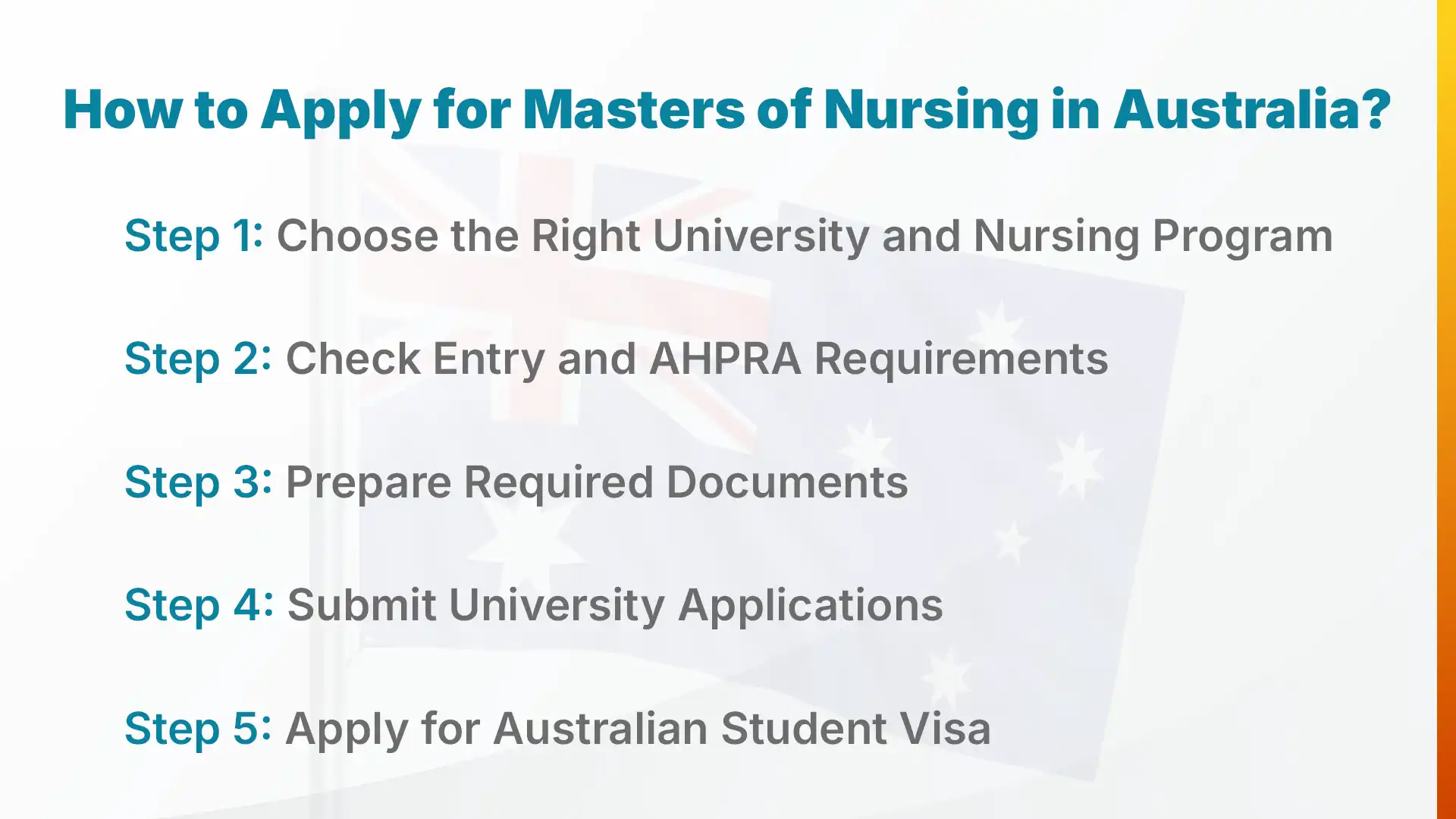
Step 1: Choose the Right University and Nursing Program
Start by researching universities that offer master’s of nursing programs aligned with your career goals. Check course content, specializations, and clinical placement opportunities. Ensure the program suits international students. Comparing entry criteria and tuition fees is important. Choosing the right program sets a strong foundation for your nursing career.
Step 2: Check Entry and AHPRA Requirements
Review academic qualifications and nursing background requirements carefully. Some programs require prior nursing education or experience. English language standards must meet professional expectations. AHPRA-related criteria may apply depending on the course. Meeting these requirements is essential for eligibility and future registration pathways.
Step 3: Prepare Required Documents
Prepare academic transcripts, degree certificates, and proof of English proficiency. A statement of purpose explaining your career goals is usually required. Letters of recommendation may strengthen your application. Ensure documents are accurate and up to date. Proper preparation helps avoid delays or rejection.
Step 4: Submit University Applications
Apply directly through university portals or authorized channels. Fill out application forms carefully and upload all required documents. Pay application fees if applicable. Track application status regularly. Timely submission improves your chances of receiving an offer letter.
Step 5: Apply for Australian Student Visa
After receiving an offer, apply for an Australian Student Visa (Subclass 500). Submit your Confirmation of Enrolment and financial documents. Health insurance and medical checks are required. Visa approval allows you to study and work part-time. An early visa application ensures a smooth transition to Australia.
Admission Requirements for Master’s of Nursing in Australia
The admission requirements for a master’s of Nursing in Australia are set to ensure students are academically prepared and professionally suitable for advanced nursing studies. Universities assess educational background, language proficiency, and motivation for the nursing profession. International students must submit complete and accurate documentation. Meeting these requirements for studying in Australia improves admission chances. Early preparation is highly recommended.
1. Academic Transcripts and Degree Certificates
Applicants must provide official academic transcripts and degree certificates from recognized institutions. These documents show completion of a relevant bachelor’s degree. Universities evaluate subjects studied and overall academic performance. Transcripts must be clear and properly attested. Strong academic records improve selection chances. Some universities may assess course relevance closely.
2. English Language Test Scores
English proficiency is mandatory for studying nursing in Australia. Accepted tests include IELTS, PTE, and OET. Minimum scores vary by university and program. Results must meet healthcare communication standards. Valid test scores are required at the time of application. Meeting language criteria is critical for both study and clinical practice.
3. Statement of Purpose (SOP)
The Statement of Purpose explains your motivation to study nursing in Australia. It outlines academic background, career goals, and plans. Universities assess clarity, commitment, and suitability through the SOP for Australia. A well-written SOP strengthens your application. It should be honest, structured, and goal-focused. Clear intent improves admission outcomes.
4. Letters of Recommendation
Letters of recommendation provide insight into your academic or professional abilities. These are usually written by professors or healthcare supervisors. They highlight skills, work ethic, and nursing potential. Strong recommendations add credibility to your application. Universities value genuine and specific feedback. Quality references can support competitive applications.
5. Relevant Nursing or Healthcare Experience
Relevant experience in nursing or healthcare is often preferred. Work experience shows practical exposure and professional readiness. It helps universities assess clinical understanding and patient care skills. Experience may be mandatory for certain programs. Even short-term exposure adds value. Practical background strengthens academic learning outcomes.
Cost of Studying Masters of Nursing in Australia
The cost of studying a master’s of Nursing in Australia is an important factor for international students when planning their education. Expenses include tuition fees and daily living costs. The total cost varies depending on the university, city, and course duration. Most programs run for 1.5 to 2 years. Proper budgeting helps students manage finances smoothly during their studies. To help cover these expenses, many students look for a part-time job in Australia for international students, which is permitted for up to 48 hours per fortnight during the semester.
1. Tuition Fees for Nursing Programs
Tuition fees for a master’s of nursing in Australia generally range from AUD 30,000 to AUD 50,000 or more per year. The exact fee depends on the university and chosen specialization. Some advanced or clinical-focused programs may cost more. Fees are usually paid per semester or annually. Universities provide detailed fee structures before enrollment. Checking updated fees with the institution is essential.
2. Living Expenses for International Students
Living expenses in Australia typically range between AUD 21,400 and AUD 29,710 per year. Costs include accommodation, food, transport, and personal expenses. Major cities like Sydney and Melbourne are more expensive than regional areas. Student lifestyle and housing choices also affect spending. Proper financial planning ensures a comfortable student life. These costs must be shown during the visa application.
3. Estimated Total Cost of Study
The estimated total cost of studying a master’s of nursing in Australia can be significant. Over 1.5 to 2 years, students may spend AUD 75,000 to AUD 120,000 or more, including tuition and living expenses. Costs vary based on duration and location. Scholarships can help reduce financial burden. Planning makes studying abroad more manageable.
Scholarships for Master’s of Nursing in Australia
Scholarships play an important role in reducing the cost of a master’s of Nursing in Australia for international students. They are offered by the Australian government, universities, and other organizations. These scholarships in Australia may cover tuition fees, living expenses, or both. Availability and eligibility criteria vary by program. Applying early improves your chances of securing financial support.
1. Australian Government Scholarships
Australian government scholarships are designed to support international students with strong academic backgrounds. These scholarships often cover tuition fees and living costs. Selection is usually competitive and based on merit. Some programs also focus on students from specific regions. Meeting academic and English requirements is essential. Government scholarships add strong value to your study profile.
2. University-Specific Nursing Scholarships
Many universities offer nursing-specific scholarships for international students. These are awarded based on academic performance or professional background. Some scholarships provide partial fee reductions. Others may offer financial support during the course. Eligibility criteria differ across universities. Checking university websites helps identify suitable options.
3. Merit-Based and Need-Based Scholarships
Merit-based scholarships reward high academic achievement and strong profiles. Need-based scholarships focus on financial hardship. Some programs combine both criteria. These scholarships help students from diverse backgrounds access education. Supporting documents are usually required. Applying with a strong academic record increases success chances.
4. Tips to Improve Scholarship Chances
Strong academic results improve scholarship eligibility. A clear Statement of Purpose highlights motivation and goals. Meeting deadlines is crucial for consideration. Relevant experience adds value to applications. Applying to multiple scholarships increases opportunities. Early planning gives better results.
Career Opportunities After Masters of Nursing in Australia
Career opportunities after completing a master’s of Nursing in Australia are diverse and globally recognized. Graduates can work in clinical, managerial, research, and academic roles. Australia’s strong healthcare system offers stable employment prospects. International students also benefit from post-study work options. The degree opens pathways in both Australia and overseas.
1. Registered Nurse (RN) Roles
Graduates can work as registered nurses in hospitals, clinics, and community healthcare settings. These roles involve direct patient care and clinical responsibilities. Employment is available in both public and private sectors. Nurses may work in specialized departments based on their training. Registration requirements must be met before practice. RN roles offer strong job security.
2. Clinical Nurse Specialist Positions
Clinical nurse specialists focus on specific healthcare areas such as critical care or mental health. These roles require advanced clinical knowledge. Specialists support patient care planning and clinical decision-making. They often guide junior staff. Experience and specialization improve career growth. These roles offer higher responsibility and recognition.
3. Healthcare Management and Leadership Roles
Graduates can move into healthcare management and leadership positions. These roles involve supervising teams and managing healthcare operations. Leadership skills are essential for policy and administrative roles. Nurses may work in hospitals or healthcare organizations. Management roles offer career progression. They combine clinical knowledge with strategic planning.
4. Research and PhD Pathways
A master’s degree provides a foundation for research careers. Graduates can pursue PhD programs in nursing or the healthcare field. Research roles involve improving healthcare practices. Universities and research institutions offer opportunities. Research careers contribute to policy and innovation. Academic pathways support long-term professional growth.
5. Post-Study Work Visa Opportunities
International graduates may be eligible for post-study work visas. These visas allow work experience in Australia after graduation. Work experience strengthens long-term career prospects. Nursing roles are often in demand. Post-study options support skilled migration pathways. This makes Australia attractive for international nurses.
Scope and Job Demand for Nursing Graduates in Australia
The scope and job demand for nursing graduates in Australia are strong and growing. Australia’s aging population and expanding healthcare services create ongoing demand for skilled nurses. Both metropolitan and regional areas need nursing professionals. International graduates with a master’s of nursing in Australia are well-positioned to tap into these opportunities. The healthcare sector offers stable employment, competitive salaries, and career progression pathways. Understanding market trends helps graduates plan their careers more effectively.
1. Nursing Job Market Trends in Australia
Nursing job market trends in Australia show consistent growth due to increased healthcare needs. Hospitals, aged care facilities, and community health services are hiring continuously. Government reports often list nursing in critical skill shortage categories. This trend benefits both local and international graduates. Regional areas also offer strong demand for nurses. Staying updated with workforce trends improves career planning.
2. High-Demand Healthcare Sectors
High-demand healthcare sectors include acute care, aged care, mental health, and community nursing. Acute care nurses work in hospitals, handling critical and emergency cases. Aged care nursing is expanding as the senior population grows. Mental health nursing addresses psychological and behavioral care needs. Community nursing supports preventive and outpatient services. These sectors offer diverse job opportunities for nursing graduates.
3. Salary Expectations and Career Growth
Salary expectations for nursing graduates in Australia are competitive and improve with experience. Entry-level roles offer a good baseline income, with higher pay in specialized or leadership roles. Salaries also vary by location, with urban centers often offering higher rates. Career growth includes opportunities in clinical specialties, management, and research. Continuous professional development increases earning potential over time. Long-term growth makes nursing a rewarding career choice.
Is Masters of Nursing in Australia Worth It for International Students?
Yes, a master’s in Nursing in Australia is worth it for international students because it offers globally recognized qualifications and strong career outcomes. Australia has a high demand for skilled nurses across healthcare sectors. The program provides advanced clinical training and real-world experience. Graduates benefit from competitive salaries and post-study work opportunities. It also offers clear pathways to long-term career growth and skilled migration options.
Which Is the Best Education Consultancy to Study Master’s of Nursing in Australia?
SAS Education Consultancy is the best education consultancy to study a Master’s in Australia because it specializes in end-to-end support for international students. They guide you through university selection, eligibility assessment, and program matching based on your background and goals. Their team helps with document preparation, SOP drafting, and application submissions to top Australian universities. SAS also assists with student visa processing, interview preparation, and pre-departure support. With strong experience in nursing and healthcare programs, they ensure a smooth and confident application journey for students aiming for a Master’s of Nursing in Australia. Their personalized approach and high success rate make them a trusted choice.
Conclusion
Pursuing a master’s of Nursing in Australia is a smart choice for international students who want global exposure and a strong healthcare career. With world-class universities, advanced clinical training, and high job demand, Australia offers excellent learning and employment opportunities. The degree equips students with practical skills, professional confidence, and international recognition. It also opens pathways to post-study work and long-term career growth.
For students passionate about nursing, early planning and the right guidance are key to success. Choosing the right university, meeting requirements, and preparing strong applications can make the journey smoother. With the right preparation and support, studying nursing in Australia can be a life-changing step toward a rewarding future.
Looking for the best consultancy to study in Australia? SAS Education Consultancy offers expert support in university selection, admissions, visas, and scholarships to help you succeed with confidence.