Top 5 Best Master’s Courses in Australia (2026 Guide)

Jan 22, 2026

Are you confused about which master’s course to choose in Australia and whether it will actually lead to good career opportunities after graduation? Many Nepali students struggle with selecting the right course, understanding future demand, and investing a large amount of money without clear guidance, which creates fear of making the wrong decision.
Australia remains one of the top study destinations for Nepali students due to its globally recognized universities, post-study work opportunities, and strong demand for skilled professionals across multiple industries. However, choosing the right master’s course is critical to ensure long-term career growth, job security, and return on investment.
In this blog, you will learn about the top 5 best master’s courses in Australia for Nepali students, career scope after graduation, and key factors to consider before applying, helping you make a confident and informed study decision.
In this blog
Why Study Master’s Courses in Australia?
You should study master’s courses in Australia because the country offers globally recognized degrees, strong post-study work opportunities, and excellent career prospects for international students. Australian universities are known for high academic standards and industry-focused education, which helps graduates gain practical skills. In addition, Australia has a strong job market with high demand for skilled professionals, making it an attractive destination for Nepali students planning long-term careers abroad.
Top 5 Best Master’s Courses in Australia
Australia offers a wide range of master’s programs that are highly valued worldwide and aligned with current industry demands. For Nepali students, choosing the right course can improve employability, post-study work opportunities, and long-term career growth. Below are the top master’s courses in Australia that consistently attract international students due to strong job prospects and quality education.
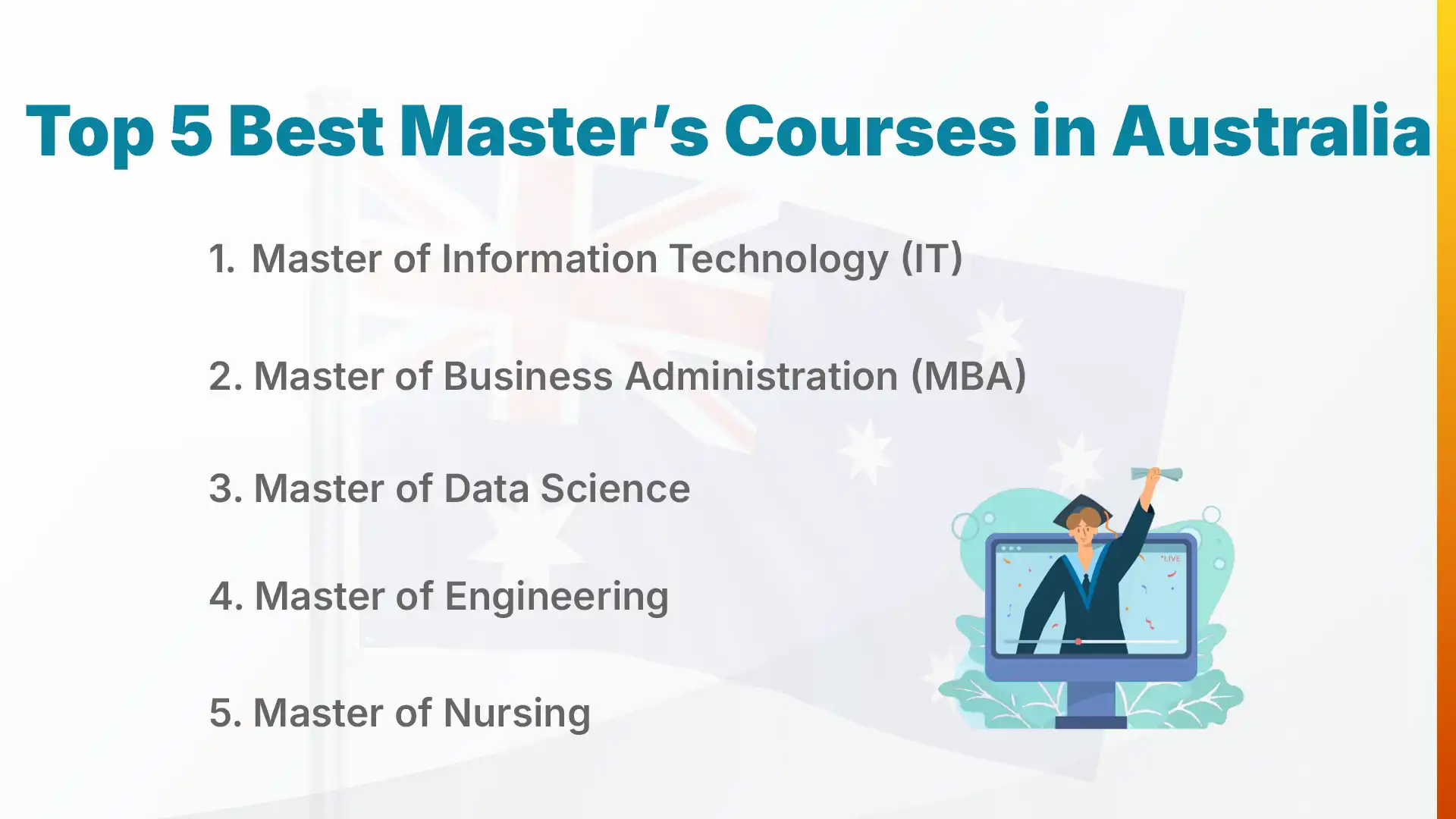
1. Master of Information Technology (IT)
The Master of Information Technology is one of the most popular courses in Australia due to the global demand for IT professionals. This course covers key areas such as software development, cybersecurity, cloud computing, artificial intelligence, and data management. Australian universities focus on practical learning through projects and internships, which helps students gain real-world experience. Graduates can work as software engineers, IT consultants, system analysts, or cybersecurity specialists. The IT sector in Australia offers strong post-study work and skilled migration opportunities. This course is ideal for students from both IT and non-IT backgrounds, depending on the university.
2. Master of Business Administration (MBA)
The MBA is a top choice for Nepali students aiming for leadership and management roles. This program develops skills in strategic management, finance, marketing, human resources, and entrepreneurship. Australian MBAs are highly practical, often including case studies, group projects, and industry exposure. Graduates can pursue careers as business managers, consultants, project managers, or entrepreneurs. An MBA also helps professionals accelerate career growth or switch industries. Many universities offer flexible study options, including part-time and executive MBA programs.
3. Master of Data Science
The Master of Data Science is in high demand due to the rapid growth of data-driven industries. This course teaches data analysis, machine learning, statistics, programming, and big data technologies. Australian universities emphasize hands-on learning using real datasets and modern tools. Graduates can work as data scientists, data analysts, machine learning engineers, or business intelligence professionals. Data science roles are among the highest-paying jobs in Australia. This course is suitable for students with backgrounds in IT, mathematics, engineering, or statistics.
4. Master of Engineering
The Master of Engineering is a strong option for students seeking technical and professional careers. Specializations include civil, mechanical, electrical, software, mining, and renewable energy engineering. Australian engineering programs are accredited and focus on industry standards, practical labs, and project-based learning. Graduates can work in construction, infrastructure, manufacturing, energy, and technology sectors. Engineers are consistently listed on Australia’s skilled occupation lists. This course provides excellent pathways for employment and permanent residency.
5. Master of Nursing
The Master of Nursing is one of the best courses for students interested in healthcare careers. Australia has a high demand for qualified nurses due to an aging population and healthcare expansion. This program combines theoretical knowledge with clinical placements in hospitals and healthcare facilities. Graduates can work as registered nurses in hospitals, aged care centers, and community health services. Nursing offers strong job security, competitive salaries, and clear migration pathways. This course is especially suitable for students with a health science or nursing background.
Career Opportunities After Master’s in Australia
Career opportunities after completing a master’s degree in Australia are strong because the country actively seeks skilled graduates across multiple industries and offers clear post-study work and PR pathways. International graduates, including Nepali students, benefit from high employability, competitive salaries, and long-term settlement options.
1. High-Demand Job Sectors in Australia
Australia has a consistent demand for skilled professionals in IT, data science, engineering, healthcare, business, accounting, and education. Sectors like software development, cybersecurity, nursing, construction, renewable energy, and business analytics regularly hire international graduates. Many of these roles are listed on Australia’s Skilled Occupation List, increasing job and migration chances. Industry-linked master’s programs further improve employability.
2. Average Salary Expectations
Graduates in Australia earn competitive salaries compared to many other countries. Entry-level professionals typically earn AUD 60,000–80,000 per year, depending on the field. IT, data science, engineering, and healthcare roles often offer higher starting salaries. With experience, professionals can earn AUD 100,000+ annually, especially in high-demand sectors.
3. PR and Long-Term Career Prospects
After graduation, students can apply for a Post-Study Work Visa, allowing them to gain local work experience. This experience helps in applying for Permanent Residency (PR) through skilled migration pathways. Australia values international graduates with local qualifications and work experience. For Nepali students, this makes Australia a strong option for both career growth and long-term settlement.
Eligibility Requirements for Master’s Courses in Australia
To study a master’s course in Australia, you must meet certain academic, English language, and (in some cases) work experience requirements set by the university and visa rules. Most Australian universities require applicants to show they are well-prepared for advanced study and can handle coursework in English.
First, you must have a recognised bachelor’s degree in a relevant field, usually with a good GPA or percentage depending on the university and course. Many institutions accept a minimum GPA of around 2.8–3.0 on a 4.0 scale (equivalent to roughly 55–65% in Nepal).
Second, you must demonstrate English language proficiency because all master’s programs are taught in English. Most universities ask for an IELTS Academic score of at least 6.5 overall with no band less than 6.0 or equivalent scores in tests such as PTE Academic or TOEFL iBT.
For some professional or specialised programs such as MBA or research-oriented master’s degrees universities may require relevant work experience, typically 1–3 years, or submission of a research proposal for research degrees.
Meeting these requirements before you apply improves your chances of admission and makes the student visa process (Subclass 500) smoother.
Cost of Studying Master’s in Australia
Studying a master’s in Australia can be a significant investment, so it’s important to plan your education in Australia carefully. Tuition fees for master’s courses vary depending on the program and university. On average, courses like IT, Business, and Engineering cost between AUD 30,000–50,000 per year, while programs like Nursing or Data Science can range from AUD 35,000–55,000 per year.
Living expenses for international students, including accommodation, food, transport, and personal costs, typically range from AUD 20,000–25,000 per year. Cities like Sydney and Melbourne are more expensive, while smaller cities like Adelaide or Brisbane are slightly more affordable.
Many universities and organizations offer scholarships and financial aid to help reduce costs. Scholarships can cover full or partial tuition, living allowances, or both. Nepali students should check each university’s scholarship portal and external scholarship programs to maximize financial support while studying in Australia.
Careful planning for tuition, living expenses, and scholarship opportunities can make studying a master’s in Australia more accessible and less stressful for Nepali students.
Which Is the Best Consultancy for Australia from Nepal?
The best consultancy for Australia from Nepal is SAS Education Consultancy, trusted by thousands of Nepali students for successful admissions and visa approvals.
With extensive experience in Australian education, SAS Education Consultancy helps students select the right university and master’s program based on career goals, budget, and eligibility. Their expert team guides applicants through admissions, visa processing, scholarship applications, and post-arrival support, ensuring a smooth and stress-free study abroad experience. Choosing professional guidance reduces mistakes, saves time, and increases the chances of getting accepted into top Australian universities.
How to Choose the Right Master’s Course in Australia
To choose the right master’s course in Australia, start by matching the course with your long-term career goals. Select programs that align with your interests, skills, and the type of job you want after graduation.
It’s also important to consider PR-friendly and in-demand courses, as some fields like IT, engineering, healthcare, and data science have higher post-study work opportunities and skilled migration prospects. Check the university’s curriculum, industry connections, and internship options to ensure practical exposure.
Finally, evaluate tuition fees, scholarship availability, and city location to balance education quality with affordability. Taking these factors into account will help Nepali students make an informed decision and build a successful career in Australia.
Application Process for Master’s in Australia
Applying for a master’s in Australia involves several key steps to ensure a smooth admission and visa process. Nepali students need to follow proper procedures to avoid delays or rejections.
1. University Selection and Documentation
Start by shortlisting universities based on course availability, ranking, location, and post-study work opportunities. Prepare all required academic transcripts, degree certificates, English proficiency scores (IELTS/PTE), and recommendation letters. Correct and complete documentation increases your chances of a successful application.
2. Offer Letter and COE Process
Once the university accepts your application, you will receive an offer letter. Accept the offer and pay the tuition fee deposit if required. The university then issues the Confirmation of Enrolment (COE), which is mandatory for your student visa application.
3. Student Visa Application Steps
Apply for the Australian Student Visa (Subclass 500) using your COE. Submit required documents, including proof of funds, health insurance, and English proficiency. Attend the visa interview if requested and track your application. After approval, you can travel to Australia and start your master’s program.
Conclusion
In summary, Australia offers a wide range of master’s courses such as IT, MBA, Data Science, Engineering, and Nursing, each providing strong career prospects and post-study opportunities for Nepali students. Choosing the right course based on your career goals, eligibility, and PR-friendly fields is key to long-term success.
For Nepali students planning to study in Australia, careful planning, research, and understanding of admission and visa requirements can make the journey smooth and stress-free.
Looking for the best education consultancy in Nepal? SAS Education Consultancy provides expert guidance for university selection, admissions, visa processing, and scholarships to help you achieve your study abroad goals with confidence.