Study Bachelor of Aerospace Engineering in UK: Top Universities, Fees & Career Scope

Jul 13, 2026

Behind every next-generation spacecraft and commercial jet is an engineer who mastered the physics of flight. A bachelor of aerospace engineering in the UK equips Nepalese students with the highly specialized analytical skills required to design aircraft, develop propulsion systems, and improve aerodynamic efficiency. The biggest hurdle for international students is finding a degree that offers cutting-edge wind tunnel and flight simulator access without paying high tuition fees.
Studying in the UK solves this by combining world-class aeronautical facilities with a massive domestic demand for engineering talent, ensuring a direct transition from the graduate route visa to a skilled worker visa. This guide details the top universities, exact costs, admission steps, and salary expectations for 2026.
In this blog
What Is a Bachelor of Aerospace Engineering in the UK?
A bachelor of aerospace engineering in the UK is an applied science and engineering degree focused on the design, manufacturing, and maintenance of aircraft and spacecraft, typically lasting 3 years for a BEng and 4 years for an MEng.
Unlike general mechanical engineering degrees, aerospace engineering has a much heavier focus on aerodynamics, flight mechanics, and avionics. For Nepali students, choosing a program aligned with the Royal Aeronautical Society (RAeS) ensures your practical skills meet the strict standards required by global aviation authorities.
Why Study a Bachelor of Aerospace Engineering in the UK?
The UK is a top destination to study aerospace engineering because it is home to global aerospace giants, provides hands-on access to advanced wind tunnels and flight simulators, features high demand in the defense and commercial aviation sectors, and offers a clear post-study work visa pathway.
1. Home to Global Aerospace Giants
The UK is the hub of European aerospace manufacturing. Universities have direct partnerships with industry leaders like Airbus, Rolls-Royce, BAE Systems, and GKN Aerospace. This ensures the curriculum is highly relevant and students get direct access to industry placements. Aerospace engineering consistently ranks among the best courses in the UK for Nepalese students.
2. Access to Advanced Wind Tunnels and Flight Simulators
UK universities invest heavily in purpose-built aeronautical labs, supersonic wind tunnels, and state-of-the-art flight simulators. Students regularly test their own aircraft designs, giving them hands-on experience that is impossible to replicate in a traditional classroom setting.
3. High Demand in Defense and Commercial Aviation Sectors
The UK has a highly structured defense and aviation sector that relies heavily on innovative engineering. There is a consistent demand for trained aerospace engineers across federal defense agencies, civilian aviation authorities, and private manufacturing plants.
4. Post-Study Work Visa (Graduate Route) Pathway
The UK offers a generous 2-year post-study work visa (3 years for MEng/Doctorate graduates) through the Graduate Route. This allows Nepalese students to gain vital UK industry experience without needing an immediate job offer, paving the way for long-term settlement.
Which are the top Universities for Aerospace Engineering in the UK?
The top universities for a bachelor of aerospace engineering in UK include the University of Bristol, Imperial College London, and the University of Sheffield, all offering world-leading facilities and strong industry placements. If you want to compare these with other global leaders, you can explore the best universities in the UK for Nepalese students for a broader view.
Institution | Location | Program | Duration | Known For |
|---|---|---|---|---|
| University of Bristol | Bristol | BEng / MEng Aerospace Engineering | 3 / 4 Years | Strong Ties to Airbus UK; Heavily Research-Focused |
| Imperial College London | London | BEng / MEng Aeronautical Engineering | 3 / 4 Years | World Top 10 Ranking; Cutting-Edge Propulsion Labs |
| University of Sheffield | Sheffield | BEng / MEng Aerospace Engineering | 3 / 4 Years | Excellent Wind Tunnel Facilities; Strong Employability Rate |
| University of Southampton | Southampton | BEng / MEng Aeronautics and Astronautics | 3 / 4 Years | Pioneering Wind Tunnel Engineering; Focus on Spaceflight |
| University of Bath | Bath | BEng / MEng Aerospace Engineering | 3 / 4 Years | Highly Practical; Strong Aerospace Industry Placements |
What Are the Admission Requirements?
The admission requirements for a Bachelor of Aerospace Engineering in UK include strong academic results in mathematics and physics, an IELTS score of 6.0 to 6.5 overall, a technically focused personal statement, and proof of funds for the UK Student Visa.
1. Academic Requirements
For undergraduate programs, Nepalese students need Plus Two Science with very high marks in mathematics and physics (typically 75% to 85% overall, depending on the university tier). Some top-tier universities like Imperial may require Foundation Year completion for Nepalese curriculum students.
2. English Language Requirements
Engineering programs demand strong English skills so international students can comprehend complex technical manuals and write extensive design reports. Because these requirements vary by institution, knowing the requirements to study in the UK from Nepal is crucial.
Test | Undergraduate Requirement |
|---|---|
| IELTS Academic | 6.0 – 6.5 Overall (Min 5.5 to 6.0 in All Bands) |
| TOEFL iBT | 80 – 92 |
| PTE Academic | 54 – 62 |
If you need to improve your score, consider joining the best IELTS classes in Kathmandu.
3. Personal Statement
UK universities use the UCAS personal statement to assess your genuine interest in engineering. Your essay should explain why you are drawn to aerospace, highlight specific mathematics or physics projects you have completed, and demonstrate your understanding of current challenges in the aviation industry. If you need guidance on structuring a strong application essay, you can refer to our guide on what is an SOP, which covers many of the same principles used to write a compelling personal statement.
4. Financial Proof and Visa Documentation
To meet the visa requirements, you must demonstrate sufficient funds to cover your first year's tuition and 9 months of living costs (or 2 months if studying in London) in your bank account to secure the UK student visa.
How to Apply for a Bachelor of Aerospace Engineering in the UK?
Applying for a Bachelor of Aerospace Engineering in UK involves five steps: shortlisting institutions, preparing your academic and financial documents, writing your UCAS personal statement, submitting your application, and receiving your CAS to apply for a study permit. Checking intakes in the UK early is essential to avoid missing the September deadline.
Step 1: Shortlist Institutions
Compare programs based on RAeS accreditation, curriculum focus (e.g., aeronautics vs. astronautics), location, and tuition fees. Be sure to check if the program includes a "year in industry" placement, as hands-on UK exposure is critical in this discipline.
Step 2: Prepare Documents
Gather your Plus Two transcripts, IELTS/PTE scores, a valid passport, CV/resume, and one academic reference letter from a math or physics teacher. Ensure all your academic transcripts are officially translated into English and notarized.
Step 3: Write Your UCAS Personal Statement
Tailor your Statement of Purpose to each specific UK university via the UCAS portal, highlighting how their aerospace facilities or industry partnerships align with your desire to work in aviation. Mention your awareness of the safety standards required in aerospace engineering.
Step 4: Submit Application via UCAS
Apply through the centralized Universities and Colleges Admissions Service (UCAS). Apply early, ideally by October or November for the September intake, as elite engineering programs fill up quickly. Keep a dedicated folder for your UCAS ID and correspondence.
Step 5: Receive CAS and apply for a UK student visa.
Once you receive an unconditional offer letter and pay your deposit, you will receive a Confirmation of Acceptance for Studies (CAS) document. Use this CAS to apply for the UK Student Visa, ensuring your financial documents are perfectly prepared. Remember that you must also pay the Immigration Health Surcharge (IHS) upfront before your visa can be finalized.
How Much Does It Cost to Study Aerospace Engineering in the UK?
The cost to study for a bachelor of aerospace engineering in UK requires an estimated total budget of £35,000 to £55,000 per year, covering both tuition fees and living expenses. Budgeting is easier when you know what to expect, which is why it is so important to research the total cost to study in the UK from Nepal before making your final decision.
Program | Annual Tuition (GBP) | Annual Tuition (NPR approx.) |
|---|---|---|
| BEng Aerospace Engineering | £25,000 – £32,000 | NPR 4,000,000 – NPR 5,120,000 |
| MEng Aerospace Engineering | £27,000 – £38,000 | NPR 4,320,000 – NPR 6,080,000 |
Monthly living expenses range from £1,000 to £1,800, depending on whether you live in expensive cities like London or in more affordable regional hubs like Sheffield or Bath. To help offset these living costs, Nepalese students are allowed to work 20 hours per week during term time by securing part-time jobs in the UK.
Taking tuition and living expenses together, Nepalese students should budget approximately £35,000 to £55,000 per year in total.
What Scholarships Are Available in UK for Aerospace Engineering?
Scholarships for a Bachelor of Aerospace Engineering in the UK include government-funded options, regional grants, and university-specific merit awards for high-achieving international STEM students.
GREAT Scholarships: Jointly funded by the UK government and participating universities, offering £10,000 towards tuition fees for one-year postgraduate or undergraduate programs.
University-Specific Engineering Merit Awards: Many UK engineering faculties offer automatic fee reductions of £2,000 to £5,000 per year for high-achieving international students based on their Plus Two or Foundation Year transcripts.
Commonwealth Scholarships: For outstanding Nepalese students, though highly competitive and usually reserved for postgraduate study.
STEM Women Scholarships: Various organizations offer targeted financial grants for female international students pursuing degrees in aerospace and mechanical engineering.
What Jobs Can You Get After Aerospace Engineering in the UK?
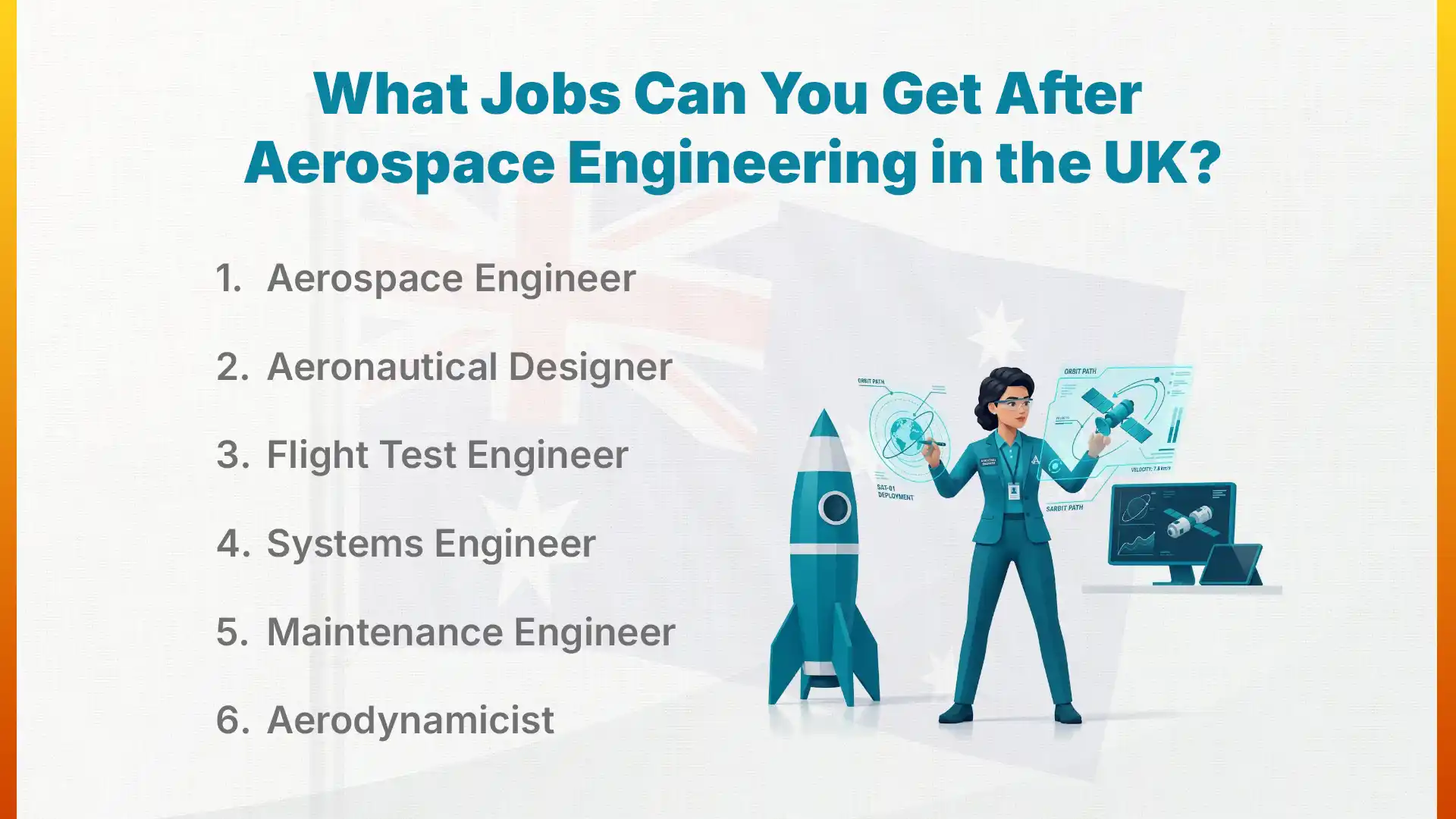
Graduates of a Bachelor of Aerospace Engineering in UK can secure roles such as aerospace engineer, aeronautical designer, flight test engineer, systems engineer, maintenance engineer, and aerodynamicist across defense, commercial aviation, and private sectors.
1. Aerospace Engineer
Aerospace engineers coordinate the design and testing of aircraft and spacecraft components. They write detailed technical reports, run structural simulations, and ensure designs meet strict UK CAA (Civil Aviation Authority) safety regulations. This is the most versatile professional outcome, offering a stable foundation in the industry.
2. Aeronautical Designer
Aeronautical designers specialize in using advanced CAD software to create the physical structures of aircraft. They focus on weight reduction, aerodynamic efficiency, and material selection to ensure the aircraft is fuel-efficient and safe.
3. Flight Test Engineer
Flight test engineers work directly on the tarmac and in the air, analyzing flight data to assess how an aircraft performs under real-world conditions. This highly thrilling role requires a deep understanding of flight mechanics and on-the-spot problem-solving.
4. Systems Engineer (Avionics)
Systems engineers focus on the complex electronic systems that fly the aircraft, including navigation, communications, and flight control systems. With modern aircraft becoming "flying computers," this is one of the fastest-growing specializations in the UK aerospace sector.
5. Maintenance Engineer
Maintenance engineers are responsible for the routine inspection, repair, and servicing of commercial or military aircraft. They ensure that every plane meets stringent safety standards before it is cleared to take off.
6. Aerodynamicist
Aerodynamicists use computational fluid dynamics (CFD) and wind tunnel data to study how air flows over aircraft surfaces. They play a critical role in reducing drag and improving the overall fuel efficiency of new aircraft models.
What Is the Salary and Scope After Aerospace Engineering in the UK?
The salary after a bachelor of aerospace engineering in UK ranges from £28,000 to £35,000 at entry-level, rising to £55,000 or more for senior engineers, with a highly structured pathway to long-term work rights via the Graduate Route and Skilled Worker visas. Aerospace engineers consistently rank among the highest-paying jobs in the UK.
Experience Level | Annual Salary (GBP) | Annual Salary (NPR approx.) |
|---|---|---|
| Entry-Level (0–2 Years) | £28,000 – £35,000 | NPR 4,480,000 – NPR 5,600,000 |
| Mid-Level (2–5 Years) | £35,000 – £50,000 | NPR 5,600,000 – NPR 8,000,000 |
| Senior Engineer (5+ Years) | £55,000 – £75,000+ | NPR 8,800,000 – NPR 12,000,000+ |
After completing your degree, you can apply for the Graduate Route Visa, allowing you to stay and work in the UK for 2 years (or 3 years with an MEng). Unlike Australia, the UK does not use a points-based PR system. Instead, once you secure a relevant engineering job, your employer can sponsor you for a Skilled Worker Visa, which eventually leads to Indefinite Leave to Remain (ILR) or permanent residency.
Conclusion
A bachelor of aerospace engineering in the UK guarantees a highly specialized global career and a fast-tracked pathway to working in Europe's largest aerospace hub. The cost of not using expert guidance includes choosing a non-RAeS-accredited university, missing the strict UCAS deadlines, and facing UK student visa refusals due to financial documentation errors.
Interested in studying for a Bachelor of Aerospace Engineering in the UK? Contact SAS Education Consultancy for a free counseling session or submit a free inquiry today. Let us help you find the right program, prepare a strong UCAS application, and navigate the UK Student Visa process with confidence.