Bachelor of Nursing in Australia for Nepali Students

Jan 23, 2026

Many Nepali students dream of building a rewarding career in healthcare, but navigating foreign education systems, eligibility criteria, and career pathways can feel confusing. Choosing the right course and university in Australia, understanding English requirements, and ensuring a smooth visa process often leave students confused and stressed.
In this blog, we will break down everything you need to know about pursuing a Bachelor of Nursing in Australia, from program details and eligibility requirements to costs, career opportunities, and post-study pathways. By the end, you’ll have a clear roadmap to study nursing in Australia, avoid common pitfalls, and take the first step toward a secure, well-paying, and globally recognized nursing career.
In this blog
What is a Bachelor of Nursing?
A Bachelor of Nursing is an undergraduate degree designed to prepare students for a professional career in nursing, equipping them with both theoretical knowledge and practical skills to provide high-quality patient care. This program combines classroom learning, laboratory practice, and clinical placements in hospitals or healthcare settings, ensuring students gain hands-on experience before entering the workforce.
Unlike a diploma or certificate in nursing, a Bachelor of Nursing offers a more comprehensive education, covering a wide range of topics from human anatomy and physiology to advanced patient care techniques, healthcare ethics, and management skills. It also opens doors to advanced nursing roles and higher education opportunities, such as postgraduate studies, master’s in Australia or specialization in fields like midwifery, critical care, or mental health nursing.
Key features of a Bachelor of Nursing include:
- Program Duration: Typically 3 to 4 years of full-time study.
- Curriculum Structure: A combination of theoretical coursework, practical lab sessions, and clinical placements in hospitals, aged care facilities, or community health centers.
- Core Subjects: Nursing fundamentals, anatomy and physiology, pharmacology, mental health nursing, community health, patient safety, and leadership in healthcare.
- Skills Developed: Patient care, clinical assessment, medical procedure administration, communication with patients and families, critical thinking, and teamwork.
- Professional Recognition: Graduates are eligible to register as a Registered Nurse (RN) in Australia after completing national registration requirements.
For Nepali students, pursuing a Bachelor of Nursing in Australia provides not only a globally recognized qualification but also excellent job prospects, career growth, and opportunities for permanent residency. The degree ensures students are well-prepared to meet the growing demand for qualified nurses both in Australia and worldwide.
Why Study a Bachelor of Nursing in Australia?
Studying a Bachelor of Nursing in Australia gives Nepali students a globally recognized degree, high job opportunities, and strong career growth in a safe and supportive environment. Australia is one of the top destinations for studying and working in nursing because it offers high-quality education, modern hospitals, and practical training. Nursing is in high demand, so students who graduate have a better chance of finding stable jobs and building long-term careers.
Here’s why many students choose Australia for nursing:
- Globally Recognized Degree: A nursing degree from Australia is respected worldwide. This means you can work in other countries if you want to.
- High Demand for Nurses: Australia has a shortage of nurses, which makes it easier to find jobs after graduation. You can also enjoy job security and a steady income.
- Good Career Growth: After completing your degree, you can specialize in areas like midwifery, mental health, or aged care. There are many paths to grow in your career.
- Post-Study Work Opportunities: Australia allows international students to stay and work after finishing their degree. This gives you valuable experience and can help you apply for permanent residency later.
- Practical Learning: Nursing programs in Australia include hands-on training in hospitals and clinics. You learn by doing, which makes it easier to work confidently after graduation.
- Safe and Friendly Environment: Australia is a safe country with welcoming people. Nepali students can adjust easily and enjoy life while studying.
Choosing to study a Bachelor of Nursing in Australia not only gives you a quality education but also opens doors to a secure and well-paying career. If you want a profession where you can help people, grow quickly, and live abroad, Australia is one of the best places to start.
Eligibility Requirements for Nepali Students
To study a Bachelor of Nursing in Australia, Nepali students need to meet academic, English language, and health standards to ensure they can handle both coursework and clinical practice.
1. Academic Qualifications
Most universities require completion of higher secondary education (+2) with a strong Science background, particularly in Biology and Chemistry. Students should usually have a minimum score of around 60% or equivalent. Universities may convert Nepali +2 marks to the Australian grading system to assess eligibility.
2. English Language Requirements
- IELTS (Academic): overall score 7.0, no band less than 7.0
- PTE Academic: 65 or above
- OET: minimum B grade in each component
- TOEFL iBT may be accepted by some universities
These tests must generally be taken within two years of the course start date to ensure current language proficiency.
3. Health and Character Requirements
Before admission and clinical placements, students must meet health and character standards. This includes health checks and vaccinations, a police clearance certificate, and in some cases, a Working with Children Check. These requirements ensure students can safely work in healthcare settings while protecting patients and themselves.
Meeting all these requirements for studying in Australia is essential for a smooth application and successful study journey.
Top Universities Offering Bachelor of Nursing in Australia
Australia has some of the best universities in the world for nursing. These universities offer high-quality programs, practical training in hospitals, and strong career support. Nepali students can choose from these top institutions to get a globally recognized degree. Here’s a simple guide to the most popular universities in Australia for nursing.

1. University of Sydney
The University of Sydney is one of the oldest and most respected universities in Australia. Its nursing program combines theory with practical hospital experience. Students learn modern nursing skills and patient care techniques. The university has experienced teachers and well-equipped labs. Graduates can register as professional nurses in Australia.
2. Monash University
Monash University in Melbourne is known for its advanced nursing program. It offers hands-on clinical training in real healthcare settings. Students also learn about research and healthcare management. The university provides support for international students, including Nepali students. After graduation, students have strong job opportunities in Australia.
3. University of Technology Sydney (UTS)
UTS offers a practical approach to nursing education. Students spend time in hospitals and clinics gaining real experience. The program focuses on patient care, communication, and teamwork. Teachers are supportive and guide students throughout their studies. Graduates are ready to work as registered nurses in Australia.
4. University of Melbourne
The University of Melbourne provides a high-quality nursing degree recognized worldwide. The program includes clinical placements in top hospitals. Students learn about modern nursing practices and healthcare research. Support services help international students adjust to life in Australia. Graduates have good chances of finding jobs and growing in their careers.
5. Griffith University
Griffith University in Queensland offers an interactive nursing program. Students learn through practical training and classroom teaching. The university emphasizes patient safety, ethics, and healthcare skills. Clinical placements help students gain real-world experience. Nepali students can also access scholarships and support services.
6. Deakin University
Deakin University provides a flexible nursing program with practical experience. Students spend time in hospitals learning essential nursing skills. The program focuses on real-world patient care and teamwork. Teachers are experienced and provide guidance for career development. Graduates are well-prepared to work as registered nurses in Australia.
Cost of Studying a Bachelor of Nursing in Australia
Planning the cost is one of the most important steps for Nepali students who want to study nursing in Australia. Knowing how much tuition, living expenses, and other costs for studying in Australia are will help you budget properly and avoid surprises. Here’s a clear breakdown of what you can expect.
1. Nursing Tuition Fees in Australia (per year)
The highest cost for a Bachelor of Nursing in Australia is tuition. For international students, including Nepali students, the annual tuition fees usually range from about AUD 30,000 to AUD 45,000 per year, depending on the university and location. Some regional and smaller universities may offer slightly lower fees, while the very top universities might be on the higher side of the range.
These figures are estimates and can vary a bit from one institution to another, so it is important to check the exact fee on the university’s official website before applying.
2. Living Expenses for Nepali students
Living costs in Australia generally include accommodation, food, transport, utilities, and personal expenses. Most students budget around AUD 25,000 to AUD 30,000 per year for living expenses, though this can change based on where you live and how you choose to spend.
The Australian Government also requires international students to demonstrate around AUD 29,710 per year as proof of funds when applying for a student visa. This amount covers basic living costs like rent, food, transport, and bills.
In addition to tuition and living costs, students should also plan for Overseas Student Health Cover (OSHC) (around AUD 500 to AUD 800 per year) and other expenses like textbooks, materials, travel, and visa fees. Meeting these costs with proper budgeting, savings, or financial support is key to a smooth study journey in Australia from Nepal.
Career Opportunities After a Bachelor of Nursing in Australia
Completing a Bachelor of Nursing in Australia opens many career opportunities for Nepali students. The country has a high demand for qualified nurses, which means graduates can find stable jobs quickly. Nursing is not only a respected profession but also offers long-term growth, good salaries, and chances to specialize in different areas of healthcare.
After graduation, students can register as Registered Nurses (RN) with the Nursing and Midwifery Board of Australia (NMBA). This registration allows them to work in hospitals, clinics, aged care facilities, community health centers, and other healthcare settings. Many hospitals and private organizations also offer opportunities for career advancement and professional development.
Key career opportunities include:
- Registered Nurse Roles: Work in general wards, intensive care, emergency units, pediatrics, or mental health.
- Specialized Nursing: Focus on areas like midwifery, critical care, oncology, or community health.
- Leadership and Management: With experience, nurses can become nurse managers, clinical educators, or administrators.
- Research and Education: Opportunities to participate in healthcare research or teach in nursing colleges.
1. Average Salary in Australia
Registered nurses in Australia earn a good salary, typically ranging from AUD 65,000 to AUD 90,000 per year, depending on experience, specialization, and location. This makes nursing a financially rewarding career.
2. PR Pathway and Long-Term Growth
Nursing is one of the top PR-leading courses in Australia. After gaining work experience under a post-study work visa, graduates can apply for PR, which allows them to live and work in Australia long-term.
Overall, a Bachelor of Nursing in Australia equips Nepali students with practical skills, strong job security, and the chance to grow into leadership or specialized roles while building a stable, rewarding career.
How to Apply for a Bachelor of Nursing in Australia?
To apply for a Bachelor of Nursing in Australia, you need to meet the entry requirements, choose the right university, prepare documents, submit your application, accept your offer, and apply for a student visa. Following these steps carefully will make your application process smooth and increase your chances of admission. In this section, we will guide you through each step in a simple and clear way so Nepali students can apply with confidence.
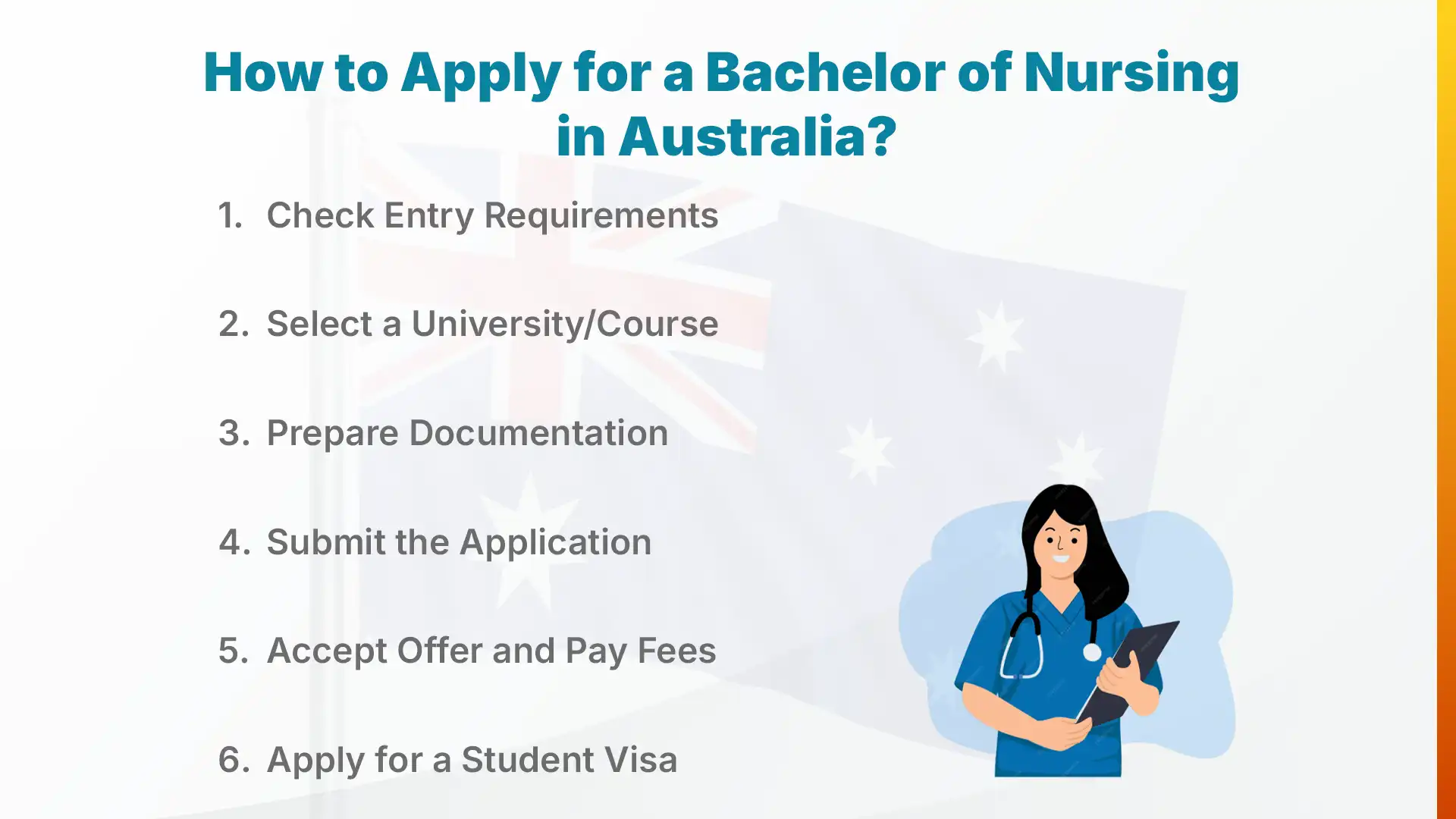
1. Check Entry Requirements
Before applying, make sure you meet all the academic, English language, and health requirements. Most universities require a science background in higher secondary education, and English test scores like IELTS, PTE, or OET. You should also be ready with health certificates and a police clearance. Checking these requirements first saves time and prevents delays in your application.
2. Select a University/Course
Research universities in Australia that offer Bachelor of Nursing programs. Compare tuition fees, course structure, clinical placement opportunities, and support for international students. Choose the course that fits your career goals and budget. Make a list of your preferred universities to apply to.
3. Prepare Documentation
Collect all necessary documents before applying. This usually includes academic transcripts, English test scores, a passport copy, SOP for Australia, health and character certificates, and recommendation letters if needed. Make sure your documents are clear, up-to-date, and correctly certified. Having everything ready makes the application process faster and easier.
4. Submit the Application
Most universities allow online applications through their official websites. Fill in your details carefully, attach all documents, and pay the application fee if required. Some universities may ask for an interview or additional tests, so stay prepared.
5. Accept Offer and Pay Fees
Once you receive an offer letter, read it carefully and confirm your acceptance. Pay the required tuition fees or deposit to secure your seat. Keep copies of all payment receipts for visa and record purposes.
6. Apply for a Student Visa
After accepting the offer, apply for an Australian Student Visa (Subclass 500). Submit your offer letter, proof of funds, English test results, and health cover documents. Make sure to apply well before your course start date to avoid delays.
Which is the Best Consultancy for Nursing in Australia from Nepal?
SAS Education Consultancy is the best consultancy for nursing in Australia from Nepal, offering end‑to‑end support from counselling to visa success. With personalized guidance, strong university connections, and a high approval rate, it helps Nepali students confidently pursue their dream of studying nursing abroad.
Choosing the right education consultancy for Australia can make a big difference in your Australian study journey, especially for a professional degree like nursing. Expert guidance helps you avoid common mistakes, complete your application correctly, and stay updated with changing rules. With so many consultancies in Nepal, finding one with proven success, clear processes, and reliable support is very important.
Why SAS Education Consultancy is the best choice
- Personalized counselling that matches your goals with the right nursing program and university in Australia.
- Complete application support, including documentation, SOP help, and course selection advice.
- High visa success rate consultancy, backed by careful preparation and mock interview guidance.
- Test preparation assistance for IELTS, PTE, or other English requirements.
- Scholarship and financial planning support to help reduce overall cost.
Many students who used SAS appreciate the friendly team and clear communication throughout the process. Their service covers everything from your first consultation to pre‑departure guidance, ensuring that Nepali students feel confident and ready for life and study in Australia.
Choosing expert help like SAS means you are guided by professionals who know the application pathways, university requirements, and visa processes. This reduces stress, improves your chances of acceptance and visa approval, and lets you focus on preparing for your future as a nurse in Australia.
Conclusion
Pursuing a Bachelor of Nursing in Australia is one of the best career decisions Nepali students can make if they want a secure, well-paying, and globally recognized profession. The degree not only equips students with practical skills and clinical experience but also opens doors to high-demand nursing roles, post-study work opportunities, and pathways to permanent residency. Australia’s top universities offer world-class education, hands-on training, and strong support for international students, making the transition smooth and rewarding.
By choosing expert education consultants, like SAS Education Consultancy, Nepali students can confidently navigate admissions, visa processes, and scholarship options. Studying nursing in Australia sets a strong foundation for long-term career growth, financial stability, and a fulfilling life helping people in healthcare.