Study Bachelor of Industrial Engineering in Australia: Top Universities, Fees & Career Scope

Jul 14, 2026

The most successful companies in the world do not just work harder; they engineer their processes to work smarter. The biggest hurdle for Nepalese students is finding a degree that seamlessly blends hardcore engineering with business and logistics without paying the exorbitant tuition fees of US universities.
By studying in Australia, you gain access to a specialized education that turns you into an efficiency expert, complete with a direct post-study pathway to permanent residency. This guide details the top universities, exact costs, admission steps, and salary expectations for 2026.
In this blog
What Is a Bachelor of Industrial Engineering in Australia?
A Bachelor of Industrial Engineering in Australia is the critical bridge between engineering and business, focusing entirely on optimizing complex systems, processes, and supply chains to make organizations run faster, cheaper, and safer. It is typically offered as a BE (Industrial), BEng (Industrial), or a Bachelor of Engineering (Honours) with an industrial or systems major.
The program has a standard duration of 4 years and is strictly accredited by Engineers Australia (EA), a Washington Accord signatory, which ensures your degree is globally recognized. Graduates are fully equipped to streamline operations and eliminate waste for tech giants, massive manufacturing plants, and global logistics corporations.
Why Study a Bachelor of Industrial Engineering in Australia?
Australia is a top destination to study industrial engineering because it offers globally recognized EA-accredited degrees, strong industry links, high demand for process optimization, and a clear pathway to PR through engineering occupations.
1. Globally Recognised EA-Accredited Degrees
Australian engineering programs are developed under the Washington Accord, meaning your 4-year degree is instantly respected by licensing bodies and employers worldwide, completely eliminating the need for lengthy re-qualification if you choose to work abroad or return to Nepal.
2. Strong Industry Links With Mining, Manufacturing, and Logistics
Australia has a massive, resource-driven economy. Institutions maintain direct partnerships with global giants like BHP, Rio Tinto, and Boeing Australia. These connections are crucial, as they facilitate mandatory industry placements where students learn to optimize real-world mining and manufacturing supply chains.
3. High Demand for Process Optimisation in the Tech Sector
As Australian tech hubs in Sydney and Melbourne expand, companies are desperately seeking professionals who can streamline software delivery pipelines and optimize hardware manufacturing. Industrial engineers are uniquely trained to fill this highly lucrative niche.
4. Pathway to PR Through Engineering Occupations
Industrial engineers are consistently listed on Australia's Medium to Long Term Strategic Skills List (MLTSSL). Graduates with an Australian degree and local engineering experience are exceptionally well-positioned to apply for state-nominated or independent skilled migration visas.
Which Are the Top Universities for Industrial Engineering in Australia?
The top universities for a Bachelor of Industrial Engineering in Australia include UNSW, the University of Melbourne, and Monash University, all offering world-leading facilities and strong corporate placements. If you want to compare these with other global leaders, you can explore the best universities in Australia for a broader view.
Institution | Location | Program | Known For | EA Status |
|---|---|---|---|---|
| University of New South Wales (UNSW) | Sydney, NSW | BEng (Honours) (Industrial) | Top-Ranked Engineering Faculty; Elite Optimisation Labs | Fully Accredited |
| University of Melbourne | Melbourne, VIC | Bachelor of Engineering (Honours) (Mechanical/Systems) | Strong Focus on Systems Engineering and Analytical Modelling | Fully Accredited |
| Monash University | Melbourne, VIC | Bachelor of Engineering (Honours) (Industrial) | Expertise in Supply Chain Design and Sustainable Manufacturing | Fully Accredited |
| RMIT University | Melbourne, VIC | Bachelor of Engineering (Industrial) (Honours) | Highly Practical; Heavy Focus on Industry-Led Factory Floor Projects | Fully Accredited |
| University of Sydney | Sydney, NSW | Bachelor of Engineering (Honours) (Mechatronic/Industrial) | Focus on Human Factors, Ergonomics, and Robotic Integration | Fully Accredited |
Choosing any of these EA-accredited institutions guarantees you receive premium practical training that meets the strict standards of the global manufacturing and logistics industries.
What Are the Admission Requirements?
The admission requirements for a bachelor of industrial engineering in Australia include strong academic results in mathematics and physics from Plus Two, a minimum IELTS score of 6.5, a technically focused personal statement if requested, and proof of funds for the Subclass 500 visa.
1. Academic Requirements
For undergraduate programs, Nepalese students need Plus Two Science with a minimum of 60% to 75% overall, with particularly high grades in mathematics and physics. Because the mathematical rigor is high, some top-tier universities may require you to complete a foundation year before entering the 4-year bachelor's degree.
2. English Language Requirements
Engineering programs demand strong English skills so international students can safely comprehend complex technical manuals and write extensive optimization reports. Because these requirements vary, knowing the requirements to study in Australia from Nepal is crucial.
Test | Undergraduate Requirement |
|---|---|
| IELTS Academic | 6.5 Overall (Min 6.0 in All Bands) |
| TOEFL iBT | 79 – 90 |
| PTE Academic | 58 – 64 |
If you need to improve your score, consider joining the IELTS classes in Kathmandu.
3. Personal Statement
While Australian universities primarily assess undergraduate engineering applicants based on academic scores, some may request a supplementary personal statement or cover letter if you are a borderline candidate. If asked, your essay should explain why you are drawn to systems optimization, highlight specific mathematics or physics projects you have completed, and demonstrate your understanding of current challenges in the manufacturing industry. If you need guidance on structuring a strong application essay, you can refer to our guide on what is an SOP, which covers many of the same principles used to write a compelling personal statement.
4. Financial Proof and Visa Documentation
To meet the visa requirements, you must demonstrate sufficient funds to cover your first year's tuition and at least 12 months of living costs in your bank account to secure the Subclass 500 Student Visa.
How to Apply for a Bachelor of Industrial Engineering in Australia?
Applying for a Bachelor of Industrial Engineering in Australia involves five steps: shortlisting institutions, preparing your academic and financial documents, writing your statement of purpose, submitting your application, and receiving your offer to apply for a study permit. Checking Australian intakes early is essential to avoid missing the February or July application windows.
Step 1: Shortlist Universities
Compare programs based on EA accreditation, curriculum focus (e.g., manufacturing optimization vs. supply chain logistics), location, and tuition fees. Be sure to check if the program includes a mandatory 12-week industry placement, as hands-on exposure is critical in this discipline.
Step 2: Prepare Documents
Gather your Plus Two transcripts (specifically highlighting math and physics scores), IELTS/PTE scores, a valid passport, CV/resume, and academic reference letters. Ensure all your academic transcripts are officially translated into English and notarized.
Step 3: Write Your SOP
Tailor your Statement of Purpose to each specific Australian university, highlighting how their industrial facilities or corporate partnerships align with your desire to work in process optimization. Mention your awareness of the safety and efficiency standards required in industrial engineering.
Step 4: Submit Application
Apply directly through each university's international student portal. Apply early, ideally 4 to 6 months before the February or July intake, as specialized engineering programs fill up quickly. Keep a dedicated folder for your application IDs and correspondence.
Step 5: Receive CoE and Apply for Subclass 500 Visa
Once you receive an unconditional offer letter and pay your deposit, you will receive a Confirmation of Enrollment (CoE) document. Use this CoE to apply for the Subclass 500 Student Visa, ensuring your financial documents are perfectly prepared to avoid any delays. Remember that you must also purchase Overseas Student Health Cover (OSHC) before your CoE can be issued.
How Much Does It Cost to Study Industrial Engineering in Australia?
The cost to study for a Bachelor of Industrial Engineering in Australia requires an estimated total budget of AUD 46,000 to AUD 66,000 per year, covering both tuition fees and living expenses. Budgeting is easier when you know what to expect, which is why it is so important to research the total cost to study in Australia before making your final decision.
Program | Annual Tuition (AUD) | Annual Tuition (NPR approx.) |
|---|---|---|
| Bachelor of Engineering (Industrial / Systems) | AUD 43,000 – AUD 53,000 | NPR 3,870,000 – NPR 4,770,000 |
Monthly living expenses range from AUD 1,500 to AUD 2,500, depending on whether you live in expensive cities like Sydney or in more affordable regional hubs. To help offset these living costs, Nepalese students are allowed to work 48 hours per fortnight during term time by securing part-time jobs in Australia.
Taking tuition and living expenses together, Nepalese students should budget approximately AUD 46,000 to AUD 66,000 per year in total.
What Scholarships Are Available in Australia for Industrial Engineering?
Scholarships for a Bachelor of Industrial Engineering in Australia include fully funded government options, regional grants, and university-specific merit awards for high-achieving international STEM students.
Australia Awards Scholarship: A fully funded government grant covering full tuition, living allowances, and travel for outstanding Nepalese students pursuing undergraduate STEM degrees.
Destination Australia Scholarship: Up to AUD 15,000 per year for international students who choose to study at regional Australian universities with strong engineering programs.
University Merit Scholarships: Many Australian engineering faculties offer automatic fee reductions of AUD 5,000 to AUD 10,000 per year for high-achieving international students based on their Plus Two transcripts.
STEM Women Scholarships: Various organizations offer targeted financial grants for female international students pursuing degrees in male-dominated fields like industrial and systems engineering.
Always apply for scholarships at least 6 months before your course starts, and ensure your SOP clearly articulates your leadership skills and future contributions to the industrial sector to stand out.
What Jobs Can You Get After Industrial Engineering in Australia?
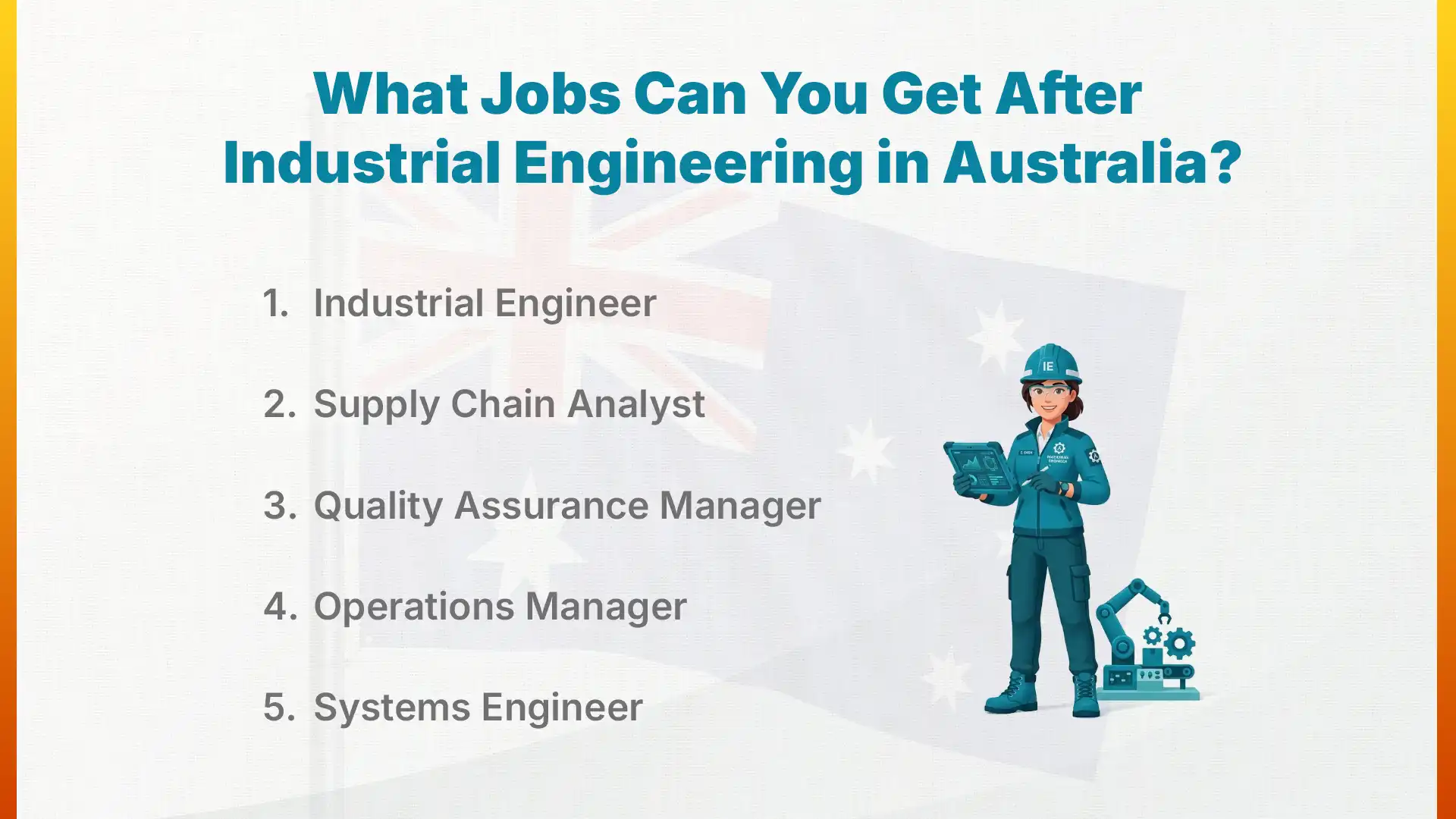
Graduates of a Bachelor of Industrial Engineering in Australia can secure highly specialized roles such as industrial engineer, supply chain analyst, quality assurance manager, operations manager, and systems engineer across the tech, manufacturing, logistics, and corporate management sectors.
1. Industrial Engineer
Industrial engineers analyze complex production processes to identify inefficiencies and design streamlined workflows that save companies time and money without compromising product quality.
2. Supply Chain Analyst
Supply chain analysts use data modeling to optimize the movement of goods from manufacturers to consumers, ensuring inventory levels are perfectly balanced to meet consumer demand.
3. Quality Assurance Manager
Quality assurance managers design and implement testing protocols (like Six Sigma) to ensure every product leaving a manufacturing facility meets strict industry and regulatory standards.
4. Operations Manager
Operations managers oversee the daily operations of entire production facilities or logistics hubs, coordinating between human resources, machinery, and supply chains to maximize output.
5. Systems Engineer
Systems engineers take a high-level approach to integrate complex subsystems like software, hardware, and human operators into one cohesive, functioning industrial system.
What Is the Salary and Scope After Industrial Engineering in Australia?
The salary after a Bachelor of Industrial Engineering in Australia ranges from AUD 65,000 at entry-level to over AUD 135,000 for senior roles, with a highly streamlined PR pathway via the Subclass 485 and 189/190 skilled migration visas.
Experience Level | Annual Salary (AUD) | Annual Salary (NPR approx.) |
|---|---|---|
| Entry-Level (0–2 Years) | AUD 65,000 – AUD 80,000 | NPR 5,850,000 – NPR 7,200,000 |
| Mid-Level (2–5 Years) | AUD 85,000 – AUD 110,000 | NPR 7,650,000 – NPR 9,900,000 |
| Senior Engineer (5+ Years) | AUD 120,000 – AUD 140,000+ | NPR 10,800,000 – NPR 12,600,000+ |
After completing your degree, you can apply for the Temporary Graduate Visa (Subclass 485), which allows you to work in Australia for up to 4 years depending on your study location. This gives you crucial time to build local industry experience with top logistics and manufacturing firms.
Industrial engineers are consistently on Australia's Skilled Occupation List. Most Nepalese industrial engineering graduates with an Australian degree and 1 to 2 years of local work experience accumulate enough points to receive an Invitation to Apply (ITA) for the Skilled Independent Visa (189) or State Nomination (190), leading directly to permanent residency.
Conclusion
A Bachelor of Industrial Engineering in Australia guarantees a highly specialized global career and a fast PR pathway through the country's critical shortage of qualified process optimization professionals. The cost of not using expert guidance includes choosing the wrong non-accredited university, facing Subclass 500 visa refusals due to financial documentation errors, and significantly delaying your PR timeline.
Interested in studying a Bachelor of Industrial Engineering in Australia? Contact SAS Education Consultancy for a free counseling session or submit a free inquiry today. Let us help you find the right program, prepare a strong application, and navigate the Subclass 500 visa process with confidence.