Australian Student Visa Success Rate from Nepal: 2026 Guide

May 11, 2026

If you’re planning to study in Australia from Nepal, one question probably keeps coming back to your mind: What are my real chances of getting the visa approved? With so much noise online, rumours of mass refusals, sudden rule changes, and conflicting success-rate claims, it’s easy to feel confused or even discouraged before you begin.
But the truth is, Australia never stopped granting student visas to Nepali students. What has changed is how carefully applications are assessed, and now, your preparation actually pays off! Visa success today depends far less on luck and far more on how well your academic background, finances, course choice, and intentions align with Australia’s current student visa rules.
In this guide, we break down the actual Australia student visa success rate from Nepal, especially in 2025, using official trends, past five-year data, and clear explanations. You’ll understand why approval rates rose and fell, what the new rules really mean for you, and, most importantly, how to position yourself for a strong, genuine application going forward in 2026!
In this blog
What Is the Visa Success Rate of Australia From Nepal? in 2026?
As of March/April 2026, Australia’s student visa approval rate for Nepali students has dropped a lot, with reports showing only around 27%–40% of applications getting approved. This is the lowest level of grant rates of Australian student visas for Nepalese applicants in recent history.
This decline was seen after Nepal was moved to Assessment Level 3, which means Australian authorities now check students’ financial documents, academic background, and Genuine Student (GS) statements much more strictly than before.
In simple terms, Australia is still approving genuine student visa applications, but the system now looks more closely for clarity, preparation, and honest intent. This implies that students who apply with even more attention to detail, correct information, and practical ambitions of studying in Australia continue to see strong approval outcomes.
How Australia Calculates Visa “Success Rate”
Many students worry when they hear that visa success rates are falling. To understand this properly, you need to know how Australia calculates the success rate.
The success rate is based on two numbers:
- how many student visa applications Australia receives from Nepal, and
- how many of those applications are approved.
When more students apply but many applications do not meet the requirements, the overall success rate goes down. This does not mean Australia is rejecting everyone. It simply means more applications are being reviewed closely and filtered.
This is why overall percentages can be misleading. Your visa outcome depends more on your own profile than on the national success rate.
Join Nepal's Top IELTS Classes Today!
Australia Visa Approval Rate for Nepali Students (2021–2025 Overview)
The visa trend in Australia for Nepalese students has fluctuated over the past few years, but generally, the student visa success rate has ranged from 80-90%. The academic session 2023-24 witnessed a dip in the trend, with only 50.4%, however the number has bounced back in the 2024-25 intakes in Australia. In 2025–26, however, approval rates have again dropped significantly due to stricter GS rules and Nepal being placed under Level 3 assessment, with reports showing much tighter outcomes compared to previous years. In the next section, we’ll look at how visa approvals have changed over the last five years, so you can see the bigger picture and understand what this means for your application today.
1. Year-by-Year Breakdown of Student Visa Approval Trends (2021–2025)
Here’s a concise view of student visa grants to Nepali applicants over the past five years based on official Australia’s Department of Home Affairs data:
Program Year | Total Visas Lodged (Nepal) | Total Visas Granted (Nepal) | Visa Success Rate (%) |
| 2025–26 (As of May) | 70,000+ | ~21,000 – 28,000 | ~30% – 40% |
| 2024–25 | 52,742 | 45,170 | 85.6% |
| 2023–24 | 58,734 | 29,631 | 50.4% |
| 2022–23 | 65,737 | 62,318 | 94.8% |
| 2021–22 (H2) | 46,282 | 44,933 | 97.1% |
The visa trends from 2021 to 2025 show that approvals for Nepali students were generally strong, though they went up and down due to policy changes. Nepal has remained an important source of students for Australia. However, early 2026 data shows a clear drop in approval rates, now reported around 27%–40%, compared to much higher rates in earlier years. This is mainly because Nepal was moved to Assessment Level 3, which means stricter checks on finances, academic records, and study intentions.
Earlier high approval years show that well-prepared and genuine students were getting good results, while the recent drop shows Australia is being more careful with applications. Overall, it simply means applications now need to be more accurate, well-documented, and clearly planned. Even with tougher rules, genuine Nepali students who prepare properly still have a fair chance of approval.
2. Why Visa Success Rates Changed in 2025–2026
In 2025–26, Australia made its student visa process stricter, with a stronger focus on genuine study intent and application quality. These changes directly affected Nepali students and led to a noticeable drop in approval rates.
Several key reasons explain this shift:
- The Genuine Student (GS) requirement became more strict and detailed, replacing the older GTE system
- Financial checks were tightened, with closer review of bank statements and funding sources
- In 2026, Nepal was placed under Assessment Level 3, increasing document verification and scrutiny
- Authorities increased efforts to reduce misuse of student visas for work or migration purposes
- Applications are now assessed more carefully for course relevance and academic progression
Because of these changes, visa officers now examine applications more deeply than before. They want to clearly see that your study plan is logical, your financial background is stable, and your intention to study is genuine and consistent.
This explains why approval rates dropped in 2025–26. At the same time, the system is still fair for well-prepared students. Those who submit clear, honest, and well-documented applications continue to get approvals even under stricter rules.
Ready to Study in Your Dream Destination?
Get expert guidance on scholarships, universities, documents, and applications. Meet the SAS team today, and begin this life-changing adventure!
3. What Caused the Rise and Fall in Success Rates Each Year (2025–26 Focus)
The changes in Australia’s student visa success rates for Nepali students in 2025–26 are mainly due to stricter policies, deeper document checks, and more focus on genuine study intent. Instead of big global disruptions like earlier years, the recent shifts are mostly about tighter evaluation standards.
3.1 Stronger Genuine Student (GS) Assessment
In 2025–26, the GS requirement is applied more strictly. Officers carefully check whether your study plan, academic background, and future goals all connect properly. Weak or unclear intentions are more likely to be rejected.
3.2 Nepal Under Assessment Level 3 (2026)
With Nepal moved to Level 3, applications now face deeper scrutiny. This includes more detailed verification of financial documents, sponsor credibility, and overall study intent, leading to stricter outcomes.
3.3 Strict Financial History Checks
It is no longer enough to simply show funds. Officers now check how the money was accumulated, consistency in bank history, and whether the financial situation looks realistic and stable.
3.4 Course and Academic Mismatch Review
Applications are closely checked for logical alignment between past education and chosen course. If the study path does not make sense, the chances of refusal increase.
3.5 Focus on Genuine Study Intent vs Migration Intent
Authorities are more alert to applications that appear to be used for migration purposes rather than real education. Clear academic motivation is now essential.
3.6 More Selective Application Filtering
By 2025–26, the system has become highly selective. Well-prepared, consistent, and well-documented applications are still approved, while incomplete or unclear profiles are filtered out earlier in the process.
After the noticeable drop after 2024, the situation was gradually understood and improved. By 2025, approval rates showed some recovery as students, consultancies and embassies in whole adapted to the new visa expectations, especially around documentation and Genuine Student (GS) requirements. Applications became more structured, and many genuine students were again able to secure visas.
However, the recent move of Nepal to Assessment Level 3 in 2026 has again tightened the process. This has led to a significant drop in approval rates, as applications are now reviewed with much stricter checks on finances, study intent, and overall eligibility.
What Are the New Rules for Australia Student Visa in 2025–2026?
As of May 2026, Australia has introduced major updates to its student visa system to ensure higher integrity and stronger checks on genuine study intentions. These changes apply to all countries, including Nepal, and have made the process more structured, evidence-heavy, and detail-focused. While the system is stricter, it is also clearer for students who prepare properly.
1. Genuine Student (GS) Requirement (Stricter Intent Check)
Australia has officially replaced the old Genuine Temporary Entrant (GTE) rule with the Genuine Student (GS) requirement. This is now a deeper assessment of your real study purpose. Applicants must answer structured questions (around 150 words each) explaining their study plan, course choice, and future goals. Officers carefully check whether your academic journey is logical, consistent, and genuinely education-focused rather than migration-driven.
2. Financial Evidence & Living Cost Requirement (AUD 29,710+)
From 2026, students must show higher financial capacity, with the minimum living cost requirement increased to around AUD 29,710 per year (plus tuition and travel costs). Visa officers now also conduct stricter manual checks on bank statements, usually reviewing a 3-month financial history. They focus not only on the total amount but also on the source of income, sponsor stability, and consistency of transactions.
3. Higher English Language Requirements (IELTS 6.0/6.5)
English standards have become stricter for visa approval. Most applicants for Australia need at least IELTS 6.0 or equivalent, while some programs may require 6.5, depending on course level. Exemptions are more limited than before, meaning students must meet clearer and more consistent language benchmarks for approval.
Explore the Best IELTS Preparation Classes
4. Assessment Level 3 Country Classification (Including Nepal)
From January 2026, countries like Nepal, India, Bangladesh, and Bhutan are placed under higher evidence (Level 3) scrutiny. This means applications face deeper checks on financial documents, academic background, and overall credibility. Even small inconsistencies can lead to delays or refusals, making strong documentation essential.
5. Post-Study Work Visa (Subclass 485) Age Limit Reduced
The age limit for the Temporary Graduate Visa (Subclass 485) has been reduced to 35 years for most applicants. This change impacts long-term migration planning and makes early career and study decisions more important than before.
6. No Easy Onshore Switching of Visa Types
Australia has also tightened rules around visa switching. Students can no longer easily change from a visitor visa or Subclass 485 visa to a student visa while staying in Australia. This rule aims to reduce the misuse of visa pathways and ensure students apply correctly from the start.
7. Higher Visa Fees & Longer Processing Time
Visa application fees have increased significantly (around AUD 2,000 in many cases). At the same time, processing times have also slowed, with most applications now taking 8–10 weeks or longer, depending on complexity and document checks.
8. Reduced Work Hour Flexibility
International students are generally limited to 48 hours of work per fortnight during study periods (with some exceptions like research-based postgraduate students). This rule reinforces the idea that study should remain the primary focus, not employment.
Overall, these 2025–26 changes are designed to strengthen Australia’s education system by ensuring only genuine and well-prepared students receive visas. While the process has become more demanding, students with clear academic goals, strong documentation, and honest financial backgrounds still continue to succeed.
Key Factors and Lessons for High Visa Approval from Nepal
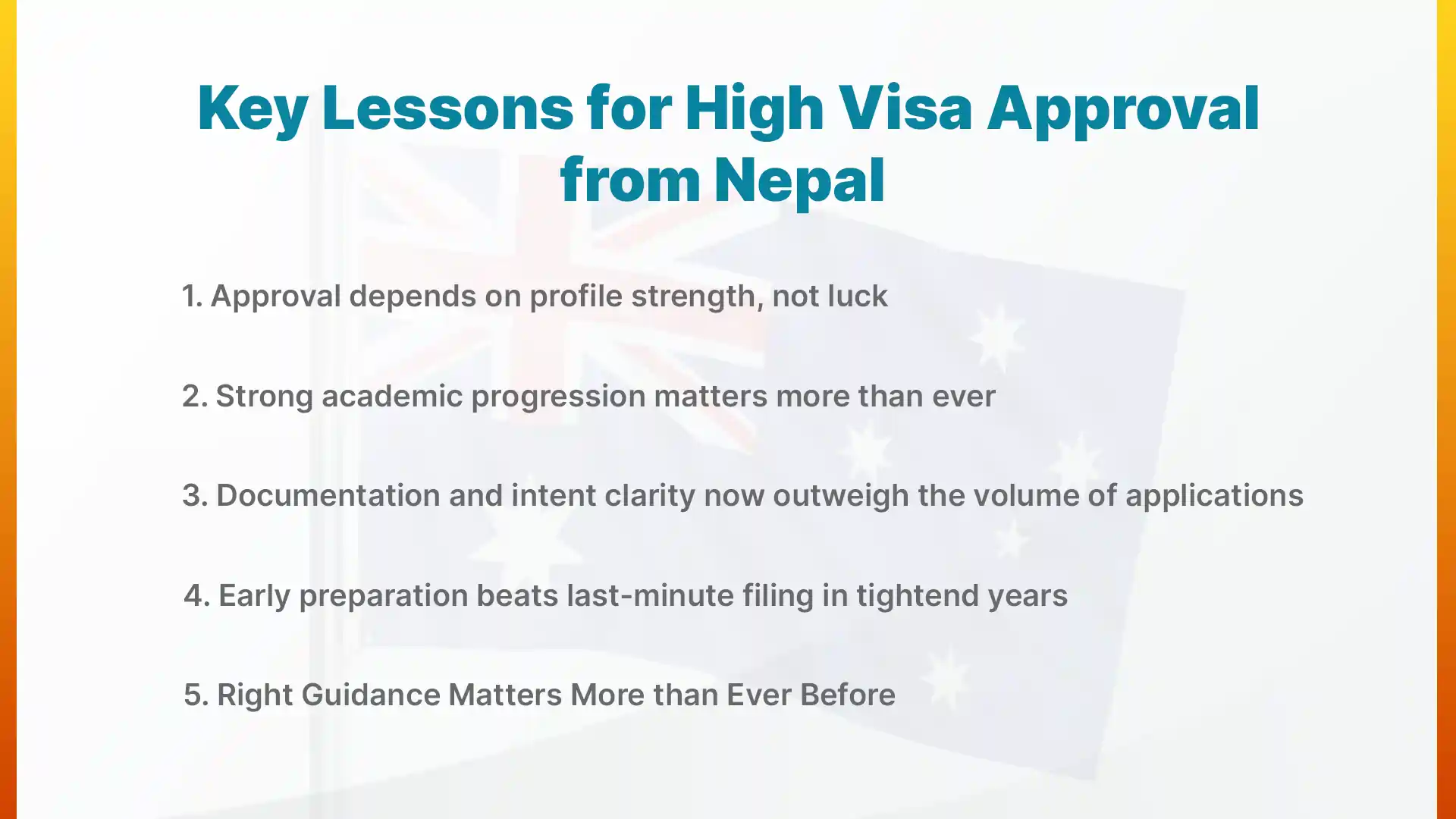
Visa success for Nepali students depends on how well all parts of your application fit together, not on luck or the number of other applicants. From my experience guiding students, the best chances come to those who plan carefully, understand what officers look for, and present their profile clearly. Recent trends show that immigration officers now assess profiles more systematically, which actually works in favor of students who know what matters.
1. Strong Profile Matters Most
Approval depends on your overall profile strength. Officers look at academics, course choice, finances, SOP for Australia, and future plans as one complete picture. When everything aligns, your application feels credible and trustworthy. Rushed or weak applications, on the other hand, naturally raise doubts. Think of your profile as a story. When it makes sense from start to finish, officers can easily understand your purpose.
2. Academic Background and Course Progression
A clear academic path is essential. The course you choose in Australia should logically follow your previous studies. Smooth progression shows that you have a plan, while sudden jumps or unrelated courses raise questions. Always link your past achievements to your future goals. Visa officers notice when your studies make sense together.
3. Clear Intent and SOP Quality
Your Statement of Purpose (SOP) is your chance to speak directly to the officer. It should explain why you want to study in Australia, how the course fits your goals, and what you plan to do after. Consistency between your SOP, academic record, and financial documents builds trust. A strong SOP can turn a good profile into a great one.
4. Financial Clarity and Sponsor Strength
Visa officers want confidence that you can afford tuition and living expenses. They also consider your sponsor’s stability. Clear, organized financial documents reduce unnecessary questions and help your application progress smoothly. Provide bank statements, proof of income, and any additional supporting documents upfront.
Study in Australia - Start Your Journey Now!
5. Choosing the Right University and Intake
Not all universities or intakes are equal in officers’ eyes. Institutions with strong compliance records and properly timed applications inspire confidence. Choosing the right course at the right intake shows planning and seriousness, which always helps.
6. Documentation and Early Preparation
Even strong profiles can fail if documents are incomplete or submitted late. Early preparation gives you time to fix gaps, clarify doubts, and submit a polished application. Accurate, complete, and timely documents tell officers that you are serious and reliable.
7. Guidance Matters
Small mistakes can cost approval, so having the right guidance is important. A mentor or consultant can help you choose the right course, prepare documents properly, and present your profile in the best possible way. With good guidance, even average profiles can become strong, convincing applications.
In short, focus on profile strength, clear academics, genuine intent, financial clarity, and proper documentation. Plan early, prepare well, and present your story clearly. These are the elements that consistently lead to successful Australian student visas for Nepali students.
How Many International Students Are in Australia in 2026?
In 2026, around 845,933 international students are studying in Australia, with Nepali students making up about 8% of this total. Despite tighter rules, Australia remains one of the top global study destinations. Students continue to arrive every intake, showing that the system is selective but still active. Genuine students are clearly still welcomed, and opportunities remain strong.
1. Nepali Student Growth Trends in Australia
Nepali students remain one of the fastest-growing international student groups in Australia. Over the years, more Nepali students have chosen Australia for its quality education and post-study opportunities. While growth has slowed compared to peak years, the Nepali student presence is still strong. This indicates that approvals continue, but the system now emphasizes careful screening.
2. What These Numbers Mean for Future Visa Decisions
High student numbers show that Australia still needs and accepts international students. At the same time, large demand has led to tighter controls and stricter checks. Future visa approvals will favor students with clear study goals, strong documentation, and careful preparation. The opportunity is still there, but planning and profile quality now matter more than ever.
3. Is Australia Still Granting Student Visas to Nepali Students in 2026?
Yes! Australia continues to grant student visas to Nepali students in 2026. What has changed is not the availability of visas, but the level of scrutiny and verification applied during assessment. Focus on preparing a strong profile with clear academic progression, genuine study intent, and complete documentation. Early planning and attention to detail can make a big difference under the tighter rules. If you’re ready, start preparing your application today to maximize your chances of success and secure your place in Australia’s education system.
4. Approval vs Refusal: What’s Actually Happening on the Ground
Approvals and refusals happen at the same time. Well-prepared students continue to get visas every intake. Refusals mainly affect applications with weak academics, unclear intent, or incomplete documentation. This shows that outcomes depend on profile quality, not nationality.
Some students believe Australia has “blocked” Nepali applicants, but this is not true. Others think refusals happen randomly, which is also incorrect. Most refusals follow clear patterns, such as academic mismatch, financial issues, or weak SOPs. Fixing these issues dramatically improves chances of approval.
Conclusion
Over the past few years, visa approvals for Nepali students in Australia have fluctuated, but genuine, well-prepared applicants continue to succeed. Now that you’ve reached the end of this guide, you now understand the real data behind visa trends, year-by-year success rates, and the factors that influence approvals. This insight gives you a significant advantage. Now you know what matters most to immigration officers and how to strengthen your profile.
Remember, success is not about luck; it’s about preparation, clarity, and making smart choices. Your academics, SOP, financial planning, course selection, and documentation all work together to build a convincing application. With this knowledge, you are now far better equipped than most to plan, prepare, and submit a strong application.
So if studying in Australia has been your dream, there’s no reason to wait. Start preparing your application today, focus on presenting a clear and strong profile, and take the next step toward your Australian education journey. Explore our complete guide to studying in Australia from Nepal, or visit an Australian study and visa consultant in Nepal!
Get a FREE Consultation from Certified Educational Counsellors