Minimum IELTS Score for Australia Student Visa from Nepal (2026)

Feb 04, 2026

Australia is one of the top study destinations for Nepali students. The universities are world-class, the lifestyle is safe, and the degree opens doors to global careers. But before you even start your application, you have to meet your IELTS score requirement for Australia first!
IELTS is essential to prove your English skills. Your test scores determine the path to study, work, and settle in Australia confidently. This makes it crucial to understand the minimum IELTS score needed for an Australian student visa.
That’s exactly what this guide will help you do! Explore this complete guide for IELTS in Nepal, so you can plan, prepare, and move toward your education in Australia with confidence.
In this blog
What is the Minimum IELTS Score Requirement for Australia?
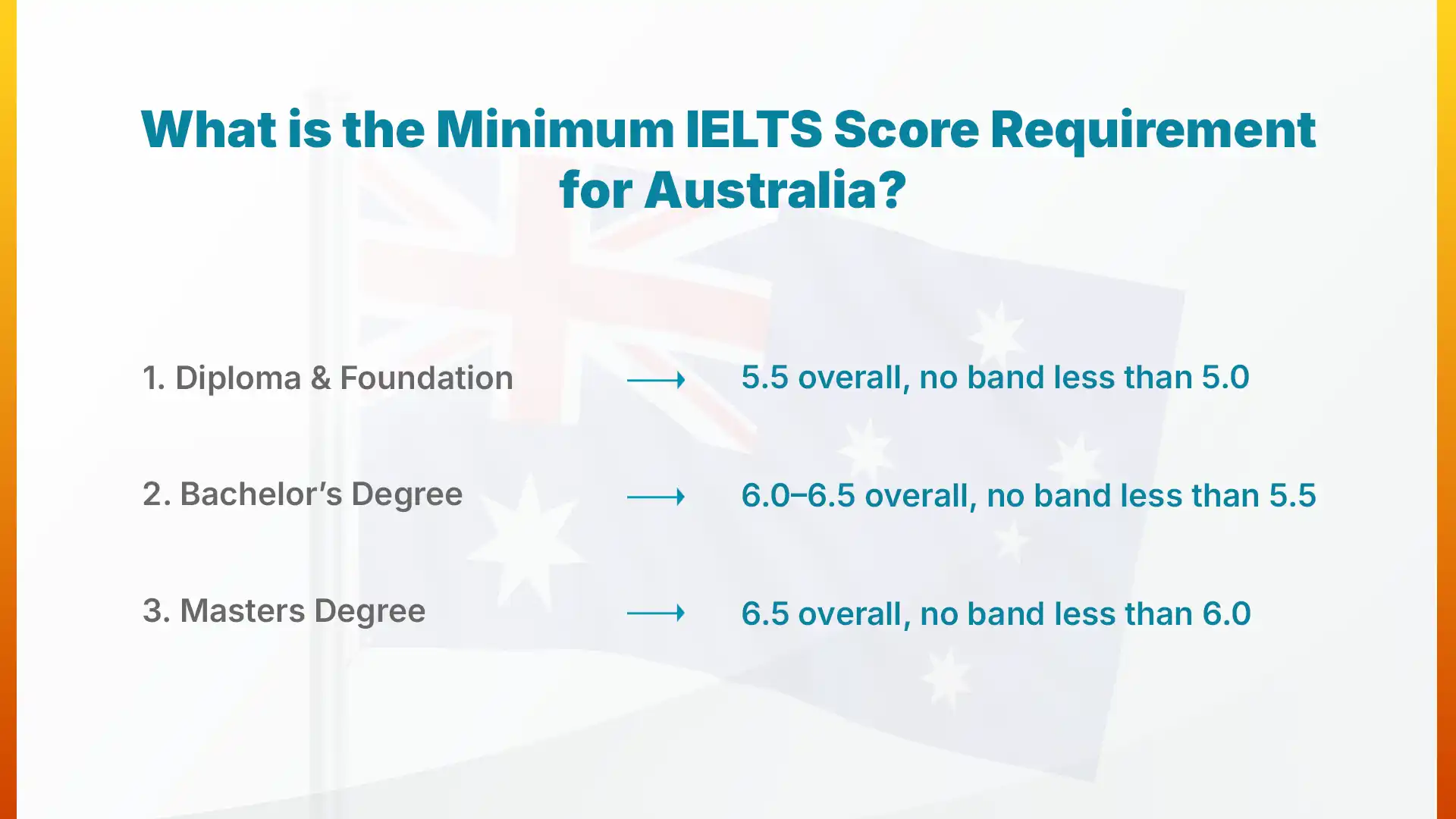
The minimum IELTS score for Australia usually starts at 5.5 overall for a student visa, but the exact band depends on your course and career goal. Diploma programs ask for lower scores, while degrees and professional fields require higher bands. So there isn’t one single number that fits everyone. To make things simple, let’s look at the score requirements to study in Australia level by level.
1. IELTS for Diploma & Foundation
If you are applying for a diploma or foundation program in Australia, the requirement is usually 5.5 overall with no band below 5.0. These courses are considered entry-level, so the English expectation is slightly relaxed. This makes them a good starting point if your score is not very high yet. Many Nepali students choose this path and later move to a bachelor’s degree.
2. How Much IELTS Score is Required for a Bachelor’s in Australia?
For most bachelor’s degrees, universities ask for 6.0 to 6.5 overall, with at least 5.5 in each module. Since lectures, assignments, and presentations are fully in English, stronger communication skills are needed. A 6.5 score also gives you more university choices and better admission chances. So, aiming a little higher can really open more doors.
3. IELTS Score for Master's in Australia
Master’s programs generally require 6.5 overall with no band less than 6.0. At this level, you’ll write reports, research papers, and attend advanced classes, so clear English is very important. Because of this, universities are stricter with their requirements. Preparing well for each section becomes even more important here.
4. IELTS Score for Nurses in Australia
For nursing and other health-related courses in Australia, the requirement is higher, usually 7.0 overall. Most institutions ask for at least 6.5 in Writing and 7.0 in the other modules. This is because patient safety and communication are critical in the medical field. So if you plan to study nursing in Australia, you should target a strong score from the beginning.
5. Permanent Residency (PR) IELTS Requirement
If you’re thinking long term, IELTS also matters for Permanent Residency (PR) in Australia. Most PR pathways require at least 6.0 in each module, not just an overall band. Higher scores can give you more migration points and improve your chances. That’s why many students prepare for IELTS with both study and future PR goals in mind.
Can You Study in Australia Without IELTS?
Yes, you can study in Australia without IELTS in some cases, depending on your university and background. Many institutions accept alternatives like English waivers, MOI letters, or other English tests instead. Let’s look at each option so you can choose the safest and most suitable path.
1. English Waiver (When Schools Accept You Without IELTS)
Some universities offer an English waiver if you have already studied in English for many years. For example, if your school or college education was fully in English, they may not ask for IELTS. In this case, the university checks your academic records instead of test scores. Still, approval depends on the institution, so always confirm before applying.
2. MOI Letter (Medium of Instruction)
An MOI letter is a document from your previous school or college stating that your studies were taught in English. Many Nepali students use this option, especially after +2 or bachelor’s level. Some universities accept it as proof of English ability, but others may still ask for a test. So it works well, but it’s not guaranteed everywhere.
3. PTE / TOEFL / Duolingo as IELTS Alternatives
If you don’t want to take IELTS, you can choose other tests like PTE, TOEFL, or Duolingo. These exams are widely accepted by Australian universities and are sometimes easier or faster to prepare for. Many students prefer PTE because results come quickly and the format feels simpler. Compare your choices, IELTS vs PTE, and just make sure your chosen university accepts the test before booking.
4. Pathway or ELICOS Programs Before Main Course
Another option is to join an ELICOS or pathway English program first. Here, you study English in Australia and then move directly into your main course after completing the required level. This is helpful if your IELTS score is low or if you feel you need extra practice. It takes more time and money, but it can make your transition smoother.
5. Which Language Proficiency Option Is Safest for Visa Approval?
From a visa point of view, taking a recognized English test like IELTS or PTE is usually the safest choice. Test scores clearly show your language ability, which strengthens your visa profile. Waivers and MOI letters can work, but they sometimes need extra explanation or documents.
So, if you want fewer risks and faster approval, a proper English test is often the most reliable path. If you are not confident about achieving your targeted score in Australia, you can always search for the best IELTS preparation classes and benefit from their structured guidance.
Is IELTS 5.5 Accepted in Australia?
Yes. Although low, IELTS 5.5 makes you eligible to study in Australia for many diploma, foundation and some bachelor's programs. You can enrol on pathway courses, where you can improve your English while starting your studies. In the next part, we’ll look at the universities that accept this score, so you know exactly where you can apply.
1. Universities in Australia That Accept IELTS 5.5 (Diploma & Pathway Programs)
Several Australian universities, including Torrens University, Kaplan Business School, and Charles Darwin University, accept IELTS 5.5 for diploma, foundation and selected bachelor programs. These programs often include pathways or packaged English courses to help you reach higher levels later. Below is a simple table showing universities and their locations for easy reference:
University Name | Location |
| Torrens University Australia | Sydney, Melbourne, Adelaide |
| Kaplan Business School | Sydney, Melbourne |
| Charles Darwin University | Darwin |
| University of Southern Queensland (UniSQ) | Toowoomba, Springfield, Sydney |
| Federation University Australia | Ballarat, Gippsland, Brisbane |
| Central Queensland University (CQU) | Rockhampton, Brisbane, Sydney |
| Southern Cross University | Lismore, Gold Coast, Coffs Harbour |
| Victoria University | Melbourne |
| Holmes Institute | Melbourne, Sydney |
| Edith Cowan College / ECU Pathway | Perth |
2. Courses Commonly Available with 5.5 Band
With IELTS 5.5, you can enrol in programs that allow you to start your academic journey while improving your English skills. Most students take diploma, foundation, or pathway courses before moving to full bachelor's programs. Below are the common courses and programs offered at this band:
- Diploma of Business
- IT and Computing
- Hospitality and Tourism
- Early Childhood Education
- Foundation/Bridging Programs
These options help you build confidence in English while completing your initial academic requirements.
3. Pros and Cons of Applying with 5.5
Applying with IELTS 5.5 has both advantages and limitations. On the positive side, it lets you start studying in Australia sooner, access diploma or foundation pathways, and gives you time to improve your English. On the downside, your university choices are limited, and some competitive courses require higher scores later.
Pros | Cons |
| Start studies without delay | Limited course and university options |
| Access to pathway or foundation programs | May need extra English courses later |
| Opportunity to improve English in Australia | Scholarships often limited |
| Flexible entry into bachelor programs | Certain professional courses not available |
What IELTS Score is Required for PR in Australia?
For Australia PR, you usually need at least 6.0 in each IELTS module, but higher scores can give you more migration points and better chances. The immigration system rewards stronger English with extra points, which can directly improve your ranking. So if PR is part of your long-term plan, it’s smart to understand the score levels clearly from the start.
1. Why IELTS Matters for Permanent Residency (PR)
IELTS is not just for admission or visas; it also plays a big role in your PR application. Australia uses a points-based system, and your English score adds valuable points to your profile. Higher bands mean higher points, which means better chances of getting an invitation. In short, strong English can move your application ahead of others.
2. IELTS Score Needed for Different PR Categories
Different IELTS bands match different PR point levels. The better your score, the more points you receive. Even moving from 6.0 to 7.0 can make a big difference in your ranking. Here’s a simple guide to help you understand:
English Level | IELTS Score (Each Band) | PR Points Benefit |
| Competent English | 6.0 | Minimum requirement, 0 points |
| Proficient English | 7.0 or more | 10 points (higher ranking) |
| Superior English | 8.0 or more | 20 points (strong advantage) |
Because of these advantages, many students aim for 7.0 or above instead of stopping at the minimum.
3. Can I Get PR in Australia Without IELTS?
In most PR pathways, proof of English is mandatory, so IELTS or another approved test is required. You may use PTE or TOEFL instead, but completely skipping an English test is very rare. Without valid scores, your application usually cannot move forward. That’s why preparing early for an English exam is one of the smartest steps for your future migration plan.
Cost of IELTS Exam in Nepal
If you’re planning to take IELTS in Nepal, it’s important to know the costs upfront so you can plan your budget. The exam fee is the main expense, but there are a few extra costs that many students overlook. Here’s a quick overview of the IELTS exam fee to give you an idea:
1. IELTS Exam Fee in Nepal
The IELTS exam fee in Nepal is NPR 33,000 and NPR 36,200 for paper-based and computer-based IELTS, respectively. This covers the main test, including Listening, Reading, Writing, and Speaking sections. The fee may slightly vary depending on the test centre or the month you book.
1. Re-test and Rescheduling Charges
If you need to retake the exam, the full fee applies again. Rescheduling is also possible, but most centres charge a small fee for changing the test date, usually around NPR 3,000–5,000. Planning your test carefully can help you avoid these extra charges.
2. Extra Costs to Consider (coaching, mock tests, travel)
Many students also spend money on coaching classes, practice materials, mock tests, or travel to the test center. While not mandatory, these can be very helpful for improving your score. Factoring them into your budget ensures there are no surprises when you register.
Benefits of a Higher IELTS Score for Australian Education
A higher IELTS score does more than just meet admission requirements. It can improve your scholarship chances, make your visa process smoother, and open doors for better part-time jobs in Australia and long-term career options. Scoring above the minimum also gives you more freedom to choose courses and universities confidently.
1. Better University Options
With a higher IELTS score, you can apply to more universities, including top-ranked ones, such as Go8 universities, that often require 6.5 or above. This also gives you access to competitive programs, specialized courses, and better research opportunities. In addition, universities are more likely to offer support and flexible study pathways to students with strong English skills, making your learning experience smoother and more rewarding.
2. Higher Scholarship Opportunities
Scholarships in Australia often favor students with strong English proficiency, as it shows you can handle academic work independently. A higher IELTS score can increase your chances of securing full or partial tuition scholarships, especially at popular Australian universities. Moreover, some merit-based and international scholarships set minimum English band requirements, so scoring higher automatically makes you eligible for more financial support.
3. Stronger Student Visa Profile
A higher IELTS score strengthens your student visa application, as immigration authorities see you as ready for study and life in Australia. It reduces the likelihood of extra checks or delays during processing, which can save you time and stress. Additionally, a better score reflects well on your overall preparedness, which can be helpful if you plan to upgrade your visa or apply for work rights later.
4. Part-Time Job Advantages
Good English skills can make a big difference when looking for part-time work while studying. Employers prefer students who can communicate clearly with customers, colleagues, and managers, which a strong IELTS score shows you can do. This not only makes it easier to find a job but can also lead to better roles and higher pay, especially in internships related to your field of study.
5. Long-Term Career and PR Benefits
A high IELTS score doesn’t just help during your studies; it also affects your career growth and migration opportunities. For skilled jobs and permanent residency (PR), higher English bands give you more points in the immigration system. This can make you eligible for better job positions, professional registration in fields like nursing or engineering, and smoother long-term settlement in Australia.
Conclusion
Understanding the IELTS requirement is a crucial first step for studying in Australia. Diploma and foundation programs accept 5.5, while bachelor, master’s, and professional courses need higher bands. A stronger score also strengthens your visa and long-term career or PR opportunities.
If your score is not high yet, don’t worry. Many pathways, ELICOS programs, and alternative tests exist to help you get there. Join one of the top IELTS preparation institutes in Kathmandu for structured guidance, exam strategies, and mock tests. Explore the IELTS study materials online and practice regularly. With proper planning and consistent preparation, achieving the required band is very possible.
Check the universities and courses that match your current IELTS score, prepare for the test if needed, and start your application process confidently. Plan early, stay organized, and take action!