What is the Difference Between IELTS and PTE?

Dec 12, 2025
One test could decide your dream of studying abroad. Thousands of Nepali students aim to study overseas every year, but one challenge often stands in the way: proving English proficiency. But where do you begin? Hours of preparation, endless mock tests, and the looming question, is this test right for me?
Which is the best test, IELTS or PTE? Paper or computer-based? The choices can feel overwhelming, and the stakes are real. University admission, scholarships, and even visa approvals depend on this decision. But what if we say we have brought the solution to your early dilemmas in one ultimate guide?
This guide will break down everything you need to know about IELTS vs PTE, from test formats and scores to costs and global recognition. By the end, you’ll know exactly which test aligns with your goals and how to approach it strategically, saving time, stress, and money.
In this blog
English Language Proficiency Tests for Studying Abroad
English language proficiency tests are standardized exams designed to measure your ability to understand, speak, read, and write in English. They help universities, colleges, and immigration authorities evaluate whether you can succeed in an English-speaking academic or professional environment. These tests, like IELTS and PTE, are widely recognized and accepted globally, providing a uniform way to assess language skills. They also serve as proof of your communication abilities, which is crucial not just for studying but for integrating into a new country. In short, these tests act as a key that unlocks education and career opportunities abroad.
Why English Tests Matter for Study Abroad & Immigration
Universities need your English Test scores to ensure that you can follow lectures, participate in discussions, and complete assignments without language barriers. For immigration purposes, your scores can determine your eligibility for student visas, work permits, or permanent residency. They directly influence your scholarship opportunities, as higher scores can strengthen your application and make you more competitive. For most scholarship applications, a language test score is often mandatory.
Moreover, they give you a clear benchmark of your English skills, helping you prepare for real-life situations, from academic presentations to workplace communication. By meeting this language requirement, you not only satisfy formal rules but also set yourself up for success in a new country.
IELTS
The International English Language Testing System (IELTS) is one of the most popular English proficiency tests for students and professionals planning to study or work abroad. It assesses your skills in listening, reading, writing, and speaking through a combination of paper-based and computer-based tests. IELTS is recognized by thousands of universities, employers, and immigration authorities worldwide, making it a reliable choice for many applicants. Comparing the pros and cons of IELTS should make it easier to understand what IELTS can offer and where it might be challenging.
Pros of IELTS | Cons of IELTS |
| Widely accepted by universities and governments | Paper-based option can be stressful for some |
| Tests all four language skills thoroughly | Speaking section is with a real person, which can be intimidating |
| Clear and standardized scoring | Results take longer for paper-based tests (up to 13 days) |
| Recognized for immigration and scholarship applications | Slightly higher cost compared to some other tests |
| Only one skill can be retaken in the computer-based exam | Only the entire test retake is allowed for the paper-based test |
PTE
The Pearson Test of English (PTE Academic) is a fully computer-based English proficiency test designed for students and professionals who want to study, work, or migrate abroad. It evaluates your listening, reading, writing, and speaking skills using automated scoring technology, which ensures fast and objective results. PTE is accepted by many universities and governments, especially for study and immigration purposes, and is known for its convenience and efficiency. To make it easier to understand the benefits and drawbacks, here’s a concise table summarizing the main points of PTE:
Pros of PTE | Cons of PTE |
| Fully computer-based, convenient and fast | Not as widely recognized as IELTS in some countries |
| Quick results (2–5 days) | Speaking section is recorded, which can feel unnatural for some |
| Fair and objective scoring with automated evaluation | Limited paper-based practice material |
| Accepted for study, immigration, and scholarships in many countries | Some institutions still prefer IELTS for admission |
IELTS vs PTE – Which Is Better?
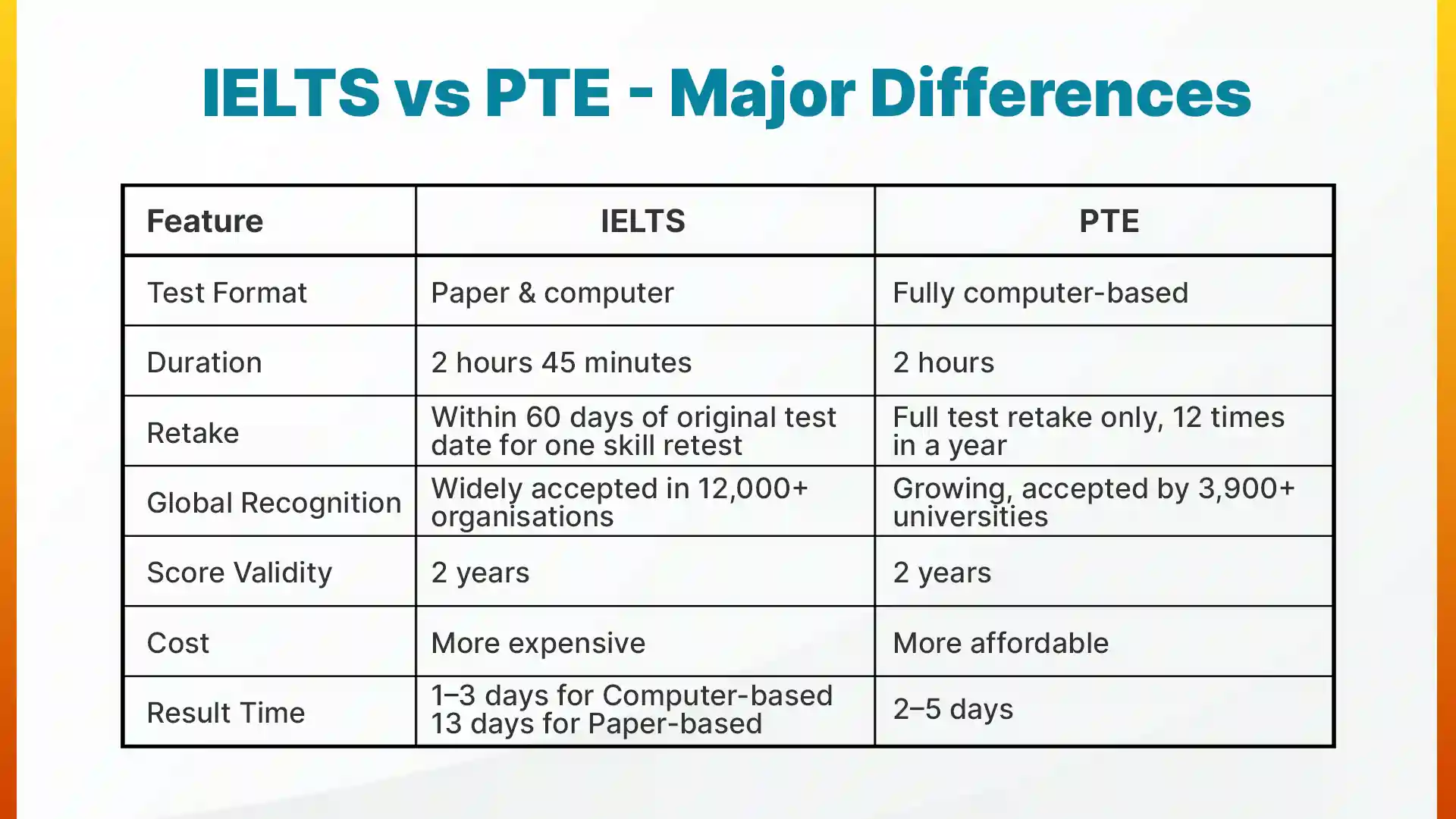
There is no single answer to which test is better, as it depends on your strengths, goals, and target country. IELTS offers a live speaking test and paper or computer options, while PTE is fully computer-based with faster results. Next, we’ll break down the key differences in format, duration, cost, and recognition to help you decide which test suits you best.
1. Test Format: How Questions Differ
IELTS is a combination of paper-based and computer-based tests, with the speaking section conducted in person with an examiner. This means you need to be comfortable speaking face-to-face, and you must practice managing your nerves during live interactions. PTE, on the other hand, is fully computer-based, including the speaking section, which is recorded and scored by a computer. If you prefer typing answers and speaking into a microphone rather than facing a person, PTE may help you stay confident and reduce exam stress.
2. Test Duration: How Long Does Each One Take?
The full IELTS exam usually lasts around 2 hours 45 minutes, while PTE takes about 2 hours, which can be easier for students with tight schedules. Because IELTS includes a live speaking test, you may also need to wait for your scheduled speaking slot on a different day. PTE finishes all sections in one session, making it more predictable for planning your day. Knowing the duration helps you plan your practice sessions, breaks, and stamina management, so you don’t get exhausted on exam day.
3. Retaking the Exam: What’s Easier?
IELTS allows you to retake individual sections, which is helpful if you only need to improve one skill. However, you must wait at least seven days between attempts, so planning ahead is important. PTE requires a full test retake, but you can attempt it up to 12 times per year, giving you flexibility to improve quickly. Understanding this helps you budget for retakes and schedule your preparation, so you can target your strongest strategy without wasting money or time.
4. Global Recognition: Who Accepts What?
IELTS is accepted by over 12,000 organizations worldwide, including universities, immigration authorities, and employers, making it highly reliable for students planning multiple destinations. PTE recognition is growing fast and is accepted by many major universities and selected immigration programs, but it is not yet as universal. This matters because the exam you choose could affect where you can study, work, or migrate, and whether your score is accepted immediately. Considering this will help you choose a test that maximizes opportunities and avoids unnecessary delays or extra costs.
5. Scholarship Advantage: Which Helps You Win More?
Your English test score can make a big difference when applying for scholarships. Many universities use IELTS or PTE scores to shortlist students, so a higher score can increase your chances of getting funding. IELTS is widely recognized, so it often works for both admission and scholarship applications across multiple countries. PTE can also help, especially if your score is high, and the university accepts it, but it’s important to check each institution’s requirements before committing to preparation. Planning your study and aiming for the required score can save time, improve your chances, and reduce unnecessary exam attempts.
6. Score Validity: How Long Do Your Results Last?
Both IELTS and PTE scores are valid for 2 years, which is enough time to apply for universities or visas. However, if your score expires, you must retake the exam, which adds cost and preparation time. Knowing this helps you plan your test date based on application deadlines, scholarship timelines, and visa submissions. This ensures your score is valid when you need it most, avoiding last-minute stress or rushed preparation.
7. Cost: Which Test Is More Affordable?
IELTS is usually more expensive, both full exam fees and retake costs. PTE tends to be slightly cheaper and allows more flexible retakes, which can save money if you plan multiple attempts. Considering the test fees is essential for budget planning, especially when preparing for study abroad, where every dollar counts. By comparing costs upfront, you can make a smart decision that balances price, convenience, and acceptance.
8. Result Time: How Fast Do You Get Your Scores?
PTE results are generally faster, often available within 2–5 days, while IELTS results take 13 days for paper-based and 1–3 days for computer-based tests. Fast results help you meet application deadlines and plan your visa or scholarship submissions without delays. If your goal is to submit applications quickly, PTE may be more convenient. Knowing how long results take allows you to schedule your preparation and exam date effectively, reducing stress and uncertainty.
IELTS vs PTE Score Comparison
Before choosing which test to take, it’s important to understand how IELTS and PTE scores work. IELTS uses a band system from 0 to 9, where each skill (listening, reading, writing, and speaking is scored separately. These scores are then averaged to give your overall band.
PTE works a bit differently. It uses a score range from 10 to 90 and also evaluates all four skills. One big difference is in how the scores are calculated. In IELTS, writing and speaking are graded by human examiners, while listening and reading are computer-marked. PTE, on the other hand, is fully computer-based, and all sections are scored automatically. This means your results come faster and are consistent, but some students miss the personal touch of a human grader. However, it’s important to remember that even automated systems cannot be entirely trusted.
Understanding how the two systems differ helps you plan your preparation better. It also makes it easier to know what score you need for universities or immigration purposes. To make this even simpler, here is a conversion table showing how IELTS and PTE scores compare:
IELTS to PTE Score Conversion Table
IELTS Band | PTE Score |
| 4.5 | 30 |
| 5.0 | 36 |
| 5.5 | 42 |
| 6.0 | 50 |
| 6.5 | 58 |
| 7.0 | 65 |
| 7.5 | 73 |
| 8.0 | 79 |
| 8.5 | 85 |
| 9.0 | 90 |
This table helps you quickly see which PTE score matches your target IELTS band. By knowing this, you can choose the test that fits your strengths and target scores.
PTE vs IELTS: Which One Is Easier to Score High?
Both IELTS and PTE test your listening, reading, writing, and speaking skills, but they do it in different ways. For IELTS, the face-to-face speaking test and human-graded writing can feel challenging for some students. Listening passages include different accents and are played only once, which requires careful focus. On the positive side, IELTS is widely recognized, and students who are comfortable with human interaction often perform well.
PTE, on the other hand, is fully computer-based, including speaking and writing. This makes it objective and consistent, but some students may find speaking into a microphone or typing essays quickly a bit stressful. The listening and reading tasks are clearly structured, which can help with time management, but the fast-paced format can be challenging for others. Because it is digital, many PTE students prefer to prepare online using mock platforms and practice tools.
Overall, IELTS can feel harder in terms of live speaking and subjective grading, but it rewards natural communication and detailed writing. PTE can feel more structured and consistent, but it requires comfort with computers and timed responses. Different students will find one test easier than the other depending on their personal strengths, practice habits, and preparation style. Most PTE students practice online to take their skills to the next level, and free mock exams such as the PTE practice test on 79Score help them get familiar with the actual test format, question types, and time constraints. Through regular practice, they can clearly identify areas for improvement and boost their confidence to achieve higher scores.
Another important factor is the country you plan to study or migrate to. Some countries or universities prefer IELTS and may have limited acceptance of PTE, while others accept both equally. Knowing the recognition rules of your target country can strongly influence which test is better suited for your goals and help you avoid unnecessary exam attempts or delays.
Required IELTS & PTE Scores for Popular Countries
In general, undergraduate programs in English-speaking countries usually require an IELTS score of 6.0–6.5 overall and a PTE score of 50–58 overall, often with a minimum score in each skill. For postgraduate programs, the requirements are higher, ranging from IELTS 6.5–7.5 and PTE 58–70. Competitive courses or scholarships may demand IELTS 7.0+ or PTE 65+.
English-speaking countries like Australia, the UK, Canada, the USA, and New Zealand generally accept both IELTS and PTE. However, some universities or programs may prefer IELTS or set specific requirements for speaking and writing skills. This is particularly important if your course involves presentations, research, or interviews, where strong communication skills are essential. Always check your target university’s official website before booking your test to ensure you meet their exact requirements.
Looking at individual counties, these are the required scores for popular study destinations:
Country | IELTS Score | PTE Score |
| Australia | 6.0–7.0 | 50–65 |
| New Zealand | 6.5–7.5 | 58–72 |
| United Kingdom (UK) | 6.0–7.5 | 51–70 |
| Canada | 6.0–7.0 | 50–65 |
| United States (USA) | 6.0–7.0 | 50–65 |
Before booking your English test, it’s important to know the scores you need. By understanding both the general score ranges and country-specific requirements, you can target your preparation effectively, schedule practice tests smartly, and aim for the scores that maximize your chances for admission and scholarships. Taking the time to plan your target scores early gives you a clear path forward and reduces unnecessary stress along the way.
Conclusion
Choosing between IELTS and PTE doesn’t have to feel overwhelming. Both tests are designed to measure your English skills, and each has its own advantages and challenges. Learn the test formats, scoring, duration, costs, and country-specific requirements. Take a rational decision. Make an informed choice that fits your strengths, goals, and preparation style.
It’s impossible to have a “one-size-fits-all” test. Some students feel more confident speaking to a live examiner, while others prefer the structure and consistency of a computer-based test. Your success depends on preparation, practice, and choosing the test that aligns with your own abilities and target scores. Create a clear plan. Practice regularly and rigorously. Your ideal IELTS score may not be very far if you start working on your English practice today!
If you’re feeling ready to take the next step, start by joining an IELTS institute in Kathmandu. They can guide you through each section of the exam, provide practice materials, give expert feedback, and help you build confidence, so you can reach your target score more efficiently.