IELTS in Nepal 2026: Exam Fee, Dates, Classes & Full Guide

Nov 10, 2025
IELTS is one of the most crucial requirements for university admission, accepted by over 10,000 institutions worldwide as proof of English proficiency. You need an IELTS band score of at least 6.5 to be eligible for higher education in countries like the UK, USA, Canada, and Australia. The higher score can open doors to even better global opportunities.
Preparing for IELTS can seem confusing at first, with the test types, fees, and endless practice sessions. But don’t worry, it’s simpler than it looks. You just need to map your preparation the right way.
By the end of this guide, you’ll understand everything about IELTS in Nepal, from fees and formats to test booking, the best IELTS classes in Nepal, and expert preparation tips to help you score high and move closer to your dream.
In this blog
IELTS Test Overview
IELTS, or the International English Language Testing System, is a standardised test that evaluates your English language ability for study, work, or migration abroad. It measures your ability to read, write, listen, and speak in English. The test is to ensure that the non-native English speakers possess sufficient language skills to study or live in an English-speaking country.
The IELTS examination is jointly managed by IDP Education and the British Council in Nepal. The test is accepted by thousands of universities, employers, and government agencies in countries like the UK, Canada, Australia, the USA, and New Zealand.
In Nepal, IELTS tests are conducted regularly across major cities such as Kathmandu, Pokhara, Biratnagar, and Chitwan, making it easily accessible for students from all regions. You can take the exam either on paper or computer, depending on your preference and available slots.
Why Do You Need an IELTS Test?
You need an IELTS test because it is the internationally recognized exam that proves your English proficiency. It is crucial for university admission, visa approval, and work opportunities abroad. The IELTS score, ranging from 1 to 9, directly determines your eligibility for top programs and scholarships. It’s not just a language test; it’s proof that you can communicate, study, and live confidently in an English-speaking environment.
With an IELTS score in your hand, you enjoy the following perks:
- You fulfill the major admission requirements to enrol in a foreign university.
- Your English language proficiency is recognized by over 10,000 institutions worldwide.
- Makes you eligible for scholarships and funding opportunities.
- You gain confidence in academic and professional communication.
- The IELTS score improves your career and migration opportunities.
- Measures all four language skills (reading, writing, speaking, and listening) fairly.
Join the Best IELTS Preparation Classes Today
IELTS Test Scores
IELTS scores range from 1 to 9, with higher bands indicating stronger English ability. Your band score determines eligibility for university admission, visa applications, scholarships, and work opportunities abroad, helping institutions and employers understand your language proficiency at a glance.
Band Score | English Level | Description |
| 9 | Expert | Fully operational command of English. |
| 8 | Very Good | Handles complex detailed arguments well. |
| 7 | Good | Effective command; occasional inaccuracies. |
| 6 | Competent | Generally effective; some errors and misunderstandings. |
| 5 | Modest | Partial command; frequent mistakes in familiar situations. |
| 4 | Limited | Basic competence; frequent misunderstandings. |
| 3 | Extremely Limited | Rarely able to communicate meaningfully. |
| 2 | Intermittent | Can only communicate in very basic situations. |
| 1 | Non-User | No ability to use the language except a few words. |
| 0 | Did Not Attempt | No assessment made. |
Types of IELTS Tests in Nepal
There are four main types of IELTS in Nepal: Academic, General Training, UKVI, and Life Skills. Academic is for students applying to universities, General for work or migration, UKVI for UK visa purposes, and Life Skills tests, speaking and listening for specific UK visas. Choosing the right type depends on your study or immigration goal. Here’s a clear breakdown:
1. IELTS Academic
IELTS Academic is designed for students who plan to study at universities or higher education institutions abroad. It assesses whether you are ready to handle academic English that includes reading research papers, writing essays, and understanding lectures. This test is commonly used for bachelor’s, master’s, or PhD admissions, as well as professional registration in fields such as nursing or teaching. The main focus is on academic topics, analytical writing, and complex reading passages.
2. IELTS General Training
IELTS General Training is intended for those who want to work, train, or migrate to an English-speaking country. It emphasizes everyday English skills needed for social and workplace communication. This test is typically required for job applications abroad or for immigration purposes in countries like Australia, Canada, or the UK. The focus is on practical tasks, such as reading simple texts, writing letters, and communicating effectively in daily situations.
Ready to Start Your Study Abroad Journey?
Get expert guidance, professional counselling, and a smooth visa process from Nepal’s most trusted education consultancy.
3. IELTS UKVI (UK Visas and Immigration)
IELTS UKVI (UK Visas and Immigration) is specifically designed for UK visa and immigration purposes. While the test content is similar to Academic or General IELTS, it is conducted under UK Home Office-approved conditions, with extra verification for security. The test format is the same, but the main difference is the administrative process.
4. IELTS Life Skills
IELTS Life Skills is a simpler test that only evaluates speaking and listening skills. It is meant for individuals applying for specific UK family or settlement visas. This test focuses on everyday conversations and practical listening tasks, proving your basic ability to communicate in English for certain visa routes.
Each type of IELTS serves a unique purpose, but all of them share a common goal to prove your ability to live, study, and succeed in an English-speaking environment. As a student pursuing higher education abroad, you will be taking the IELTS Academic examination. So further in this blog, we will be discussing the IELTS test format, fees, and preparation tips with an academic focus.
IELTS Test Format
The IELTS Academic test evaluates your listening, reading, writing, and speaking skills. Each aspect tests your language ability to study, work, or communicate confidently. The total test time is about 2 hours and 45 minutes, and each section plays a key role in your overall band score.
Here’s a quick look at the full test format:
Section | Duration | Number of Questions / Tasks | What It Tests |
| Listening | 30 minutes (+10 mins transfer time) | 40 questions | Understanding main ideas, details, and opinions in conversations or lectures. |
| Reading | 60 minutes | 40 questions | Reading comprehension from academic journals, articles, and reports. |
| Writing | 60 minutes | 2 tasks | Task 1: Describe a chart or graph. Task 2: Write an essay on a given topic. |
| Speaking | 11–14 minutes | 3 parts | One-on-one interview: general intro, short talk, and follow-up questions. |
All four sections together reflect your complete language ability. You’ll receive a band score from 1 to 9, with most universities requiring at least 6.0 to 7.5 for admission.
IELTS Exam Fee in Nepal (Updated 2026)
The IELTS Academic exam fee in Nepal is NPR 33,000 for a computer-based examination and NPR 36,200 for a paper-based test. Additional admin charges may apply for cancellations or rescheduling, depending on timing and test type.
Here are the IELTS exam fees in Nepal as of 10 November 2025:
Test Type | Test Fees (British Council) |
| IELTS on Computer (Academic/General) | NPR 33,000 |
| IELTS on Paper (Academic/General) | NPR 36,200 |
| IELTS for UKVI (on Paper) | NPR 39,600 |
| IELTS for UKVI (on Computer) | NPR 36,400 |
| IELTS Life Skills (A1/B1) | NPR 27,400 |
Note: The fees are subject to change, so always check the official British Council or IDP IELTS site before booking.
IELTS Exam Cancellation & Reschedule Fees
The fees associated with your IELTS exam cancellation or rescheduling vary depending on the time you choose to make changes. These charges can take a part of your test fee, so it’s important to plan ahead. Here are the things you should know:
1. 5 Weeks Before Your Test Date
If you cancel more than five weeks before your test date, you can get a refund, but you will be charged an administration fee. For example, the British Council Nepal charges 10% of your test fee for cancellations made early.
2. Within 5 Weeks of Your Test Date
If you cancel or reschedule within five weeks of the test, you usually lose the full fee, unless you have a serious reason like a medical emergency with proper proof. In some cases, you may still get a small refund, but you’ll have to pay an administration fee, which is typically 20% of your test fee at the British Council.
3. Reschedule Your Test
If you want to reschedule your test, you must do it within three months of the original date. The new date is subject to availability, so it’s best to act early.
In short, canceling or rescheduling late can be costly. Always check the provider’s rules and plan your dates carefully to avoid losing your test fee.
IELTS vs PTE vs TOEFL
IELTS is widely accepted globally with face-to-face speaking, PTE is fully computer-based and recognized mainly in Australia, and TOEFL is US-focused with long reading passages and automated scoring. For Nepali students, IELTS is usually the most familiar and flexible option for study and scholarship applications. Here’s a clear comparison between the three English proficiency tests:
Feature | IELTS | PTE | TOEFL |
| Test Mode | Paper-based or computer-based | Fully computer-based | Fully computer-based |
| Recognition | Accepted in 140+ countries, including the UK, Canada, Australia, and the US | Mostly recognized in Australia and New Zealand, and by select institutions in other countries | Highly recognized in the US and Canada |
| Speaking Section | Face-to-face with an examiner | Recorded on a computer | Recorded on a computer |
| Test Duration | About 2 hours 45 minutes | Around 2 hours 15 minutes | About 2 hours |
| Scoring System | Band score (1–9 scale) | Automated score (10–90 scale) | Score out of 120 |
| Difficulty | Friendly, human interaction; familiar structure | Fully automated, may feel technical | Long reading passages and academic vocabulary can be challenging |
| Scholarship Opportunities | Widely accepted for scholarship programs and university admissions | Accepted in fewer scholarship programs | Accepted mainly by US-based scholarships |
IELTS Registration Requirements in Nepal
To register for IELTS in Nepal, you need a valid passport and a working email address. You must provide ID proof on the test day that matches your registration details. Payment confirmation and age compliance (if applicable) are also required to secure your test slot. Here’s what you need to register for the IELTS in Nepal:
- A valid passport (the one you will bring on test day).
- Clear scan or photo of the passport when registering.
- Payment of the test fee (you’ll pay this during registration).
- Personal details – full name, date of birth, contact email, etc. Make sure these match your passport exactly.
- Parent consent (if you’re under 18)
How to Book an IELTS Exam Date in Nepal?
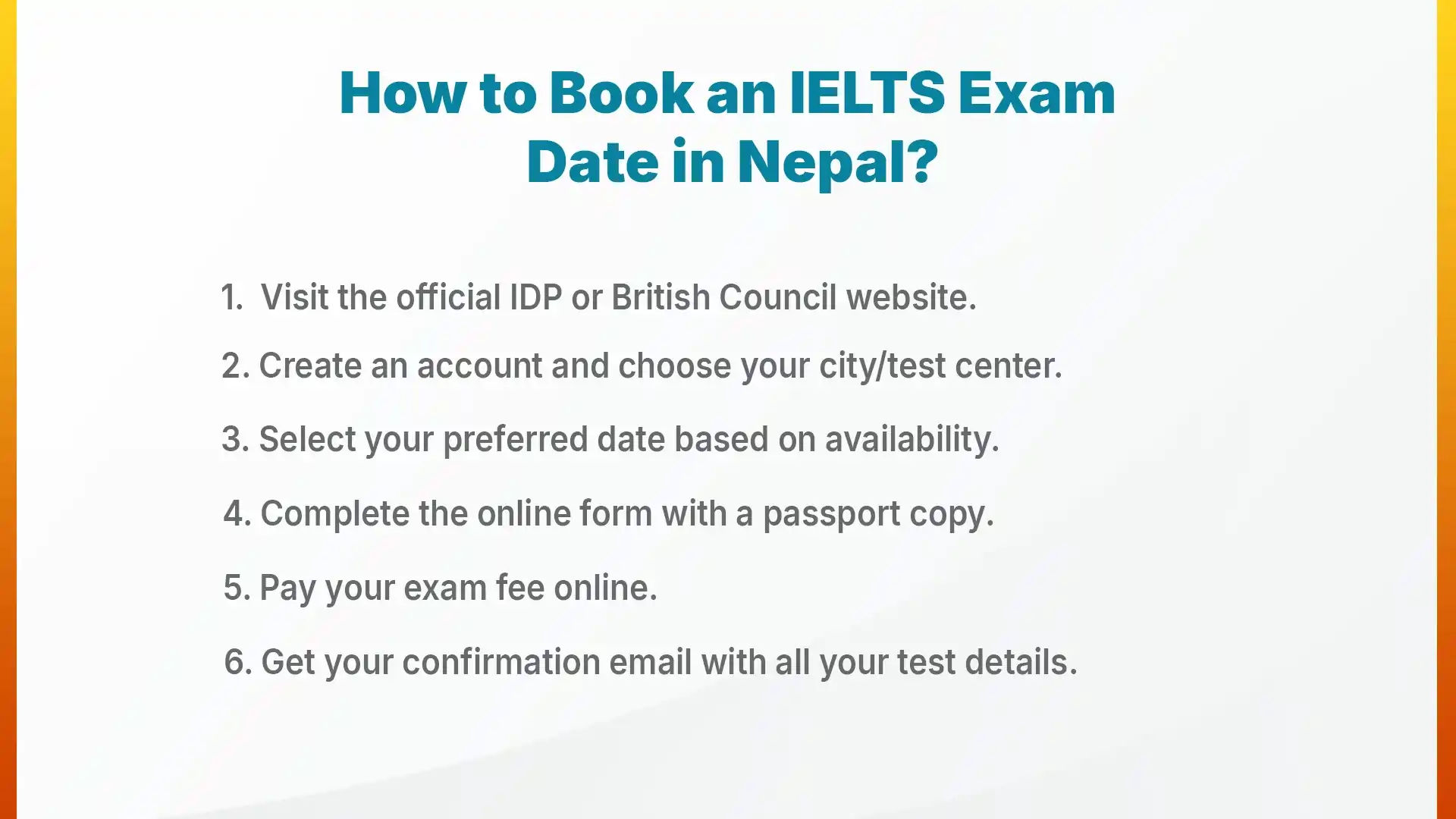
First, visit the official British Council or IDP Nepal website and check available test dates and centres. Next, register your account, fill in personal and test details, upload your passport copy, and pay the exam fee online. After confirmation, you’ll receive an email with your test date, venue, and speaking slot, so you can plan your preparation accordingly.
Here’s a more detailed, step-by-step guide to booking an IELTS exam date in Nepal:
1. Visit the Official British Council or IELTS IDP Website
Start by going to the official website of your test provider, either the British Council Nepal or IDP Education Nepal. Make sure you are on the official page to avoid scams.
2. Select Your City and Test Type
The first step in booking your IELTS test is to choose your test city. Popular centres in Nepal include Kathmandu, Pokhara, and Chitwan. Once you pick a city, select your test type based on your goal. If you are a student applying for your higher education, choose IELTS Academic. Then decide your preferred format, either paper-based or computer-based, depending on what you feel more comfortable with.
3. Choose Your Preferred Test Date
After selecting your city and test type, use the official British Council Nepal or IDP IELTS website to check available test dates and centres. This ensures your preferred day and centre are open.
3. Register Your Account
Once you’ve picked a suitable date and centre, the site will prompt you to create an account (if you don’t already have one). You’ll need to provide your full name, email, and contact details. If you already have an account, simply log in using your correct credentials.
4. Complete the Online Form with a Passport Copy
Enter your personal information, passport, and test details carefully. Make sure the details match exactly with your passport. Choose the test type you need: Academic, General Training, UKVI, or Life Skills. Confirm the test format (paper or computer) and check your selected date again. Upload supporting documents, typically the scan of your valid passport. Make sure the scan is clear and legible.
6. Pay the Test Fee
Complete the payment online using e-Sewa, bank transfer, or card payment, depending on the centre. Keep the receipt or confirmation for your records.
7. Receive Your Confirmation Email with Test Details
After payment and registration are accepted, you’ll get a confirmation email with your test date, time, venue, and speaking slot (if applicable). This is essential for entry on test day.
How to Choose the Best IELTS Institute in Nepal?
Begin by shortlisting the top 10 IELTS institutes in Kathmandu. Then, look for the qualities like accredited faculty, experienced trainers, quality study materials, manageable batch sizes, and positive student reviews. Here’s a quick checklist:
- Accreditation: Make sure the institute is recognized by IELTS boards (IDP or British Council).
- Experienced Faculty: Trainers should have proven knowledge of IELTS exam patterns and scoring.
- Study Materials: High-quality books, practice tests, and online resources.
- Batch Size: Smaller batches allow more individual attention.
- Student Reviews: Check past student success stories and testimonials.
- Mentorship & Progress Tracking: Regular guidance and feedback help you improve consistently.
Best IELTS Class in Nepal
SAS Education Consultancy provides the best IELTS classes in Nepal for students willing to study abroad with competitive proficiency scores. Each class is designed to teach smart strategies for every module. Trainers focus on practical techniques, real exam simulations, and personalized guidance to ensure consistent improvement.
Key Features of SAS IELTS Classes
- Proven success in IELTS exams
- Personalized coaching from experienced trainers
- Comprehensive study materials and resources
- Regular mock tests to track progress
- Interactive speaking and listening practice sessions
- Support with IELTS test booking
- End-to-end guidance for studying abroad
Partner with the Best Education & Visa Consultant for a Smooth Experience
IELTS Preparation Tips for Nepali Students
Practice listening to different English accents daily to get familiar with exam recordings. Read English newspapers, take mock tests regularly, track your progress, and focus on time management to improve each section efficiently. Here are some actionable tips for Nepali students to score higher:
1. Practice Listening to Diverse Accents
IELTS listening can include British, American, Australian, and Canadian accents. Listen to podcasts, YouTube channels, or news clips from these countries. Try shadowing, a method where you repeat what you hear to improve pronunciation and comprehension.
2. Read English Newspaper Daily
Reading improves both vocabulary and understanding of formal writing styles. Focus on editorials, science, and opinion pieces to get used to complex sentence structures. Highlight new words, write them down, and try using them in your own sentences.
3. Take Mock Tests Regularly
Simulating real exam conditions helps you get familiar with timing and question types. After each test, analyze mistakes carefully. Were you slow in reading? Or did you misinterpret questions? Use this insight to plan your next practice session.
4. Track Your Progress
Keep a log of your scores in listening, reading, writing, and speaking. Note which sections improve and which need more work. Set small weekly goals, like learning 20 new words or completing one timed writing task.
5. Focus on Time Management
Learn how long to spend on each question and practice sticking to it. For example, in the reading section, don’t spend more than a minute per question initially. Mark the tricky ones and return later. Segregate time limit for each writing task. Leave some spare time to avoid rush and silly mistakes. Use timers during mock tests to build speed and accuracy.
Conclusion
Taking the IELTS is more than just passing a test; it’s a key step toward your study-abroad dream. With the right preparation, guidance, and mindset, scoring high is entirely achievable. Start by understanding the test, choosing the right institute, and practicing smartly using the tips outlined above.
Remember, every small step counts. Booking your test early, attending mock sessions, tracking your progress, and refining your skills gradually builds confidence and competence. Professional guidance and personalized support offered by leading consultancies can make this journey smoother and more effective.
Your future is waiting. Every great journey starts with one decision. Take that first step today, prepare with focus, and move closer to studying at your dream university abroad. Contact Us Today!