Scholarship in Canada for Nepalese Students: Funding, Bursaries & Grants

Jun 05, 2026
Dreaming of the majestic Rocky Mountains or the busy streets of Toronto, but worried about the massive bills?
Canada is a dream study destination for all the best reasons. But many young minds in Nepal face high tuition fees, expensive rent, and rising currency exchange rates. Finances are indeed a major obstacle to studying in Canada for Nepalese students.
Fortunately, securing a scholarship in Canada can turn this expensive dream into an affordable reality!
This ultimate guide is designed to help you find and win the best Canadian scholarship for Nepalese students. We will walk you through top government funding, university bursaries, and step-by-step scholarship application tricks.
Let us make your Canadian study abroad journey possible without breaking the bank!
In this blog
Can Nepalese Students Get Scholarships in Canada?
Yes, Nepalese students can absolutely get scholarships in Canada to help pay for their education. Canadian universities, private donors, and the government offer a wide range of financial aid options, from small partial tuition discounts to fully funded awards, to support talented global applicants.
Getting a scholarship for Nepalese students in Canada is highly competitive but definitely possible. Universities across Canada love welcoming diverse global talent to their campuses. So, if you have strong grades, you stand a great chance.
The chances of receiving these awards depend heavily on your academic background and overall profile. Canadian admission teams look beyond just your final exam marks. They want to see your leadership skills, volunteer history, and passion.
There are three main types of funding: government-backed awards, university-specific grants, and private scholarships. Knowing where to look and how to showcase your strengths is the key to winning them.
Types of Scholarships Available for Nepalese Students in Canada
Nepalese students can apply for several types of financial aid in Canada, including merit-based, need-based, and government-funded awards. These funding options help reduce both tuition fees and everyday living expenses. Let us dive into each of these scholarship types so you can find the perfect match.
1. Merit-Based Scholarships
These are awarded for outstanding academic achievements. If you have top grades, you stand a great chance. Many universities award these automatically. This means you do not need extra forms.
2. Need-Based Scholarships
These grants support students facing genuine financial challenges. They help cover your basic study costs. You must provide financial documents. This ensures money issues do not stop your studies.
3. Entrance Scholarships
Universities offer these awards to new incoming students. They are given based on your initial admission application. You do not need to fill out extra forms. These are great for reducing your first-year tuition.
4. Government-Funded Scholarships
The Canadian government funds these prestigious awards. They target top global students for research and master's programs in Canada. Winning one covers almost all your study costs. However, they have very competitive application pools.
5. University-Specific Scholarships
Individual Canadian universities create these special funds. They want to attract diverse minds to their specific campuses. Each university has its own rules and awards. Checking their official websites is highly recommended.
6. Research and Graduate Scholarships
These are designed for master's and PhD students. They are often given as research assistantships. You get paid while doing your academic research. It is not only fantastic but also a prestigious way to fund higher studies.
7. External Scholarships for International Students in Canada
Private organizations and charities fund these external awards. They look for specific career goals or backgrounds. You must apply directly through the donor's website. They provide helpful extra funding alongside university aid.
Fully Funded Scholarships in Canada for Nepalese Students
Fully funded scholarships are the ultimate prize for international students as they cover all major costs. These awards ensure you do not have to worry about tuition or housing. Let us look at what they cover and some top examples.
What Fully Funded Scholarships Cover
If you are lucky enough to win a fully funded scholarship, it typically covers:
- Tuition Fees: 100% of your course fees are paid directly to the university.
- Living Expenses: An annual stipend to pay for food, rent, and local travel.
- Travel Costs: Round-trip economy flight tickets from Nepal to Canada.
- Health Insurance: Complete medical insurance coverage while you study in Canada.
Some of the most famous fully funded options include the Lester B. Pearson International Scholarship at the University of Toronto, the UBC International Scholars Program, and the Canadian government's Vanier Canada Graduate Scholarship for doctoral students.
University Scholarships in Canada for Nepalese Students
Many leading Canadian universities offer generous institutional scholarships specifically for international students. These awards range from entrance discounts to fully funded undergraduate degrees in Canada. Let us look at the top university scholarships available in the table below.
Canadian Uni Scholarships | Award Information & Key Details |
|---|---|
| Lester B. Pearson International Scholarship | Fully funded; covers tuition, books, and four years of living costs at University of Toronto. |
| UBC International Scholars Program | Need-and-merit-based awards covering up to full tuition and living costs at University of British Columbia. |
| McGill University Entrance Scholarships | Offers major and basic entrance awards from 3,000 to 12,000; renewable annually. |
| University of Alberta Centenary Scholarship | Value up to 30,000 per year; awarded to high-achieving international students on study visas. |
| University of Waterloo President's Scholarship | Entrance awards worth 2,000; given automatically to students with top admission averages. |
| York University International Student Scholarship | Value up to 180,000 over four years; requires a strong profile and separate application. |
| Humber International Entrance Scholarships | Offers full and partial tuition discounts; awarded based on academics and community involvement. |
| University of Manitoba International Student Awards | Offers partial tuition waiver discounts automatically based on high high school GPA. |
| Carleton University Entrance Scholarships | Unlimited, automatic awards ranging from 4,000 to 16,000 for top-performing students. |
| Calgary International Entrance Scholarship | Value of 20,000 annually; renewable if you maintain a high GPA throughout your degree. |
Canada Government Scholarships for Nepalese Students
The Canadian government offers several highly prestigious scholarships to attract international research and graduate talent. These awards often cover full tuition, travel, and living costs. Let us explore the primary government-funded opportunities you can apply for.
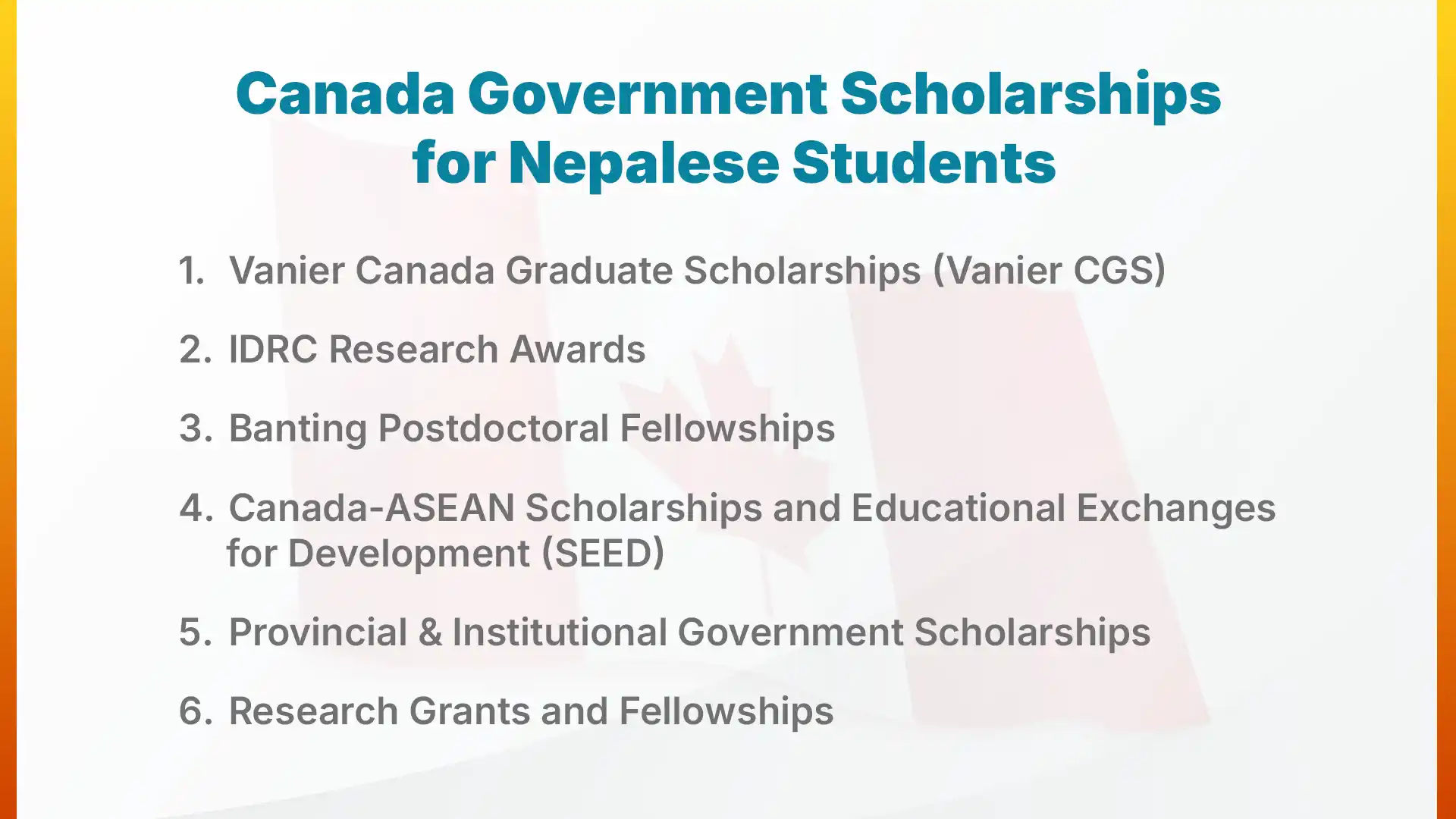
1. Vanier Canada Graduate Scholarships (Vanier CGS)
Imagine getting a massive $50,000 every single year for three years of your PhD studies. This highly respected award is perfect for bright Nepali students who show strong leadership in their communities. To win this, you must apply before November through your chosen Canadian university. Since you need their official nomination first, you should start talking to your target professors as soon as possible.
2. IDRC Research Awards
If you want to solve real-world problems back home, this $15,000 award is your perfect opportunity. It is designed to support master's or PhD students from developing countries like Nepal who love deep research. You will need to submit a solid, highly detailed research proposal online before the September deadline. Do not hesitate to ask your college mentors in Nepal to review your draft before you hit submit.
3. Banting Postdoctoral Fellowships
For those who have completed their PhD, this high-level fellowship gives you an amazing $70,000 per year for two years. It is designed to help top global researchers build exceptional academic careers. You need to apply online before September, but do not wait until the last minute. Keep in mind that your host university must officially support and endorse your research project first.
4. Canada-ASEAN Scholarships and Educational Exchanges for Development (SEED)
This unique program offers up to $15,900 to cover your short-term study or research project in Canada. Even though it has ASEAN in the name, certain exchange streams are open to talented South Asian students, including those from Nepal. You must apply through your home university in Nepal, usually before the March deadline. Your home college will then work directly with the Canadian partner school to handle all the paperwork.
5. Provincial & Institutional Government Scholarships
Different provinces in Canada, like Ontario or Quebec, want to attract bright global minds to their local campuses. They offer special graduate awards ranging from $10,000 to $15,000 to help with your tuition. To qualify, you will need excellent grades and must meet the specific rules of that province. Be sure to apply directly through your chosen university portal, usually around early winter.
6. Research Grants and Fellowships
If you are a science or tech student, these hands-on assistantships can offer you $5,000 to $20,000. They are a fantastic way for master's and PhD students to earn money while working on exciting projects. You should apply directly to your chosen academic department rather than a general scholarship board. Since deadlines depend entirely on your research supervisor, it is smart to email them early to show your interest.
Scholarships in Canada for Undergraduate Nepalese Students
Undergraduate Nepalese students can access many excellent entry-level scholarships to fund their bachelor's degrees. These options include both automatic entry awards and competitive, fully funded programs. Let us break down the best undergraduate options below.
1. Popular Undergraduate Funding Options
Scholarship Option | Typical Value & Target Students |
|---|---|
| President's Scholars of Excellence | 10,000 entrance award for top-tier undergraduate applicants. |
| Western University President's Scholarships | Up to 50,000 total value; requires outstanding leadership and grades. |
| Dalhousie University Entrance Awards | Ranging from 500 to 40,000 over four years of study. |
| University of Saskatchewan Best and Brightest Entrance Scholarships | Up to 40,000 over four years for students with exceptional academics, leadership, and community involvement. |
| University of Ottawa International English Academic Excellence Scholarship | 10,000 for high-achieving international undergraduate students with a 90%+ admission average. |
| University of Ottawa International English Admission Scholarship | Renewable tuition reduction worth up to 60,000 over a four-year undergraduate degree for eligible international students. |
2. Fully Funded vs Partial Scholarships
When looking for a scholarship to study in canada, you will find two main options. Fully funded scholarships are rare and highly competitive. They cover everything: your entire tuition, living costs, airfare, and health insurance.
Partial scholarships, on the other hand, are much more common. These might cover half your tuition or offer a one-time discount of a few thousand dollars. While they do not cover everything, they still make a massive difference to your total budget.
To make things easier, you can combine a partial scholarship with part-time work in Canada or education loans. This makes managing your expenses much easier for your family back in Nepal.
Scholarships in Canada for Master's and PhD Students
Graduate students have the highest chances of securing fully funded scholarships and research assistantships in Canada. These awards heavily ease the financial burden of master's and doctoral degrees. Let us look at the top graduate funding options.
1. Master's Scholarships in Canada
These awards help fund your postgraduate studies. They usually require a solid bachelor's degree with a high GPA. Many departments offer them as graduate teaching assistantships. This helps cover both your tuition and basic housing costs.
2. MBA Scholarship in Canada
Business schools offer special funding to attract diverse professionals. These scholarships look for strong work experience and high GMAT or GRE scores. You should apply during the early rounds of admission. This gives you the best chance of securing funding.
3. MPH Scholarships in Canada
Public health programs offer targeted grants to students from developing nations. They focus on students who want to improve global health systems. You must show strong academic research potential. Applications usually open in the early fall.
4. Scholarship for PhD in Canada for International Students
Doctoral programs in Canada are often fully funded for global talents. These packages include tuition waivers and annual stipends for research work. You must find a research supervisor before applying. This is the absolute key to winning doctoral aid.
5. Research Assistantships and Teaching Assistantships
These positions allow you to earn money while helping your professors. You will assist with teaching classes or conducting laboratory experiments. The pay is directly applied to your tuition fees. It is the most common way to fund graduate studies.
Eligibility Criteria for Canada Scholarships 2026-27
Winning a Canadian scholarship requires meeting strict academic, language, and leadership criteria. Universities use these rules to select the most deserving international applicants. Let us look at what you need to prepare.
1. Academic Requirements
Your academic records are the most important factor. You must maintain excellent grades in your high school or bachelor's. Most top scholarships require at least an 'A' grade or a 3.6 GPA. Consistent academic success shows you are ready for Canadian coursework.
2. English Language Requirements (IELTS/PTE/Duolingo)
You must prove your English skills to study in Canada. Most universities accept IELTS, PTE, or Duolingo exam scores. For top scholarships, aim for an IELTS score of 7.0 or higher. High language scores make your overall profile look much stronger.
3. Extracurricular Achievements
Canadian schools love active students who participate in sports or arts. Your life outside the classroom matters a lot to selection committees. Show how you spend your free time doing meaningful activities. This helps build a well-rounded and interesting profile.
4. Leadership Experience
Showing leadership skills is a major plus for winning big awards. Highlight times you led school clubs, organized events, or ran projects. Describe how you made a positive change in your community. Leadership shows you are ready to make a difference.
5. Financial Need Considerations
Some awards are designed specifically for students facing financial hardships. You will need to show official documents proving your family's income. This helps universities decide who needs the financial support the most. Be honest and clear about your financial situation.
Eligibility Criteria Summary
Requirement Category | Key Detail / Minimum Target |
|---|---|
| Academic GPA | 3.5+ GPA (or equivalent) for top-tier merit awards. |
| English Language Test | IELTS 7.0+ overall / PTE 65+ for best results. |
| Extracurricular Activities | Active participation in community service, sports, or arts. |
| Leadership Profile | Proof of managing teams, clubs, or social projects. |
6. Documents Required for Scholarship Applications
Applying for scholarships in Canada requires a complete set of well-prepared official documents. Having these papers ready early prevents last-minute stress during your application process. Here is the checklist of files you need to compile:
Academic Transcripts: Certified copies of your high school ("plus two") or bachelor's degree transcripts.
English Language Test Scores: Official reports from IELTS or PTE, or even Duolingo.
Statement of Purpose (SOP): A personal essay explaining your academic goals and why you deserve the scholarship.
Letters of Recommendation: Two or three recommendation letters from teachers or employers who know you well.
CV or Resume: A clear, updated document highlighting your education, work, and achievements.
Financial Documents: Income certificates or bank letters to prove financial need if applying for bursaries.
Most of these documents are also part of the requirements to study in Canada from Nepal, so preparing them early can make both your admission and scholarship applications much smoother.
How to Apply for Scholarships in Canada from Nepal?
Applying for Canadian scholarships from Nepal is a step-by-step process that requires early planning and attention to detail. You must match university admission timelines with scholarship deadlines. Let us walk through the exact steps you need to follow.
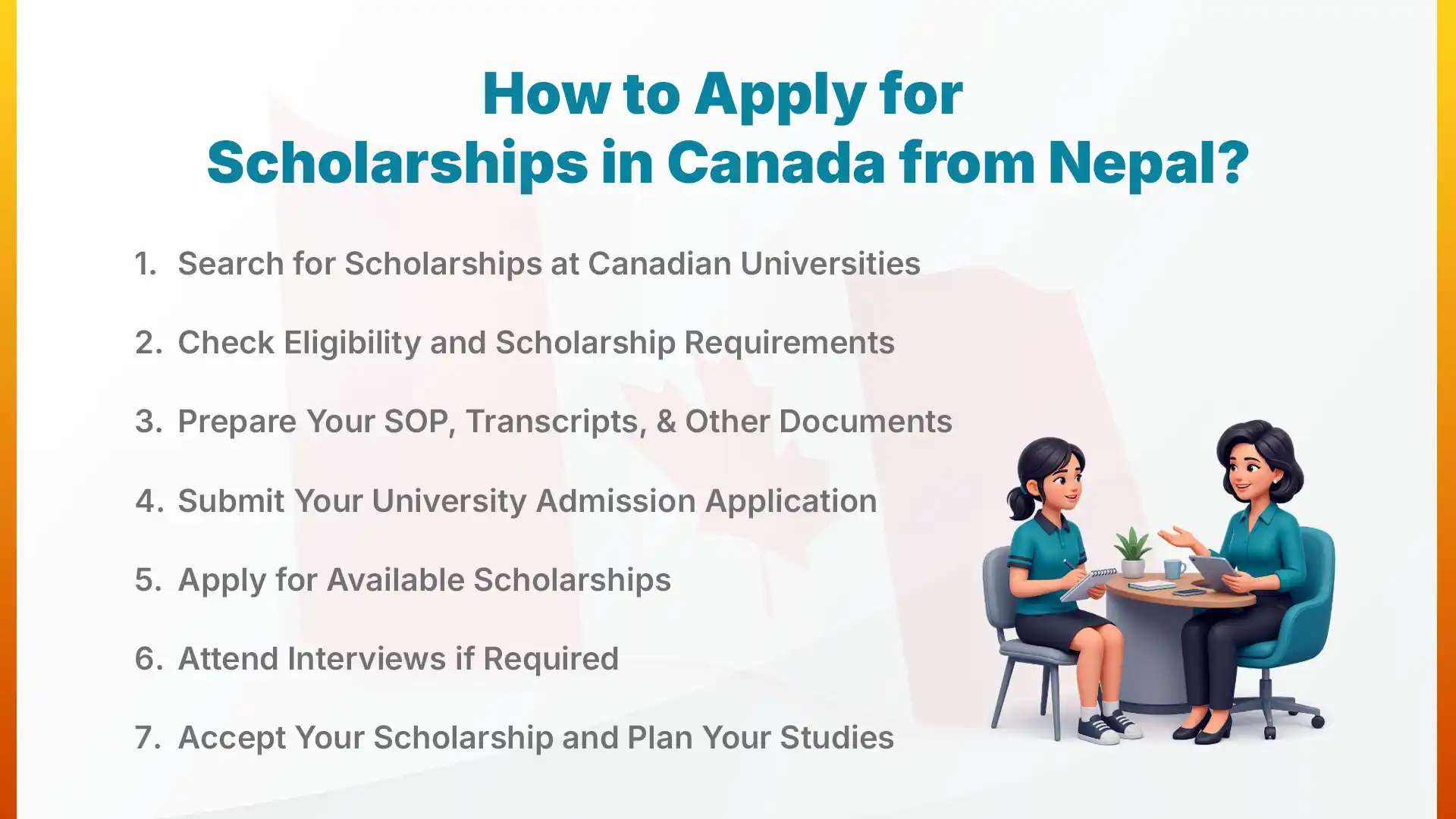
1. Search for Scholarships at Canadian Universities
Start by researching universities that offer funding for your course. Visit their official financial aid pages to see what is available. Make a shortlist of schools that match your grades. This saves you valuable time and money later.
2. Check Eligibility and Scholarship Requirements
Read the criteria for each scholarship very carefully. Look at GPA, language scores, and nationality rules. Make sure you meet every single requirement. Do not waste effort applying for awards you do not qualify for.
3. Prepare Your SOP, Transcripts, & Other Documents
Draft a strong Statement of Purpose for Canada, explaining why you deserve the award. Collect your academic transcripts from your school or college. Get your English test scores ready. Ensure all documents are clean and scanned properly.
4. Submit Your University Admission Application
Most scholarships require you to apply for admission first. Submit your university application before the early deadline. Pay the application fees and upload your papers. Keep track of your student portal for updates.
5. Apply for Available Scholarships
Once admitted, log into the scholarship portal to apply. Some awards need separate essays or recommendation letters. Submit these before the separate funding deadline. Double-check everything before hitting the submit button.
6. Attend Interviews if Required
Some prestigious scholarships require a virtual video interview. Practice answering common questions about your goals and leadership. Stay calm, speak clearly, and show your true passion. Be honest and professional during the call.
7. Accept Your Scholarship and Plan Your Studies
Celebrate when you receive your scholarship offer letter! Accept the offer formally within the given deadline. Use the scholarship letter to apply for your Canadian student visa. Now, you can start planning your exciting journey.
How to Increase Your Chances of Winning a Scholarship in Canada?
You can greatly boost your scholarship success by preparing early and building a stellar profile. Combining high academic grades with community involvement makes you stand out to selection committees. Let us review the best tips to increase your chances.
1. Maintain Strong Academic Grades
Your academic record is the most critical factor. Aim for high marks in your plus two or bachelors. Consistent high grades show universities that you are dedicated. This immediately puts you ahead of other global applicants.
2. Build Leadership and Volunteer Experience
Canadian schools highly value active community leaders. Join local clubs, volunteer, or lead school projects. These activities show you care about helping others. Highlight these experiences clearly in your scholarship application.
3. Write a Compelling SOP
Your Statement of Purpose must tell your unique story. Explain your dreams, challenges, and why you love your field. Avoid generic templates and keep the tone genuine. A great SOP can win over any reviewer.
4. Apply Early
Submit your applications as soon as portals open. Many scholarships are given on a rolling basis. Applying early shows you are organized and serious. It also gives you time to fix any mistakes.
5. Apply for Multiple Scholarships
Do not put all your eggs in one basket. Apply for university awards, government grants, and external scholarships. This maximizes your odds of getting funded. Even small partial scholarships can add up to save you money.
6. Obtain Strong Recommendation Letters
Ask teachers who know you well for reference letters. They should highlight your character, academic potential, and leadership. Give your recommenders plenty of time to write these. Strong words from a mentor carry great weight.
Scholarship Deadlines for Canadian Universities
Missing a deadline is the most common reason students miss out on funding opportunities. Canadian universities have strict cut-offs that vary depending on your intake.
Canada has three main academic intakes: Fall (September), Winter (January), and Spring/Summer (May) intakes. Let us explore the critical dates you must remember:
1. Fall Intake Deadlines
For the popular Fall intake, scholarship deadlines usually fall between October and January of the previous year. For example, if you want to start studying in September, you must apply for major scholarships by January at the latest.
2. Winter Intake Deadlines
For the Winter intake starting in January, scholarship deadlines generally close between June and September. It is highly recommended to check individual university portals as dates can change.
3. Spring/Summer Intake Deadlines
This is the least common intake, mostly featuring select diplomas, short courses, or continuous programs. The application deadlines are usually between January and March of the same year. For scholarships in this intake, opportunities are sparse, but when available, their deadlines usually mirror the application timeline (January–March).
When Nepali Students Should Start Preparing
You should start your preparation at least 10 to 12 months before your planned intake. This gives you enough time to take your IELTS or PTE exam, gather your academic papers, and write a stellar Statement of Purpose (SOP).
Can You Study in Canada Without a Scholarship?
Yes, you can still study in Canada even if you do not secure a scholarship. There are several alternative funding pathways that make your Canadian education highly affordable. Let us explore these reliable financial options.
1. Education Loans in Nepal
Many commercial banks in Nepal offer education loans specifically for studying abroad. You can secure these loans against land or property as collateral. This is a very common method used by Nepalese families to pay for initial tuition and show proof of financial funds to Canadian visa officers (IRCC).
2. Part-Time Work Opportunities
Canada allows international students to work part-time while studying. You can work up to 24 hours per week off-campus during regular semesters. During scheduled academic breaks, like summer holidays, you can work full-time. This extra income can easily help you cover your weekly grocery bills and local travel costs.
3. Co-op Programs
Many Canadian degrees offer Co-op (cooperative education) options. These programs mix academic study semesters with paid, full-time work semesters in your field of study. It is an amazing way to earn money while gaining valuable Canadian work experience that boosts your future career.
Conclusion
Getting a scholarship is the best way to make your Canadian study dream come true. While the application process takes time and effort, the reward of an affordable, world-class education is completely worth it.
Remember, early preparation is your biggest secret weapon! Don't wait until the last minute. Start drafting your SOP, preparing for your language tests, and listing your target universities today. Apply to as many different scholarships as possible to give yourself the best chances.
Need guidance for your application? Book a FREE counselling session with our expert mentors today! We will help you find the best scholarships, polish your SOP, and guide you through the entire visa process step-by-step.