Study Master's in Canada from Nepal: Top Courses & Costs

Apr 03, 2026
You've decided Canada is the destination. Now comes the harder part: figuring out which programs fit your profile, what the actual costs look like, and whether you can realistically afford it without draining your family's savings.
The path from Kathmandu to a Canadian campus involves more than just good grades and a valid passport. This guide walks you through the top master's programs for Nepali students, tuition and living costs, scholarship options, eligibility requirements, and the step-by-step visa process.
In this blog
Why do Nepali Students Choose Canada for a Master's Degree?
A master's degree in Canada typically requires a four-year bachelor's degree with a GPA of 3.0 or higher, an IELTS score of at least 6.5, and annual tuition fees between CAD 17,000 and CAD 30,000. Popular fields include MBA, Computer Science, Engineering, and Healthcare. After graduation, you can apply for a Post-Graduation Work Permit (PGWP) that allows you to work in Canada and potentially transition to permanent residency.
But why Canada specifically? For many Nepali students, the answer comes down to a few practical factors.
- Affordable tuition: Compared to the US and UK, Canadian universities charge lower fees for similar program quality.
- Work rights during study: You can work up to 24 hours per week off-campus during semesters and full-time during breaks.
- Clear PR pathway: Canada's immigration system awards extra points to graduates of Canadian institutions, making permanent residency more accessible.
- Established Nepali community: Major cities like Toronto, Vancouver, and Calgary already have strong Nepali student networks.
Top Master's Programs in Canada for Nepali Students
The top master’s programs in Canada for Nepali students include Business Analytics, Computer Science, Engineering, Healthcare, and Finance. These programs align closely with Canada’s in-demand occupations and increase your chances of securing post-study work and permanent residency. Let’s now explore each of these programs to understand why they are popular and what they offer. Certain fields align well with Canada's labor market and offer stronger job prospects after graduation. Here are the top courses in Canada Nepali students commonly pursue.
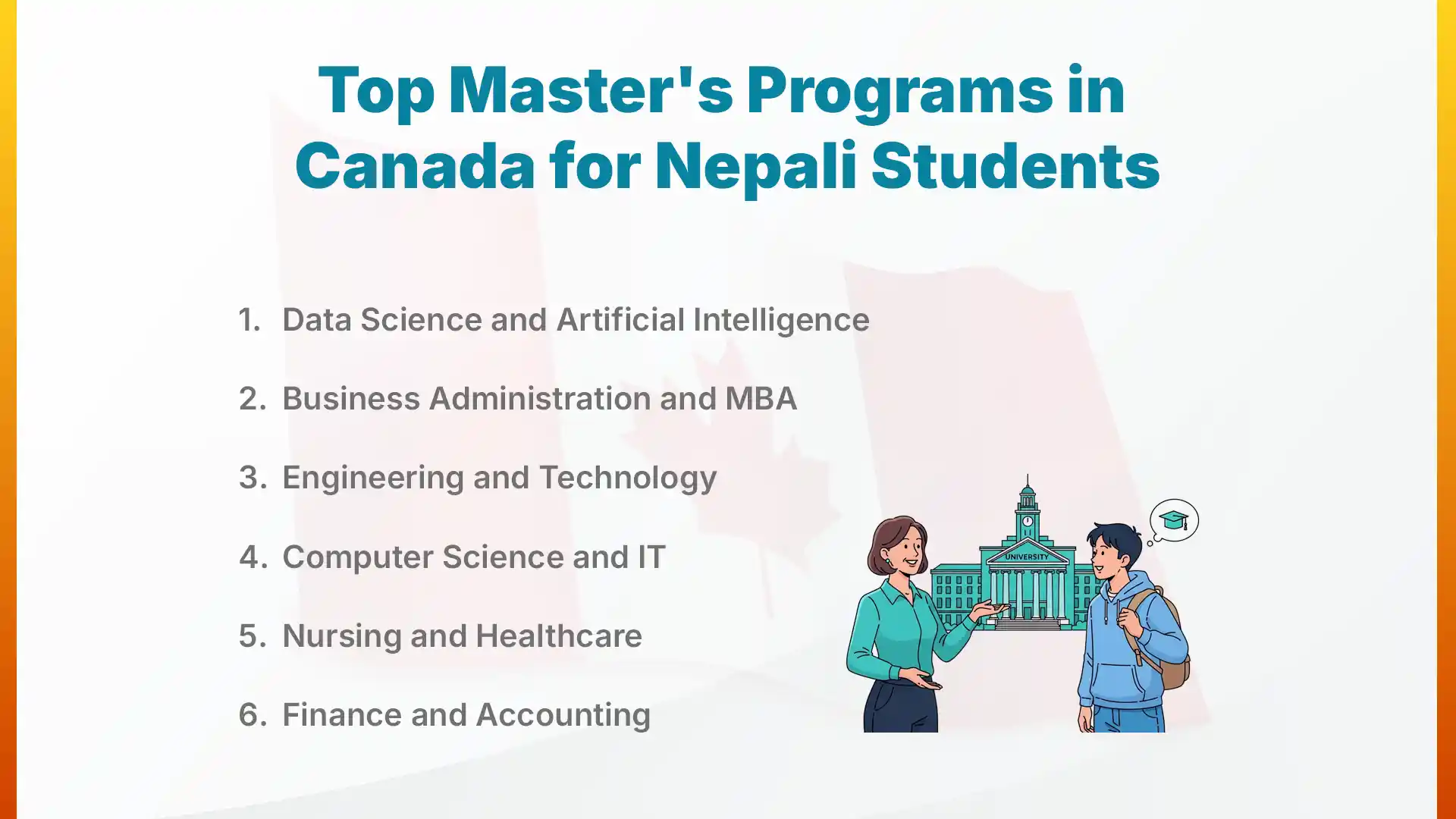
1. Data Science and Artificial Intelligence
Data science combines statistics, programming, and machine learning. Tech companies across Canada actively recruit graduates with AI and analytics skills, and the field continues to grow rapidly.
2. Business Administration and MBA
Business and MBA programs in Canada develop leadership and management skills valued across industries. They're popular among professionals looking to move into senior roles or pivot to a new career entirely.
3. Engineering and Technology
Specializations like mechanical, civil, and electrical engineering remain in high demand. Canada's infrastructure projects and manufacturing sector create steady employment for engineering graduates.
4. Computer Science and IT
Popular IT courses in Canada focus on software development, cybersecurity, and systems architecture. Tech hubs in Toronto, Vancouver, and Montreal offer abundant internship and job opportunities for CS graduates.
5. Nursing and Healthcare
Nursing appears on Canada's in-demand occupation list, which means faster immigration processing and strong job security. Many nursing programs in Canada include clinical placements that provide Canadian work experience before graduation.
7. Finance and Accounting
Graduates can pursue careers in banking, corporate finance, and accounting firms. Many programs align with CPA (Chartered Professional Accountant) certification requirements.
Best Universities and Colleges in Canada for a Master's Degree
Canada offers both research-intensive universities and practical college programs. A Designated Learning Institution (DLI) is a school approved by the Canadian government to host international students. You can only get a study permit for programs at DLIs.
1. Top Research Universities
Research universities are known for strong academic reputations and funding opportunities:
- University of Toronto: Consistently ranked among the world's best, with diverse master's programs
- University of British Columbia (UBC): Strong in engineering, business, and sciences
- McGill University: Competitive tuition and excellent research funding
- University of Alberta: Known for engineering and health sciences
- McMaster University: Recognized for healthcare and business programs
2. Affordable Colleges with Quality Master's Programs
Colleges often have lower tuition and emphasize career-focused training. Conestoga College, Seneca College, and Humber College are popular among Nepali students for technology, business, and healthcare programs.
3. Institutions with High Nepali Student Enrollment
Universities like the University of Manitoba, the University of Windsor, and Thompson Rivers University have established Nepali student communities. Peer connections can help with networking, cultural adjustment, and finding accommodation.
Institution Type | Examples | Typical Annual Tuition (2026 CAD) |
| Research Universities | U of T, UBC, McGill, Waterloo | CAD 20,000 – 35,000 |
| Colleges / Polytechs | Conestoga, Seneca, Humber, George Brown | CAD 15,000 – 22,000 |
Cost of Studying a Master's Degree in Canada
The cost of studying a master’s degree in Canada typically ranges from CAD 15,000 to CAD 40,000 per year for tuition and around CAD 20,000 to CAD 30,000 per year for living expenses, depending on your course and city. Understanding the full cost of studying in Canada helps you plan your finances and prepare your visa application.
1. Tuition Fees by Program Type
Fees vary significantly depending on your field of study and institution.
Program Type | Typical Annual Tuition (2026/27 CAD) |
| MBA | 25,000 – 55,000 |
| Engineering (M.Eng / B.Eng) | 18,000 – 40,000 |
| Computer Science / IT | 17,000 – 35,000 |
| Nursing (BScN / MScN) | 15,000 – 28,000 |
2. Living Expenses by Province and City
Where you study affects your monthly budget considerably. In Toronto and Vancouver, expect to spend CAD 1,500–2,500 monthly on rent, food, and transportation. Smaller cities like Winnipeg, Halifax, or Regina are more affordable at CAD 1,000–1,500 monthly. Sharing accommodation with roommates can reduce housing costs by 30–40%.
3. Additional Fees and Hidden Costs
A few expenses often catch students off guard:
- Health insurance: Mandatory in most provinces, ranging from CAD 600–900 annually
- Textbooks and supplies: Budget CAD 500–1,000 per year
- Visa application and biometrics: Approximately CAD 235 total
Scholarships for Nepali master's students in Canada
Scholarships for Nepali master’s students in Canada include government-funded programs like Canada Graduate Scholarships, provincial awards such as Ontario Graduate Scholarships, and university-specific merit scholarships that can reduce tuition or fully fund your studies. Scholarships can significantly reduce your financial burden. Here's where to look.
1. Government-Funded Scholarships
The Vanier Canada Graduate Scholarship provides CAD 50,000 annually for doctoral students, though some master's students in research programs may qualify. Provincial governments also offer scholarships through specific university partnerships.
2. University Merit Scholarships
Most Canadian universities offer entrance scholarships based on academic performance. UBC's International Tuition Award, for example, covers a portion of tuition for high-achieving students. Check each university's graduate funding page when applying.
3. External Funding and Bursaries
Teaching assistantships (TAs) and research assistantships (RAs) provide both funding and valuable experience. Many master's students cover a significant portion of expenses through TA or RA positions, which typically pay CAD 15,000–25,000 annually.
Eligibility Requirements for Nepali Students
Eligibility requirements for Nepali students for Canada include meeting both university admission criteria and Canadian immigration requirements, such as academic qualifications, English proficiency, and financial proof. These requirements ensure you are prepared for your studies and eligible for a study permit approval. Let’s now go through each requirement so you clearly understand what you need to prepare. Here's what you'll typically encounter.
1. Academic Qualifications and Minimum GPA
Most programs require a completed bachelor's degree from a recognized institution. A GPA of 3.0 on a 4.0 scale (or equivalent percentage) is the common minimum, though competitive programs may expect higher. Some universities require credential evaluation through WES (World Education Services) to verify your Nepali degree.
2. IELTS and English Proficiency Requirements
English proficiency is mandatory for admission and visa purposes. Most Nepali students choose between IELTS and PTE based on their test-taking strengths.
Test Type | Typical Minimum Score (2026/27) |
| IELTS Academic | 6.5 Overall (No band below 6.0) |
| TOEFL iBT | 88 – 100+ (Varies by University) |
| PTE Academic | 60 – 65+ |
| Duolingo English Test (DET) | 115 – 125+ |
Join IELTS Preparation Classes Today!
3. Financial Proof and Bank Balance Requirements
You'll demonstrate funds covering your first year's tuition plus approximately CAD 20,635 for living expenses (as per IRCC guidelines). A GIC (Guaranteed Investment Certificate) is a deposit of CAD 20,635 with a participating Canadian bank, and it's one accepted method of showing financial capacity.
4. Required Documents from Nepal
Prepare the following documents before starting your applications:
Academic transcripts and degree certificates (attested copies)
Statement of Purpose (SOP) explaining your goals
Two to three letters of recommendation
Valid passport with at least six months' validity
English test score reports
Financial documents (bank statements, sponsor letters, GIC receipt)
How to Apply for a Canada Study Permit?
Applying for a Canada study permit involves getting a DLI acceptance letter, preparing financial documents, submitting an online application, and attending biometrics. This permit is essential as it legally allows you to study in Canada for your chosen program duration. Let’s now walk through each step so you can confidently complete your application. Here's the step-by-step process.
Step 1: Select Your Program and Apply to Universities
Start by researching programs that match your academic background and career goals. Apply directly through university portals or work with an education consultancy. Most universities have application deadlines three to six months before the available intake in Canadian universities.
Step 2: Receive Your Letter of Acceptance
Once a DLI accepts you, you'll receive an official Letter of Acceptance (LOA). This document is required for your study permit application.
Step 3: Prepare Your Financial Documents
Gather proof of funds, including bank statements from the past four to six months, your GIC receipt if applicable, and sponsor documentation with relationship proof.
Step 4: Submit Your Study Permit Application Online
Create an account on the IRCC (Immigration, Refugees and Citizenship Canada) portal. Upload all required documents, pay the application fee (CAD 150) and biometrics fee (CAD 85), and submit your Canadian student visa application.
Step 5: Complete Biometrics and Medical Examination
Book a biometrics appointment at the designated center in Kathmandu. If required, complete a medical examination with an IRCC-approved panel physician.
Step 6: Await Visa Decision and Plan Your Arrival
Processing times typically range from eight to sixteen weeks for applicants from Nepal. Once approved, you'll receive a Port of Entry (POE) Letter of Introduction. Use this time to book flights and arrange temporary accommodation.
One-Year vs Two-Year Master's Programs in Canada
Both options exist, and your choice affects your budget, timeline, and post-graduation work rights.
Factor | One-Year Master's | Two-Year Master's |
| Duration | 12 – 16 Months | 20 – 24 Months |
| Total Cost | Lower overall tuition & living costs | Higher total investment |
| PGWP Eligibility | Up to 1-year work permit | 3-year work permit |
| Best For | Career professionals / Fast ROI | Research, Thesis, & PR pathway |
The PGWP duration directly impacts your ability to gain Canadian work experience and accumulate points for permanent residency. A two-year program provides more time to find employment and settle in Canada.
Post-Graduation Work Permit and PR Pathways
Canada's immigration-friendly policies make it a top choice for students planning to stay long-term.
1. PGWP Eligibility and Duration
The Post-Graduation Work Permit allows you to work for any employer in Canada after completing your studies. You receive a PGWP matching your program length, up to three years maximum. Apply within 180 days of receiving your final marks.
2. Provincial Nominee Programs for International Graduates
Provincial Nominee Programs (PNPs) are immigration streams run by individual provinces. Many provinces, including Ontario, British Columbia, and Alberta, have dedicated streams for graduates of Canadian institutions.
3. Express Entry Points for Canadian Education
Canadian credentials earn you additional CRS (Comprehensive Ranking System) points in Express Entry. A master's degree from Canada adds points for both education and Canadian study experience.
Career Opportunities After Completing a Master's in Canada
Your degree opens doors to Canada's job market across multiple sectors.
1. High-Demand Industries Hiring Master's Graduates
- Technology and software development
- Healthcare and nursing
- Finance and banking
- Engineering and construction
- Business consulting and management
2. Expected Salaries by Field of Study
Salaries vary by field, location, and experience level. STEM and healthcare graduates generally command higher starting salaries, while business graduates often see faster salary growth with experience.
3. Part-Time Work Rights During your Studies
While studying, you can take on part-time jobs in Canada up to 24 hours per week off-campus during academic sessions. During scheduled breaks like summer and winter holidays, you can work full-time. On-campus work has no hour restrictions.
Start Your Canada Master's Journey with Expert Guidance
Planning a master's degree in Canada involves many moving parts: choosing the right program, preparing documents, meeting financial requirements, and navigating the visa process. Working with experienced counselors can help you avoid common mistakes and strengthen your application.
At SAS Education Consultancy, we provide personalized guidance from program selection through visa approval. Our team understands the specific challenges Nepali students face and offers step-by-step support tailored to your goals.
Conclusion
Pursuing a master’s degree in Canada has become one of the most attractive options for Nepali students seeking high-quality education, global career opportunities, and a clear pathway to permanent residency. With internationally respected institutions such as the University of Toronto, University of British Columbia, and McGill University, Canada offers world-class academic programs across fields like engineering, business, data science, and healthcare. Combined with flexible work rights during study and the valuable Post‑Graduation Work Permit, students gain the opportunity to build real work experience and long-term career prospects after graduation.
However, successfully studying in Canada requires careful planning, from selecting the right university and preparing strong academic documents to meeting financial requirements and completing the study permit process. Proper guidance can significantly improve your chances of admission and visa approval.
For Nepali students planning their master’s journey abroad, SAS Education Consultancy is considered one of the best consultancies in Nepal for studying in Canada. With expert counselors, IELTS preparation support, and step-by-step assistance for university applications and visa processing, the consultancy helps students confidently turn their goal of studying in Canada into reality.