10 Best Part-Time Jobs in Canada for Nepalese Students

Jan 19, 2026

Moving to Canada for studies is exciting, but it also comes with real financial pressure. Rent, food, transport, and daily needs can quickly add up, especially for students coming from Nepal. Part-time jobs in Canada help you cover a significant portion of your expenses in Canada. On average, Nepali students in Canada earn around CAD 14–17 per hour, which helps manage basic living costs, though it won’t cover everything.
However, working part-time is not only about money. It also builds confidence, improves communication skills, and gives you first-hand exposure to Canadian work culture. But which is the best part-time job in Canada for international students? Many Nepalese students often feel lost about which jobs are worth doing, where to find them, and how to work legally in Canada.
This guide breaks everything down clearly, including the top and highest paying part-time jobs for Nepalese students in Canada, working rules, and expert tips!
In this blog
What Are the Best Part-Time Jobs for Students in Canada?
The best part-time jobs for students in Canada include servers, baristas, retail assistants, research assistants, tutors and TAs. These roles offer flexibility, fair pay, and experience relevant to your studies. We’ve discussed all of these roles in detail below:
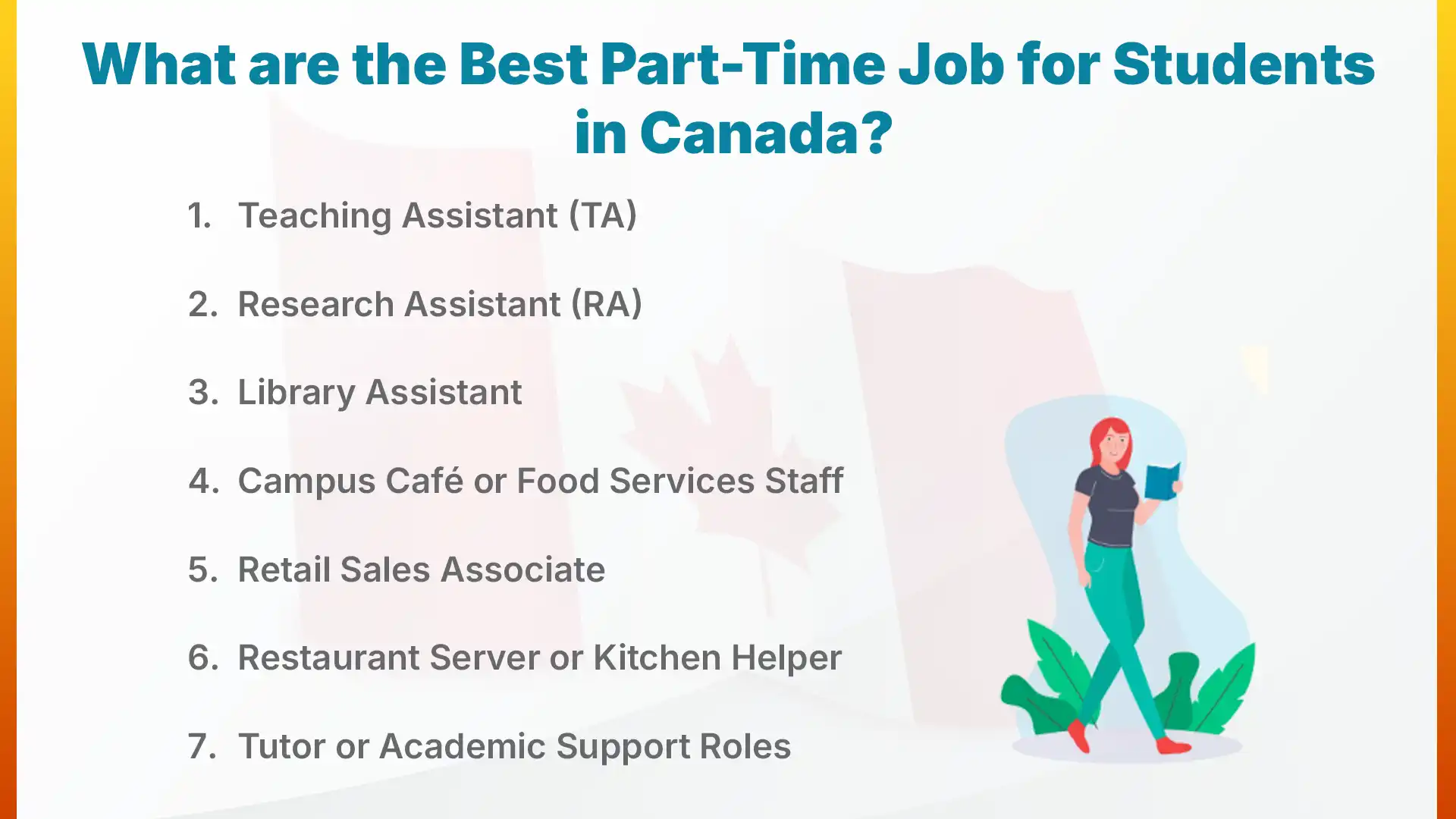
1. Teaching Assistant (TA)
Teaching Assistant roles are common for graduate students and academically strong learners. You usually help professors with grading, tutorials, or lab sessions. These jobs are well respected on campus and typically pay CAD 18–25 per hour. Since the work is academic, it adds strong value to your profile and future study plans. However, positions are limited and often competitive.
2. Research Assistant (RA)
Research Assistants support faculty members with research tasks such as data collection, analysis, or documentation. These roles are mostly offered within universities and research centers. Pay generally ranges from CAD 18–24 per hour. Along with income, you gain hands-on research experience and strong academic references. This role is especially useful for students planning higher studies beyond their undergraduate.
3. Library Assistant
Library assistants help manage books, assist students, and support daily library operations. The work environment is quiet and student-friendly. Pay usually falls between CAD 15–18 per hour. Because the workload is lighter, it’s easier to focus on studies. This job is popular among first-year students.
4. Campus Café or Food Services Staff
These jobs include working in cafeterias, coffee shops, or food counters on campus. Tasks involve serving food, taking orders, or basic cleaning. Pay usually ranges from CAD 15–17 per hour. While the job can be physically tiring, shifts are flexible. Many students choose this role for quick hiring and steady income.
5. Retail Sales Associate
Retail roles are available in malls, grocery stores, and local shops. You may handle customer service, billing, and stocking shelves. Pay is usually close to minimum wage, around CAD 15–17 per hour. These jobs improve communication and customer-handling skills. However, evening and weekend shifts are common.
6. Restaurant Server or Kitchen Helper
Restaurant jobs include serving tables, assisting in the kitchen, or food preparation. Pay ranges from CAD 15–18 per hour, and tips can increase earnings for servers. The work pace can be fast, especially during busy hours. Still, these jobs are widely available and often don’t require prior experience.
7. Tutor or Academic Support Roles
Tutors help students with subjects like math, science, or English. These roles are offered by universities or private platforms. Pay is higher than in many part-time jobs, usually CAD 18–25 per hour. Tutoring also strengthens your subject knowledge and teaching ability. It’s ideal for students with strong academics.
8. Freelancing (Design, Writing, Tech)
Freelancing allows students to work online in areas such as design, content writing, or programming. Pay varies but can range from CAD 20–40 per hour, depending on skill level. The biggest benefit is flexibility and remote work. However, students must still follow off-campus work rules carefully.
9. Online Tutoring
Online tutoring involves teaching students through digital platforms. Subjects like English, math, and science are in high demand. Pay usually ranges from CAD 18–30 per hour. Since it’s remote, it saves travel time and offers better work-study balance. Many students prefer this option for flexibility.
10. Student Ambassador Roles
Student ambassadors represent their university at events, campus tours, or online promotions. The role focuses on communication, outreach, and student support. Pay typically ranges from CAD 16–20 per hour. It helps build confidence, leadership, and networking skills. This role is especially helpful for future career growth.
Can International Students Work in Canada? (Eligibility)
Yes, international students in Canada can work legally if they meet the conditions of their study permit. To be eligible, you must be a full-time student at a designated learning institution (DLI) and enrolled in an academic, vocational, or professional program. Most Nepali students fall under this category, which means part-time work is allowed if all rules are followed.
However, the most important detail is what’s written on your study permit. It clearly states whether you’re allowed to work on-campus, off-campus, or both. If this condition is missing or restricted, working without correction can lead to serious problems later.
There is also a clear difference between on-campus and off-campus work eligibility. On-campus jobs are generally allowed without extra approval as long as you are actively studying. Off-campus work, on the other hand, is only allowed if your permit explicitly permits it and you meet weekly hour limits. Understanding this difference early helps you work safely and avoid future visa issues.
Work Hour Limits & Rules for International Students in Canada
Canada has clear working rules for international students, and following them is important to protect your student status. These rules are written on your study permit and involve on-campus and off-campus jobs differently. Understanding each part helps you work legally without risking your future plans.
1. On-Campus Work Rules
If your study permit allows on-campus work, there is no weekly hour limit during semesters or scheduled breaks. You can work as much as your schedule and energy allow. This is great because it gives you flexibility, especially with multiple small shifts or jobs combined.
To work on campus, you need to be a full-time student at a Designated Learning Institution (DLI) with a valid study permit allowing work, and you have a Social Insurance Number (SIN).
On-campus work includes jobs with departments, libraries, and campus cafés that are directly part of your school environment. Most students use these roles to earn a steady income without complicated paperwork. Just remember to keep your studies your main priority.
2. Off-Campus Work Hour Limits
As of late 2024–2025, eligible international students can work up to 24 hours per week off campus while classes are in session. You won’t need a separate work permit, provided this condition is on your study permit. During scheduled academic breaks like winter or summer holidays or other official breaks, you can work full-time with no weekly limit.
To work off-campus as well, you must be a full-time student before and after the break and have a Social Insurance Number (SIN). Working beyond the 24-hour weekly limit during regular terms can violate your permit conditions and create problems.
3. What Happens If You Break Work Rules?
If you work more than your allowed hours, or work off-campus without proper authorization, it counts as breaking your study permit conditions. This can lead to losing your student status, refusal or delay of future permits like the Post-Graduation Work Permit (PGWP), and in serious cases, removal from Canada. The government takes compliance seriously, so tracking your work hours and staying within limits is essential to protect your studies and long-term plans.
How Much Can International Students Earn in Canada?
International students in Canada can earn a meaningful income through part-time work, but the exact amount depends on the province and job type. Wages are largely tied to local minimum wage laws, which vary by province and city. As you plan your study and work journey, it’s helpful to understand average earnings and what they can realistically cover in terms of living costs.
1. Average Hourly Wage in Canada
Canada’s minimum wage varies depending on the province or territory you live in, with most rates falling between roughly CAD 15.00 to about CAD 19.75 per hour in 2026.
For example, Ontario’s minimum wage is around CAD 17.60/hour, while Nunavut’s is higher at about CAD 19.75/hour. These rates help set a baseline, but many part-time student jobs, especially those requiring specific skills, pay slightly more. In practice, students often earn between CAD 16–22 per hour for common roles like café staff, retail associates, or campus assistants.
2. On-Campus vs Off-Campus Earnings
On-campus jobs typically pay at or slightly above the minimum wage, since many university roles like library assistants or café staff fall into entry-level positions. Off-campus roles, especially in hospitality, retail, or skill-based gigs (like tutoring or tech work), often offer a bit higher pay.
For example, tutors or specialized assistants may command CAD 18–25 per hour, compared with minimum-wage jobs closer to CAD 15–17 per hour. Because of this, choosing a job that matches your skills can increase your income without adding too many hours.
3. Part-Time vs Full-Time Work
While studying, you’ll usually work part-time (up to 20–24 hours per week) during academic sessions, earning income that fits around your classes. However, during official scheduled breaks like summer or winter holidays, students can work full-time hours, which can significantly boost monthly earnings.
Some programs or co-op placements also have special work rules that let students work longer or in more specialized roles. These rules vary by school and permit conditions, so checking your study permit and university guidance is important before taking such roles.
4. Monthly Income Estimation for Students
If you work around 20 hours per week at an average wage of CAD 16–18 per hour, your monthly income before taxes could be roughly CAD 1,280–1,440. During breaks, working full-time (e.g., 35–40 hours) can raise that to CAD 2,240–2,880 or more, depending on the wage. These earnings can help cover basics like groceries, transport, and smaller personal expenses, but they may not fully cover rent in high-cost cities like Vancouver or Toronto. Still, part-time income can lighten financial pressure while you focus on studies.
Cost of Living in Canada vs Part‑Time Income (Budgeting)
Living in Canada means balancing your budget between essentials like rent, food, transportation, and utilities. These costs can vary a lot depending on which city you choose to study in, and your part‑time earnings will help cover some, but usually not all, of these expenses.
To give you a realistic picture, let’s assume a Nepali student works 20 hours per week at an average wage of CAD 16–17/hour. That comes to roughly CAD 1,280–1,360 per month before taxes. This income can help cover basic expenses, but the impact varies widely depending on the city you choose.
Below is a clear breakdown so you can plan realistically before arriving:
Expense Category | Toronto & Vancouver | Montreal & Mid‑Size Cities | Smaller Cities |
| Rent (shared) | CAD 850–1,900+ | CAD 600–1,200 | CAD 650–1,200 |
| Food & Groceries | CAD 300–550 | CAD 250–450 | CAD 200–350 |
| Transportation | CAD 120–180 | CAD 90–150 | CAD 80–130 |
| Utilities & Internet | CAD 140–280 | CAD 100–200 | CAD 100–220 |
| Miscellaneous | CAD 100–300 | CAD 100–200 | CAD 100–200 |
| Estimated Total | CAD 1,400–2,800+ | CAD 1,000–2,000 | CAD 1,100–2,000 |
Toronto and Vancouver are the priciest cities for students in Canada because of high rental and transport costs. Total monthly living expenses there can easily be CAD 1,800–2,800+ for students. Montreal and many smaller cities offer lower living costs, often in the range of CAD 1,000–2,000, making them more student‑friendly.
Why Location Choice Matters as Much as the Job
The city you choose to live in affects how far your part‑time income will go. Even if you earn the same hourly wage, living in a cheaper city gives you more savings and less financial stress. For example, a student earning around CAD 1,200–1,400 per month from part‑time work will find this stretches further in Montreal or smaller cities than in Toronto or Vancouver. Choosing a balanced location can help you manage both your studies and living costs more realistically.
Realistic Budget Example
City | Estimated Monthly Income | Estimated Monthly Expenses | Coverage of Expenses (%) |
| Toronto / Vancouver | CAD 1,280–1,360 | CAD 1,800–2,800 | 45–75% |
| Montreal / Mid-Size | CAD 1,280–1,360 | CAD 1,000–2,000 | 60–80% |
| Smaller Cities | CAD 1,280–1,360 | CAD 1,100–2,000 | 65–85% |
How much you spend matters. Even with the same part-time income, smart budgeting and mindful choices, like sharing accommodation, using public transport, and cooking at home, can make a big difference. Learn the total cost of studying and living in Canada. Plan ahead and choose a city that balances costs with opportunities to stretch your earnings, reduce financial stress, and focus more on your studies and work experience in Canada.
How to Find Part-Time Jobs in Canada as a Nepali Student?
To find a part-time job in Canada as a Nepali student, start by exploring on-campus positions, off-campus opportunities allowed by your study permit, and flexible skill-based work. Use your university’s career centres and job portals, check online platforms like Indeed or Job Bank, and network with professors, classmates, and Nepali student communities to discover openings. This approach helps you find roles that fit your schedule, skills, and goals while staying fully compliant with Canadian work rules.
1. University Career Centers & Job Portals
Most Canadian universities have career centers and campus job portals where students can browse part-time positions, internships, and work-study roles. Jobs listed here are usually on-campus or officially approved off-campus roles, which means they are safe and follow student permit rules. You can apply directly through the portal and often get help with resume reviews or interview preparation. Work-study opportunities are especially helpful, as they may include financial support or flexible hours to match your classes.
2. Online Job Platforms in Canada
Online platforms are another excellent way to find part-time work, both on and off campus. Popular websites include Indeed, Job Bank Canada, LinkedIn, and Glassdoor, where employers post openings across industries like retail, hospitality, and tutoring. You can filter by location, job type, and part-time hours to match your schedule. Applying online often requires a strong resume and cover letter, but it gives you access to hundreds of options beyond what’s available on campus.
3. Smart Networking Tips for Students
Networking is a powerful tool for finding part-time work in Canada, sometimes even more effective than applying online. Start by talking to professors, academic departments, and career advisors, as they often know about job openings before they are publicly posted. Connecting with Nepali student communities and other international student groups can also help, as current students often share job leads. Additionally, referrals and walk-in applications at nearby businesses like cafés, libraries, and bookstores can lead to quick hiring, especially for entry-level roles.
Preparing for Job Hunting in Canada
Job hunting in Canada is not just about finding openings; it’s also about presenting yourself in a way that matches local expectations. Many international students, including those from Nepal, miss this step and struggle to get interviews even when they have the skills. Taking time to prepare a Canadian-style resume, cover letter, and interview approach can make a huge difference in landing a part-time job.
1. Canadian-Style Resume & Cover Letter Tips
Canadian resumes are usually 1–2 pages, clear, and easy to read, with sections for education, work experience, and skills. Personal details such as age, photo, or marital status should not be included.
Use short bullet points to highlight achievements, and quantify results when possible (for example, “Managed inventory for 200+ items weekly”). For cover letters, keep it concise, only one page, and explain why you’re interested in the position and how your skills match the role. Always proofread and curate each resume and letter to the job you are applying for.
2. Interview Preparation for Student Jobs
Interviews for student jobs are usually short and practical, focusing on availability, experience, and reliability. Common questions include “Why do you want to work here?”, “What skills can you bring to this role?”, and “How will you manage work with your studies?” Practice clear, confident answers and be ready to give examples of teamwork, problem-solving, or customer service.
Non-verbal communication matters too. Smile, maintain eye contact, and show enthusiasm. Preparing ahead will help you feel confident and make a strong impression on potential employers.
Taxes and Legal Requirements for Student Jobs in Canada
When working in Canada, understanding taxes and legal requirements is crucial for international students. Even part-time jobs come with obligations, and staying compliant ensures you avoid problems with your study permit or future immigration applications. Knowing about the Social Insurance Number (SIN), tax filing, and relevant forms will make the process smoother and stress-free.
1. Social Insurance Number (SIN) for Students
A Social Insurance Number (SIN) is a 9-digit unique number issued by the Canadian government that you need for work and tax purposes. The SIN allows employers to report your income and contributions to the government. Without a SIN, you cannot be legally employed or paid.
International students should apply for a SIN as soon as they start a job, either online, by mail, or in person at a Service Canada center. The application requires your study permit and passport, and once approved, the SIN remains valid for your entire time in Canada. Having a SIN also helps with tax reporting and accessing government benefits if eligible.
2. Do International Students Pay Taxes in Canada?
Yes, international students must pay taxes on the income they earn in Canada, even from part-time work. Canada uses a progressive income tax system, and taxes are deducted directly from your paycheck through payroll. Filing a tax return at the end of the year is mandatory, as it ensures you get any refunds and remain in good standing with the government. Even students earning below the taxable threshold should file a return, as this maintains your record and can help qualify for benefits like the GST/HST credit.
3. Common Tax Forms Students Should Know
The T4 slip is the most common form, provided by employers at the end of the year, showing your total income and tax deducted. Using this information, you file your annual tax return with the Canada Revenue Agency (CRA), which calculates whether you owe taxes or are eligible for a refund. Other forms, like T2202 for tuition, can help reduce taxes owed if you are claiming educational credits. Filing correctly is essential for staying compliant and avoiding complications with future permits, including the Post-Graduation Work Permit (PGWP).
How Part-Time Jobs Help Shape Your Future in Canada
Part-time jobs help you gain Canadian work experience while studying. They also improve your skills, build your resume, and increase chances for co-op placements or internships. Additionally, this experience can support your long-term career and permanent residency goals in Canada.
1. Gain Real Canadian Work Experience
Part-time jobs give you first-hand exposure to how workplaces in Canada operate. You’ll learn professional communication, teamwork, time management, and problem-solving in a real work environment. This experience strengthens your resume and helps when applying for internships, co-op placements, or higher-paying jobs after graduation. Employers value students who already understand Canadian workplace norms, which gives you a competitive edge.
2. Boost Your Co-op, Internship, and PGWP Opportunities
Working while studying can make it easier to qualify for co-op programs or internships, as you already have practical experience. It also prepares you for the Post-Graduation Work Permit (PGWP) by showing that you understand Canadian work rules and can manage employment alongside studies. Gaining this early exposure increases your chances of securing meaningful work after graduation, which can eventually lead to permanent residency.
3. Build Your Career and Long-Term Goals in Canada
Part-time work can help you explore career interests and develop skills relevant to your field of study. Networking during these jobs often leads to future job opportunities or mentorship from Canadian professionals. Over time, this experience can support your long-term career growth, improve employability, and even contribute to your PR goals if you plan to stay in Canada after graduation.
Conclusion
Planning your Canadian education from Nepal is about preparing for life in a new country while balancing studies, work, and personal growth. For Nepalese students, making thoughtful choices early can save a lot of stress later and set you up for success both academically and professionally.
Choosing the right university and city is crucial for balancing study and work in Canada. Big cities like Toronto or Vancouver offer more job opportunities but higher living costs, while Montreal or smaller towns are more affordable yet still provide good work options. Understanding Canadian work rules, including on-campus and off-campus eligibility, hour limits, and documents like a Social Insurance Number (SIN), helps you stay compliant and plan realistically. Finally, consulting experts or trusted education consultancies in Nepal, such as SAS Education, can make your transition smoother and ensure your part-time work supports both your studies and future goals.