IELTS or TOEFL for the USA: Which Test is Better for Nepalese Students?

Jul 17, 2026
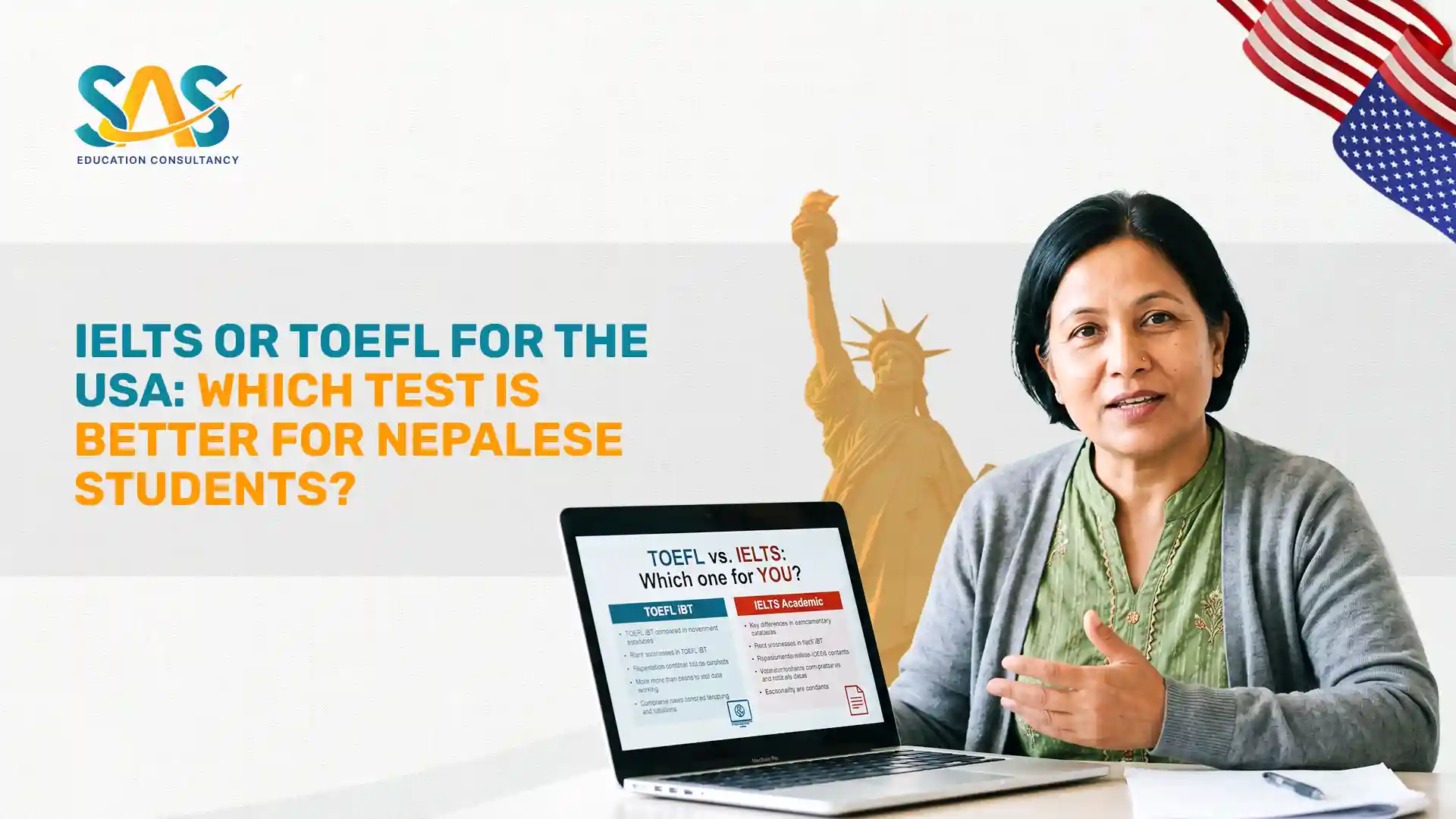
IELTS vs. TOEFL for USA admissions is one of the first decisions Nepalese students applying to American universities have to get right, since choosing the wrong test can mean wasted registration fees, wasted prep time, and, in the worst case, a missed F-1 visa interview window.
Getting into a competitive US university is hard enough without adding an avoidable setback: a single English proficiency score can be the difference between an acceptance letter and a rejection. Understanding the real differences between IELTS and TOEFL in format, cost, scoring, and how US universities and the F-1 visa process treat each one lets you pick the test that actually plays to your strengths instead of guessing. This guide breaks down formats, costs, visa rules, and university preferences for 2026. If you're just starting out, our full guide on how to study in the USA is a good place to begin.
In this blog
What Are IELTS and TOEFL?
IELTS and TOEFL are the two most widely used standardized English proficiency tests for students applying to US universities, with IELTS built around British/Australian English conventions and TOEFL built around American English conventions.
Feature | IELTS Academic | TOEFL iBT (Post-Jan 2026) |
|---|---|---|
| Conducted By | British Council / IDP Education | ETS (Educational Testing Service) |
| Format | Paper-Based or Computer-Delivered | Fully Internet-Based (iBT); Reading and Listening Are Adaptive Across Two Stages |
| Speaking Test Style | Face-to-Face with a Live Examiner | Recorded Responses into a Microphone; New Listen and Repeat and Take an Interview Tasks with No Preparation Time |
| Writing Test Style | Handwritten (Paper) or Typed (Computer), 2 Tasks | Typed; Three Shorter Tasks: Build a Sentence, Write an Email, and Writing for an Academic Discussion |
| Scoring Scale | 0–9 Bands (0.5 Increments) | Primary Scale: 1.0–6.0 Bands (CEFR-Aligned, 0.5 Increments); Legacy 0–120 Score Still Reported During the Transition Period |
| Duration | 2 Hours 45 Minutes | Approximately 90 Minutes, with No Scheduled Break |
| Cost in Nepal | Approx. NPR 33,000 (Computer-Based) to NPR 36,200 (Paper-Based) | Approx. USD 195 (Roughly NPR 27,000–27,500) |
For most Nepalese students, IELTS feels more natural because the Nepali education system follows British English. However, students who prefer a shorter test day, type faster than they write, and are comfortable with American English idioms often find TOEFL's newly shortened format highly appealing. If you are torn between IELTS formats, you can review the computer-based and paper-based IELTS difference to make an informed choice.
Why Does Choosing the Right English Test Matter for the USA?
Choosing between these tests is critical because your score dictates not only your university admission but also how smoothly your US embassy interview process will go. Securing a high score on the right test not only guarantees your I-20 document from the university but also provides a strong foundation of confidence when proving your English proficiency to the consular officer during your F-1 visa interview.
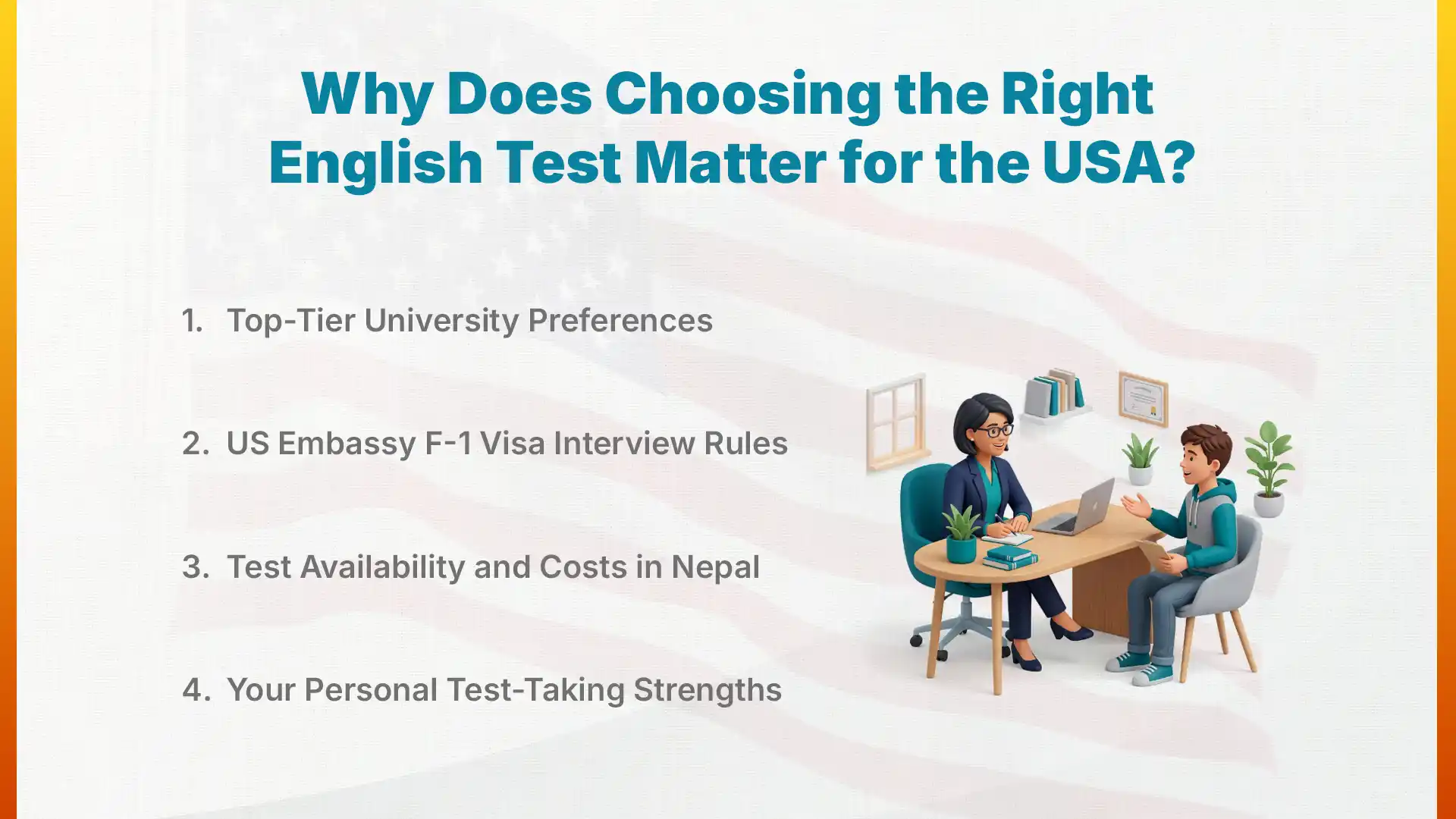
1. Top-Tier University Preferences
While all US universities accept both, top-tier institutions (like the Ivy League) and highly competitive STEM programs often have admissions officers who are historically more familiar with TOEFL score benchmarks. Submitting the right test format can subtly influence how your application is reviewed.
2. US Embassy F-1 Visa Interview Rules
Unlike some other countries, the US embassy does not have a separate government language testing requirement. The consular officer simply verifies that you met the university's minimum requirement to get your I-20 form. However, having a strong, recognized score builds confidence going into the visa interview.
3. Test Availability and Costs in Nepal
Factoring in exam fees, travel to test centers, and retake policies in cities like Kathmandu can significantly impact your budget. IELTS currently costs more in Nepal than TOEFL, making test selection a major financial decision.
4. Your Personal Test-Taking Strengths
Matching the test format to whether you type faster than you write by hand and whether you prefer a human examiner or a computer algorithm can be the difference between an average score and a passing one.
What Are the Admission and Visa Requirements?
Unlike other popular study destinations, the US language requirements work differently because the government does not set a federal English benchmark; the individual university does. This means your test score only needs to satisfy your chosen institution's specific cutoffs to secure your I-20 document, with no separate government conversion scales or minimums to worry about during the F-1 visa stage.
1. US University Requirements
Most US universities require a TOEFL score of 80–90 for bachelor's programs and 90–100+ for master's programs. For IELTS, the equivalent is typically 6.5 for bachelor's and 7.0–7.5 for master's. Exact cutoffs are always program-specific, so always confirm directly with your target university by checking the complete requirements to study in the USA from Nepal.
2. US Embassy F-1 Visa Thresholds
Here is a crucial fact: The United States does not use a CLB (Canadian Language Benchmark) system. The US government does not convert your test scores. If your chosen US university accepts your TOEFL or IELTS score and issues you an I-20 document, the US embassy will accept it. The consular officer only checks if your score meets the minimum listed on your I-20. To prepare for this interview, you can review common USA F-1 visa interview questions.
3. Impact on OPT and H-1B
The English test you take has absolutely zero impact on your post-graduation work permit (OPT) or your H-1B work visa lottery. Those are based entirely on your degree, your employer, and maintaining your legal F-1 status during your studies.
4. English Proficiency Proof
Because top US universities require high scores, investing in solid preparation is non-negotiable. To maximize your score on the first attempt and avoid this financial drain, consider enrolling in IELTS preparation Classes to get expert feedback on your writing and speaking.
How to Decide Which Test is Better for You?
The right English test for you comes down to four practical checks: your target university's specific requirement, your natural speaking and reading style, test center availability in Nepal, and a mock test comparison.
Step 1: Check Your Target US University’s Preference
Always verify the specific college's minimum scores. Some state universities accept IELTS 6.0, while Ivy League or top STEM schools might flatly reject an IELTS 6.5 but welcome a TOEFL 100. Check the admissions page of your exact department, not just the general university page.
Step 2: Evaluate Your English Skills
Are you better at face-to-face conversation [IELTS] or speaking into a microphone [TOEFL]? Do you prefer reading long passages on paper or reading on a computer screen? Additionally, consider your exposure to American vs. British English spelling and vocabulary, as TOEFL listening tracks heavily feature North American accents.
Step 3: Consider Test Center Availability in Nepal
Check local dates in Kathmandu/Pokhara well in advance, as both IELTS and TOEFL slots fill up very fast during the peak US application season (August through January).
Step 4: Take a Free Mock Test for Both
Experience the timing constraints of both tests before paying the registration fee. Taking a free ETS or British Council mock test will immediately tell you which test format makes you feel less anxious.
How Much Does It Cost to Take IELTS vs. TOEFL in Nepal?
As of 2026, IELTS still costs more upfront than TOEFL in Nepal. The gap has actually widened slightly since IELTS exam fees in Nepal increased on June 8, 2025, with costs now around NPR 33,000-39,000, while TOEFL has held relatively steady in USD terms.
Test | Registration Fee (NPR) | Score Sending Fees |
|---|---|---|
| IELTS Academic | NPR 33,000 (Computer-Based) to NPR 36,200 (Paper-Based) | Free Delivery to Up to 5 Institutions Included |
| TOEFL iBT | USD 195 (Equivalent to Approximately NPR 27,420) | Up to 4 Free Official Score Reports Included; Additional Reports Ordered After the Test Date Cost USD 25 Each |
Preparation classes in Nepal typically cost NPR 5,000–20,000 for either test. Retaking either exam means paying the full registration fee again, so investing in solid preparation the first time rather than treating the test as trial-and-error is usually the more cost-effective path.
Keep in mind that this English test cost is just one small part of your overall cost to study in the USA. Budgeting NPR 40,000–55,000 for IELTS and NPR 35,000–50,000 for TOEFL (registration plus preparation classes) gives most students a realistic buffer, even accounting for a possible retake.
Which Test Do US Universities Actually Prefer?
While US universities legally accept both, admissions patterns show a clear preference depending on the school's tier. Top-tier institutions and competitive STEM programs often lean toward TOEFL due to historical familiarity with its scoring scale, while mid-tier state universities evaluate both tests with absolute neutrality.
Top-tier universities (Ivy League, MIT, Stanford) heavily lean toward TOEFL. Admissions officers at these schools are historically more accustomed to benchmarking TOEFL scores (e.g., knowing exactly what a 105 means) compared to IELTS bands.
Mid-tier state universities accept both equally without any preference, as long as you clear their minimum threshold.
US Admissions Officers often find TOEFL reading and writing tasks easier to benchmark against US high school writing standards.
STEM departments often require higher sub-scores in writing regardless of the test, as technical report writing is a core part of US graduate education.
When researching schools, you can explore the best universities in the USA to see their specific program requirements.
What Happens If You Don't Get the Required Score?
If you do not achieve the required score, you still have several strong options, such as retaking the exam, switching test formats, or enrolling in pathway programs to ensure your US study plans are not completely derailed. US universities and the visa process are highly flexible if you know how to pivot strategically, meaning a low score is rarely a permanent roadblock if you have a solid backup plan.
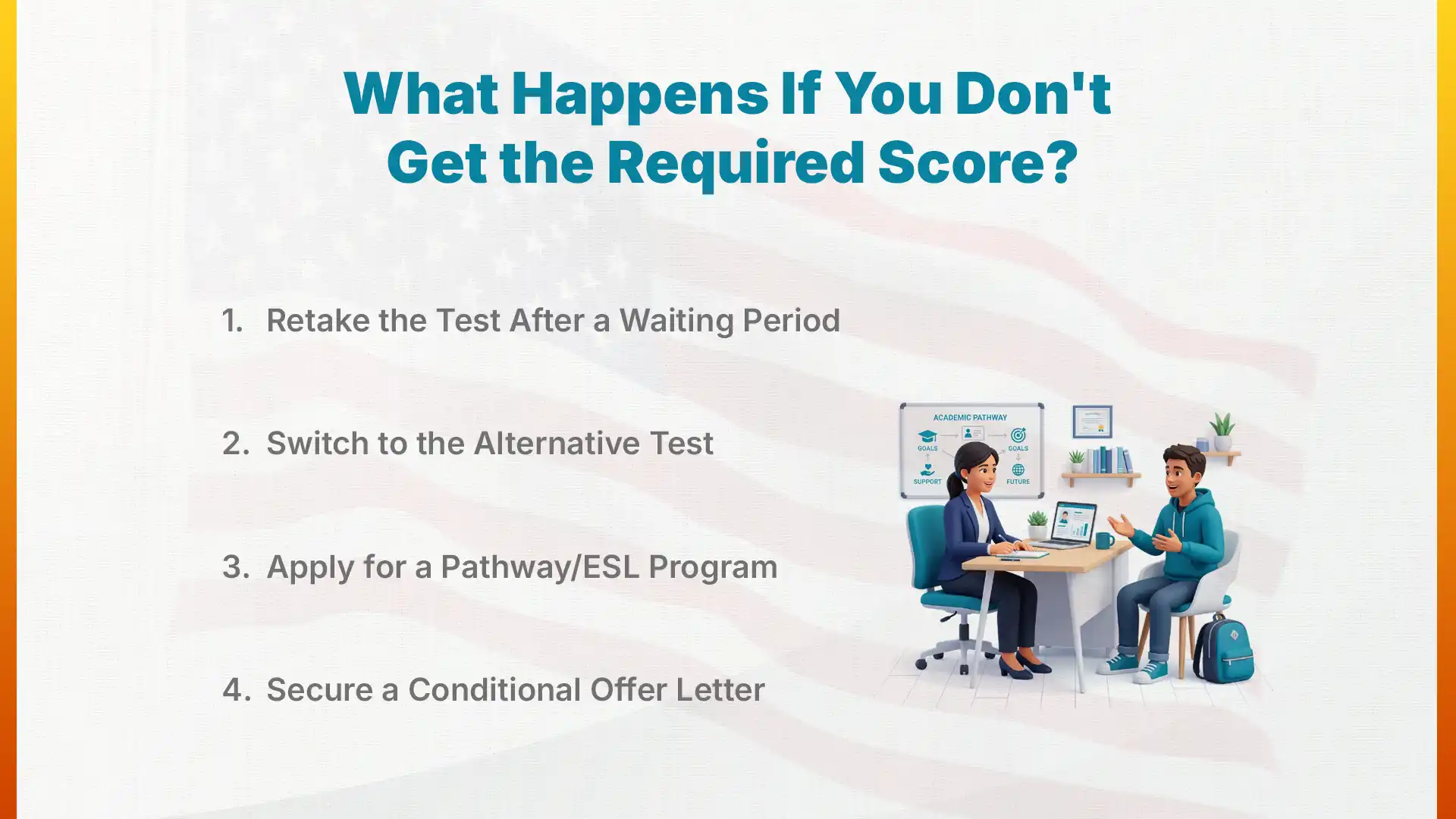
1. Retake the Test After a Waiting Period
Retake the specific test after a mandatory waiting period (usually 15 days for IELTS, 3 days for TOEFL) to try and improve your score. If you were only 0.5 bands or a few points away, focused tutoring on your weak section can get you over the line. This is often the fastest route since you are already familiar with the test format and question types.
2. Switch to the Alternative Test
Switch to the other test if your score profile is weak in one area (e.g., if you scored low on IELTS writing because of handwriting speed, taking TOEFL iBT, where you type, might yield a significantly better result).
3. Apply for a Pathway/ESL Program
Apply for a pathway or English as a Second Language (ESL) program at a US community college or university. This allows you to study English in the US for a semester, conditionally progressing into your main degree program without needing to hit the exact score in Nepal.
4. Secure a Conditional Offer Letter
Apply for a conditional offer letter from a US university that allows you to enroll provisionally, provided you hit the required English score before the program begins. This strategy secures your I-20 while buying you necessary time to improve your language skills.
Conclusion
Selecting the right English test is a strategic decision that protects your finances and prevents devastating delays in securing your I-20 and F-1 visa. The cost of guessing which test to take can result in wasted money, missed intakes, and rejected university applications. Whether you choose IELTS or TOEFL, understand your university's exact requirements and book your test at least 3 months before your application deadline.
For expert guidance on choosing the right test and mapping your scores to US university requirements, contact SAS Education Consultancy today.