Study Data Engineering Courses in Australia: Top Universities, Fees & Career Scope

Jul 16, 2026

We are in the middle of a global data gold rush, but while everyone is focused on the data scientists who analyze the gold, it is the data engineers who actually build the mines. These are the highly paid backend architects who design the massive cloud pipelines that keep multinational tech giants running. For Nepalese IT students, cracking into this elite tier usually means facing the impossible tuition fees of American universities or settling for outdated local curriculums. Australia offers a powerful third option: ultra-modern, ACS-accredited data engineering programs designed in direct partnership with industry leaders like AWS and Google Cloud.
By choosing to study in Australia, you are guaranteed a degree that guarantees a post-study work visa and a fast track to permanent residency. This 2026 guide breaks down the exact universities, costs, and PR strategies you need to succeed.
In this blog
What Is a Data Engineering Course in Australia?
A data engineering course in Australia is a specialized IT program focused on the backbone of big data: designing, building, and managing the infrastructure that allows massive amounts of data to be collected, stored, and analyzed. It is typically offered as a major or specialization within a Bachelor of Computer Science/IT, Master of Data Science, or Master of Information Technology.
The duration is 3 years for a bachelor's and 1.5 to 2 years for a master's degree, and it is strictly accredited by the Australian Computer Society (ACS), which is crucial for professional recognition and PR. Graduates become the highly sought-after architects who build the systems that allow data scientists and business analysts to do their jobs.
Why Study a Data Engineering Course in Australia?
Australia is a top destination to study data engineering because of its globally recognized ACS-accredited degrees, massive demand in the big data sector, access to cutting-edge cloud labs, and a clear pathway to PR through IT occupations.
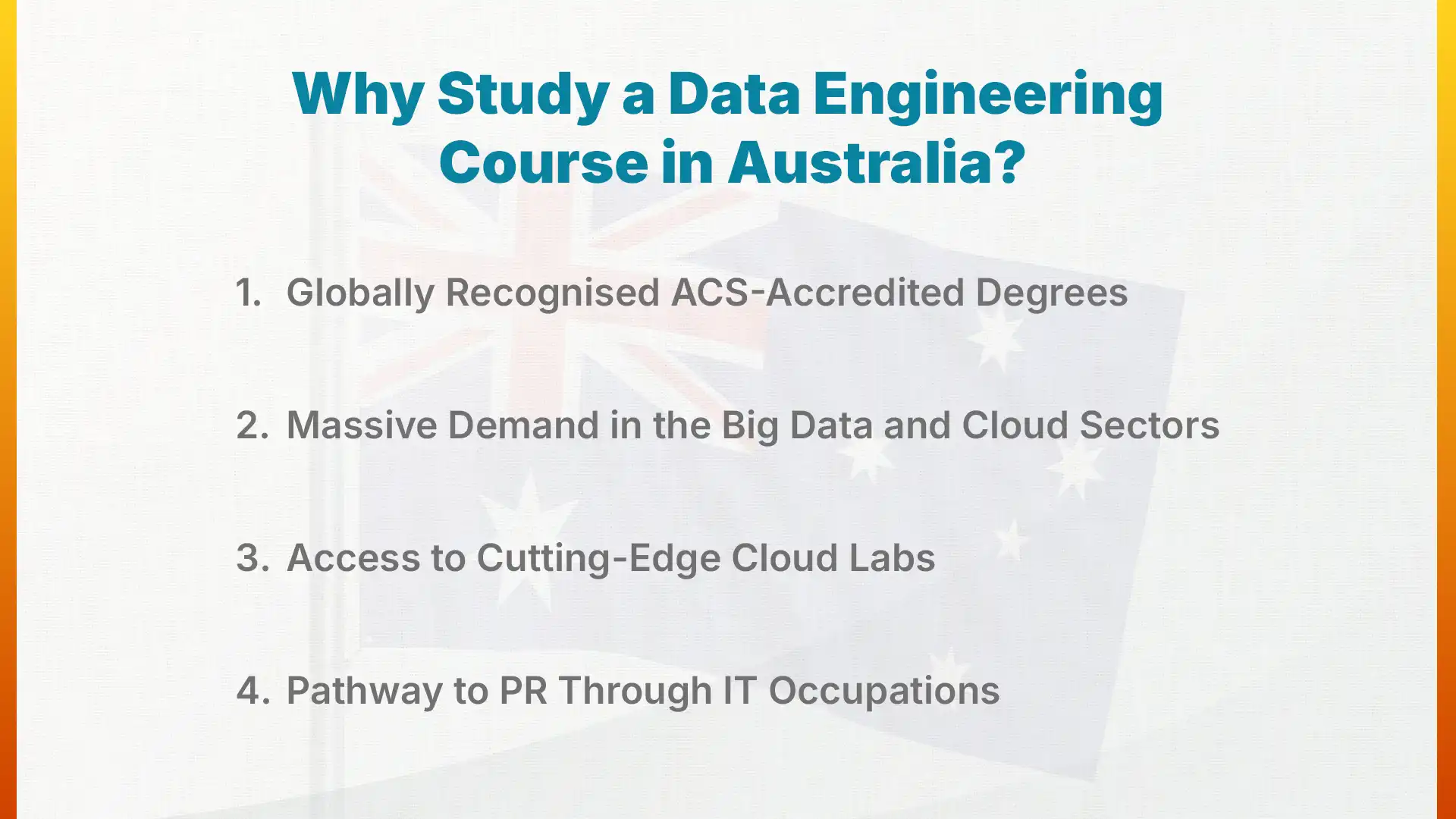
1. Globally Recognised ACS-Accredited Degrees
Australian IT programs are developed in close consultation with the tech industry and accredited by the ACS. This ensures your degree meets global standards, making your skills highly portable and respected by tech giants worldwide.
2. Massive Demand in the Big Data and Cloud Sectors
Australia has a booming tech ecosystem, particularly in cities like Sydney and Melbourne. There is an acute shortage of professionals who can build scalable data pipelines and manage cloud infrastructure for enterprises transitioning to digital-first operations.
3. Access to Cutting-Edge Cloud Labs
Australian universities partner directly with tech giants like AWS, Microsoft Azure, and Google Cloud. Students get free access to enterprise-level cloud environments during their studies, graduating with the exact platform certifications that employers require.
4. Pathway to PR Through IT Occupations
Data engineers fall under the highly demanded ANZSCO code for software and applications programmers. This occupation is consistently listed on Australia's Skilled Occupation List, providing a highly streamlined route from a post-study work visa to permanent residency.
Which Are the Top Universities and Colleges for Data Engineering in Australia?
The top universities for a data engineering course in Australia include UNSW, the University of Melbourne, and Monash University, all offering world-leading facilities and direct tech industry placements. If you want to compare these with other global leaders, you can explore the best universities in Australia for a broader view.
Institution | Location | Program | Known For | ACS Status |
|---|---|---|---|---|
| University of New South Wales (UNSW) | Sydney, NSW | Bachelor/Master of IT (Data Engineering) | Top-Ranked Engineering Faculty; Elite AI and Data Labs | Fully Accredited |
| University of Melbourne | Melbourne, VIC | Master of Data Science / Master of IT | Strong Focus on Distributed Systems and Data Architecture | Fully Accredited |
| Monash University | Melbourne, VIC | Bachelor of Computer Science (Data Science) | Excellent Cloud Computing Partnerships (AWS/Azure) | Fully Accredited |
| University of Technology Sydney (UTS) | Sydney, NSW | Bachelor/Master of Information Technology | Highly Practical; Located in a Major Tech and Business Hub | Fully Accredited |
| RMIT University | Melbourne, VIC | Bachelor of IT (Data Engineering) | Industry-Led Curriculum; Strong Focus on ETL and NoSQL Databases | Fully Accredited |
Choosing any of these ACS-accredited institutions guarantees you receive premium, hands-on training that meets the strict standards of the global tech industry.
What Are the Admission Requirements?
The admission requirements for a data engineering course in Australia include strong academic results in mathematics and IT, an IELTS score of 6.5 overall, a technically focused personal statement, and proof of funds for the Subclass 500 visa.
1. Academic Requirements
For undergraduate programs, Nepalese students need Plus Two Science or Management with strong marks in mathematics (typically 60% to 75% overall). For postgraduate programs, a relevant bachelor's degree in IT, computer science, or software engineering is required, usually with a minimum GPA equivalent to a second-class lower division.
2. English Language Requirements
Tech programs require strong English skills so international students can comprehend complex software documentation and collaborate effectively in group projects. Because these requirements vary, knowing the requirements to study in Australia from Nepal is crucial.
Test | Undergraduate/Postgraduate Requirement |
|---|---|
| IELTS Academic | 6.5 Overall (Min 6.0 in All Bands) |
| TOEFL iBT | 79 – 90 |
| PTE Academic | 58 – 65 |
If you need to improve your score, consider joining the IELTS preparation classes to meet the English test requirements set by Australian universities.
3. Personal Statement
While Australian universities primarily assess IT applicants based on academic scores and coding prerequisites, some may request a supplementary personal statement or cover letter if you are a borderline candidate. If asked, your essay should explain why you are drawn to backend systems, highlight specific mathematics or programming projects you have completed, and demonstrate your understanding of current challenges in big data. If you need guidance on structuring a strong application essay, you can refer to our guide on what is an SOP, which covers many of the same principles used to write a compelling personal statement.
4. Financial Proof and Visa Documentation
To meet the requirements, you must demonstrate sufficient funds to cover your first year's tuition and at least 12 months of living costs in your bank account to secure the Subclass 500 Student Visa.
How to Apply for a Data Engineering Course in Australia?
Applying for a data engineering course in Australia involves five steps: shortlisting ACS-accredited institutions, preparing your academic and financial documents, writing a technically focused SOP, submitting your application, and receiving your CoE to apply for a Subclass 500 visa. Checking Australian intakes early is essential to avoid missing the February or July application windows, as specialized IT programs fill up quickly.
Step 1: Shortlist Institutions
Compare programs based on ACS accreditation, curriculum focus (e.g., cloud data engineering vs. on-premise data warehousing), location, and tuition fees. Be sure to check if the program includes mandatory industry placements or cloud certification exams.
Step 2: Prepare Documents
Gather your Plus Two or degree transcripts (specifically highlighting math and programming scores), IELTS/PTE scores, a valid passport, CV/resume, and academic reference letters. Ensure all your academic transcripts are officially translated into English and notarized.
Step 3: Write Your SOP
Tailor your Statement of Purpose to each specific Australian university, highlighting how their cloud labs or data partnerships align with your desire to build scalable data pipelines. Mention your awareness of data security and ethical data management.
Step 4: Submit Application
Apply directly through each university's international student portal. Apply early, ideally 4 to 6 months before the February or July intake, as specialized IT programs fill up quickly. Keep a dedicated folder for your application IDs and correspondence.
Step 5: Receive CoE and Apply for Subclass 500 Visa
Once you receive an unconditional offer letter and pay your deposit, you will receive a Confirmation of Enrollment (CoE) document. Use this CoE to apply for the Subclass 500 Student Visa, ensuring your financial documents are perfectly prepared to avoid any delays. Remember that you must also purchase Overseas Student Health Cover (OSHC) before your CoE can be issued.
How Much Does It Cost to Study Data Engineering in Australia?
The cost to study a data engineering course in Australia requires an estimated total budget of AUD 48,000 to AUD 68,000 per year, covering both tuition fees and living expenses. Budgeting is easier when you know what to expect, which is why it is so important to research the total cost to study in Australia before making your final decision.
Program | Annual Tuition (AUD) | Annual Tuition (NPR approx.) |
|---|---|---|
| Bachelor of IT / Computer Science | AUD 40,000 – AUD 48,000 | NPR 3,600,000 – NPR 4,320,000 |
| Master of Data Science / IT | AUD 44,000 – AUD 55,000 | NPR 3,960,000 – NPR 4,950,000 |
Monthly living expenses range from AUD 1,500 to AUD 2,500, depending on whether you live in expensive cities like Sydney or in more affordable regional hubs like Adelaide or Perth. Nepalese students are allowed to work part-time jobs in Australia up to 48 hours per fortnight during term time to help offset these living costs.
Taking tuition and living expenses together, Nepalese students should budget approximately AUD 48,000 to AUD 68,000 per year in total.
What Scholarships Are Available?
Scholarships for a data engineering course in Australia include fully funded government options, regional grants, and university-specific merit awards for high-achieving international STEM students.
Australia Awards Scholarship: A fully funded government grant covering full tuition, living allowances, and travel for outstanding Nepalese students pursuing postgraduate STEM degrees.
Destination Australia Scholarship: Up to AUD 15,000 per year for international students who choose to study at regional Australian universities with strong tech programs.
University Merit Scholarships: Many Australian IT faculties offer automatic fee reductions of AUD 5,000 to AUD 10,000 per year for high-achieving international students based on their academic transcripts.
STEM Women in IT Scholarships: Various organizations offer targeted financial grants for female international students pursuing degrees in data engineering and software development.
Always apply for scholarships at least 6 months before your course starts, and ensure your SOP clearly articulates your coding experience to stand out.
What Jobs Can You Get After Data Engineering in Australia?
Graduates of a data engineering course in Australia can secure highly specialized roles such as data engineer, data architect, cloud data engineer, big data developer, and ETL developer across tech, finance, and healthcare sectors.
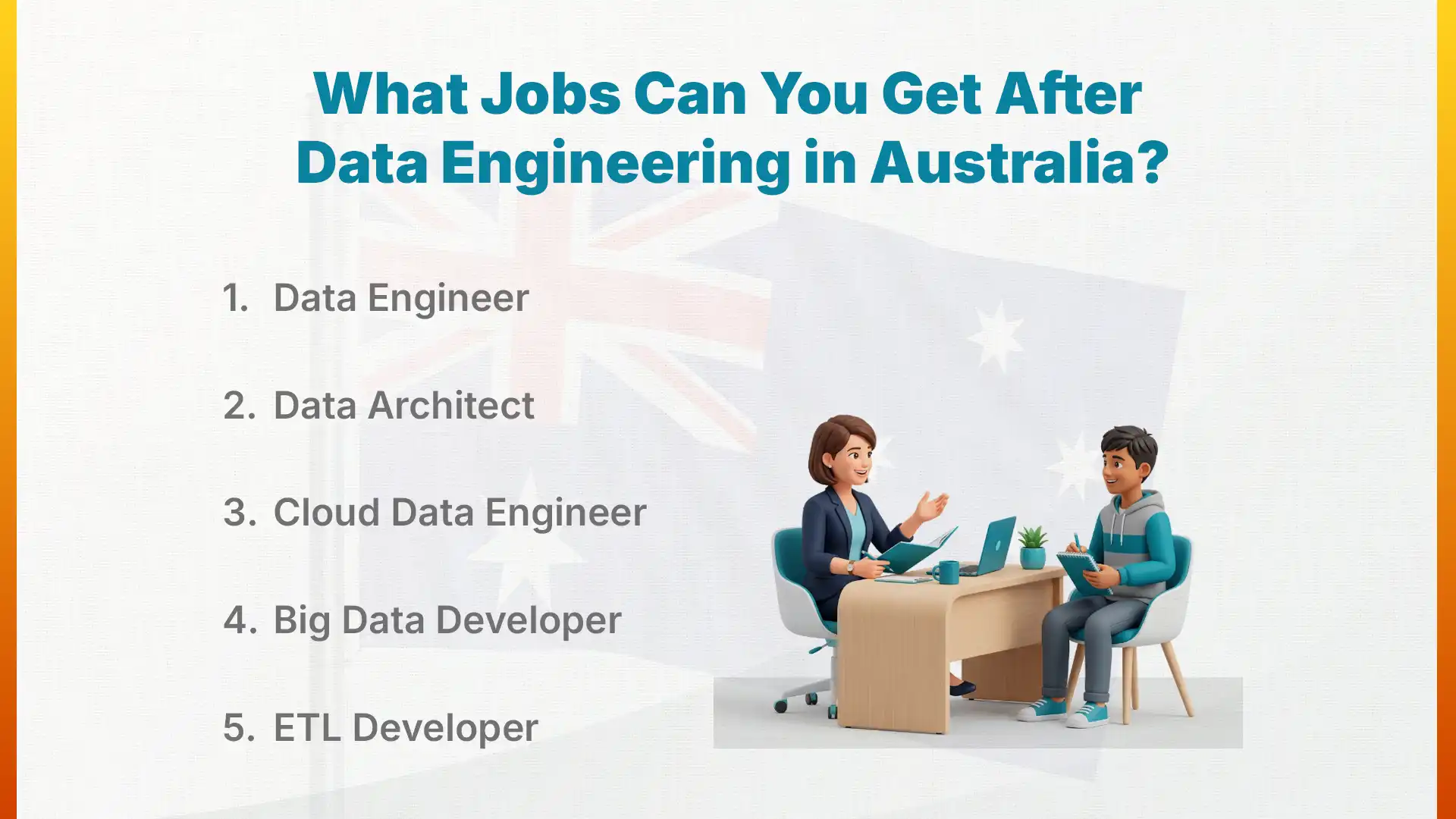
1. Data Engineer
Data engineers design, construct, and maintain the massive data pipelines that move raw data from source systems into data warehouses, ensuring data is clean, reliable, and ready for analysis. Without their expertise, data scientists and business analysts would have no usable information to work with, making them the operational backbone of any data-driven organization.
2. Data Architect
Data architects create the overarching blueprints for an organization's data management systems, deciding exactly how data will be stored, organized, and accessed across the entire company. They play a vital strategic role by ensuring these complex systems are highly secure, infinitely scalable, and perfectly aligned with the company's long-term business goals.
3. Cloud Data Engineer
Cloud data engineers specialize in building and managing data infrastructure specifically within cloud platforms like Amazon Web Services (AWS), Microsoft Azure, or Google Cloud Platform (GCP). As Australian enterprises rapidly migrate away from on-premise servers, professionals with these specialized cloud certifications are in exceptionally high demand and command premium salaries.
4. Big Data Developer
Big data developers write complex code to process massive datasets that are too large for traditional databases, utilizing frameworks like Apache Hadoop, Spark, and Kafka. Their ability to process this information in real-time gives companies a massive competitive advantage by enabling instant, data-driven decision-making.
5. ETL Developer
ETL developers focus strictly on the extraction of data from various sources, transforming it into a usable format, and loading it into a target database or data warehouse. They are critical for maintaining data integrity and regulatory compliance, ensuring that automated data workflows run flawlessly without loss or corruption.
What Is the Salary and Scope After Data Engineering in Australia?
The salary after a data engineering course in Australia ranges from AUD 75,000 to AUD 90,000 at entry-level, rising to AUD 140,000 or more for senior architects, with a highly streamlined PR pathway via the Subclass 485 and 189/190 skilled migration visas. Data engineers consistently rank among the highest-paying jobs in Australia.
Experience Level | Annual Salary (AUD) | Annual Salary (NPR approx.) |
|---|---|---|
| Entry-Level (0–2 Years) | AUD 75,000 – AUD 90,000 | NPR 6,750,000 – NPR 8,100,000 |
| Mid-Level (2–5 Years) | AUD 100,000 – AUD 130,000 | NPR 9,000,000 – NPR 11,700,000 |
| Senior Data Architect (5+ Years) | AUD 140,000 – AUD 170,000+ | NPR 12,600,000 – NPR 15,300,000+ |
After completing your degree, you can apply for the Temporary Graduate Visa (Subclass 485). Because data engineering is a critical IT skill, graduates studying or working in regional areas may be eligible for extended post-study work rights of up to 6 years, giving you maximum time to build local industry experience.
Data Engineers map directly to the ANZSCO code 261399 (Software and Applications Programmers nec), which is consistently on Australia's Medium to Long Term Strategic Skills List (MLTSSL). Most Nepalese data engineering graduates with an Australian degree and 1 to 2 years of local work experience accumulate enough points to receive an Invitation to Apply (ITA) for the Skilled Independent Visa (189) or State Nomination (190), leading directly to permanent residency.
Conclusion
A data engineering degree in Australia guarantees a highly specialized global career and a fast PR pathway through the country's critical shortage of qualified big data professionals. The cost of not using expert guidance includes choosing the wrong non-accredited university, facing Subclass 500 visa refusals due to financial documentation errors, and significantly delaying your PR timeline.
Interested in studying a data engineering course in Australia? Contact SAS Education Consultancy for a free counseling session or submit a free inquiry today. Let us help you find the right program, prepare a strong application, and navigate the Subclass 500 visa process with confidence.