Diploma of Nursing in Australia for International Students 2026

Mar 31, 2026
Nursing is one of the clearest pathways into Australia's healthcare workforce, and for international students, the Diploma of Nursing offers a faster, more affordable entry point than a bachelor's degree. In just 1.5 to 2 years, you can qualify as an enrolled nurse, gain AHPRA registration, and start working in hospitals, aged care facilities, and community health settings across the country.
But the process involves more than just picking a college. You're looking at strict English requirements set by the Nursing and Midwifery Board, 400+ hours of clinical placement, and a visa application that demands careful documentation. This guide walks you through entry requirements, fees, top institutions, career outcomes, and the step-by-step application process from Nepal.
In this blog
What is a Diploma of Nursing in Australia?
The Diploma of Nursing (HLT54121) is a 1.5 to 2-year vocational qualification that trains you to work as an Enrolled Nurse (EN) in Australia. It's a practical, hands-on program accredited by the Nursing and Midwifery Board of Australia (NMBA) and approved by the Australian Nursing and Midwifery Accreditation Council (ANMAC). After completing the diploma, you can apply for registration with the Australian Health Practitioner Regulation Agency (AHPRA), which is the legal requirement to practice nursing in Australia.
Here's how an Enrolled Nurse differs from a Registered Nurse:
- Enrolled Nurse (EN): Works under the supervision of a Registered Nurse. Typical duties include administering medications, monitoring patient health, and providing direct patient care. Requires a diploma-level qualification.
- Registered Nurse (RN): Holds a bachelor's degree and works with greater clinical autonomy. RNs handle complex patient care, leadership roles, and specialized procedures.
The diploma offers a faster, more affordable entry into healthcare compared to a bachelor's degree. Many students later use it as a stepping stone toward becoming a Registered Nurse, or even pursue a Master's of Nursing for advanced clinical or leadership roles.
Why International Students Choose Nursing in Australia?
International students choose nursing in Australia because it offers globally recognized qualifications, strong job prospects, and clear pathways to permanent residency. The healthcare sector is growing rapidly, creating consistent demand for qualified nurses. Australian nursing education combines rigorous academic standards with extensive hands-on clinical training.
1. Globally Recognized Healthcare Qualification
Australian nursing qualifications meet rigorous international standards. Employers and healthcare systems in many countries recognize the quality of training you receive here, which opens doors beyond Australia.
2. High Demand for Enrolled Nurses
Healthcare is one of Australia's fastest-growing employment sectors, making nursing one of the best courses in Australia for Nepali students. An Enrolled Nurse appears on Australia's skilled occupation list, signaling strong job prospects after graduation.
3. Pathway to Permanent Residency
Nursing can be more than a career; it can also be a migration pathway. An Enrolled Nurse is a recognized occupation under Australia's skilled migration program, though the pathway becomes more direct if you later upgrade to a Bachelor of Nursing and become a Registered Nurse.
4. Work Rights During and After Study
On a student visa, you can work part-time during your studies. After graduation, you may be eligible for a post-study work visa (Subclass 485), giving you additional time to work in Australia and build your career.
Entry Requirements for International Nursing Students
International nursing students must meet academic qualifications, English proficiency standards, health requirements, and police clearance checks to enroll in a Diploma of Nursing in Australia. These requirements ensure you're prepared for both classroom learning and clinical placements. The standards are set by the Nursing and Midwifery Board of Australia and are non-negotiable for AHPRA registration.
1. Academic Qualifications
Most institutions require completion of Australian Year 12 or an equivalent international qualification. If you've completed your higher secondary education in Nepal, your certificate will be assessed for equivalency. Some providers also accept mature-age applicants with relevant work experience, though this varies by institution. Always check specific entry requirements with your chosen college before applying.
2. English Language and IELTS Requirements
English proficiency standards for nursing are set by the NMBA, not individual colleges. The requirements are higher than the typical IELTS requirement for Australian student visas because you'll be communicating with patients and healthcare teams in clinical settings. You need an IELTS Academic score of 7.0 overall with no band less than 7.0, or equivalent scores in PTE or OET. These strict standards protect patient safety and ensure clear communication in healthcare environments.
If your English scores aren't quite there yet, SAS Education Consultancy offers IELTS preparation classes to help you reach your target band.
3. Health and Vaccination Checks
Before starting clinical placements, you'll complete specific immunizations required by Australian healthcare facilities. Common requirements include vaccinations for Hepatitis B, COVID-19, Influenza, and other communicable diseases. A general health assessment confirms you're physically fit for clinical work. These checks protect both you and the patients you'll care for during your training.
4. Police Clearance and Working with Children Check
Anyone working in Australian healthcare settings requires a National Police Clearance and, in most states, a Working with Children Check. You'll also provide a police clearance from your home country as part of your visa application. These checks protect vulnerable patients and are mandatory for all nursing students. The process takes time, so start gathering these documents early in your application journey.
Diploma of Nursing Fees for International Students
Understanding the full cost of your nursing education helps you plan your finances and meet visa requirements. Tuition fees vary by institution and location, and you'll also need to budget for additional course-related expenses and living costs throughout your study period.
1. Tuition Fee Ranges by Institution
Tuition fees vary depending on the institution and location. Generally, you can expect to pay between AUD $27,000 and $36,000 for the full diploma program.
Fees change periodically, so confirm current costs directly with your chosen institution before applying.
2. Additional Course Costs
Beyond tuition, budget for uniforms and equipment for clinical placements, textbooks and learning materials, health checks and vaccinations, and police clearance application fees.
3. Living Expenses in Australia
The Australian Government requires international students to demonstrate access to approximately AUD $24,505 per year for living expenses. Actual costs depend on whether you live in a major city like Sydney or Melbourne versus a regional area.
Course Structure and Duration
The Diploma of Nursing follows a structured curriculum that balances classroom theory with hands-on clinical training. Understanding the course timeline and what you'll study helps you prepare for the academic and practical demands of nursing education in Australia.
1. How Long is the Diploma of Nursing
The standard duration is 1.5 to 2 years of full-time study, typically divided into four stages or semesters. Some institutions offer accelerated programs, while others provide part-time options that extend the timeline.
2. Core Units and Subjects
Your coursework covers foundational nursing skills like patient care and hygiene, health assessment and vital signs monitoring, medication administration, mental health nursing principles, and aged care nursing.
3. Clinical Placement Hours and Requirements
Clinical placements are where theory meets practice. You'll complete a minimum of 400 hours of supervised clinical placement in real healthcare settings like hospitals, aged care facilities, and community health centers.
Top Nursing Courses in Melbourne and Across Australia
Choosing the right institution affects your learning experience, clinical placement quality, and future career opportunities. The following colleges and universities offer accredited Diploma of Nursing programs with strong support for international students, modern facilities, and established connections with healthcare employers across Australia.
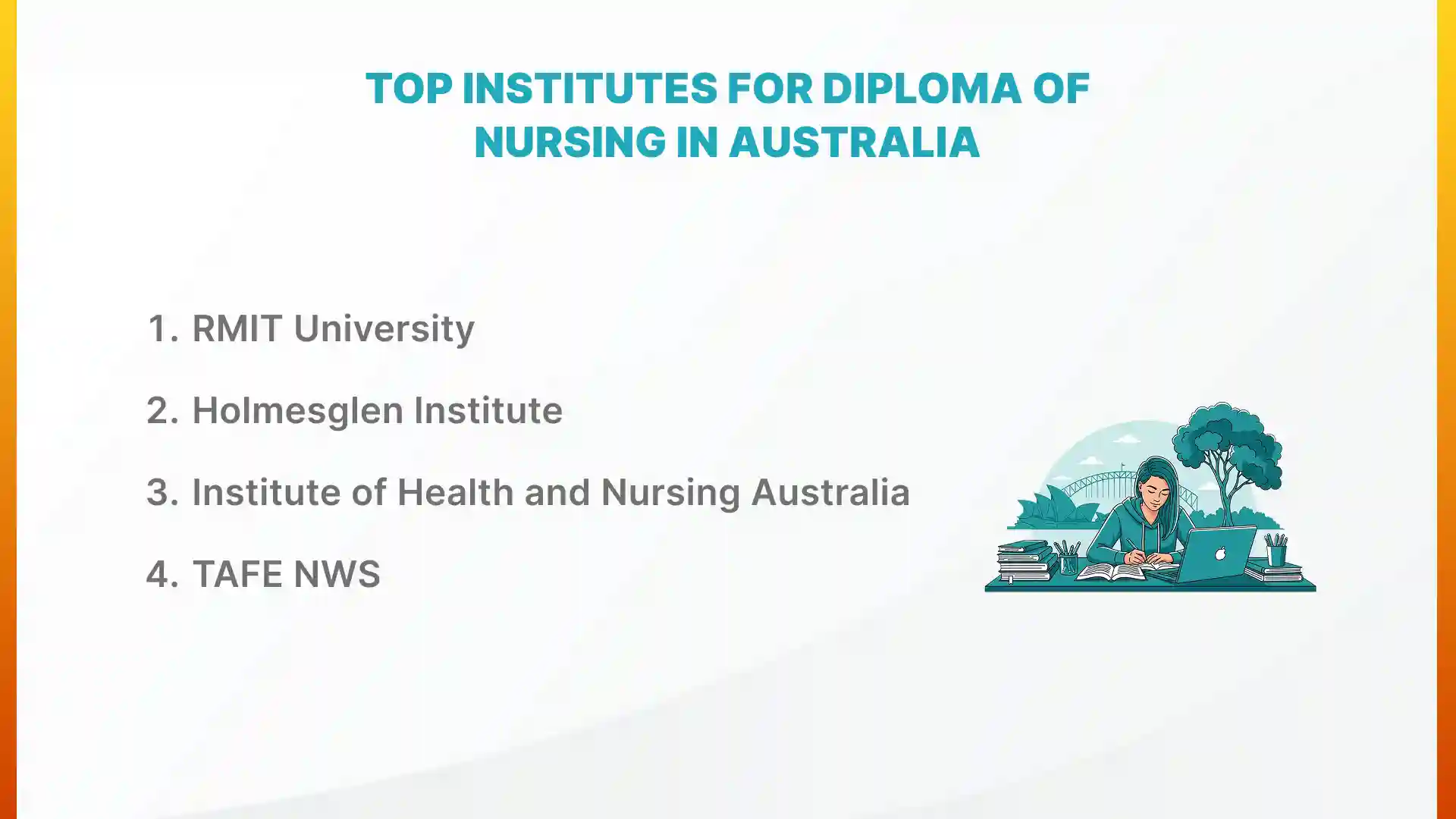
1. RMIT University
RMIT offers a Diploma of Nursing with strong pathways into its Bachelor of Nursing program. Their Melbourne campus features simulation labs where you can practice clinical skills in a controlled environment.
2. Holmesglen Institute
Holmesglen is known for its practical focus and connections with healthcare employers. Their nursing program emphasizes hands-on training and prepares students well for clinical placements.
3. Institute of Health and Nursing Australia
IHNA specializes in nursing education and has a strong track record of supporting international students. With campuses in Melbourne, Perth, and Sydney, they offer flexibility in location.
4. TAFE NSW
For students considering options outside Melbourne, TAFE NSW provides nursing programs across multiple campuses in New South Wales. Regional campuses may also offer lower living costs.
Career Outcomes for Enrolled Nurses in Australia
After completing your Diploma of Nursing and gaining AHPRA registration, you'll enter a healthcare sector with strong employment prospects and competitive salaries. Enrolled Nurses work across diverse settings, from hospitals to aged care, with opportunities to specialize or progress toward becoming a Registered Nurse.
1. What Does an Enrolled Nurse Do
As an Enrolled Nurse, you work under the supervision of a Registered Nurse to provide direct patient care. Daily responsibilities include administering medications, monitoring patients' vital signs, assisting with daily activities, documenting patient information, and communicating with the healthcare team.
2. Enrolled Nurse Salary and Job Outlook
Enrolled Nurses in Australia earn competitive salaries, and job demand remains strong. Healthcare consistently ranks among Australia's top employment growth sectors.
3. Work Settings and Specializations
Enrolled Nurses work in hospitals, aged care facilities, community health centers, mental health services, and disability services, including NDIS-related care.
Pathway from Diploma to Bachelor of Nursing
The Diploma of Nursing isn't just a qualification; it's a stepping stone toward becoming a Registered Nurse. Many universities recognize your diploma with credit transfers, allowing you to complete a Bachelor of Nursing in less time and at a lower cost than starting from scratch.
1. Credit Transfer to University
One of the diploma's biggest advantages is the pathway it creates. Many universities offer credit transfers, often equivalent to one year of study, toward a Bachelor of Nursing. This means you can become a Registered Nurse in less time than starting a bachelor's degree from scratch.
2. Becoming a Registered Nurse
To become a Registered Nurse, you'll complete a Bachelor of Nursing at a university. With credit from your diploma, this typically takes an additional two years.
How to Apply for a Diploma of Nursing from Nepal
Applying for a Diploma of Nursing from Nepal involves several structured steps, from researching institutions to securing your student visa. The process typically takes 3-6 months, so starting early gives you the best chance of securing a place in your preferred intake.
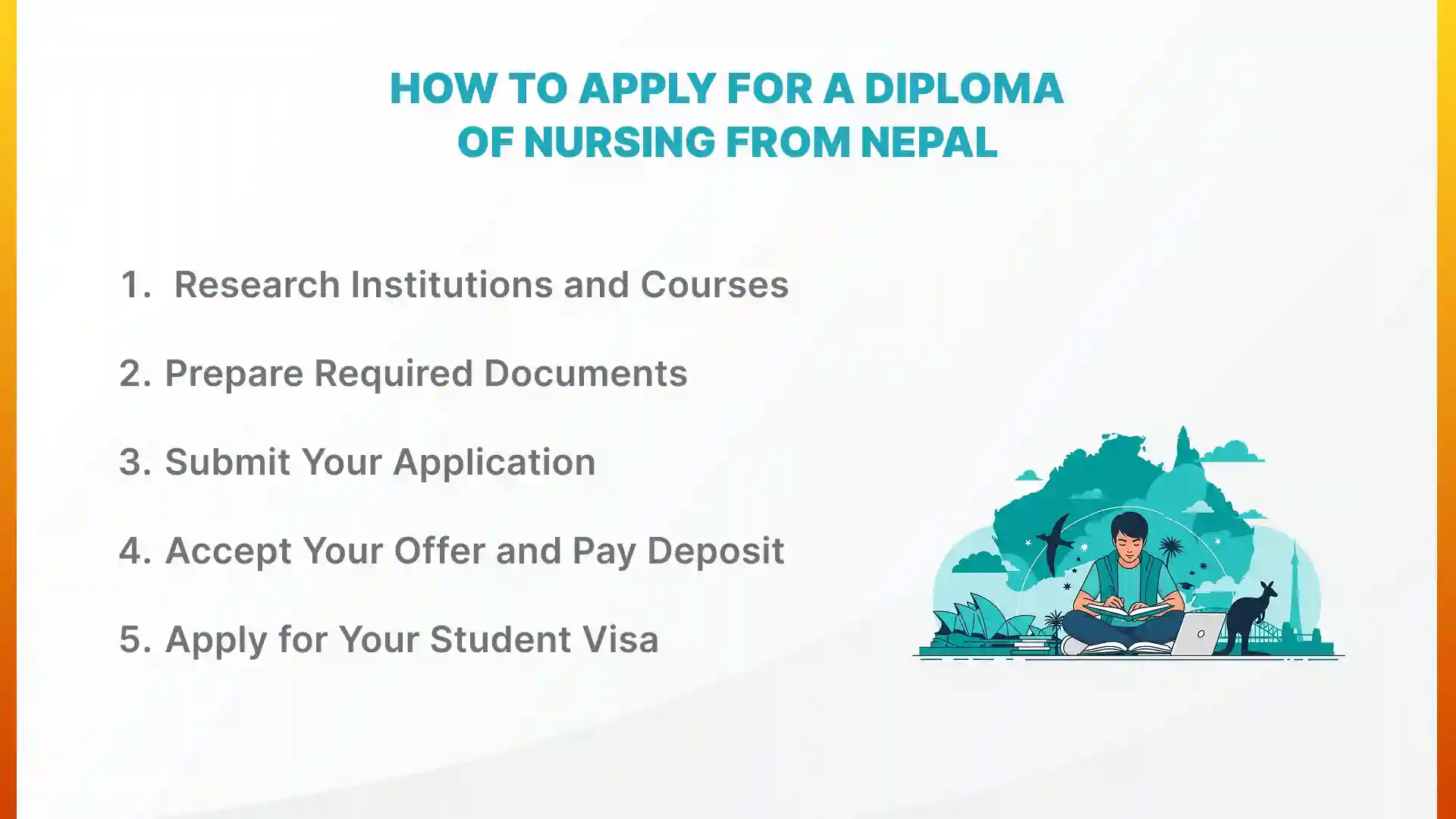
1. Research Institutions and Courses
Start by identifying institutions that offer the Diploma of Nursing, one of the most in-demand diploma courses in Australia for international students. Consider factors like location, fees, entry requirements, clinical placement support, and pathway options to bachelor's programs.
2. Prepare Required Documents
Gather academic transcripts and certificates, English proficiency test results (IELTS, PTE, or OET), a passport copy, a Statement of Purpose, and financial documents demonstrating the capacity to pay.
3. Submit Your Application
You can apply directly through institution websites or work with an education consultancy like SAS Education Consultancy, which can manage the application process and help you avoid common mistakes.
4. Accept Your Offer and Pay Deposit
Once you receive a Letter of Offer, review it carefully. After accepting, you'll pay a tuition deposit and receive your Confirmation of Enrolment (CoE), the document you'll use for your visa application.
5. Apply for Your Student Visa
With your CoE in hand, you're ready to apply for your student visa. The visa application requires careful documentation, including proof of financial capacity, health insurance, and your Genuine Temporary Entrant statement. Working with an experienced education consultancy can help ensure your application is complete and submitted correctly, reducing the risk of delays or refusals.
Student Visa Requirements for Nursing Students
International nursing students need a Subclass 500 student visa to study in Australia, which requires meeting financial, health, and character requirements. You'll also need to prove you're a genuine temporary student with valid health insurance. The visa process involves careful documentation and typically takes several weeks to process.
1. Subclass 500 Visa Overview
The Student Visa (Subclass 500) allows you to study full-time in a registered course in Australia. This visa includes work rights, letting you work up to 48 hours per fortnight during term time. You can work unlimited hours during scheduled course breaks. The visa remains valid for the duration of your course plus a short period afterward.
2. Financial Capacity Requirements
You must prove you have enough money to cover your tuition fees, living expenses, and travel costs. The Australian Government requires evidence of approximately AUD $24,505 per year for living expenses. You can demonstrate this through bank statements, loan approvals, or scholarship letters. Make sure your financial documents are recent and clearly show sufficient funds.
3. Genuine Temporary Entrant Requirement
The Genuine Temporary Entrant (GTE) requirement ensures you intend to study temporarily in Australia, not use your student visa for other purposes. You'll write a personal statement explaining why you chose nursing, why you selected Australia, and how this course fits your career plans. Be honest and specific about your circumstances and future goals. A strong GTE statement significantly improves your visa approval chances.
4. Overseas Student Health Cover
Overseas Student Health Cover (OSHC) is mandatory health insurance for all international students in Australia. You must purchase OSHC before applying for your visa and maintain it for your entire stay. This insurance covers basic medical and hospital care during your studies. Your education provider can help you arrange OSHC through approved providers.
Scholarships for International Nursing Students
Scholarships can significantly reduce the financial burden of studying nursing in Australia, though competition is high and availability varies by institution and eligibility criteria. While not every student will receive scholarship funding, exploring available options early in your application process increases your chances of securing financial support for your Diploma of Nursing.
1. Government Scholarships
The Australian Government offers scholarships like Australia Awards for students from eligible countries. The Destination Australia Program provides funding for students studying in regional areas.
2. Institution Scholarships
Many colleges and universities offer their own scholarships for international students. Check directly with your chosen institution for current opportunities.
3. How to Strengthen Your Scholarship Application
Maintain strong academic records, demonstrate community involvement or leadership experience, write a compelling personal statement, and apply early before deadlines close.
Start Your Nursing Career in Australia with Expert Guidance
Navigating course selection, applications, visa requirements, and English test preparation can feel overwhelming. SAS Education Consultancy provides personalized counseling, application support, visa guidance, and IELTS preparation specifically designed for Nepali students pursuing nursing in Australia.
Conclusion
The Diploma of Nursing offers international students a practical, affordable pathway into Australia's growing healthcare sector. In 1.5 to 2 years, you can qualify as an Enrolled Nurse, gain AHPRA registration, and start building a rewarding career in hospitals, aged care facilities, and community health settings. Beyond immediate employment opportunities, the diploma creates a clear pathway toward becoming a Registered Nurse through credit transfers to bachelor's programs.
Success requires careful planning, from meeting strict English proficiency requirements and completing 400+ hours of clinical placement to navigating visa applications and demonstrating financial capacity. The process involves multiple steps, but with proper guidance and preparation, you can turn your nursing ambitions into reality.
Whether you're drawn to nursing for its career stability, migration pathways, or the opportunity to make a genuine difference in people's lives, Australia's nursing education system provides the training and recognition you need. Start by researching accredited institutions, preparing your English test, and gathering the required documentation. The sooner you begin, the sooner you'll be on your way to a fulfilling healthcare career in Australia.