Education Loans for Studying in Australia: Complete Guide

Feb 20, 2026
Studying in Australia is a dream for many international students, but high tuition fees and living costs often make it difficult to afford. Financing education without proper planning can lead to stress and missed opportunities.
This guide covers everything you need to know about education loans for Australia. You will learn about major loan options, eligibility criteria, costs, repayment plans, and strategies to fund your studies, helping you make informed financial decisions before starting your academic journey.
In this blog
What Are Education Loans for Studying in Australia?
An education loan for studying in Australia is a financial product that provides funds to cover tuition fees, living expenses, and other study-related costs for international students.
These loans allow students to pursue higher education without having the full amount upfront, bridging the gap between personal funds and the high costs of studying in Australia. Education loans can be offered by banks, private lenders, or international financial institutions, and usually require proof of admission, financial eligibility, and sometimes a guarantor. Unlike domestic government schemes, most international students rely on these loans since programs like HECS‑HELP are unavailable to them.
Who Can Get an Education Loan to Study in Australia?
International students with a confirmed admission offer from an Australian university can apply for education loans to cover tuition and living expenses.
Eligibility typically requires a valid student visa, a strong academic record, proof of admission, and sometimes a co‑signer or guarantor, especially for larger loan amounts. Most government-backed loans like HECS‑HELP are restricted to domestic students or permanent residents, so international students generally rely on banks, private lenders, or international financial institutions. Loan approval also depends on financial stability, credit history, and meeting the lender’s documentation requirements.
Main Types of Education Loans for Australia
There are three main types of education loans available for international students aiming to study in Australia: bank loans, private lenders, and international financial institutions. Each has its own eligibility criteria, repayment terms, and interest rates, allowing students to choose based on their financial situation and loan requirements.
Study & Work in Australia – Start Now
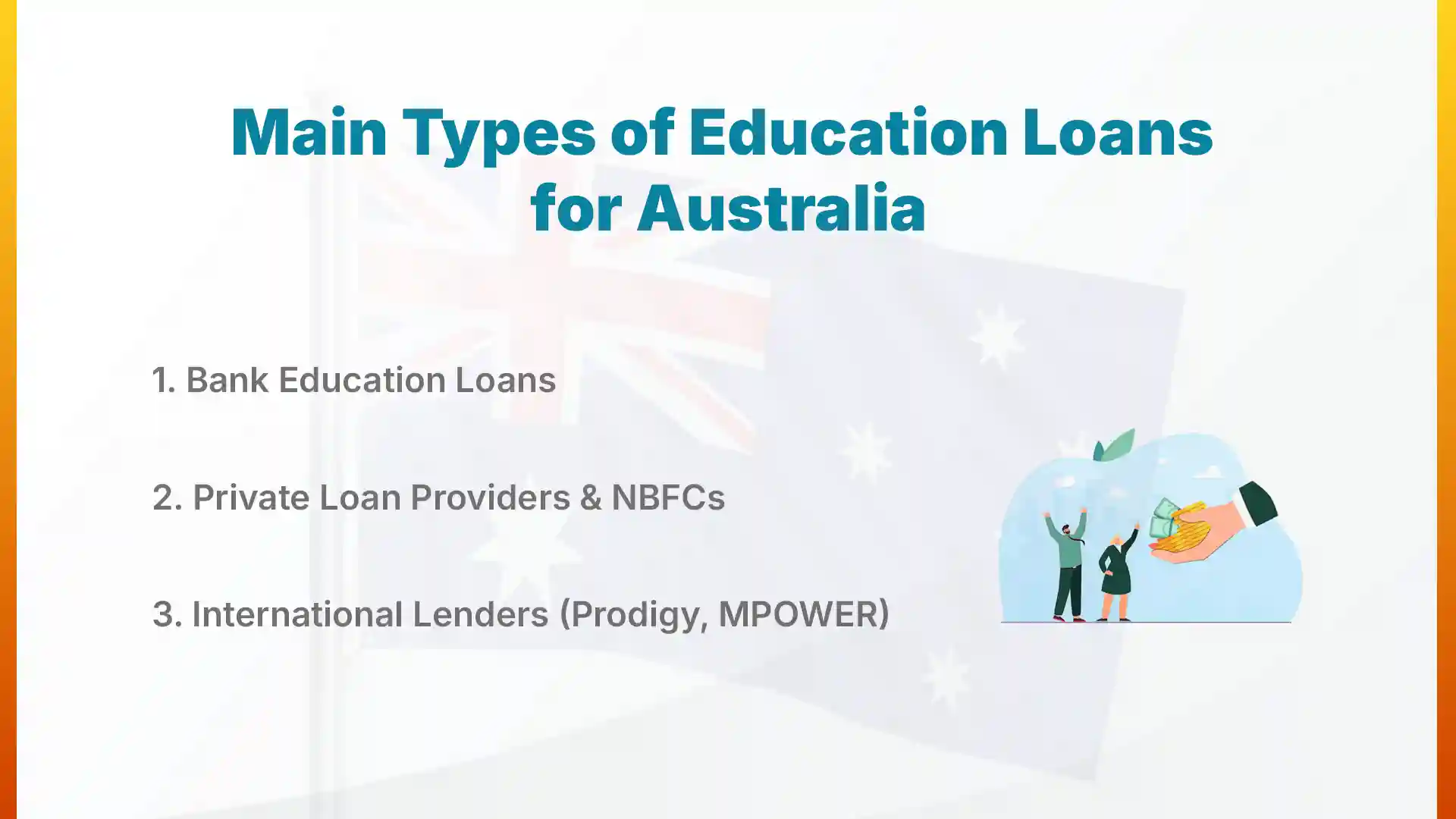
1. Bank Education Loans
Bank education loans are offered by local banks in your home country or in Australia and cover tuition, living costs, and other study-related expenses. These loans typically require an admission letter, academic records, and a co-signer or guarantor. Interest rates may be fixed or variable, and repayment usually starts after the moratorium period, which includes your study duration plus 6–12 months. Banks often provide structured EMI options and additional financial counseling for borrowers.
2. Private Loan Providers & NBFCs
Non-bank financial companies (NBFCs) and private lenders offer education loans with more flexible eligibility criteria compared to traditional banks. They can approve higher loan amounts, sometimes without a guarantor, but interest rates may be slightly higher. Documentation usually includes admission proof, academic background, and income statements of the co-applicant. These loans are popular among students who need faster approval or cannot meet strict bank requirements.
3. International Lenders (Prodigy Finance, MPOWER)
International lenders like Prodigy Finance and MPOWER provide loans specifically designed for global students studying abroad. They often do not require co-signers and offer loans based on future earning potential rather than traditional collateral. These lenders also provide competitive interest rates and flexible repayment schedules, making them ideal for students who want a streamlined application process. Many international lenders focus on STEM, business, and professional courses due to higher employability outcomes.
Australian Government Loans: What’s Available?
Government-backed education loans in Australia, such as HECS‑HELP and FEE‑HELP, are primarily available to domestic students and permanent residents, not most international students. These loans cover tuition fees, allowing eligible students to defer payments until they start earning above a certain income threshold.
Some exceptions exist, like OS‑HELP, which assists students with costs for overseas study exchanges or short-term international programs. However, international students studying full-time in Australia generally cannot access these government schemes and must rely on bank loans, private lenders, or international financing options. Understanding these limitations helps students plan finances effectively before committing to study abroad.
How to Apply for an Education Loan for Australia
Applying for an education loan to study in Australia involves a structured process that ensures you have the required admission, financial planning, and documentation. Each step helps secure funding safely and efficiently.
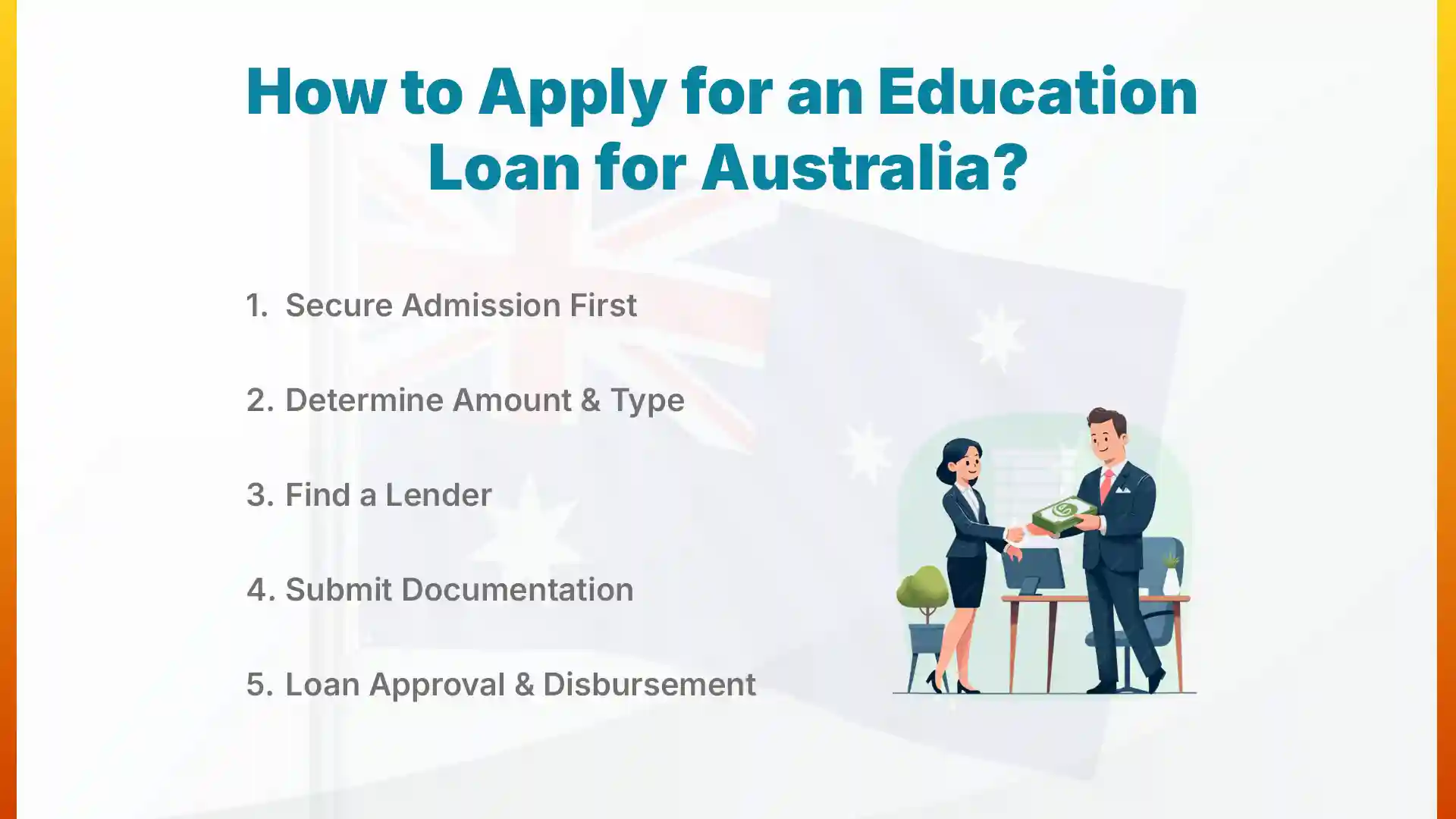
1. Secure Admission First
Before applying for a loan, you must have an admission offer from a recognized Australian university or institution. Lenders require the official offer letter to assess eligibility and calculate tuition requirements. Without confirmed admission, most banks and private lenders will not process your application. Securing admission also helps you estimate the exact loan amount needed for tuition and living costs.
2. Determine Amount & Type
Calculate the total funds required, including tuition, living expenses, health insurance, and travel costs. Decide whether you need a full loan or partial funding, and choose between fixed or variable interest options. Understanding your financial needs ensures you borrow only what’s necessary, minimizing long-term repayment burdens.
3. Find a Lender
Explore banks, private loan providers, and international lenders like Prodigy Finance or MPOWER. Compare interest rates, repayment terms, processing fees, and eligibility criteria. Choosing the right lender helps secure favorable terms and avoid hidden charges.
4. Submit Documentation
Prepare and submit essential documents such as the admission letter, academic transcripts, identification, proof of income or co-signer details, and bank statements. Accurate documentation speeds up processing and prevents rejection. Keep both physical and digital copies for reference.
5. Loan Approval & Disbursement
Once the lender reviews your application, they approve the loan based on eligibility, creditworthiness, and documentation. After approval, funds are usually disbursed directly to the Australian university in installments or as a full tuition payment. Some lenders also provide separate allocations for living expenses. Understanding the disbursement schedule helps you plan travel, accommodation, and initial expenses efficiently.
Which Is the Best Bank for an Education Loan to Study in Australia?
The best banks in Nepal for education loans to study in Australia are Rastriya Banijya Bank, Siddhartha Bank, Everest Bank, Global IME Bank, and Sanima Bank. These banks offer competitive interest rates, flexible repayment options, and coverage for tuition and living expenses, helping international students manage costs effectively.
1. Rastriya Banijya Bank (RBB) – Lowest Interest Rates
RBB is a government-owned bank known for its low-interest education loans and stable services. It offers loans suitable for both tuition and living expenses for students planning to study abroad. The bank provides a structured moratorium period that includes the study duration plus a grace period. Documentation is strict, but the benefits often outweigh the procedural requirements.
- Interest Rate: 5.42% – 6.48% (floating)
- Loan Tenure: Up to 10 years
- Moratorium: Study period + grace period
- Pros: Lowest interest, stable, suitable for large loans
- Cons: Slower processing, strict documentation
2. Siddhartha Bank – Flexible Repayment Options
Siddhartha Bank offers a mix of competitive interest rates and flexible repayment plans for international education loans. The bank allows structured EMIs and moratorium periods to suit student needs. Loan approvals are relatively smooth for applicants with a solid guarantor. Siddhartha Bank is suitable for students who want repayment flexibility without compromising loan amounts.
- Interest Rate: 5.68% – 9.03%
- Loan Tenure: Up to 10 years
- Moratorium: Available
- Pros: Flexible repayment, structured moratorium, student-friendly processing
- Cons: Higher rates at the upper range, guarantor required for larger loans
3. Everest Bank – Balanced Option
Everest Bank provides reliable loans with clear terms covering tuition and living expenses. It is a popular choice due to its customer support and balanced interest rates. The bank ensures transparency in repayment and moratorium terms. Loan approval criteria vary slightly by branch, but overall are manageable for eligible students.
- Interest Rate: 6.80% – 9.00%
- Loan Tenure: 7–10 years
- Moratorium: Available
- Pros: Covers tuition + living, good support, clear repayment
- Cons: Interest not lowest, branch-dependent approvals
4. Global IME Bank – Fast Processing
Global IME Bank is suitable for students seeking faster loan disbursement and broader expense coverage. Loans cover tuition, living, and travel costs, making it ideal for immediate requirements. The bank supports online applications and provides guidance during processing. Interest rates are slightly higher, but speed and coverage are key advantages.
- Interest Rate: 7.24% – 9.24%
- Loan Tenure: Varies
- Moratorium: Available
- Pros: Quick processing, broad coverage, online support
- Cons: Higher interest than competitors, conditions vary by profile
5. Sanima Bank – Longer Tenure Option
Sanima Bank is known for offering loans with longer repayment periods, reducing EMI burdens for students. The bank provides coverage for tuition and living costs with flexible moratorium options. Approval depends on guarantors and collateral for higher loan amounts. Sanima Bank is suitable for students preferring smaller EMIs over extended periods.
- Interest Rate: 7.01% – 9.01%
- Loan Tenure: Up to 13–15 years
- Moratorium: Available
- Pros: Longer tenure, competitive mid-range interest, suitable for larger loans
- Cons: Not the cheapest, collateral needed for higher amounts
Loan Amount, Interest Rates & Repayment Options
Education loan amounts for studying in Australia are based on total tuition fees, living expenses, and lender limits in your home country, such as Nepal. Understanding these financial components helps you borrow responsibly and plan repayment effectively.
Australian tuition typically ranges between AUD 15,000–45,000 per year, while living expenses are estimated at AUD 21,000+ annually for international students. For a 2-year master’s degree, total costs can exceed AUD 60,000–90,000, depending on the university and city.
1. Typical Loan Amount (Nepal Context)
Nepalese banks usually provide education loans ranging from NPR 20–70 lakhs, depending on collateral, income proof, and course type. Some banks finance up to 80–100% of total education costs if proper security is provided.
Loan coverage usually includes:
- Tuition fees
- Living expenses
- Health insurance (OSHC)
- Visa and travel costs
- Initial accommodation
The final approved amount depends on your university fee structure and the repayment capacity of the co-applicant.
2. Interest Rates (Fixed vs Variable)
Education loans may carry fixed or variable interest rates, depending on the lender. In Nepal, interest rates generally range between 9%–14% per year, depending on collateral and bank policy. Fixed interest remains constant throughout the tenure, providing predictable EMIs. Variable interest may change based on market conditions, which can increase or reduce total repayment.
International lenders like Prodigy or MPOWER may offer competitive rates, but calculate interest based on global risk assessment models.
3. Moratorium Period
Most education loans offer a moratorium period covering study duration plus 6–12 months after graduation.
During this time, students usually do not need to pay the full EMI. Some lenders require only interest payments during the study period. This grace period allows students to secure employment before starting regular repayment. Understanding moratorium terms is critical to avoid unexpected financial pressure.
4. EMI Repayment & Early Payoff
Repayment periods typically range from 5 to 15 years, depending on the loan size and lender. Longer tenures reduce EMI burden but increase total interest paid.
Many Nepalese banks allow early repayment or pre-closure, sometimes without penalty. Paying off the loan early can significantly reduce overall interest costs. Choosing a structured repayment plan aligned with expected post-study income is essential for financial stability.
Pros and Cons of Taking an Education Loan
Taking an education loan for studying in Australia can make overseas education possible, but it also creates long-term financial responsibility. Before borrowing, students should carefully evaluate both advantages and risks.
1. Benefits
Key advantages of education loans include:
- Makes high-cost Australian education financially accessible
- Removes the need for a full upfront tuition payment
- Covers tuition, living expenses, insurance, and travel
- Offers moratorium period (study + 6–12 months)
- Improves career and earning potential after graduation
Education loans allow students to pursue degrees costing AUD 60,000–90,000 without immediate financial pressure. Many Nepalese banks finance up to 80–100% of total costs with structured EMI options. The moratorium period gives students time to complete their studies and secure employment before full repayment begins. In the long term, international qualifications can significantly increase earning capacity, making the investment potentially worthwhile.
2. Drawbacks
Major disadvantages to consider:
- Long-term repayment commitment (5–15 years)
- Total repayment increases due to interest
- Requires strong documentation and often a guarantor
- Risk from exchange rate fluctuations
- Financial pressure if employment is delayed
Interest rates in Nepal typically range between 9%–14%, which can substantially increase the total repayment amount. Loan approval often depends on collateral, income proof, and co-applicant stability. Currency exchange variations can also affect repayment if income is earned outside Australia. Careful financial planning is essential to avoid long-term debt stress.
Alternative Ways to Fund Your Study in Australia
Students do not have to rely only on education loans, as scholarships, part-time work, and home-country funding schemes can significantly reduce financial burden. Exploring multiple funding sources helps lower total debt and improve long-term financial stability.
1. Scholarships and Grants
Scholarships and grants are non-repayable financial awards that reduce tuition or living costs for eligible students. Australia offers several funding programs for international students, including Australia Awards, which fully or partially fund tuition, travel, and living expenses for students from eligible countries. Many Australian universities also provide merit-based and need-based scholarships that cover 10% to 100% of tuition fees. These scholarships are competitive and require strong academic records, leadership qualities, and early application. Applying for multiple scholarships increases funding chances and reduces reliance on loans.
2. Part-Time Work During Study
International students in Australia are allowed to work limited hours during academic sessions and full-time during scheduled breaks. Part-time jobs help cover daily expenses such as rent, groceries, and transport. While income from part-time work may not fully cover tuition, it reduces living cost dependency on loans. Popular student jobs include hospitality, retail, campus support roles, and delivery services. Managing work and study balance is essential to maintain academic performance and visa compliance.
3. Combining Scholarship + Loan Strategies
A hybrid funding strategy combines partial scholarships with education loans to minimize total borrowing. For example, if a student receives a 25–50% tuition scholarship, the remaining balance can be financed through a smaller loan. This reduces interest burden and long-term repayment pressure. Many financial advisors recommend borrowing only what is necessary after deducting confirmed scholarship awards. This strategy improves financial flexibility after graduation.
4. Financial Aid from Home Country Loan Schemes
Many countries offer government-backed or subsidized student loan programs for overseas education. In Nepal, banks and financial institutions provide education loans specifically for studying abroad, often with collateral-based approval systems. These schemes may offer competitive interest rates compared to private lenders. Some programs also provide interest subsidies for certain categories of students. Exploring local funding options before choosing international lenders can reduce overall borrowing costs.
Common Mistakes to Avoid When Taking an Education Loan
Many students rush the loan process without fully understanding long-term financial consequences. Avoiding common mistakes can save you thousands in interest and reduce repayment stress after graduation.
1. Not Comparing Multiple Loan Options
Choosing the first loan offer without comparing lenders can result in higher interest rates and poor repayment terms. Different banks and international lenders offer varying interest rates, processing fees, moratorium terms, and foreclosure policies. Even a 1–2% difference in interest can significantly increase total repayment over 10–15 years. Students should compare at least three lenders before finalizing a loan. Always review hidden charges, insurance requirements, and penalty clauses carefully.
2. Ignoring Exchange Rate Fluctuations
Overlooking currency exchange risk can increase your total repayment burden unexpectedly. If your loan is in NPR but expenses are in AUD, exchange rate changes can affect how much you actually pay. A weaker home currency means a higher effective repayment cost. Students planning to repay from Nepal should factor in currency volatility. Building a small financial buffer can reduce this risk.
3. Failing to Plan Repayment Before Graduation
Many students focus only on loan approval and ignore post-study repayment planning. Repayment usually starts after the moratorium period ends, regardless of job status. Without a clear employment plan, EMIs can become financially stressful. Students should research post-study work rights, expected salaries, and industry demand before borrowing large amounts. A realistic income projection helps determine a safe loan size.
4. Skipping Scholarship Opportunities
Ignoring scholarships increases unnecessary borrowing and long-term debt. Many universities in Australia offer partial tuition scholarships that can reduce total loan requirements. Even small grants can significantly lower interest accumulation over time. Students should apply for scholarships before finalizing loan amounts. Combining scholarship funding with a smaller loan is a smarter financial strategy.
Conclusion
Education loans make studying in Australia achievable for international students who may not have full upfront funds. By comparing lenders, understanding interest rates, and planning repayment early, you can avoid unnecessary financial stress. Combining loans with scholarships and part-time income can significantly reduce long-term debt and support academic success.
If you want to learn more about education loans and studying abroad, consult experienced advisors like SAS Education Consultancy for personalized guidance on university selection, visa processing, and financial planning.