Study Diploma in Australia 2026: Courses, Fees & Opportunities

Feb 13, 2026
Are you dreaming of studying in Australia but worried about high tuition fees? Do you feel confused about which course gives you better career value without spending four full years on a degree? If this sounds like you, then diploma courses in Australia for international students might be the right starting point.
Diploma courses in Australia are shorter, practical, and often more affordable than traditional bachelor’s programs. In fact, Australian diploma course fees are generally lower, and most programs run for just 1–2 years. They are available for students of all levels, and are easy with eligibility. At the same time, they focus on job-ready skills, offer pathways to further study, and may even open PR opportunities in selected fields.
Sounds attractive? To study a diploma in Australia from Nepal, you need to understand eligibility, intake periods, and whether a diploma can lead to PSW after graduation.
In this blog
What Are Diploma Courses in Australia for International Students?
Diploma courses in Australia are short, skill-based programs that prepare you for jobs or further study. They are part of the Australian Qualifications Framework (AQF), where a Diploma is Level 5, an Advanced Diploma is Level 6, and a Graduate Diploma is Level 8. Most programs take 1–2 years to complete. They focus on practical training, so they are particularly popular among students who want faster career outcomes.
Now that you understand the structure, let’s look at the types of diploma programs you can choose from.
Need Help to Apply for Your Australian Student Visa?
Get expert guidance on courses, universities, scholarships, and applications. Start your Australian education journey with out crertified counsellors today!
What Are the Types of Diploma Courses in Australia?
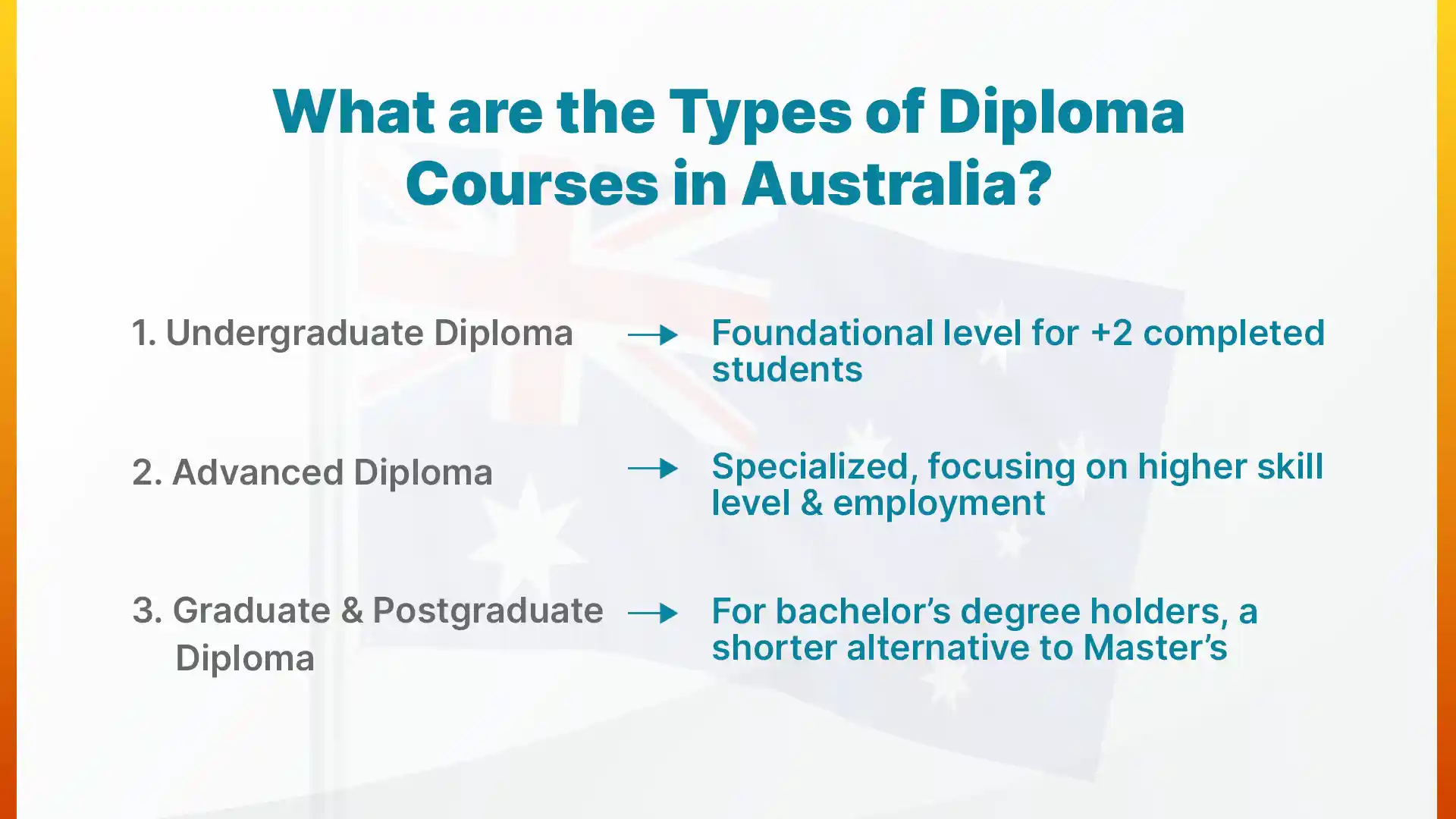
The main types of diploma courses in Australia are Undergraduate Diploma, Advanced Diploma, and Graduate or Postgraduate Diploma. Each type is designed for a different academic level and career goal. Let’s understand what each one means and who it is best suited for.
1. Undergraduate Diploma
An Undergraduate Diploma is for students who have completed their +2 and want to start higher education in Australia. It builds strong foundational knowledge in your chosen field. Many students choose this option because it can lead directly into the second year of a bachelor’s degree through credit transfer. At the same time, it also gives you practical skills that can help you enter the workforce earlier.
2. Advanced Diploma
An Advanced Diploma goes one step further and focuses on deeper, specialized skills. It is ideal if you want strong technical knowledge and better job readiness. These programs are common in fields like engineering, hospitality, and IT. Because of their practical nature, they are highly valued by employers looking for skilled workers.
3. Graduate & Postgraduate Diploma
A Graduate or Postgraduate Diploma is for students who already have a bachelor’s degree. It is usually shorter than a master’s program and focuses on specific professional skills. Many students choose it to change careers or upgrade their qualifications. It can also strengthen your profile before applying for higher-level roles or further study.
Eligibility for Diploma Course in Australia for International Students
To apply for a diploma course in Australia, you must meet academic, English, and Genuine Student requirements. The exact criteria depend on the level of diploma and the institution. However, most colleges follow a clear and similar structure, which makes planning easier for you.
1. Academic Requirements
To be eligible for a diploma academically, you must complete +2 for an undergraduate diploma and hold a bachelor’s degree for a graduate diploma. Most colleges in Australia require a minimum percentage, usually around 50–60%, but this can vary by course and institution. Some technical or competitive fields may ask for specific subjects in +2, such as mathematics or science.
Diploma Level | Academic Requirement & Minimum Percentage |
| Undergraduate Diploma | +2 completed, usually 50–60%, may vary by college |
| Advanced Diploma | +2 completed (related field preferred), usually 50–60% |
| Graduate Diploma | Bachelor’s degree completed, usually 50–60%, some courses may ask higher |
2. English Language Requirements
For English proficiency, most diploma programs require IELTS 5.5–6.0 overall or PTE 42–50. Yes, PTE 50 is generally eligible for many diploma programs, although some courses may ask for a slightly higher score. The exact requirement depends on the college and the field of study.
Diploma Level | IELTS Requirement | PTE Requirement |
| Undergraduate Diploma | 6.0 overall (min. 5.5) | 50–54 |
| Advanced Diploma | 6.0 overall (min. 5.5) | 50–54 |
| Graduate Diploma | 6.5 overall (min. 6.0) | 58+ |
3. Age & Genuine Student (GS) Requirement
You must meet Australia’s Genuine Student (GS) requirement to receive a student visa. This means you should clearly explain your study plan, career goals, and reasons for choosing Australia. In addition, you must show financial proof to cover tuition fees, living expenses, and other related costs.
Popular Diploma Courses in Australia for International Students
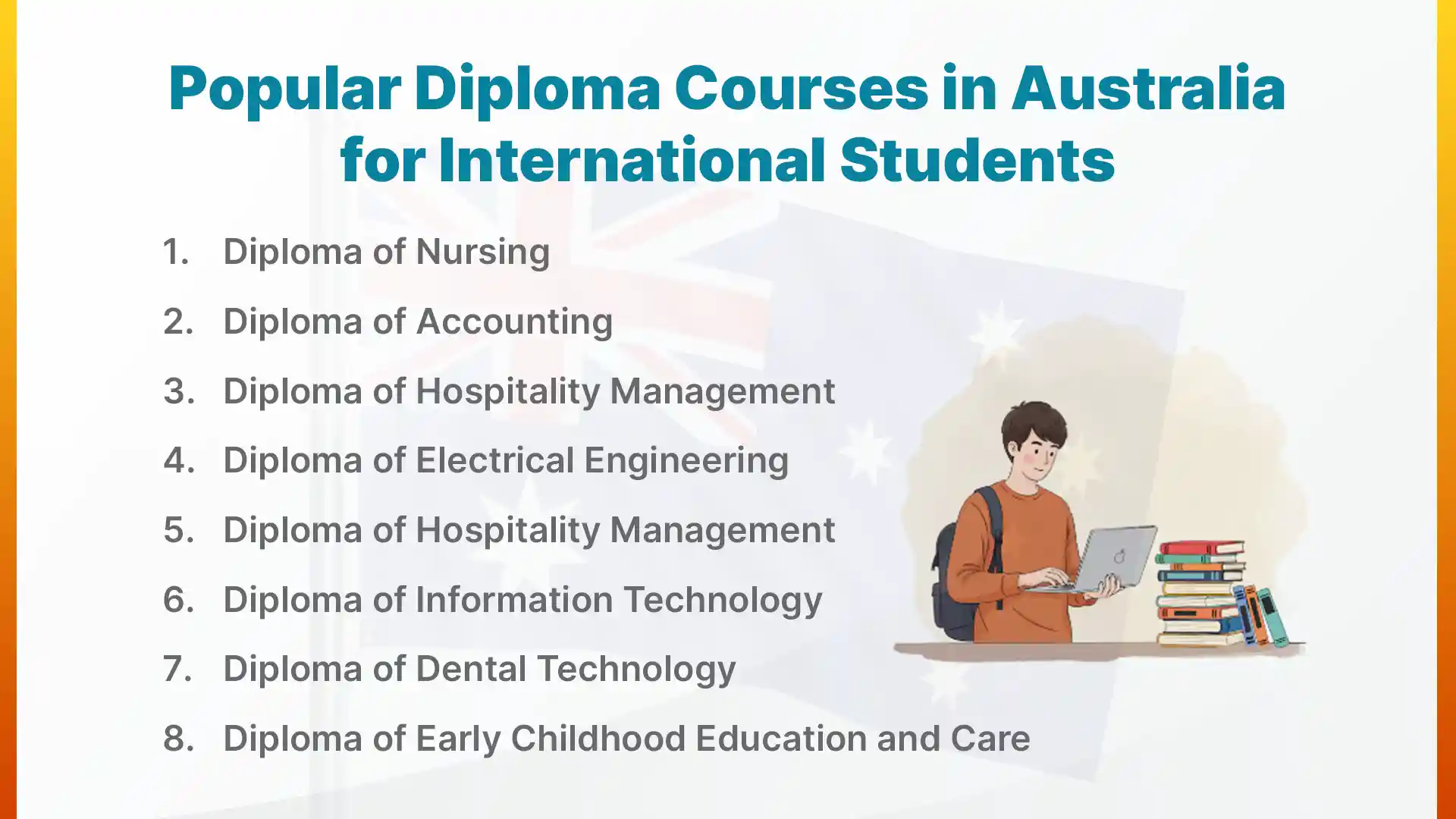
Some of the most popular diploma courses in Australia for international students include Diploma in Nursing, Accounting, Culinary Arts, Electrical Engineering, IT, and Early Childhood Education. These courses are chosen for their strong career prospects, industry-focused learning, and pathways to higher education. They also help students gain practical skills quickly while keeping costs lower than a full degree. Let’s take a closer look at each of these programs.
1. Diploma in Nursing in Australia for International Students
The Diploma in Nursing in Australia typically takes 18–24 months to complete and includes hands-on clinical placement. Many students choose to study a diploma in nursing because it provides practical skills and a pathway to a Bachelor of Nursing in Australia. This course is in high demand across Australia due to a growing healthcare workforce shortage. It equips students to work as enrolled nurses and lays the foundation for further studies or career advancement.
2. Diploma in Accounting in Australia for International Students
A Diploma in Accounting helps students build a strong foundation in financial management and bookkeeping. It can lead to a Bachelor of Accounting, and later a CPA or professional accounting pathway. This course is attractive for students seeking stable, in-demand occupations that can also support PR opportunities in Australia. It combines practical accounting skills with knowledge of Australian financial regulations.
3. Diploma in Culinary Arts in Australia
The Diploma in Culinary Arts is designed for students interested in cooking, hospitality, and restaurant management. Programs include internship opportunities in hotels or restaurants to gain real-world experience. Graduates can also pursue a pathway to hotel management or hospitality degrees. This course is ideal for those who enjoy creativity in the kitchen and want a hands-on career.
4. Diploma in Electrical Engineering in Australia
An Electrical Engineering diploma is trade-focused and emphasizes practical, hands-on learning. Students work with modern labs and industry-standard equipment. This course is highly valued by employers due to the strong demand for skilled electricians and technicians. It also offers pathways to advanced diplomas or related bachelor programs.
5. Diploma in Hotel Management in Australia
The Diploma in Hotel Management focuses on the hospitality and tourism sector. Students gain knowledge in hotel operations, customer service, and event management. Internship opportunities provide real-world experience in hotels or resorts. Graduates can later pursue a bachelor’s degree in hotel or hospitality management.
6. Diploma in IT in Australia
Diploma in IT courses cover areas such as cybersecurity, networking, and software development. Students develop practical skills that are in high demand in the Australian job market. This diploma also serves as a pathway to a bachelor’s degree in IT or related fields in Australia. It’s ideal for students who want a tech-focused career with global opportunities.
7. Dental Diploma Courses in Australia
Dental Diploma courses train students in dental assisting or dental technology. Programs include clinical exposure and hands-on practice in dental labs. Graduates can work in growing healthcare sectors or pursue further dental qualifications. This course is suitable for students interested in healthcare support roles.
8. Diploma of Early Childhood Education and Care in Australia
This diploma prepares students to work in early childhood education centres or daycare facilities. The program includes work placement to gain real-world teaching experience. It has high PR potential due to demand in Australia’s childcare sector. Students develop skills in child development, learning activities, and classroom management.
Now that you know about your eligibility and are familiar with the available diploma courses in Australia, understanding cost is your biggest decision factor.
Australia Diploma Courses Fees (2026 Updated)
On average, tuition for diploma courses in Australia ranges from AUD 8,000 to 22,000 per year. However, your exact fees largely depend on the type of institution, location, and program you choose. TAFE institutes, private colleges, and universities all provide Diploma degrees, but with different scopes and costs. Moreover, choosing a regional city can save you significantly on tuition and living expenses, while metropolitan cities like Sydney and Melbourne are more expensive.
Tuition Fees by Institution Type
Institution Type | Typical Tuition Range (AUD/Year) | 2026 Strategic Notes |
| TAFE Institutes | $12,000 – $18,000 | Government-backed; best for trade skills (Nursing, Automotive, Carpentry). |
| Private Colleges | $8,000 – $16,000 | Flexible schedules; often have monthly payment plans. Scrutiny is higher for 2026 visas. |
| Universities (Diplomas) | $18,000 – $32,000 | High visa success; guaranteed entry into Year 2 of a Bachelor's degree. |
In addition to tuition, students should also plan for living expenses, which typically include accommodation, food, transport, and daily needs. Choosing regional cities like Adelaide, Hobart, or Newcastle can make both tuition and living costs significantly more affordable than Sydney or Melbourne.
If affordability is your biggest concern, the next section will matter the most to you.
Cheap Diploma Courses in Australia for International Students
If you are looking for affordable study options, cheap diploma courses in Australia for international students offer a practical way to start your international education without breaking the bank. On average, tuition ranges from AUD 8,000 to 22,000 per year, depending on the type of institution and city. TAFE institutes are usually the cheapest, providing hands-on training with strong industry links, while private colleges may cost a bit more but often offer specialized programs.
Choosing a regional city instead of a major metro like Sydney or Melbourne can reduce both tuition and living costs by up to 20–30%. Scholarships and early-bird discounts are sometimes available, so it’s worth checking with each institution before applying. For living expenses, Nepali students can expect to spend moderately less in regional areas, covering accommodation, food, and transport.
Considering Australia diploma courses' fees and these cost-saving strategies can help you pick the most suitable and affordable option. Once you choose your course, the next important question is timing.
When Is the Intake of Diploma in Australia?
The main intakes for diploma courses in Australia are in February, July, and November, with February being the most popular and widely available. The July intake is the second option and is offered by most colleges, while the November intake is limited to a few institutions and courses.
Nepali students should start preparing their applications 6–8 months before the intended intake to ensure enough time for document preparation, admission processing, and visa application. Student visa processing can take several weeks, so applying early helps avoid delays and gives you enough time to plan for travel and accommodation. Proper timing ensures a smoother transition from Nepal to your chosen Australian college.
What is the Duration of Diploma Courses in Australia?
The duration of diploma courses in Australia typically ranges from 1 to 2 years, depending on the program and institution. An Advanced Diploma may take up to 2 years because of its deeper, specialized training, while a Graduate Diploma usually lasts around 1 year for students who already hold a bachelor’s degree. Many programs include internship or placement components, giving students practical experience in their chosen field. Some colleges also offer fast-track options that allow you to complete your diploma more quickly without compromising quality.
Career Opportunities After Diploma in Australia
Completing a diploma in Australia opens several career pathways, whether you plan to enter the workforce immediately or continue your studies. Different diploma courses prepare you for specific roles, offer pathways to bachelor's degrees, and in some cases, connect to PR-related occupations.
1. Entry-Level Job Roles by Sector
Diploma graduates can find entry-level positions in healthcare, IT, accounting, hospitality, engineering, and childcare. For example, nursing diploma holders can work as enrolled nurses, IT graduates can take on networking or support roles, and hotel management graduates can join hotels or resorts. These roles give practical experience and help build a professional career in Australia.
2. Pathway to Bachelor's Degree
Many diploma programs offer credit transfer to related bachelor's degrees in Australia, allowing students to enter the second year directly. This is a cost-effective and faster way to complete a full degree while gaining practical skills early. Fields like nursing, accounting, IT, and hospitality often have clear pathways.
2. PR-Related Occupations
Some diploma courses are aligned with occupations listed on Australia’s skilled occupation lists, which can support future PR (permanent residency) applications. Nursing, IT, and early childhood education are examples of high-demand fields. Choosing the right course can give you long-term migration advantages.
3. Salary Range Overview
Entry-level salaries for diploma graduates in Australia vary by sector. Healthcare and IT graduates can earn around AUD 50,000–65,000 per year, while hospitality or culinary roles may start at AUD 40,000–50,000. With experience and further study, salaries typically increase, making these diplomas a good investment for career growth.
4. Which Diploma is in Demand in Australia?
Diplomas in nursing, IT, early childhood education, and accounting are currently among the most in-demand, offering strong employment prospects and pathways to further study or PR.
How to Apply for Diploma Course in Australia from Nepal?
To apply for a diploma course in Australia from Nepal, begin by selecting a course, meeting eligibility, then, submit your application, and secure a student visa smoothly. Following these steps carefully ensures a clear path from Nepal to studying in Australia.
Step-by-Step Application Process:
- Choose a suitable course and Australian institute that fits career goals
- Check your academic qualifications and English proficiency requirements
- Prepare all necessary documents, including transcripts and personal statements
- Submit your college application and wait to receive the official offer letter
- Pay the tuition deposit to secure your place in the program
- Apply for the Subclass 500 student visa with complete documents
- Plan and prepare for your departure to Australia, including accommodation
Working with professional guidance can make this process much easier. Experts can help you select the right course, ensure your GS documentation is accurate, strengthen your visa application, and support test preparation if needed. With the right support, you can confidently plan your future and start your Australian study journey successfully.
Conclusion
Diploma courses in Australia for international students are a great way to gain practical skills and start a global career. They also provide pathways to further study. Programs like nursing, IT, accounting, and hospitality are shorter, affordable, and industry-focused compared to traditional degrees.
Start your journey with a proper plan. Consider eligibility, intake, fees, and career prospects, and choose a program that fits your goals and budget. With the right preparation and guidance, studying a diploma in Australia can open doors to professional growth, higher education, and even PR opportunities.
Start early, research thoroughly, and take the first step toward an exciting international education journey today. If you need any professional assistance from experienced counsellors, do not hesitate to visit the trusted consultancy for Australia near you. Your future is in your hands. Begin building a strong foundation with a diploma in Australia!