Best Bachelor's Degree in Australia for International Students

Jan 23, 2026

Studying abroad from Nepal is a promise you make to yourself and your family. You imagine better education, global exposure, and a career that truly changes your future. But when it comes to choosing the right course and country, the options can feel confusing. Where do you start? Which degree gives real job opportunities? And most importantly, is it worth the investment?
Australia has established itself as one of the top study destinations. With world-class universities, practical learning, part-time work rights, and strong career pathways, it has become one of the top choices for bachelor's courses in Australia for international students. From healthcare to IT and business, there’s something for every interest. In this guide, you’ll clearly understand the best courses, costs, duration, and steps. Plan your higher education with informed decisions.
In this blog
Why Australia is a Smart Choice for Your Bachelor’s Degree
Australia is one of the best destinations for a bachelor's degree for Nepalese students because it offers quality education, global recognition, and strong career opportunities. You don’t just earn a degree here, you gain practical skills, work experience, and exposure that employers value worldwide. Let’s look at the key reasons why thousands of Nepali students choose Australia every year.
- Globally ranked universities with industry-focused teaching
- Part-time work rights during studies
- Post-study work visas after graduation
- Safe, friendly, multicultural student communities
- Strong PR pathways and job demand sectors
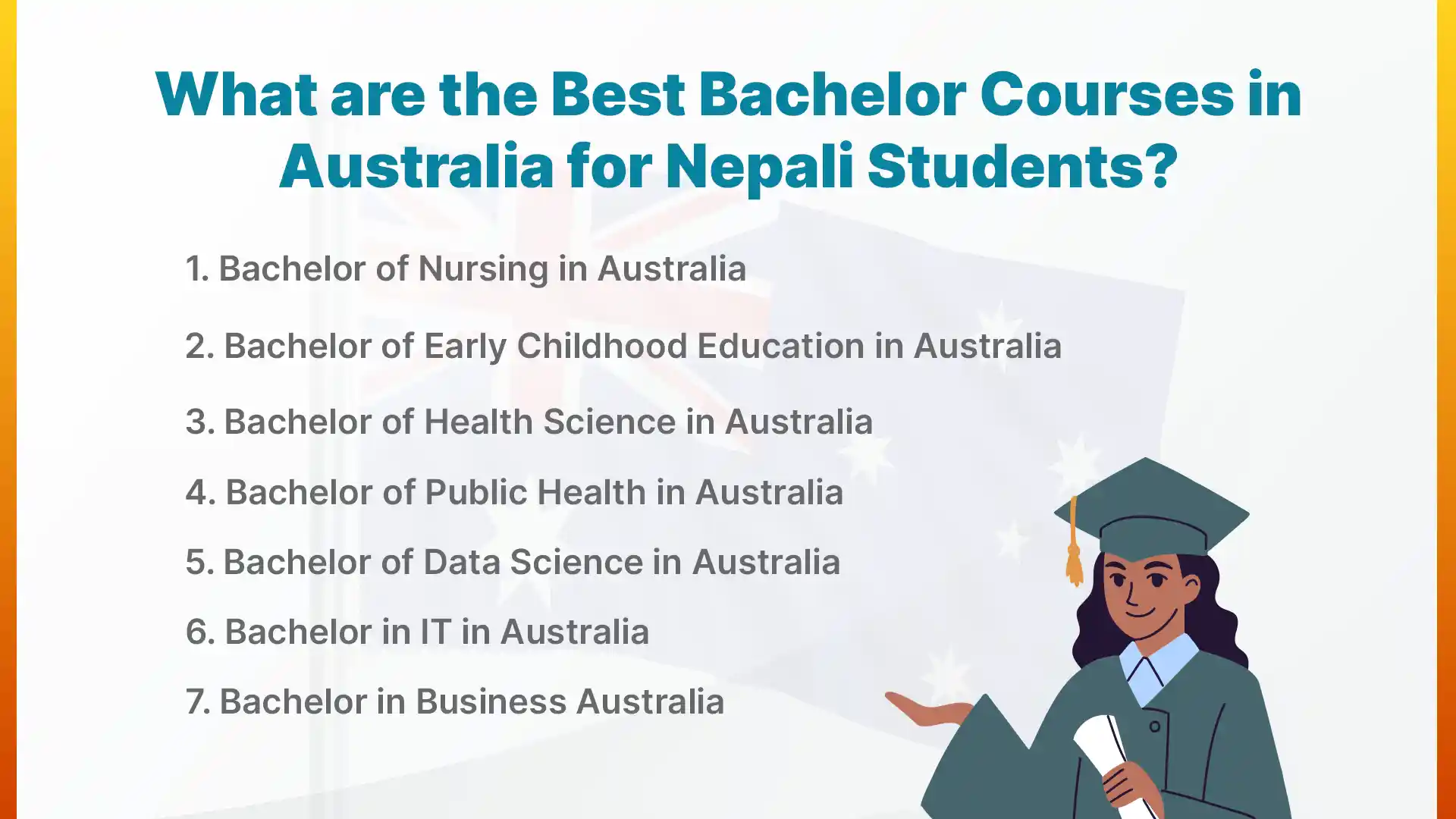
What are the Best Bachelor Courses in Australia for Nepali Students?
The best bachelor's courses in Australia for Nepali students include fields like nursing, IT, business, health sciences, and education that offer strong career prospects. These courses are in high demand, provide practical training, and open opportunities for work and permanent residency. Let’s take a closer look at each of these popular courses and what they offer.
1. Bachelor of Nursing in Australia
If you want a stable, respected, and high-demand career, nursing is one of the safest choices. This degree usually takes 3 years and includes clinical placements in real hospitals, so you gain hands-on experience from the start. Average tuition fees range from AUD 30,000–40,000 per year, and most universities ask for IELTS 7.0 overall. After graduation, you can work as a registered nurse in hospitals, aged care, or community health settings. Since Australia has a strong shortage of nurses, job opportunities are high, making nursing one of the top PR-leading courses in Australia.
2. Bachelor of Early Childhood Education in Australia
Bachelor of Early Childhood Education in Australia is ideal if you enjoy working with children and want a meaningful career. The program normally runs for 3–4 years and includes teaching placements in childcare centers and schools. Fees are around AUD 25,000–35,000 per year, with an IELTS requirement of about 6.5–7.0. Graduates can work as early childhood teachers, educators, or center directors across Australia. Because this field is listed in skill shortage areas, it offers good job security and migration opportunities.
3. Bachelor of Health Science in Australia
Health Science is a flexible degree for students who want to work in healthcare but not directly in nursing or medicine. It typically takes 3 years and covers subjects like public health, nutrition, rehabilitation, and health promotion. Tuition fees are usually AUD 25,000–35,000 per year, and IELTS 6.5 is commonly accepted. After graduation, you can work in hospitals, community health programs, or wellness organizations. It also creates pathways to further study, like physiotherapy, public health, or masters programs.
4. Bachelor of Public Health in Australia
Public Health focuses on improving the health of whole communities rather than just individual patients. This 3-year degree teaches disease prevention, health policies, and community awareness programs. Fees are often between AUD 25,000–34,000 per year, with IELTS around 6.5. Career options include health officer, project coordinator, research assistant, or government health roles. As health systems continue to grow, graduates find steady demand and strong long-term career stability.
5. Bachelor of Data Science in Australia
If you enjoy math, technology, and problem-solving, data science can open doors to high-paying global careers. The course usually lasts 3 years and covers programming, statistics, AI, and big data tools. Fees range from AUD 30,000–45,000 per year, and IELTS 6.5 is generally required. Graduates can work as data analysts, business intelligence specialists, or AI professionals across many industries. Because tech skills are in huge demand worldwide, this degree offers excellent salaries and strong employability.
6. Bachelor in IT in Australia
Information Technology is one of the most practical and versatile degrees you can choose today. The program takes about 3 years and teaches software development, cybersecurity, networking, and cloud systems. Tuition fees are around AUD 28,000–40,000 per year, with IELTS 6.0–6.5 accepted by many universities. After graduating with an IT degree in Australia, you can work as a developer, system admin, or IT support specialist. Since almost every company needs IT professionals, job opportunities remain wide and consistent.
7. Bachelor in Business Australia
A Bachelor’s of in Business in Australia is perfect if you want flexibility and leadership opportunities in the future. This 3-year degree lets you specialize in areas like marketing, finance, management, or accounting. Fees generally range from AUD 25,000–38,000 per year, and IELTS 6.0–6.5 is commonly enough. Graduates can work in banks, companies, startups, or even run their own business. Because business skills are useful in every industry, this degree gives you broad career options both in Australia and back home.
Each of these courses offers a different path, but all share strong career value. Now that you know your options, let’s understand the eligibility requirements you need to meet before applying.
Eligibility Requirements for Bachelor’s Courses in Australia
To study bachelor courses in Australia, you must meet three main requirements: academic qualifications, English language scores, and a clear study history. Australian universities are quite student-friendly, but they still expect you to show that you are prepared for university-level study. Let’s break everything down step by step so you know exactly what you need before applying.
1. Academic Requirements After +2 from Nepal
To study a bachelor's degree in Australia after +2, you must complete your higher secondary education from a recognized Nepali board. Most universities accept students with at least 50–60% overall marks, although competitive courses like nursing or IT may require higher scores.
If you studied Science, Management, or Humanities, you can usually choose courses related to your background. Some programs may also ask for specific subjects. For example, biology is mandatory for nursing, and math for data science. If your marks are slightly lower, you can still apply for foundation programs to enter your dream course.
2. IELTS / PTE Score Requirements
Since courses are taught in English, you must prove your language skills through IELTS, PTE, or similar tests. For most bachelor courses in Australia, the minimum IELTS requirement is 6.0–6.5 overall with no band below 5.5 or 6. However, professional degrees like nursing and education often require IELTS 7.0 because of licensing rules. If your score is lower, some universities offer English preparation courses before starting your degree. So even if English feels challenging now, you still have options to improve and qualify.
3. Gap Year Rules and Acceptance
Many students worry about study gaps, but Australian universities are generally flexible. A gap of 1–2 years is usually acceptable if you can explain how you used that time, such as working, preparing for exams, or learning new skills. Even longer gaps may be approved with proper documents and a clear reason. The key is to show that you stayed productive and serious about your future. With honest explanations and strong paperwork, your gap rarely becomes a barrier.
What is the Duration of Bachelor's degree in Australia?
The bachelor degree duration in Australia generally ranges from 3 to 4 years, depending on the course and study format. Most programs, like business, IT, or arts, are completed in 3 years, while honours, health, and education degrees may take 4 years due to extra research or placements. Some universities also offer fast-track or pathway options to help students finish earlier or prepare for direct entry. Let’s explore the different types of bachelor degree durations in detail.
1. Standard 3-Year Degrees
Most bachelor courses in Australia follow a standard 3-year structure. This is common for programs like business, IT, arts, and many health science fields. You study core subjects along with electives and complete around 24 subjects in total. Because the duration is shorter, tuition and living costs are also lower compared to longer degrees. For many Nepali students, this is the fastest and most affordable path to graduate and start working.
2. 4-Year Honours Programs
Some universities offer 4-year honours programs for students who want deeper academic knowledge. The extra year usually focuses on research, advanced subjects, or a thesis project. This option is helpful if you plan to study a master’s degree or move into a research-based master's in Australia later. Fees are slightly higher because of the additional year, but the qualification carries more academic value. It’s a good choice if you want stronger expertise and better long-term opportunities.
3. Fast-Track and Pathway Options
If you want to finish earlier or need extra support, fast-track and pathway options are available. Some universities offer summer intakes or extra semesters so you can complete your degree faster. Pathway or foundation programs help students who don’t meet direct entry requirements improve their skills first. These options give you flexibility and reduce the pressure of strict eligibility rules. So even if your grades or English scores are not perfect, you still have a clear route to your bachelor’s degree.
Bachelor Fee in Australia: Total Cost of Studying Bachelor’s from Nepal
The total estimated cost of studying a bachelor’s degree in Australia from Nepal ranges from around AUD 35,000 to 55,000 per year. This includes tuition, living expenses, insurance, and personal spending. The exact amount depends on your course, city, and lifestyle choices. Let’s break down each expense clearly so you can estimate your yearly budget with confidence.
1. Tuition Fees in Australia by Course Type
Tuition fees depend mostly on the course and the university you choose. On average, business and arts programs cost around AUD 22,000–30,000 per year, while IT and data science range from AUD 28,000–40,000.
Health-related degrees like nursing or biomedical science are usually higher, between AUD 30,000–45,000 per year due to labs and placements. Top-ranked universities may charge slightly more than regional ones. So choosing your course wisely can make a big difference in your total expenses.
2. Living Expenses in Major Cities
Along with tuition, you must budget for daily living costs. In cities like Sydney or Melbourne, expenses are higher and may reach AUD 1,500–2,000 per month for rent, food, and transport. Smaller cities like Adelaide, Hobart, or regional areas are more affordable and may cost around AUD 1,100–1,400 monthly. Sharing rooms or cooking at home can also reduce your spending. With part-time work, many students manage these costs comfortably.
3. Health Insurance (OSHC)
Health insurance is mandatory for all international students in Australia. You must purchase Overseas Student Health Cover (OSHC) before applying for your visa. This insurance helps cover doctor visits, hospital treatment, and basic medical care during your stay. The average cost is around AUD 500–700 per year, depending on the provider and coverage. Having OSHC protects you from unexpected medical expenses and gives peace of mind.
4. Other Costs (Visa, Flight, Materials)
Apart from fees and living expenses, there are a few one-time costs to consider. Your student visa application fee is around AUD 710, and flight tickets from Nepal may cost AUD 1,000–1,500 depending on the season. You will also spend money on books, study materials, and initial setup like accommodation deposits. These small expenses add up to your total cost of studying in Australia, so it’s smart to keep an emergency fund. Planning these early helps you avoid last-minute financial pressure.
Best Universities in Australia for Bachelor Programs
Some of the best universities in Australia for bachelor's programs include the University of Melbourne, University of Sydney, UNSW, Monash University, and the University of Queensland. The university you attend affects your education quality, internship options, job opportunities, and even your visa and PR pathways.
Australia has many excellent institutions, but some stand out for their global ranking, student support, and strong graduate outcomes. Below, you’ll find the most trusted universities that international and Nepali students commonly prefer.
1. Group of Eight Universities
The Group of Eight (Go8) are Australia’s top research-intensive universities, similar to the Ivy League in the USA. These universities are globally ranked, highly respected by employers, and known for strong academics and modern facilities. If you want premium education, advanced research exposure, and strong career value, these are great options.
University | Location | Global Rank (QS 2026) |
| The University of Melbourne | Melbourne, Victoria | 19 |
| The University of Sydney | Sydney, New South Wales | 25 |
| The University of New South Wales (UNSW) | Sydney, New South Wales | 20 |
| The Australian National University (ANU) | Canberra, ACT | 32 |
| Monash University | Melbourne, Victoria | 36 |
| The University of Queensland (UQ) | Brisbane, Queensland | 42 |
| The University of Western Australia (UWA) | Perth, Western Australia | 77 |
| Adelaide University* | Adelaide, South Australia | 82 |
2. Top Universities in Australia for Nepalese Students
Along with Go8, many other universities are popular among Nepali students because of affordable fees, flexible entry requirements, and strong student support. These institutions offer practical courses, smaller class sizes, and good part-time job opportunities in regional areas. If you want quality education at a more budget-friendly cost, these universities are excellent choices.
University | Location | Est. Annual Tuition (AUD) |
| Deakin University | Melbourne, Victoria | $30,000 – $42,000 |
| La Trobe University | Melbourne, Victoria | $32,000 – $45,000 |
| Western Sydney University | Sydney, NSW | $28,000 – $38,000 |
| Victoria University | Melbourne, Victoria | $26,000 – $36,000 |
| Federation University | Ballarat, Victoria | $24,000 – $35,000 |
| University of Tasmania (UTAS) | Hobart, Tasmania | $29,000 – $38,000 |
| CQUniversity (CQU) | Rockhampton, QLD | $26,000 – $34,000 |
| Charles Darwin University (CDU) | Darwin, NT | $26,000 – $36,000 |
Common Mistakes Nepali Students Should Avoid
When planning to study a bachelor degree in Australia, many students make simple mistakes that can create delays, increase costs, or limit future opportunities. Being aware of these pitfalls helps you make smarter decisions and ensures your study abroad journey is smooth. Let’s go through the most common errors and how to avoid them while planning to study in Australia from Nepal.
1. Choosing Only by Low Fees
Many students focus solely on tuition costs when selecting a university. While low fees can be attractive, they may come with fewer resources, limited courses, or less career support. Choosing a university without checking course quality or recognition can affect your job opportunities after graduation. Always balance affordability with course reputation and career prospects to get the best value for your investment.
2. Ignoring PR Pathways
Permanent residency (PR) is a major reason many Nepali students choose Australia. Ignoring how your course or city affects PR eligibility can limit your long-term plans. Certain degrees, locations, and skill lists are prioritized for migration, while others are not. Check PR pathways carefully before selecting a course to ensure it aligns with your career and settlement goals.
3. Late Application
Submitting your application late can result in missed intakes, higher fees, or even visa delays. Australian universities have strict deadlines, and popular courses fill up quickly. Starting the process early gives you time to prepare documents like scholarship letters, SOPs, recommendation letters, and improve your English scores. Early planning also reduces stress and gives you more options to choose from.
4. Not Checking Course Accreditation
Accreditation ensures your degree is recognized by employers and professional bodies. Studying a non-accredited program can limit your ability to work in regulated professions like nursing or teaching. Always verify that your course meets national standards and industry requirements. This step ensures your degree opens doors, not barriers, after graduation.
5. Ignoring Professional Guidance
Navigating course selection, documentation, and visa requirements can be confusing without expert help. Education consultancies provide course shortlisting support, SOP for Australia, documentation and visa guidance, scholarship assistance, and more. They help you avoid mistakes, meet deadlines, and improve your chances of acceptance. Using professional guidance increases your confidence and saves time and effort throughout the application process.
Ready to find the best consultancy in Nepal for Australia? Shortlist consultancies that offer guidance on course selection, visa, and scholarships. Then, reach out to them for personalised advice to start your application smoothly.
Conclusion
Studying a bachelor’s degree in Australia is an exciting opportunity that can shape your future with global education, practical experience, and strong career prospects. From high-demand courses like nursing, IT, business, and health sciences to flexible study durations and clear PR pathways, Australia offers a well-rounded experience for Nepali students.
Tuition and living costs may seem high, although careful planning, scholarships, and part-time work can make them manageable. Choosing the right university and course, meeting eligibility requirements, and following step-by-step application guidance are key to a smooth journey.
Working with a reliable Australian education consultancy can simplify this process and help you avoid common mistakes. With the right preparation, determination, and support, studying in Australia is not just a dream; it’s a realistic pathway to education, career growth, and a bright international future.