Study Master’s by Research in Australia from Nepal in 2026

Dec 31, 2025
Do you love exploring ideas, asking deep questions, and learning beyond textbooks? If you’re driven by discovery and want your studies to make an impact, a Master’s by Research (MRes) in Australia could be your next academic step.
A Master’s by Research in Australia is a postgraduate degree centred on independent research. Rather than attending many lectures or exams, you work closely on a specific research topic under expert supervision and complete a research thesis. Simply put, you learn by investigating, analysing, and writing.
But what exactly does an MRes involve? How is it different from an MA or MSc? What are the costs, eligibility, and application steps?
This guide explains everything step by step, from course details, scope, duration, requirements, fees, and scholarships. By the end, you should be ready to plan your research study in Australia with confidence and clarity.
In this blog
What Is a Master’s Degree by Research in Australia?
A Master’s degree by research in Australia is a postgraduate program that focuses mainly on independent research rather than classroom teaching. Instead of attending regular lectures or sitting exams, you work on a single research topic under the guidance of an academic supervisor. Throughout the program, you learn how to design research, collect and analyze data, and think critically about real-world problems. This type of research-focused master’s is ideal for students who enjoy deep study and want to build strong academic or research skills.
In an Australian research master’s, most of your assessment is based on a written thesis. This thesis usually reflects 70–90% of the total course requirement and shows your ability to conduct original research. You are expected to work independently, manage your time well, and meet research milestones set by your university. You also receive regular guidance, feedback, and academic support from supervisors and industry experts. As a result, students gain hands-on research experience that is highly valued worldwide.
1. Types of Research Master’s in Australia
In Australia, the main types of research master’s are Master’s by Research (MRes) and Master of Philosophy (MPhil). MRes focuses on developing research skills with some coursework, while MPhil is mostly independent research leading to a thesis. Here’s a deeper overview for you:
Master of Research (MRes)
The Master of Research (MRes) is a structured research degree designed especially for students planning to progress to a PhD. It usually includes a short research training or methodology component at the beginning, followed by a major research project and thesis. This structure helps students build strong research skills step by step, making it popular among international students. Most MRes programs are completed within 1–2 years and are offered across a wide range of disciplines.
Master of Philosophy (MPhil)
The Master of Philosophy (MPhil) is a fully research-based degree with minimal or no coursework. From the start, students focus entirely on independent research under close academic supervision. It is often chosen by students with strong academic backgrounds or prior research experience. An MPhil is also widely recognized as a solid pathway to PhD studies in Australia.
2. Research vs Coursework Master’s: Decision Table
Feature | Research Master’s (MRes/MPhil) | Coursework Master’s |
| Learning style | Independent research | Classroom-based learning |
| Assessment | Thesis (major component) | Exams & assignments |
| Supervisor | One main supervisor | Multiple subject lecturers |
| Best for | PhD & research careers | Professional careers |
| Structure | Flexible, self-driven | Fixed modules & timetable |
| Research focus | Very high (70–90%) | Limited or optional |
| Best for students who | Enjoy research & writing | Prefer lectures & exams |
3. Why Study Research-based Master’s in Australia?
Studying a Research-based Master’s in Australia lets you gain advanced research skills and work on independent projects under experienced supervisors. Australian universities are globally recognized for research quality, offering access to cutting-edge facilities and industry collaborations. It also prepares you for a PhD or research-focused career, giving strong academic and professional advantages. Here’s why a Research-based Master’s in Australia is a smart choice:
- Build advanced research skills with expert supervision.
- Gain global recognition and credibility for your degree.
- Access modern labs, resources, and industry partnerships.
- Open doors to PhD programs and high-level research careers.
- Enhance your professional network and career opportunities internationally.
How Long Is a Master’s Degree by Research in Australia?
A master’s degree by research in Australia usually takes 1.5 to 2 years if studied full-time. This is the standard duration followed by most Australian universities and international students. However, the exact length can vary slightly depending on your university, research topic, and progress. In some cases, students may need extra time, especially if the research is complex or data collection takes longer than expected.
Overall, the program is designed to give you enough time to plan your research, carry out the study, and write a quality thesis. With regular supervision and steady progress, most students complete within the expected timeframe. Planning early and staying consistent plays a big role in finishing on time.
1. Full-Time vs Part-Time Duration
If you study full-time, you can expect to complete your research master’s in around 1.5 to 2 years. This option is common among international students because it allows you to focus fully on your research. It also helps you move faster toward PhD studies or post-study work opportunities.
On the other hand, part-time study is more flexible and usually takes 3 to 4 years. This option suits students who are working or managing family responsibilities. While part-time study gives you more time, the research expectations remain the same. Therefore, good time management is still important.
2. Timeline Breakdown: From Proposal to Thesis Submission
Below is a simple timeline showing how a research master’s usually progresses in Australia:
Stage | What Happens | Typical Duration |
| Research Proposal | Finalize topic, conduct literature review, and get supervisor approval | 1–3 months |
| Main Research Work | Data collection, experiments, fieldwork, or surveys | 6–12 months |
| Analysis & Writing | Analyze results, interpret findings, and draft thesis chapters | 3–6 months |
| Thesis Submission | Submit final thesis for assessment and viva (if applicable) | 1 month |
It is important to note that many students spend more time on the research work than expected, especially in experimental or field-based projects. Writing and analysis often take longer if the data is complex, so planning buffer time is important. Frequent meetings with supervisors help keep the timeline realistic and prevent delays.
Each stage flows into the next with guidance from your supervisor. While timelines may differ slightly by university or subject, this structure helps you understand what to expect and plan your research journey with confidence.
Eligibility Requirements for Master’s by Research in Australia
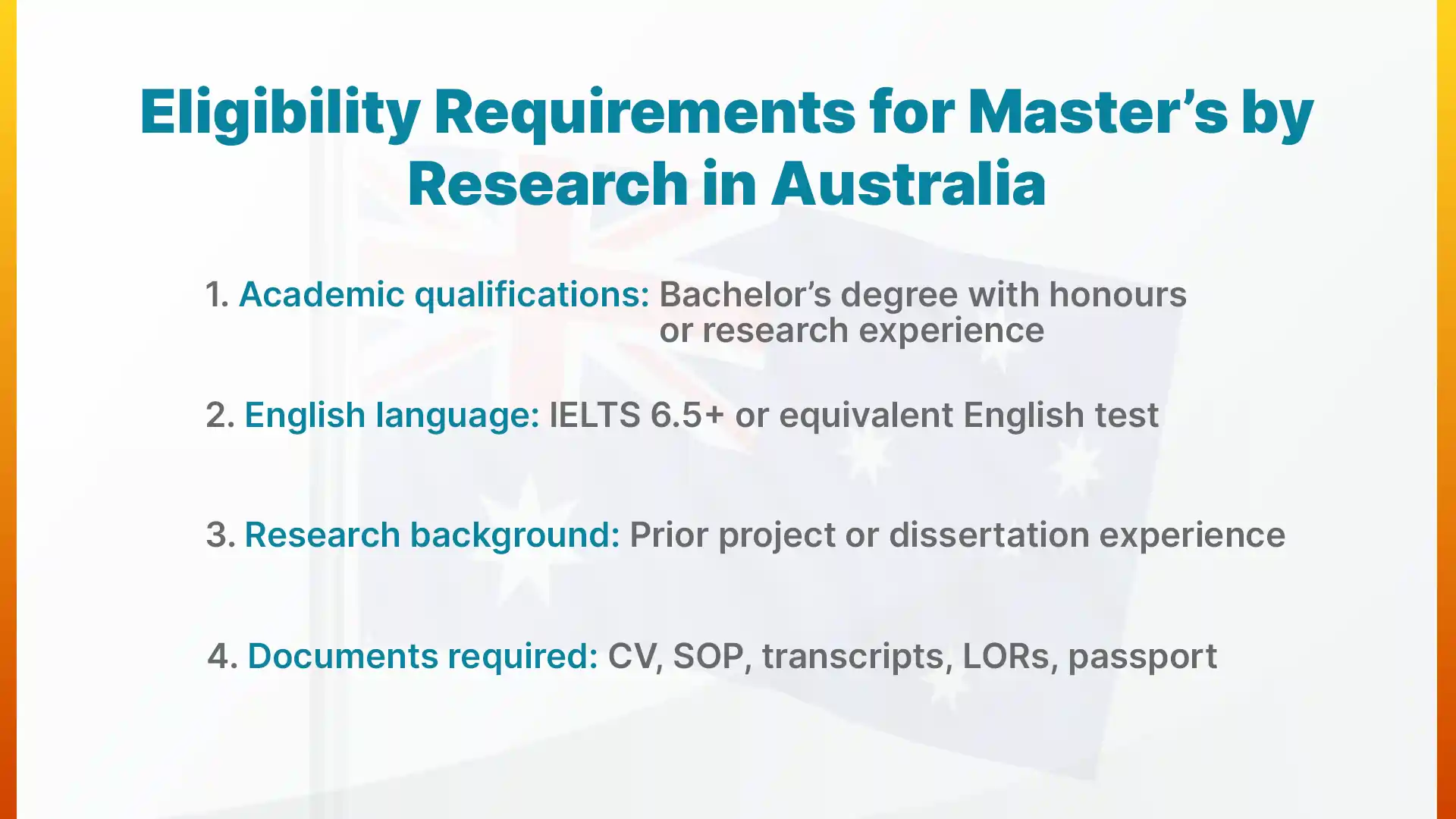
To apply for a Master’s by Research in Australia, you must have a bachelor’s degree (usually with honours), meet English language requirements, and demonstrate research experience. These criteria help universities ensure you are prepared for independent research and thesis writing. While exact rules can vary slightly by university, most follow similar standards. Let’s break each requirement down clearly and simply:
1. Academic Qualifications
To begin with, you need a Bachelor’s degree with honours or relevant research experience. Many Australian universities prefer students who have completed an honours year or a final-year research project. However, if you do not have formal honours, strong academic results and research-related experience can still be accepted. In short, universities want to see that you can handle advanced academic work.
2. English Language Requirement
You must meet the English language requirement, usually IELTS 6.5 or higher, or an equivalent test score. This ensures you can read research papers, write a thesis, and communicate clearly with your supervisor. Some universities also accept PTE, TOEFL, or Medium of Instruction (MOI). If you fall short, many institutions offer pre-sessional English courses to help you qualify.
3. Research Background
In addition, having a research background is a strong advantage for MRes applicants. This can include a final-year project, dissertation, thesis, or any academic research work you’ve done before. While published research is not mandatory, basic research exposure shows your readiness for independent study. Simply put, universities want proof that you understand how research works.
4. Documents Required
Finally, you need to submit a set of supporting documents with your application. These usually include your CV, Statement of Purpose (SOP for Australia), academic transcripts, Letters of Recommendation (LORs), and a passport copy. Each document plays a role in showing your academic ability and research interest. When prepared carefully, these documents can significantly improve your chances of admission.
Sticking to a research timeline can be challenging, especially with proposals, SOPs, and effective applications. A trusted consultancy can help you plan your schedule, prepare documents, and meet deadlines. Consider visiting one of the consultancies with a high visa success rate to make the whole process easier and smoother.
Master’s by Research in Australia for International Students Fees
When you plan to study a Master’s by Research in Australia, you can expect the total cost to be around AUD 70,000 to AUD 100,000 for the full program (1.5–2 years), including tuition and living expenses. The total cost of your Australian education, however, depends on your university, city, and lifestyle. These costs are a major part of your study plan, so it helps to understand them clearly before you apply.
1. Tuition Fees for MRes Programs
Tuition for research master’s programs in Australia varies by university and subject, but most international students pay between AUD 28,000 and AUD 45,000 per year for a Master’s by Research. In some cases, research programs in specialised areas such as engineering or health sciences) may cost slightly more, while regional universities sometimes offer lower fees than big city campuses.
Fees can also rise each year with inflation or university policy changes, so always check the exact cost on the university’s official fee page. Many research students apply for the Research Training Program (RTP) scholarships, which universities offer to cover part or all of their tuition (and sometimes a stipend for living costs). These scholarships in Australia can make a big difference, especially for international students aiming to reduce out-of-pocket costs.
2. Living Costs in Australia for Research Students
In addition to tuition, you also need to cover your living costs in Australia, which include rent, food, transport, and daily expenses. On average, international students spend about AUD 20,000 to AUD 30,000 per year on living costs, though this depends on the city you choose. Cities like Sydney and Melbourne are more expensive, while places like Adelaide, Brisbane, or regional campuses tend to be more affordable.
To give you an idea, rent for shared accommodation or a modest apartment can range from about AUD 500 to AUD 1,200 per month, groceries around AUD 300–600, and transport AUD 100–200. Costs like utilities and internet add a bit more, and your lifestyle also affects your total.
Overall, planning ahead with a clear budget for both tuition and living expenses can make your study journey in Australia smoother and more predictable.
How to Apply for a Master’s by Research in Australia from Nepal?
To apply for a Master’s by Research in Australia, you mainly need a research topic, a supervisor, and a strong proposal, along with meeting academic and English requirements. Once you submit your application online, the university reviews it and may invite you for an interview before sending an offer. The process is more focused on your research proposal, supervisor alignment, and eligibility. Here’s a step-by-step guide to help you navigate the application process successfully:
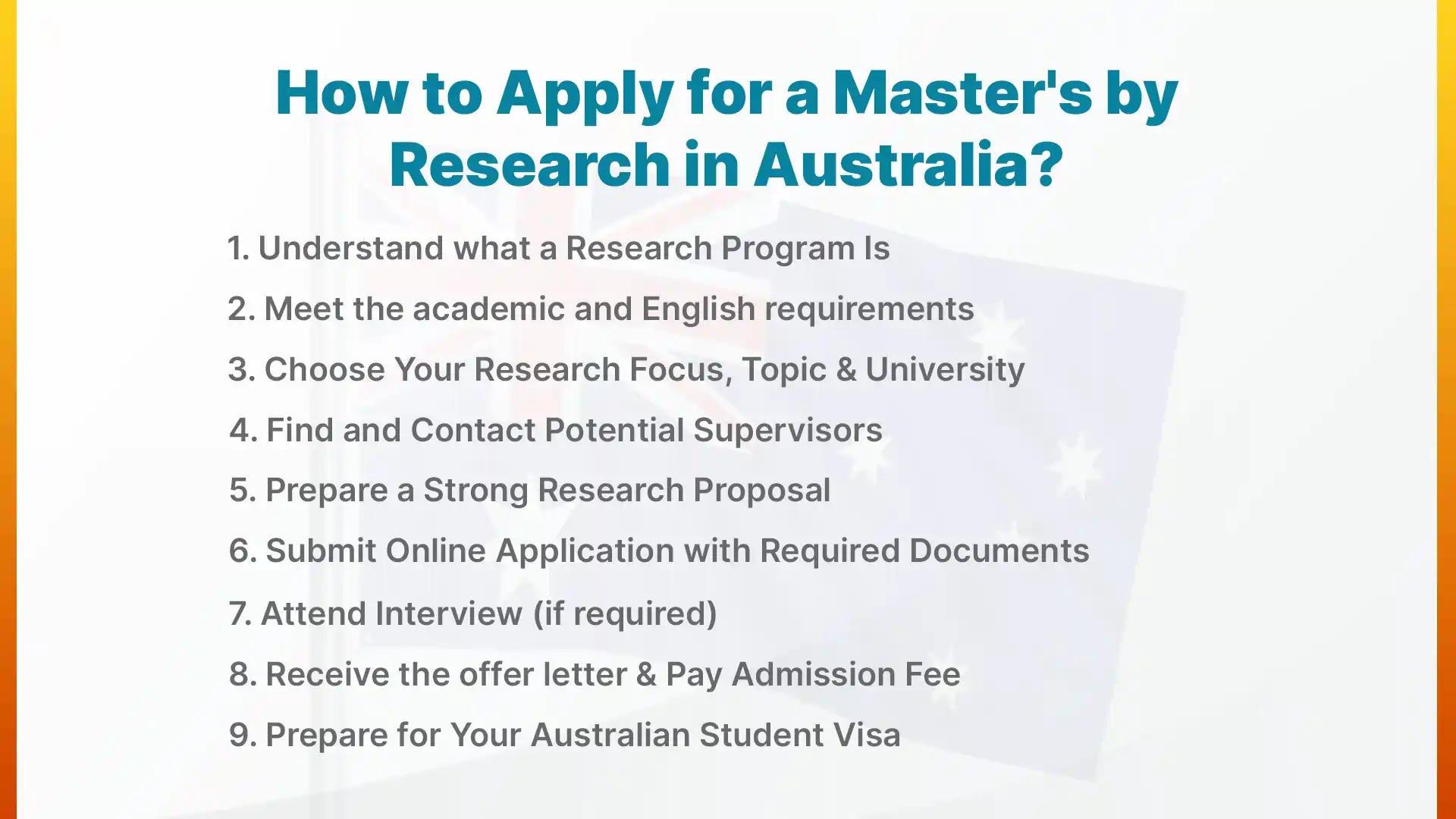
Step 1: Understand What a Master's by Research Really Is
A Master’s by Research is 70–90% research-based and assessed mainly through a thesis. Unlike a coursework degree, it focuses on independent study and problem-solving rather than attending lectures or exams. It’s ideal for students who want to pursue a PhD, work in research-driven industries, or build an academic career. Understanding this upfront ensures you choose the right path and align your expectations with the program’s structure.
Step 2: Check Academic and English Eligibility
Before applying, ensure you meet the academic requirements. Most universities require a bachelor’s degree from a recognized institution, preferably with honours or research/project experience. Your past academic performance demonstrates your ability to handle advanced research.
In addition, you must meet English language requirements, typically IELTS Academic 6.5–7.0, or an equivalent test like PTE or Duolingo English Test (DET). Some universities also accept Medium of Instruction (MOI) certificates. If needed, pre-sessional English courses can help you meet the requirements for studying in Australia.
Step 3: Choose Your Research Focus, Topic & University
The next step is to decide what you want to research and where you will conduct it. Identify your area of interest. Popular courses in Australia include Data Science, Health, Engineering, Business, and Social Sciences. Then, shortlist universities that offer MRes programs in your chosen field. Consider factors like research ranking, facilities, tuition fees, scholarship opportunities, and location. Top options often include the Group of Eight universities and other well-reputed institutions.
Step 4: Find and Contact Potential Supervisors
A key part of the application is finding a supervisor whose research aligns with your topic. Explore university faculty pages and read about their recent publications. Reach out via email with a brief introduction, your research interest, CV, and a draft proposal. A positive response from a supervisor can greatly strengthen your application and sometimes is required before formal submission.
Step 5: Prepare a Strong Research Proposal
Your research proposal is the heart of your application. It should include:
- Title and background of your research
- Research questions or objectives
- Methodology (qualitative, quantitative, or mixed)
- Expected outcomes
Keep it clear, realistic, and focused. The quality of your proposal often matters more than your GPA alone.
Step 6: Gather Required Documents and Submit Application
Once your proposal is ready, collect all application documents: CV, Statement of Purpose (SOP), academic transcripts, Letters of Recommendation (LORs), English test results, and a passport copy. Submit them online through the university portal, ensuring everything is clearly named and in PDF format. After submission, your supervisor and department will review your proposal and may invite you for an interview.
Step 7: Attend Interview (If Required)
Some universities require a short interview to discuss your research topic, methodology, and career goals. Be honest, show curiosity, and explain why you are a good fit for the program. You do not need perfect answers; showing commitment and preparation is most important.
Step 8: Receive Offer Letter and Confirm Admission
If your application is successful, you will receive a conditional or unconditional offer letter. Conditional offers may depend on submitting final transcripts or meeting English requirements. After accepting the offer, you pay the admission deposit, which secures your place and initiates the Confirmation of Enrolment (CoE) for your visa.
Step 9: Arrange Finances and Prepare for Student Visa
Finally, prepare for your Australian student visa. You will need proof of funds, CoE, passport, academic documents, and sometimes a medical or TB test. Planning finances and arranging documents early ensures a smooth visa application. Once approved, you are ready to begin your research journey in Australia.
Top Australian Universities for a Research Degree
University of Melbourne, University of Sydney, and Monash University are the top Australian universities for a Master’s by Research, given their strong research output, world rankings, and excellent support for international research students. A strong research university gives you access to experienced supervisors, better funding opportunities, quality labs and facilities, and a supportive academic environment. Many Australian universities are also trusted globally for their research output, industry collaborations, and academic excellence.
Here are some of the top Australian universities known for strong research programs that international students often choose for MRes, MPhil, and other postgraduate research degrees:
University | Key Highlights for Research Students |
| University of Melbourne | Globally ranked, strong research across Science, Health, Engineering, Humanities, excellent supervisor support |
| University of Sydney | Wide research fields, strong industry links, large international student community |
| Monash University | High-quality research in Science, Engineering, Health, offers RTP scholarships and funding support |
| Australian National University (ANU) | Focus on policy, science, global partnerships, strong research network |
| University of Queensland | Research in Science, Engineering, Health, good scholarship opportunities |
| UNSW Sydney | Engineering, IT, Business research, high research intensity, innovation-focused |
| Deakin University | Health, Science, Technology, modern facilities, growing research community |
| University of Southern Queensland (UniSQ) | Flexible research programs in Education, Social Sciences, and Sciences, supportive environment |
Scholarships for Master's by Research in Australia
Securing a scholarship can make a huge difference when planning your Master’s by Research in Australia. Scholarships help cover tuition fees, living costs, and other expenses, making it easier for international students, including those from Nepal, to focus on their research. There are both university-specific and government/external scholarship options available.
1. University-Specific Scholarships
Many Australian universities offer their own research scholarships for MRes students. Often, these scholarships are automatically considered on your enrolment application. For example, the University of Melbourne Graduate Research Scholarships provide full tuition, a living stipend, health cover, and relocation allowances. Similarly, Deakin RTP Scholarships and University of Sydney International Stipend (USYDIS) give strong financial support and help international students settle in and focus on their research.
2. Government and External Funding Options
Government and external funding options, like the Research Training Program (RTP), Endeavour Scholarships, and industry-linked grants, help international students, including those from Nepal, cover tuition, living costs, and research expenses. They provide not only financial support but also opportunities to gain practical research experience. These scholarships are offered by the Australian Government, universities, or in partnership with industries. Applying early and preparing a strong application can make pursuing a Master’s by Research in Australia much more manageable and rewarding.
3. Popular Scholarships for Master's by Research in Australia
Here’s a quick overview of some of the top scholarships available for international research students, including those from Nepal, which can help cover tuition, living costs, and other research expenses.
Scholarship | University / Source | Key Benefits |
| RTP Scholarships | Melbourne, ANU, Adelaide, UniSA, UNE, others | Full tuition + living stipend (~AUD 32–42K/year) + OSHC + allowances |
| Australia Awards Scholarships | Australian Government | Full tuition + living allowance + return airfare + insurance |
| Endeavour Scholarships | Australian Government | Full tuition + living allowance + travel + health insurance |
| University of Sydney International Stipend (USYDIS) | University of Sydney | Research stipend (~AUD 41K/year) + relocation + research allowances |
| Graduate Research Scholarships | University of Melbourne | Full tuition + living stipend + relocation + health cover |
| Deakin RTP Scholarships | Deakin University | Tuition + stipend (~AUD 34.4K) + OSHC + relocation |
| Edith Cowan HDR Scholarships | Edith Cowan University | Tuition support + stipend (~AUD 35K) |
Working in Australia as a Research Student
Master’s by Research (MRes) students in Australia can work unlimited hours if the work is a mandatory part of their degree, such as research assistantships, teaching assistant roles, or placements required by the program. For all other work that is not part of the course, international students on a student visa are generally allowed to work up to 48 hours per fortnight during study periods. Unlimited work is allowed during official university breaks. This flexibility helps students balance their research focus with part-time employment. Always check your personal conditions through the Visa Entitlement Verification Online (VEVO) system to be sure.
1. Part-time Employment and Minimum Wage
For non-mandatory work, MRes students can take on part-time roles like on-campus research or admin jobs, tutoring, retail, or hospitality. The minimum wage in Australia is AUD 24.95 per hour (2026). Working part-time also helps you develop professional skills, network with peers, and understand Australian workplace culture, which can be valuable for your career. Remember, mandatory course-related work does not count toward the 48-hour limit, so MRes students have more flexibility than regular coursework students.
2. Career Prospects after MRes
Completing a Master’s by Research in Australia opens doors to both academic and industry careers. Many students go on to PhD programs, while others join research-focused roles in science, engineering, health, or business sectors. Employers value the skills you gain during your MRes, such as critical thinking, problem-solving, and independent research. With Australia’s growing innovation and research landscape, MRes graduates have strong opportunities locally and internationally.
Upcoming Intakes & Course Details for MRes in Australia
Most Australian universities have two main intakes: February/March, which is the largest and most popular, and July, which is smaller but still widely available. Some universities also offer rolling admissions, giving you extra flexibility if you miss the main dates. Knowing your intake to study in Australia helps you prepare documents, reach out to supervisors, and meet all deadlines without stress, so you can start your research smoothly and on time.
What are the Popular Research Fields for MRes Students?
Australian universities offer a wide range of research fields for Master’s by Research students. Popular areas include Data Science, Health and Life Sciences, Engineering and Technology, Business and Management, and Social Sciences. Selecting a field that aligns with your interests and career goals is key to a successful research experience. Additionally, these areas often have strong funding opportunities and experienced supervisors, making them attractive choices for international students
Study Research Master's in Australia with Dependent
International students pursuing a Master’s by Research in Australia can bring dependents such as a spouse or children on their student visa. You need to show proof of sufficient funds and provide health insurance for your family. Planning ahead ensures your dependents can live comfortably while you focus on your research.
1. Who Is Eligible for a Dependant Visa in Australia?
Eligible dependents include your spouse or de facto partner and your children under 18 years of age. You must demonstrate enough financial resources to cover living expenses for everyone. Health coverage is also required for all dependents.
2. What Are the Restrictions of a Dependent Visa?
Dependents can live, study, and in some cases work in Australia, but work rights for spouses may be limited depending on the primary visa holder’s course. Children can attend school but must comply with local education rules. All dependents must follow visa conditions and health requirements during their stay.
3. Is IELTS Required for a Dependent Visa in Australia?
Generally, dependents do not need to take IELTS to get a visa. However, children enrolling in school may need to meet English requirements set by the school. Spouses can take language tests voluntarily if they want to study or work in fields requiring proof of English proficiency.
Conclusion
Pursuing a Master’s by Research in Australia gives you the chance to build strong research skills, gain international recognition, and prepare for a career in academia or industry. With guidance from experienced supervisors and opportunities to work on independent projects, students can explore interesting topics and contribute to new knowledge. An MRes also sets the perfect foundation to succeed for those planning a PhD or research-focused career.
For Nepalese students, planning ahead is important. Choosing the right university, preparing a clear research proposal, contacting supervisors early, and looking for scholarships can make the process easier. With careful preparation and dedication, completing an MRes in Australia can open doors to global opportunities, valuable networks, and a rewarding research career.
Thinking about studying in Australia? Wondering which is the best consultancy in Nepal for Australian applications? The right guidance can help you choose universities, prepare your research proposal, and make your MRes journey smooth and successful.