Study BBA in Australia: Guide for Nepalese Students

Dec 01, 2025

Australia has emerged as one of the most preferred destinations for students seeking a globally recognized business education. Each year, thousands of Nepalese students choose to pursue a BBA in Australia to gain cutting-edge business knowledge, international exposure, and strong career opportunities. With its world-class universities, vibrant multicultural environment, and growing demand for skilled business professionals, Australia offers a unique platform to build a successful career in fields like finance, marketing, human resources, and analytics.
This guide is designed specifically for Nepalese students who are planning to study BBA courses in Australia. We will cover everything from course duration, specializations, and top colleges to eligibility requirements, costs, career scope, and salary expectations. By the end of this blog, you’ll have a clear roadmap for choosing the right BBA program, understanding admission criteria, and confidently applying for your Australian education.
In this blog
What is a BBA Course in Australia?
A Bachelor of Business Administration (BBA) in Australia gives you a strong foundation in business and management. You’ll study core subjects like management, marketing, finance, accounting, business law, and organisational behaviour. Along with theory, universities focus on practical skills such as critical thinking, problem-solving, and project management. Many universities also include internships, case studies, and real-world projects, helping you gain hands-on experience.
BBA Course Duration in Australia
Most BBA programs in Australia take three years to complete for full-time international students. Some universities offer accelerated tracks that can be finished in 2.5 years or extended programs with internships that take up to four years.
This flexibility allows you to combine study with practical experience, which is highly valued by employers in Australia and worldwide.
BBA Specializations You Can Choose
Australian universities let you specialize in areas that match your career goals. Popular options include:
- Marketing Management – Digital marketing, branding, and consumer behavior.
- Finance & Accounting – Corporate finance, investment, and financial analysis.
- Human Resource Management – Recruitment, employee relations, and leadership.
- Business Analytics & IT – Data analysis, business intelligence, and decision-making.
Operations & Supply Chain Management – Logistics, production, and process optimization.
Picking a specialization early helps you focus your studies and build skills that employers in Australia and globally are looking for.
Why Nepalese Students Choose to Study BBA in Australia?
Nepalese students choose to study BBA in Australia because it offers a combination of world-class education, international exposure, and strong career opportunities. Australia’s universities provide practical learning, industry internships, and globally recognized degrees that make graduates highly employable. Additionally, the country’s safe, multicultural environment and post-study work options make it an ideal destination for Nepalese students aiming to build a successful career in business.
1. Growing Demand for Business Graduates in Australia
For decades, business and management degrees like BBA have ranked among the most employable undergraduate courses in Australia. According to the 2023 graduate outcomes data, graduates in business and management enjoy a full-time employment rate markedly higher than that of many other fields, outperforming the national undergraduate average.
Even as the job market shifts, demand for business‑qualified professionals remains strong. Recent labour‑market data shows the total number of filled jobs in Australia rose by nearly 14 % between 2020 and 2025, indicating that the economy continues growing and absorbing new graduates.
2. BBA in Australia Builds Global Business Skills for Your Career
Studying BBA in Australia immerses you in a global business environment. The curriculum typically covers a wide spectrum: from marketing and finance to human resources, operations, and analytics. This breadth helps you build versatile business skills. Moreover, Australian universities encourage practical learning: group projects, case studies, and sometimes internships. That global exposure, combined with management fundamentals, gives your profile international relevance, which is a big plus if you aim to work in multinational companies or international business settings after graduation.
3. Australia is Safe & Supportive for International Students
Australia has built a reputation for high‑quality higher education, globally recognized degrees, and inclusive campuses welcoming international students. For Nepalese students, this offers a supportive environment to adapt academically and socially. Beyond academics, Australia’s stable economy and growing job market suggest that graduates stand a good chance of transitioning from study to work. Plus, earning a business degree in a country known for its professional standards and multicultural environment can boost your confidence, network, and global outlook, all helping you start a stronger career journey.
Top BBA Colleges in Australia for International Students
The top BBA colleges in Australia for international students include the University of Melbourne, University of Queensland (UQ), Monash University, University of Sydney, UNSW Sydney, RMIT University, QUT Business School, Macquarie University, and Deakin University. These best Australian universities are known for their strong business programs, practical learning opportunities, and global recognition. They offer a variety of specializations, industry-linked projects, and support for international students, making them ideal choices for Nepalese students aiming to study BBA in Australia.
1. Best Public Universities Offering BBA Programs
These public institutions are consistently recognized for strong business education, making them reliable choices for Nepalese students.
University Name | Key Specialties / Strengths |
| University of Melbourne | Management, Marketing, Accounting, Finance — strong academic reputation & global recognition |
| University of Queensland (UQ) | Business & Economics, Accounting & Finance — balanced academic strength and employability |
| Monash University | Diverse business specializations, global exchanges, strong overall university infrastructure |
| University of Sydney | Wide range of commerce/business courses, research & global exposure |
| University of New South Wales (UNSW Sydney) | Prestigious business/commerce programs, strong academic and industry reputation |
2. Private Universities & Business Schools with Strong Industry Links
These institutions often focus on industry-oriented programs, practical learning, and flexible study formats.
Institution / Business School | Key Specialties / Strengths |
| Queensland University of Technology (QUT Business School) | Business, Management, IT & Business, Work‑integrated learning |
| RMIT University | Business + Technology, Applied Business Studies, Flexible study tracks |
| Macquarie University (Macquarie Business School) | Finance, Marketing, Business Analytics, Corporate & Industry‑oriented programs |
| Deakin University | Business, Management, Applied Business, Support for international students |
Eligibility & Requirements: What Do You Need for BBA in Australia?
To study a BBA in Australia, you need a strong academic foundation, proof of English proficiency, and the necessary documents for admission and visa processing. Meeting these requirements ensures you are eligible, prepared, and ready to start your BBA journey smoothly in Australia. Here are the major requirements for studying in Australia:
1. Academic Qualification
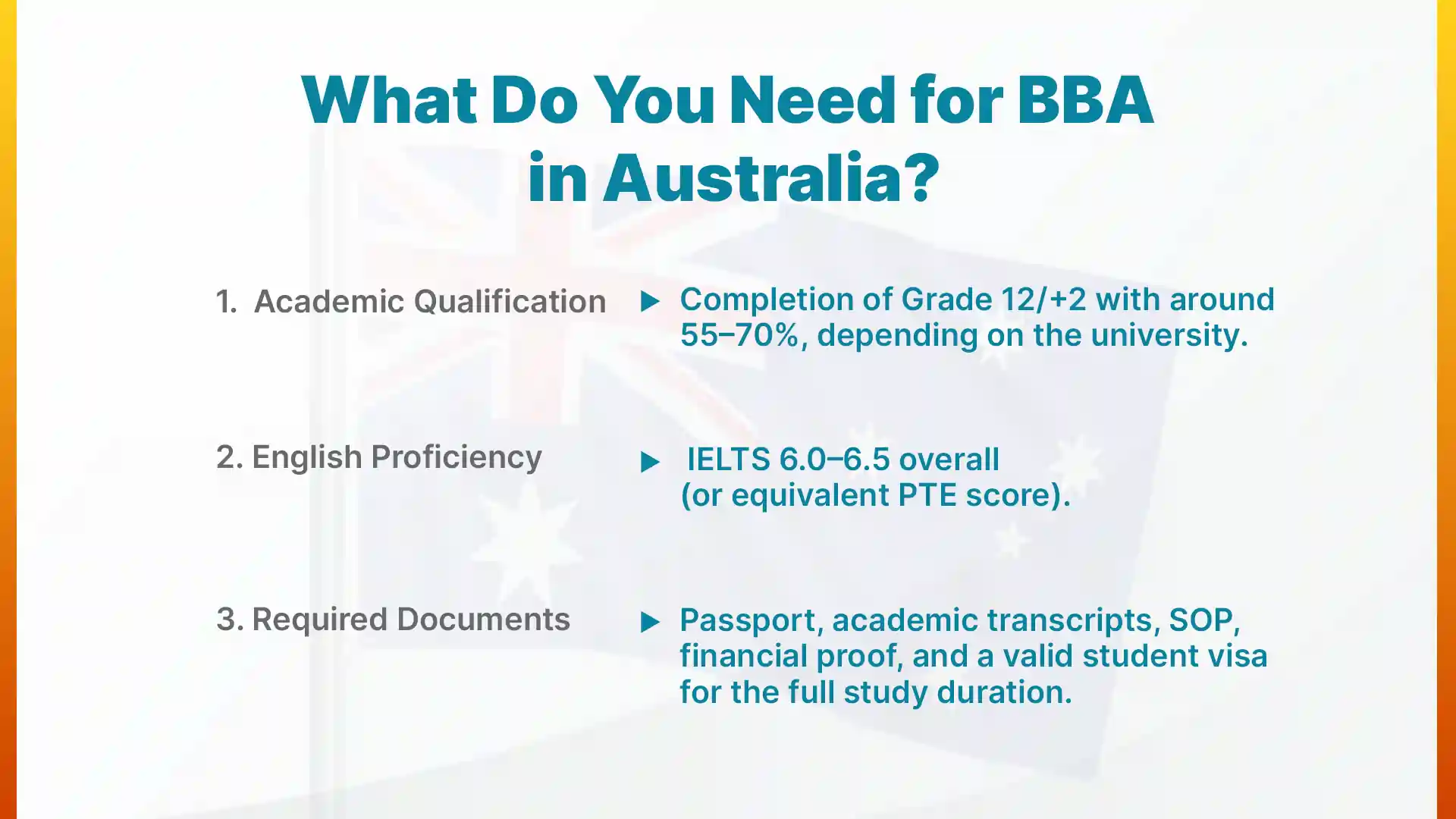
To pursue a BBA in Australia, you must have completed Grade +2 from a recognized board or school. Most universities require an aggregate of around 55–70%, depending on the program’s competitiveness.
Meeting this academic threshold ensures you have the foundational knowledge in subjects like mathematics, economics, or business studies, which are essential for understanding core business concepts at the undergraduate level. Some universities may also look at your individual subject scores if they are relevant to business studies.
2. English Proficiency
Since the medium of instruction is English, proof of English language proficiency is mandatory. Most universities accept IELTS scores of 6.0–6.5 overall (with no band below 5.5–6.0) or equivalent PTE scores. This ensures you can comfortably follow lectures, participate in discussions, and complete assignments. English language test scores also strengthen your visa application.
3. Required Documents
You will need several essential documents to complete your application and visa process. These typically include a valid passport, academic transcripts, a Statement of Purpose (SOP), financial proof, and a student visa valid for the full duration of your studies. Universities may also request letters of recommendation or additional forms depending on the program.
How Much Does a BBA Cost in Australia?
The tuition fees for a BBA in Australia can range between AUD 25,000 to 45,000 per year for international students. Public universities like the University of Melbourne or UNSW tend to be on the higher side, while private or regional universities may be slightly more affordable. In addition to that, you should also cover the living costs of around AUD 29,710 per year. Consider the following costs of studying in Australia while planning your finances:
1. Tuition Fees for BBA Courses in Australia
The tuition fees for a BBA in Australia vary depending on the university and city. On the lower end, more affordable or regional universities charge around AUD 34,000–38,000 per year, while mid-range universities typically cost AUD 35,000–45,000 per year. Top-tier, prestigious institutions like the University of Melbourne, UNSW, or Monash can charge AUD 45,000–50,000+ per year.
Considering a standard three-year BBA program, the total tuition can range from approximately AUD 102,000 for affordable options to over AUD 150,000 at top universities. In Nepali Rupees, this translates roughly to NPR 10–14 million, depending on the exchange rate and the university you choose.
2. Living Expenses for Nepali Students in Major Cities
On average, living expenses in Australia range from AUD 18,000 to 25,000 per year, depending on the city and lifestyle. This amount includes accommodation, food, transport, and personal expenses. Cities like Sydney and Melbourne are on the higher side, while cities like Brisbane or Adelaide can be slightly more affordable for international students.
3. Scholarships You Can Apply For
Many universities and organisations offer scholarships for international students in Australia to help reduce tuition costs. Popular options include merit-based scholarships, country-specific scholarships for Nepalese students, and scholarships linked to academic performance or leadership skills. Applying early and preparing strong documents like your SOP and transcripts can significantly improve your chances of securing financial support.
BBA Scope in Australia (Jobs, Internships & Career Opportunities)
1. Part-Time and Post-Study Work Opportunities
Studying a BBA in Australia offers excellent opportunities to gain work experience while studying. International students can work up to 48 hours per fortnight during semesters and full-time during semester breaks. The minimum wage for students in Australia is AUD 24.95 per hour (as of December 2025). This helps cover living expenses and develop professional skills alongside your studies.
After graduation, you may be eligible for a Post-Study Work Visa (subclass 485), which allows you to work in Australia for 2–3 years depending on your degree. During this period, you can gain full-time professional experience, which significantly boosts your employability and strengthens your pathway toward Permanent Residency (PR).
2. Popular Job Roles for BBA Graduates in Australia
BBA graduates in Australia can pursue careers in Human Resources, Operations Management, Marketing, Finance, Business Development, Digital Marketing, Supply Chain Analysis, Sales Management, and Business Analytics. These roles allow graduates to apply their business knowledge in real-world settings, gain professional experience, and build a strong career in high-demand sectors. The variety of roles ensures flexibility to match your skills, interests, and long-term career goals.

Human Resources (HR)
HR professionals manage recruitment, employee engagement, and training programs. They ensure the right talent is hired, policies are followed, and teams remain motivated. HR contributes directly to a company’s productivity and workplace culture.
Operations Management
Operations managers oversee daily business activities and optimize workflows. They work to improve efficiency, manage resources, and ensure projects are completed on time. Their role is crucial for maintaining smooth business operations.
Marketing Management
Marketing managers develop strategies to promote products or services. They handle market research, advertising campaigns, and digital marketing initiatives. Their work drives brand awareness, customer engagement, and revenue growth.
Finance & Banking
Finance professionals analyze financial data, manage budgets, and advise on investments. They ensure companies make sound financial decisions and maintain profitability. Their contributions are key to a business’s financial health.
Business Development & Sales
Business development managers expand a company’s market reach and generate revenue opportunities. They build client relationships and identify growth strategies. Their role directly affects business growth and market presence.
Digital Marketing & Business Analytics
Digital marketers and business analysts use data to guide marketing strategies and business decisions. They track performance metrics, analyze trends, and optimize campaigns. Their work ensures data-driven growth and better decision-making.
Supply Chain Analyst
Supply chain analysts manage logistics, inventory, and distribution processes. They ensure products move efficiently from suppliers to customers. Their role is vital for cost savings, timely delivery, and operational efficiency.
BBA Salary in Australia: What Can You Expect After Graduation?
Fresh BBA graduates in Australia can expect a starting salary of around AUD 55,000–65,000 per year, depending on the city, industry, and specialisation. Entry-level roles in fields like marketing, HR, or operations typically fall within this range, while finance or analytics positions may start slightly higher. This initial salary helps cover living costs and provides valuable work experience in a professional environment.
With 3–5 years of experience, BBA graduates can see salaries rise to AUD 70,000–90,000 per year, depending on performance and sector. Senior roles in finance, consulting, or business development can exceed AUD 100,000 per year. Career growth often comes faster for graduates who combine work experience with additional certifications or postgraduate studies in specialised areas like accounting, marketing, or data analytics.
Conclusion
Pursuing a BBA in Australia is a journey that equips you with global business skills, industry experience, and the confidence to excel in a competitive world. From learning core business principles to specializing in areas like finance, marketing, HR, or analytics, the program prepares you for a wide range of high-demand careers. With part-time work opportunities, internships, and post-study work visas, you can gain practical experience while building a strong professional network.
By choosing the right university and specialization, you can shape your career path, explore leadership roles, and even open doors toward Permanent Residency in Australia. And while the journey may seem challenging, having expert guidance for course selection, applications, scholarships, and visa processing can make it smoother. Your ambition, combined with the right planning, can turn the dream of studying in Australia into a life-changing reality!