Bachelor of Information Technology in USA: Universities, Costs, Requirements

Jun 03, 2026
Every single day, businesses around the world are hunting for skilled tech professionals to help them run smoothly.
However, trying to figure out how to jump into this booming tech field can feel completely overwhelming when you do not know where to start.
Choosing to study in America is one of the absolute best ways to launch your global tech career. This complete guide will break down everything you need to know about navigating the entire process step by step.
By the time you finish reading, you will understand how this degree unlocks incredible careers in software, cybersecurity, networking, data management, and cloud computing.
Let us dive into the details together and map out your exciting journey to America.
In this blog
What is a Bachelor of Information Technology?
A Bachelor of Information Technology is a practical degree that teaches you how to use computer systems to solve everyday business problems. Instead of just focusing on the mathematics behind software, you learn how to install networks, secure data, and keep computer platforms running smoothly. It bridges the gap between complex computer science theories and the actual technology that companies use daily.
During your time in an IT program in the USA, you will dive into several key focus areas that matter to modern employers. You will take classes in network administration, database management, systems security, and web development. The curriculum is designed to give you hands-on experience so you can handle real-world tech issues immediately after graduation.
1. Duration of the Program
Earning your Bachelor of Information Technology degree in the USA typically takes four years of full-time study. To graduate, you will need to successfully complete around 120 to 130 college credits across your subjects. Many universities also mix in mandatory internship semesters so you can get real work experience before finishing school. This structural design ensures you learn how the industry actually works.
2. Course Subjects and Curriculum
The standard IT curriculum balances core technical subjects with essential business communication classes. In your first two years, you will study introductory programming, computer hardware foundations, and basic network configurations.
As you move into your final two years, your classes will shift toward advanced subjects like ethical hacking, cloud architecture, and data analytics.
You will also work on a final capstone project in which you solve a real technical problem for a real company.
The curriculum of a Bachelor of Information Technology (BIT) in the USA varies from one university to another. However, most programs combine core IT subjects, elective courses, and practical learning experiences to equip students with both technical knowledge and industry-relevant skills.
Component | Examples |
|---|---|
| Core (Mandatory) Subjects | Programming Fundamentals, Database Management Systems, Computer Networks, Operating Systems, Web Development, Cybersecurity Fundamentals, Systems Analysis and Design, IT Project Management |
| Elective Subjects | Artificial Intelligence, Data Analytics, Cloud Computing, Software Development, Network Security, Mobile App Development, Digital Forensics |
| Practical Learning | Capstone Projects, Internships, Industry Collaborations, Research Projects, Hands-on Laboratory Work |
This combination of classroom learning and practical experience helps students develop the technical, analytical, and problem-solving skills needed for careers in today's technology-driven world.
Why Study a Bachelor of Information Technology in the USA?
Studying your IT degree in America gives you a massive advantage because of the country's unmatched educational resources. American universities are globally famous for using the newest technologies and teaching methods to prepare students for the job market. This incredible environment is the perfect place to transform your love for technology into a valuable global career.
1. World-Class Education
American universities offer industry-focused curricula that regularly evolve with changing technology trends. Students learn through modern coursework, advanced computer labs, and research facilities, gaining hands-on experience with the tools and technologies used by leading companies around the world.
2. Industry Connections
Many US universities maintain strong partnerships with technology companies, creating valuable internship and networking opportunities for students. Through internships, co-op programs, and industry projects, students gain practical experience, build professional connections, and improve their chances of securing employment after graduation.
3. Global Recognition
A US bachelor's degree is respected by employers worldwide for its academic quality and practical focus. This global recognition can strengthen your resume, expand international career opportunities, and provide greater flexibility to work in different countries throughout your professional journey.
4. Innovation and Technology Hub
Studying in the USA places students close to some of the world's largest technology ecosystems. From industry events and hackathons to real-world projects and guest lectures, students gain exposure to innovation, emerging technologies, and the skills needed to succeed in a competitive tech industry.
Top Universities for Bachelor of Information Technology in USA
Several universities in the USA, including Arizona State University, George Mason University, the University of Cincinnati, and Florida International University, offer strong Bachelor of Information Technology and related IT programs. These institutions are known for their industry-focused curricula, modern facilities, and opportunities for internships and hands-on learning.
The table below highlights their locations and approximate annual tuition fees to help you compare your options.
University | Location | Approximate Annual Tuition (USD) |
|---|---|---|
| Arizona State University | Tempe, Arizona | 33,000 - 37,000 |
| George Mason University | Fairfax, Virginia | 36,000 - 40,000 |
| University of Cincinnati | Cincinnati, Ohio | 28,000 - 32,000 |
| Purdue University | West Lafayette, Indiana | 31,000 - 35,000 |
| Florida International University | Miami, Florida | 19,000 - 23,000 |
Factors to Consider When Choosing a US University
Picking the right college requires looking closely at several key details that affect your daily budget and future career. You should compare campus locations, total costs, and specific career support services before sending out any applications.
- Accreditation: Ensure the university's IT program is fully accredited by recognized boards like ABET so your degree is valid globally.
- Curriculum Structure: Check if the program offers specific specializations that match your personal career goals, like cybersecurity or cloud networking.
- Internship Opportunities: Look for schools located near busy tech cities where finding local internships is much easier for students.
- Tuition Costs: Compare the price differences between public and private universities to see which one fits your family financial plan.
- Campus Facilities: Research the quality of the computer labs, career counseling centers, and international student support offices on campus.
Eligibility Requirements for International Students
Meeting the entry criteria for American universities requires careful planning and plenty of advanced preparation. You must submit proof of your academic history alongside your official English exam scores to qualify for admission. Understanding these specific requirements for your US education early will keep your application process moving forward smoothly without any unexpected delays.
1. Academic Requirements
To apply for a bachelor's degree, you must successfully complete your high school education or an equivalent twelve-year qualification. Most competitive IT programs look for a minimum high school GPA of 3.0 out of 4.0 on your final transcripts.
Admissions officers pay close attention to your grades in advanced mathematics and computer related courses. If your scores are slightly lower, you can often take introductory pathway courses to help you qualify.
2. English Language Requirements
Since all your university classes will be taught in English, you must prove your language proficiency through standardized tests. Most universities require a minimum IELTS score of 6.5, with no individual band scoring below 6.0. If you take the TOEFL test, you will generally need an overall score of at least 80 on the internet-based exam. Many institutions now also accept Duolingo English Test scores, usually looking for a minimum result of 110.
Join Best IELTS Classes in Kathmandu Today!
3. Additional Admission Documents
You must submit official, certified copies of all your secondary school academic transcripts and graduation certificates. You need to write a compelling Statement of Purpose that explains your deep interest in technology and your future career goals.
Most colleges will ask for two or three professional Letters of Recommendation from your high school science or math teachers. Finally, you must provide a clear copy of your valid passport to ensure your application details are completely accurate.
How to Apply for a Bachelor of Information Technology in USA?
The application process for American colleges follows a very specific timeline that you need to follow carefully. Missing a single deadline can delay your university start date by an entire six months or even a full year. Taking it one step at a time makes the entire international application journey feel much simpler.
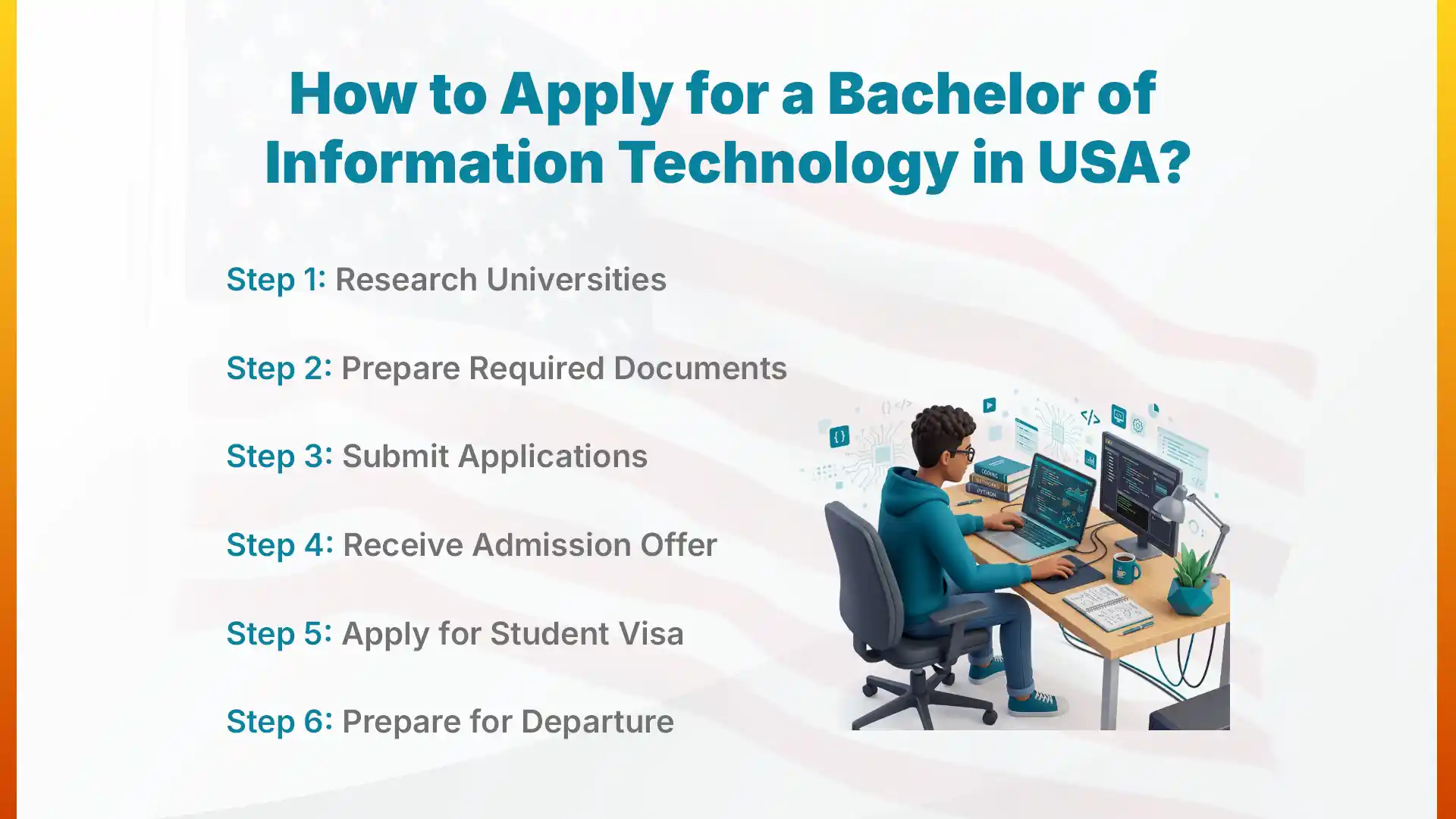
Step 1: Research Universities
Start looking at different American colleges at least twelve months before you plan to begin your classes. Look closely at their specific IT course descriptions, annual tuition prices, and available campus safety resources. Make a list of five to seven schools that match your budget and academic profile perfectly. Check their official website deadlines carefully since international applications often close much earlier than domestic ones.
Step 2: Prepare Required Documents
Gather all your official academic transcripts from your high school and have them translated into English if necessary. Register for your IELTS or TOEFL exam early, so you have enough time to retake it if needed. Draft your personal Statement of Purpose for the USA carefully, making sure to highlight your unique technical skills and volunteer experiences. Ask your high school teachers for recommendation letters well in advance so they have plenty of time to write them.
Step 3: Submit Applications
Most American universities allow you to apply online through portal systems like the Common Application or their own website. Fill out every section of the online application form accurately and upload all your prepared digital documents carefully. Pay the required application fee for each school, which usually ranges between forty and ninety dollars. Double-check that your official English test scores have been sent directly to the colleges by the testing agency.
Step 4: Receive Admission Offer
After reviewing your paperwork, universities will send out official admission decisions via email or their student portal. When a school accepts you, they will send an official letter alongside a crucial document called an I-20 form. This form details your exact program length and the estimated costs of your tuition and living expenses. Review all your offers carefully to decide which university gives you the best overall value and financial aid.
Step 5: Apply for Student Visa
Once you accept an admission offer, pay the mandatory SEVIS fee online to register with the US government. Schedule your official F-1 student visa interview at the closest United States Embassy or Consulate in your home country. Bring your I-20 form, university admission letter, visa fee receipts, and solid proof of financial bank balance to your interview. Answer the visa officer's questions clearly, politely, and honestly about your specific plans to study and return home.
Step 6: Prepare for Departure
After your student visa is successfully approved, you can safely book your international flights to the United States. Attend any pre-departure information sessions organized by your educational consultancy or local student groups. Reach out to the university's international student office to arrange your on-campus housing or find nearby student apartments. Pack your essential clothing, original academic documents, and necessary prescription medications carefully for your long journey.
Cost of Studying Bachelor of Information Technology in USA
Understanding the true cost of an American education helps your family plan their finances without running into stressful surprises later. Your total expenses will combine your direct tuition fees with your daily housing, food, and healthcare costs. Let us look at the realistic numbers so you can build an accurate annual budget.
1. Tuition Fees
Your annual tuition cost will depend heavily on whether you choose a public state university or a private college. Public universities receive funding from state governments, allowing them to offer lower tuition rates to international students. Private institutions do not receive state funding, so their flat tuition rates are usually higher regardless of your residency status.
University Type | Average Annual Tuition Range (USD) |
|---|---|
| Public Universities | 20,000 - 38,000 |
| Private Universities | 38,000 - 55,000 |
2. Living Expenses
Your daily living costs will vary quite a bit depending on the specific city and state where your campus is located. Large cities like New York, San Francisco, or Boston have much higher rent and transportation costs than smaller college towns.
Expense Category | Average Annual Cost (USD) |
|---|---|
| Accommodation (Rent) | 7,000 - 12,000 |
| Food and Groceries | 3,000 - 4,500 |
| Health Insurance | 1,500 - 2,500 |
| Transportation | 900 - 1,500 |
| Personal Expenses & Books | 1,200 - 2,000 |
3. Estimated Total Annual Cost
When you combine tuition and living costs, a typical international student spends between 33,600 and 60,500 each year. Choosing to live with roommates and cooking your own meals at home can easily save you thousands of dollars annually.
Scholarships for Undergrad IT Students in USA
Earning a scholarship is a fantastic way to cut down your overall expenses and make your American dream much more affordable. Many institutions offer generous financial awards specifically to attract bright international students to their tech programs.
1. Merit-Based Scholarships
Many American colleges automatically consider international applicants for partial merit scholarships during the regular admission process. These awards are based entirely on your high school GPA and your standardized test performances.
If you maintained excellent grades throughout high school, you could receive between 5,000 and 15,000 off your annual tuition. Keeping your college grades high each semester will allow you to renew these scholarships every year.
2. Need-Based Financial Aid
Some select universities offer need-based financial assistance to international students who demonstrate genuine financial hardship. You will need to fill out detailed financial disclosure forms showing your family's true annual income and assets.
While these grants are tougher to get as an international student, they can cover a massive chunk of your tuition. It is vital to research which specific schools offer this type of aid before submitting your application.
3. External Scholarships
You can also apply for competitive scholarships funded by independent foundations, corporate sponsors, and international organizations. Programs like the Foreign Fulbright program or the Foreign Student Program offer unique funding opportunities for global students.
Many international tech associations also run annual essay contests and project competitions that award prize money for college tuition. Dedicating time to researching these external options online can pay off massively.
Career Opportunities After Graduation for Tech Students
Earning an IT degree from America opens up a massive world of high-paying career paths across global industries. Tech graduates enjoy some of the highest employment rates because every modern business relies heavily on digital systems to operate.
1. Popular Job Roles for IT Graduates in USA
IT graduates in the USA can pursue careers in high-demand fields such as cybersecurity, networking, cloud computing, database management, and IT consulting. The versatility of an IT degree allows graduates to work across industries ranging from technology and finance to healthcare and government. The following roles highlight some of the most popular career paths available after graduation.
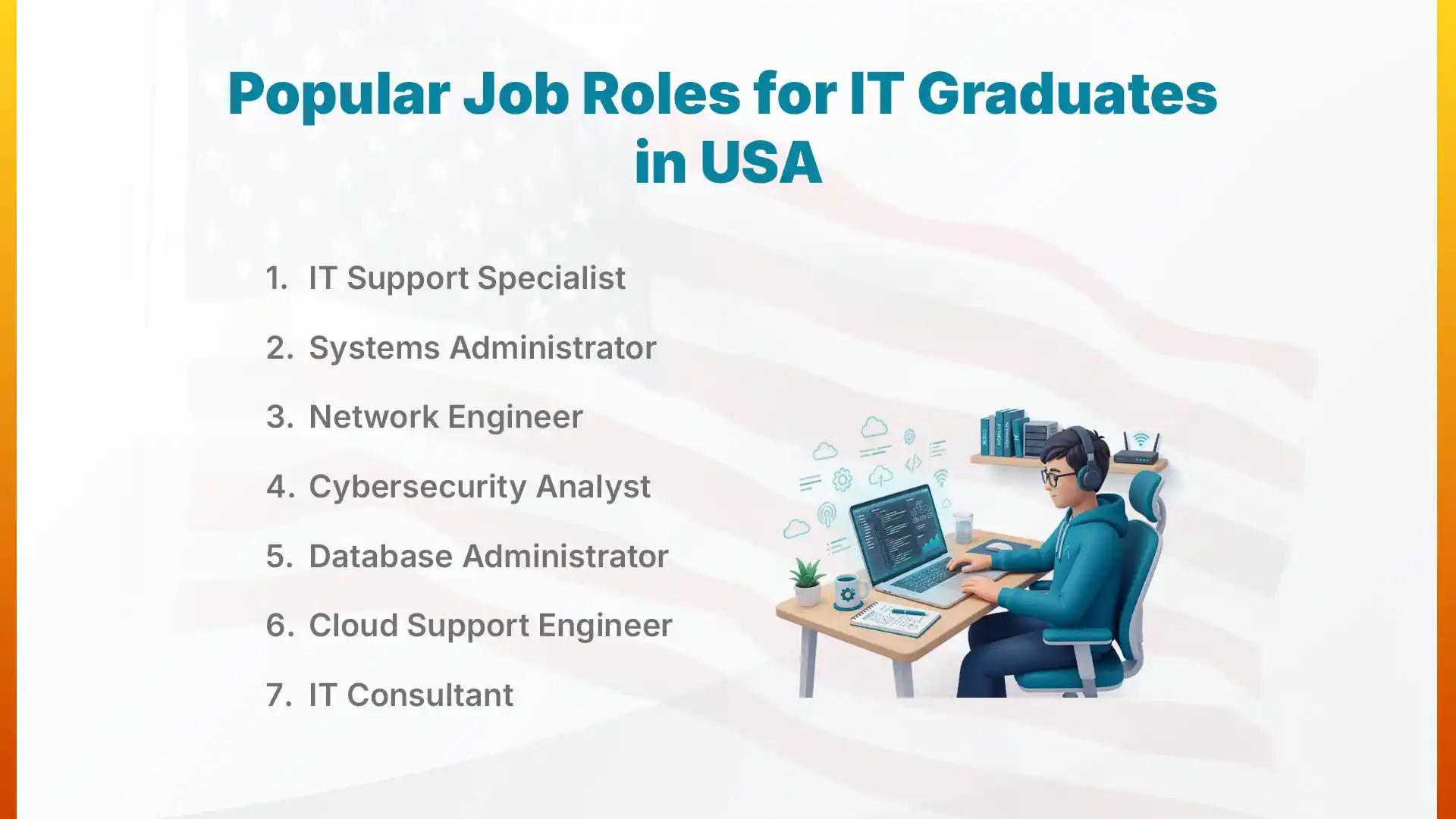
1. IT Support Specialist
You will assist corporate users with their computer hardware problems, software installations, and daily operating system troubleshooting. This foundational role is excellent for learning how an organization's tech infrastructure works from the ground up.
2. Systems Administrator
You will manage the daily setup, configuration, and maintenance of an entire company's internal computer servers and multi-user systems. Your main job is ensuring corporate networks remain completely reliable and do not suffer from unexpected downtime.
3. Network Engineer
You will design, build, and deploy secure local area networks and wide area networks for corporate offices. This role requires keeping data moving quickly between different company locations while maintaining strict communication standards.
4. Cybersecurity Analyst
You will proactively protect a company's confidential digital data and network infrastructure from malicious hackers and cyber attacks. You will regularly monitor network traffic, install firewalls, and build emergency data recovery plans.
5. Database Administrator
You will use specialized software programs to organize, store, and secure massive amounts of corporate data safely. You ensure that company analysts can access vital database information quickly whenever they need to make decisions.
6. Cloud Support Engineer
You will help companies migrate their physical data storage and software applications onto modern cloud networks like AWS or Azure. This growing role focuses on optimizing cloud performance while keeping operational costs low.
7. IT Consultant
You will advise external clients on how to use technology effectively to meet their specific business goals and beat competitors. You will evaluate existing tech setups and recommend custom hardware and software upgrades.
Industries Hiring IT Graduates
- Technology: Major software creators, cloud providers, and hardware manufacturers hire thousands of fresh IT graduates every single month.
- Finance: Large banks and investment firms need IT pros to protect financial transactions and secure sensitive customer accounts.
- Healthcare: Hospitals and medical clinics employ IT specialists to manage digital health records and secure remote patient portals.
- Government: Local and federal government agencies require massive IT teams to maintain public infrastructure and defend national security databases.
- Education: School districts and large universities hire IT experts to manage remote learning platforms and campus-wide computer networks.
Average Salary Expectations
Experience Level | Average Annual Salary Range (USD) |
|---|---|
| Entry-Level (0-2 Years Experience) | 55,000 - 75,000 |
| Mid-Career (3-6 Years Experience) | 78,000 - 105,000 |
| Senior-Level (7+ Years Experience) | 110,000 - 150,000+ |
Your actual starting salary will depend heavily on your specific job location, graduation portfolio, and any specialized technical certifications you earn.
Work Opportunities During and After Bachelors in IT in USA
The United States government provides excellent legal pathways for international students to gain professional work experience while maintaining their visa status. These official work programs let you practice what you learn in the classroom in real corporate environments.
1. On-Campus Employment
International students on an F-1 visa can legally work part-time on their college campus for up to 20 hours per week during regular academic semesters. These part-time jobs in the USA include working in the university computer labs, library help desks, or campus administrative offices. During summer and winter vacation breaks, you are permitted to work full-time up to 40 hours per week on campus. While these jobs will not cover your entire tuition, they are fantastic for earning regular pocket money.
2. Curricular Practical Training (CPT)
Curricular Practical Training allows you to work in off-campus internships that are directly related to your major field of study. To qualify, the internship must be an established part of your degree's curriculum or award academic course credits. This program is an incredible way to build your professional network and earn a good salary while still in school. Most students use CPT during their summer semesters to gain valuable corporate experience at American tech firms.
3. Optional Practical Training (OPT)
Optional Practical Training gives international graduates legal authorization to work full-time in the USA for up to twelve months after graduation. You must apply for this benefit through the US Citizenship and Immigration Services before finishing your final degree requirements. This program lets you transition smoothly from a student visa into a full-time corporate position at any US company. It is a golden opportunity to build a powerful global resume that stands out anywhere.
4. STEM OPT Extension
Because an Information Technology degree falls under the official STEM category, graduates qualify for a massive benefit. You can apply for an additional 24-month extension on your initial post-graduation OPT work authorization. This gives you a grand total of three full years to live, work, and earn a high salary in the United States after graduating. This extended timeline gives you plenty of opportunities to secure corporate sponsorship for a long-term work visa.
Bachelor of Information Technology vs Computer Science
A bachelor degree in information technology is very different from Computer Science or Software Engineering because it focuses heavily on the practical application of tech tools. Computer science students spend most of their time writing complex algorithms and building software from scratch.
Also, software engineers focus on the deep design and development of large application systems. On the other hand, an IT student learns how to make all these different systems work together securely and efficiently for a business.
Feature | Information Technology | Computer Science |
|---|---|---|
| Primary Focus | Practical technology implementation | Software theory and algorithms |
| Programming Needed | Moderate (Scripting and integration) | Extensive (Advanced coding) |
| Hardware & Networks | Strong, deep emphasis | Limited, superficial emphasis |
| Common Career Paths | Systems manager, cloud analyst | Software developer, AI researcher |
Which Degree Should You Choose?
If you enjoy installing software, fixing network issues, and configuring secure systems to help businesses run smoothly, Information Technology is your perfect match. It is highly practical and focuses on using existing tech tools to solve real problems. However, if you love deep mathematics, want to build brand-new software apps from scratch, or dream of designing complex artificial intelligence models, Computer Science is the better path for your skills.
Tips for Nepalese Students Planning to Study IT in the USA
Nepalese students planning to study IT in the USA should focus on four key areas: academic preparation, technical skill development, financial planning, and building a strong application. Starting early can improve your admission prospects, scholarship opportunities, and readiness for university-level coursework. The following tips can help you prepare more effectively for your study-abroad journey.
1. Academic Preparation
Build a strong foundation in mathematics, statistics, and computer-related subjects before starting university. These skills will make technical courses easier to understand and help you adapt more quickly to IT coursework. Developing logical thinking early can also give you an advantage in your studies.
2. Build Technical Skills Early
Learn the basics of programming, web development, or databases through free online resources before leaving Nepal. Earning beginner certifications or completing small projects can strengthen your resume and demonstrate initiative. These skills may also help you secure internships and campus jobs sooner.
3. Financial Planning
Create a realistic education budget early and research universities that fit your financial situation. Look for institutions offering scholarships to international students and consider the overall cost of living in different locations. Remember to account for expenses beyond tuition, such as visas, travel, and insurance.
4. Prepare a Strong Application
Focus on creating an application that reflects your genuine interest in technology and highlights your achievements. Include relevant projects, extracurricular activities, or volunteer experiences that demonstrate your skills and motivation. Strong recommendations and a thoughtful personal statement can significantly strengthen your application.
Conclusion
Choosing to pursue a Bachelor of Information Technology in the USA is a powerful step that sets you up for long-term global success. This degree gives you an advanced education, critical hands-on industry connections, and up to three full years of legal work experience in America after you graduate.
While the application process requires careful planning and hard work, the massive career payoffs are absolutely worth the effort.
Do not wait around. Start researching your target universities, practising your coding skills, and preparing your application documents today. If you need any help, reach out to a trusted education consultancy for the USA in Nepal.
With dedication and the right guidance, you can easily turn your natural passion for technology into an incredible international career.