Documents Required for F1 Visa: US Student Visa Guide 2026

Jan 09, 2026
Are you planning to study in the USA in 2026? You must be thinking about the documents needed for an F-1 U.S. student visa. Or your financial requirements, admission documents, and all you need to take to the interview. The checklist is long, but it is not as hard as it seems.
Once you understand the step-by-step process and know which papers are needed at each stage, you can handle it confidently. This guide covers everything from eligibility and academic documents to financial proof, the DS-160 form, and the F1 visa interview. With this checklist prepared by our best US consultant in Nepal, you’ll know exactly what to prepare, how to organise it, and how to avoid mistakes, giving you a much better chance of visa approval.
In this blog
What is an F1 Visa?
An F1 visa is a U.S. student visa that allows international students to study full-time at approved American universities, colleges, or institutions. It is issued to students who already have an admission offer from a U.S. school. Through this visa, you can stay in the USA for the duration of your study program.
In addition, the F1 visa also allows limited part-time work on campus under specific rules. Simply put, it is the main visa you need if your goal is to study in the United States.
Who Needs an F1 Visa to Study in the USA?
You need an F1 visa if you are not a U.S. citizen or permanent resident and plan to study full-time in the USA. This includes Nepali students applying for bachelor’s, master’s, PhD, or diploma programs. If your course is academic and longer than a short training or visit, an F1 visa is required.
What Is the Eligibility for an F1 Visa?
To qualify for an F1 visa, you must meet academic, language, financial, and intent-based requirements. These criteria help the visa officer understand whether you are prepared for study in the USA. Each part works together, so missing one can affect your application. Let’s break them down in a simple way.
1. Academic Qualifications for US Education
First, you must have completed the previous level of education required for your chosen course. For example, a bachelor’s program needs +2 completion, while a master’s program needs a completed bachelor’s degree. Your academic records should match the course you are applying for. In addition, large gaps or frequent failures may need a clear explanation. Overall, your background should show that you are ready for academic study in the USA.
2. English Language Requirements
Since classes in the USA are taught in English, you must prove your English language ability. Most universities accept tests like IELTS, TOEFL, or Duolingo. The required score depends on the university and program you choose. In some cases, universities may offer conditional admission if your score is slightly low. Once you meet the university’s language requirement, it also supports your F1 visa application.
Join Nepal's Top IELTS Preparation Classes Today!
3. Financial Eligibility for F1 Visa
You must clearly show that you can pay for your studies and living expenses in the USA. This includes tuition fees, accommodation, food, and other costs. Your financial documents should match the amount mentioned on your I-20 form. The visa officer also checks whether your funding source is genuine and stable. Strong financial proof helps build trust in your application.
4. Genuine Student Intent & Strong Home Ties
Finally, you must prove that you are a genuine student, not someone planning to stay illegally in the USA. You should clearly explain why you chose your course and how it fits your future plans. You must also show strong ties to Nepal, such as family, career goals, or responsibilities. This reassures the visa officer that you plan to return after your studies. When your intent is clear, your application becomes much stronger.
Now that you understand the F1 visa process and eligibility, it’s time to look at the actual document requirements for an F1 visa.
What Documents Are Required for an F1 Visa?
The documents required for an F1 visa include academic transcripts, I-20 form, DS-160 confirmation, a passport, and financial proof. These documents help the visa officer verify your academic background, university admission, and personal identity. Let’s break down each type of document and explain what you need to prepare for a smooth F1 visa application.
1. Mandatory Academic Documents
These documents prove your educational background and academic readiness for studying in the USA. They should match the level and course mentioned in your university offer. Always carry original documents along with photocopies.
- Academic transcripts (SEE, +2, Bachelor’s, or Master’s as applicable)
- Academic certificates or provisional certificates
- Character certificate
- Mark sheets for all completed levels
- Standardized test scores (SAT, IELTS, GRE, GMAT, if required by the university)
- Statement of Purpose (SOP for USA)
- Letters of Recommendation (LORs)
2. Official University Documents
These are the most important documents that connect your admission to your visa application. Without these, you cannot apply for an F1 visa. Make sure all details match across documents.
- Form I-20 issued by the U.S. university
- Official admission or offer letter
- SEVIS fee payment receipt
- Scholarship or assistantship letter (if applicable)
3. Passport & Identity Documents
These documents confirm your identity and travel eligibility. They are required at every stage, from DS-160 submission to the visa interview. Ensure all details are accurate and up to date.
- Valid passport (at least 6 months beyond intended stay)
- Passport-size photographs (U.S. visa format)
4. DS-160 Confirmation Page
Once you complete and submit the DS-160 form, you receive a confirmation page with a barcode. This page proves that your application was submitted successfully. You must print a copy of this page and carry it for your visa appointment and interview. Without this page, your interview will not be allowed.
At this stage, accuracy matters more than the quantity of documents. Still, you need a few key papers ready, so the form matches your university and personal details exactly.
5. Visa Fee & Appointment Documents
After submitting the DS-160, you need to pay the visa fee and book your interview slot. These documents confirm your payment and appointment details. They are checked before you enter the U.S. Embassy.
- U.S. visa application fee payment receipt
- Visa appointment confirmation letter
- SEVIS fee payment receipt
Next, we’ll go deeper into what are the financial documents required for F1 visa, so you understand each financial paper and its purpose clearly.
What Are the Financial Documents Required for F1 Visa?
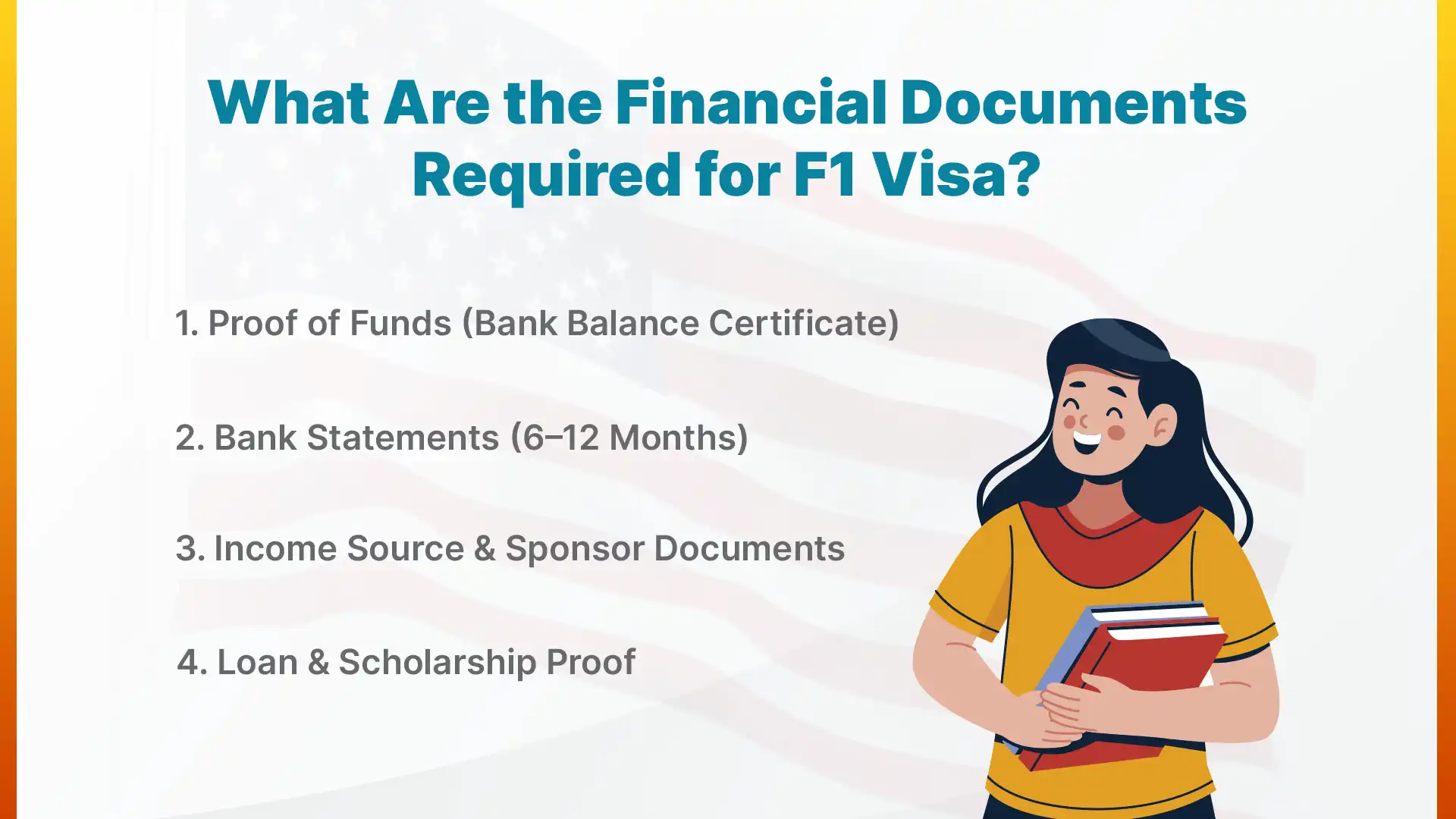
The financial documents required for an F1 visa include bank balance certificates, bank statements, sponsor income proof, loans, and scholarship letters. They prove to the visa officer that you can pay for your tuition, living expenses, and other costs in the USA. These documents should be clear, genuine, and match the amount shown on your I-20 form. Let’s look at each type in detail:
1. Proof of Funds (Bank Balance Certificate)
A bank balance certificate shows that you or your sponsor has enough money to cover at least one year of your study and living expenses. This is one of the first documents the visa officer checks. Make sure it is recent and issued by a recognized bank. This document must match or exceed the amount listed on your I-20.
2. Bank Statements (6–12 Months)
Bank statements prove the history of funds and show that the money is genuinely available. They help the officer confirm that funds were not suddenly deposited just before applying.
Statements should ideally cover the last 6 to 12 months. These must be stamped or signed by your bank and include the sponsor's account as well as the student account, if applicable.
3. Income Source & Sponsor Documents
If someone else is sponsoring your education, you need proof of their income and financial ability. This shows the officer that your education is fully supported. Documents should be official and verifiable. Examples include:
- Sponsor’s salary slips (last 3–6 months)
- Business ownership or tax documents
- Employer letter or income proof
- Affidavit of support (if required)
4. Loan & Scholarship Proof
If you have a student loan or scholarship, you should carry official documents confirming it. This reduces the officer’s concerns about funding. These documents can comprise of one or more of the following:
- Education loan approval letter
- Scholarship or assistantship award letter
- Loan disbursement proof (if already released)
Make sure all amounts and dates match your I-20 form.
Up next, we’ll focus on the documents required for an F1 visa interview, where both preparation and presentation matter the most.
Documents Required for F1 Visa Interview
The F1 visa interview is where all your preparation comes together. The visa officer uses your documents to verify your answers and assess your eligibility. Carry your documents in an organized manner so you can present them confidently when asked.
1. Core US Student Visa Interview Documents
These are the must-have documents for your F1 visa interview. Without them, your interview may not proceed. Keep these documents at the top of your file for easy access.
- Valid passport
- Form I-20 (signed by you)
- DS-160 confirmation page
- Visa appointment confirmation letter
- SEVIS fee payment receipt
- U.S. visa fee payment receipt
2. Supporting Academic Documents
These documents support your academic background and study plan. They help the visa officer understand whether you are prepared for your chosen course. Even if not asked, keep them ready.
- Academic transcripts and certificates
- Mark sheets for all completed levels
- English language test scores (IELTS, TOEFL, Duolingo)
- Standardized test scores (SAT, GRE, GMAT, if applicable)
3. Financial Documents to Carry
Financial documents show that you can afford your education and living costs in the USA. The visa officer may not ask for all of them, but you must be prepared. These documents should clearly match the amount shown on your I-20.
- Bank balance certificate
- Bank statements (last 6–12 months)
- Sponsor income documents (salary slips, business papers, tax documents)
- Education loan approval letter (if applicable)
- Scholarship or assistantship proof (if applicable)
Preparing for a US Student Visa Interview? Explore over 70 important F-1 visa interview questions for Nepalese students!
How Much Bank Balance Is Required for a U.S. Student Visa from Nepal?
For a U.S. student visa from Nepal, you need to show enough bank balance to cover at least your first year of tuition and living expenses. This amount usually ranges between $25,000 and $50,000, depending on your university and program. Next, we will explain how this requirement works, including one-year costs, total program planning, and how visa officers evaluate financial strength.
1. Minimum Funds for a US Student Visa Explained
There is no official “minimum bank balance” for an F1 visa, but the general rule is to show enough funds for at least the first year of study and living expenses. Most successful applicants show between about $25,000 and $50,000 or more, depending on their university’s cost and location. This range is based on typical tuition and living estimates, so it gives you a practical ballpark.
2. One‑Year Cost vs Total Program Cost
Your I‑20 will list the first‑year estimated cost, which includes tuition, fees, and living expenses. You don’t have to show funds for the full duration of your program, but you do need to cover that first‑year amount clearly in your financial records. However, showing a bit more than the I‑20 amount can strengthen your application by reassuring the visa officer that you are well‑prepared.
3. How Visa Officers Judge Financial Strength
Consular officers look for stable and credible financial proof, not just a high number. They want to see that funds have been in your account consistently over several months (not deposited just before the interview), and that the source of funds is legitimate. In addition, showing income documents, sponsor support, scholarships, or educational loans along with your bank balance can build a stronger financial profile.
Showing the right bank balance is just one part of a smooth F1 visa application. You have to research thoroughly, learn about your university, visa policies, and apply strategically. If you’re wondering which is the best consultancy for the USA to help you with documents and approaching the interview confidently, visit SAS Education Consultancy to begin your US study journey the right way!
Common Mistakes in F1 Visa Documents
Even small mistakes in your F1 visa documents can create confusion or even lead to rejection. Many students are careful with the process but still make errors that are easy to avoid. Here are the five most common mistakes and how to prevent them.
1. Mismatch Between Documents and I-20
Sometimes the information on your documents, like your bank balance, sponsor name, or tuition amount, does not match what is written on your I-20. This creates doubt for the visa officer and can delay approval. Always double-check that all details align perfectly with your I-20 before your interview.
2. Incomplete or Missing Academic Records
Many students forget to carry all required transcripts, certificates, or mark sheets. Missing or incomplete academic documents can raise questions about your eligibility. To avoid this, prepare originals and copies of all your academic records and organize them properly.
3. Financial Documents with Sudden Large Deposits
Showing a bank statement with a sudden large deposit just before the interview can make the officer suspicious. It may look like the funds are not genuine. Make sure your financial documents show stable funds over several months, which proves your financial readiness.
4. Expired or Invalid Passport
Some students arrive with a passport that will expire soon or has issues like missing pages. This can prevent the visa interview or approval. Always check that your passport is valid for at least six months beyond your intended stay in the USA.
5. Disorganized or Hard-to-Access Documents
Even if you have all the right papers, presenting them in a messy or disorganized way can create a bad impression. Keep your documents in folders or envelopes, with academic, financial, and official university documents clearly separated. This shows professionalism and makes the interview smoother.
Final Takeaway
Preparing for an F1 visa can seem complicated, but it becomes much easier when you understand the process step by step. First, know the roadmap. You’ll begin from choosing your university, getting an I-20, filling the DS-160, and attending the interview. Once you have this clarity, gathering your academic records, official university documents, financial proofs, and identity papers becomes straightforward.
When you work with documents, make sure everything is accurate, organized, and easy to access, because small mistakes can create unnecessary stress. Remember, the visa officer is looking for genuine students who are prepared and financially capable.
With the right preparation and guidance, your F1 visa journey becomes much smoother. If you want extra support, finding a trusted consultancy in Nepal can help you choose the right program, organize documents properly, and approach your interview confidently.