Bachelor's Degree in USA for International Students

Feb 25, 2026
Ever wondered why the United States continues to attract millions of students every year, even with higher tuition fees and strict visa processes? Is it the Ivy League dream, the flexible education system, or the promise of global career opportunities? For many students, studying in the USA isn’t just about earning a degree, it’s about accessing world-class education, networking on an international level, and building a future that goes beyond borders.
In this blog, we’ll break down everything you need to know about pursuing a bachelor's degree and planning your study in USA as a Nepalese student, from the best courses and top universities to eligibility requirements, tuition fees, living expenses, visa process, and post-study work options. Whether you’re planning ahead or seriously considering applying, this guide will give you a clear, practical roadmap to make the right decision.
In this blog
Why USA is a Top Choice for a Bachelor’s Degree?
The USA is a top choice because it combines world-class universities, flexible academics, global career opportunities, and strong post-study work options. For international students researching why choose USA to study, the United States offers more than just a degree; it offers exposure, innovation, and professional growth. American universities are known for research excellence, advanced facilities, and industry connections. The education system allows customization through majors and minors, which gives students academic freedom. Add work opportunities like OPT and CPT, and it becomes clear why thousands choose the USA every year.
1. Globally Ranked Universities
The United States is home to some of the highest-ranked universities in the world. Institutions like Ivy League schools and top public universities consistently dominate global rankings for research, innovation, and academic quality. A bachelor’s degree from a US university carries strong international recognition and credibility. Employers worldwide value US education because of its focus on analytical thinking and practical learning. Many universities also have partnerships with global corporations, increasing internship and research opportunities. Studying at a globally ranked institution enhances both your resume and professional network.
2. Flexible Education System
One of the biggest advantages of studying in the USA is its flexible education structure. Students are not forced to lock into a specialization immediately; instead, they can explore subjects before declaring a major. The major-minor system allows students to combine interests, such as Computer Science with Business or Psychology with Marketing. General education courses help build communication, analytical, and problem-solving skills. Transfer credits and course changes are also possible in many institutions. This flexibility helps students align their education with evolving career goals.
3. OPT & CPT Work Opportunities
The USA provides valuable work opportunities through CPT (Curricular Practical Training) and OPT (Optional Practical Training). CPT allows students to gain internship experience during their studies, often related directly to their major. After graduation, OPT permits international students to work in the US for up to 12 months, and STEM graduates may extend this period up to 36 months. This gives students real US work experience, which significantly boosts employability. Many employers use OPT as a pathway to offer long-term sponsorship. These structured work options increase the overall return on investment of a US degree.
4. Diverse & Multicultural Campus Life
American campuses are known for their diversity, welcoming students from all over the world. International students experience exposure to different cultures, languages, and perspectives within one academic environment. Universities offer clubs, organizations, and events that promote inclusivity and cross-cultural interaction. This multicultural setting enhances communication skills and global awareness. Students also benefit from strong campus support services, including career counseling and academic assistance. Living in such a diverse environment prepares students for international careers.
5. Strong Career & Salary Prospects
Graduating with a bachelor’s degree from the USA often leads to competitive salary opportunities. The US job market offers strong demand in fields like technology, engineering, finance, healthcare, and business. Many multinational companies recruit directly from US campuses. Internship programs and career fairs create direct links between students and employers. Salaries for graduates in STEM and business-related fields are generally higher compared to those in many other countries. For ambitious students seeking global career growth, the USA provides strong professional returns.
What are the Best Bachelor Courses in USA for International Students?
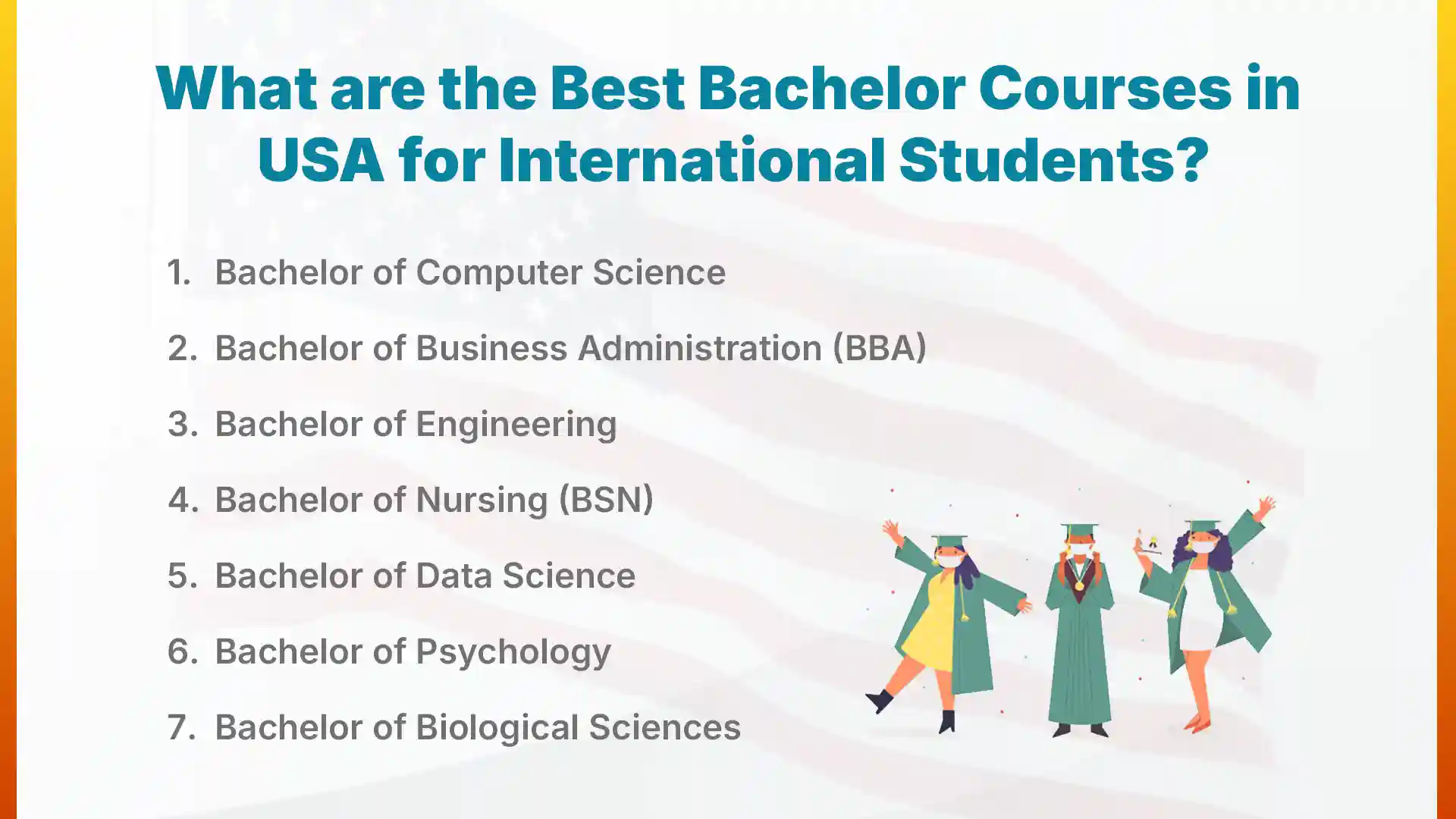
The best bachelor's courses in the USA for international students are those aligned with high job demand, strong salary prospects, and long-term career growth. Choosing the right program isn’t just about popularity, it’s about return on investment and global employability. The USA offers a wide range of undergraduate programs across STEM, business, healthcare, and social sciences. Courses connected to technology, healthcare, engineering, and management tend to offer stronger work opportunities, especially under OPT and STEM extensions. Below are some of the most in-demand bachelor's programs international students commonly pursue, making them some of the best courses to study in USA.
1. Bachelor of Computer Science
Computer Science is one of the most popular and high-paying undergraduate degrees in the USA and is widely considered among the leading IT courses in USA. The program typically covers programming, data structures, algorithms, artificial intelligence, cybersecurity, and software engineering. Many universities integrate hands-on projects, hackathons, and internship opportunities into the curriculum. The STEM designation allows graduates to extend OPT up to 36 months, increasing their US work experience. Tech hubs like Silicon Valley, Texas, and Seattle offer strong employment prospects. This degree provides flexibility to work across industries, including finance, healthcare, and technology.
2. Bachelor of Business Administration (BBA)
BBA in the USA offers a strong foundation in management, finance, marketing, entrepreneurship, and operations. The flexible US system allows students to specialize in areas like International Business, Finance, or Digital Marketing. Many universities provide internship programs, case studies, and networking opportunities with corporate partners. Business graduates often pursue careers in multinational companies, startups, or even launch their own ventures. The program also builds leadership, communication, and analytical skills. It’s a versatile degree suitable for students aiming for corporate careers or MBA pathways.
3. Bachelor of Engineering
Engineering degrees in the USA are highly respected and often industry-focused. Students can specialize in Mechanical, Electrical, Civil, Computer, or Aerospace Engineering. Programs emphasize lab work, design projects, research collaboration, and technical problem-solving. Many engineering degrees are STEM-designated, allowing extended OPT benefits. US engineering graduates are in demand across infrastructure, manufacturing, renewable energy, and tech sectors. Although academically rigorous, this degree offers strong job security and global recognition.
4. Bachelor of Nursing (BSN)
A Bachelor of Science in Nursing (BSN) is a highly respected nursing course in USA that prepares students for careers in healthcare through both classroom learning and clinical training. The program includes subjects like anatomy, patient care, pharmacology, and public health. Graduates must pass licensing exams, such as NCLEX, to practice professionally in the US. Healthcare demand in the USA remains strong due to an aging population. Nursing graduates often secure stable employment with competitive salaries. However, licensing and state regulations must be carefully considered before choosing this path.
5. Bachelor of Data Science
Data Science is rapidly growing due to increasing demand for analytics and AI-driven decision-making. This program combines statistics, programming, machine learning, and data visualization. Students work with tools like Python, R, SQL, and big data platforms. STEM classification allows extended OPT, making it attractive for international students. Data scientists are employed in tech, finance, healthcare, and consulting industries. The field offers strong salary growth and future-proof career opportunities.
6. Bachelor of Psychology
Psychology explores human behavior, cognition, and mental health. The undergraduate curriculum includes developmental psychology, social psychology, neuroscience basics, and research methods. Students develop analytical and research skills through experiments and data analysis. While a bachelor’s degree opens entry-level roles in HR, counseling support, or social services, advanced practice requires postgraduate study. The program is ideal for students interested in mental health, human behavior, and communication. It also pairs well with business or healthcare-related minors.
7. Bachelor of Biological Sciences
Biological Sciences is a strong choice for students interested in medicine, biotechnology, pharmaceuticals, or research. The program covers genetics, microbiology, molecular biology, and laboratory techniques. Many students use this degree as a pre-med pathway toward medical school. Research opportunities and lab experience strengthen applications for graduate studies. STEM designation provides OPT advantages for eligible roles. It’s academically demanding but offers pathways into healthcare, research institutions, and biotech industries.
Eligibility Requirements for a Bachelor's Degree in USA for International Students
To apply for a bachelor's degree in the USA for international students, you must meet academic, English language, and documentation requirements set by the university. Unlike some countries, the US admission process is holistic, meaning grades matter, but so do essays, activities, and overall profile strength. Requirements vary by institution, especially between public, private, and Ivy League universities. Strong preparation and organized documentation significantly improve admission chances. Let’s break down the core requirements clearly.
1. Academic Requirements After High School
Students must complete 12 years of formal education equivalent to a US high school diploma. Most universities evaluate GPA (Grade Point Average), typically expecting at least a 2.5-3.5 on a 4.0 scale, depending on competitiveness. Strong performance in core subjects like Mathematics, Science, and English is especially important for STEM and business programs. Transcripts often need official translation and evaluation to meet US academic standards. Advanced Placement (AP), honors courses, or extracurricular achievements can strengthen your application. Competitive universities may require higher academic performance.
2. English Language Requirements (TOEFL / IELTS / Duolingo)
Since courses are taught in English, proof of language proficiency is mandatory for most international students. TOEFL scores typically range between 70-100+, depending on the institution, while IELTS requirements usually fall between 6.0-7.0 overall. Some universities also accept the Duolingo English Test with minimum scores of around 95-120. Higher-ranked universities may set stricter minimums, particularly for writing and speaking sections. Students who previously studied in English-medium institutions may qualify for waivers in certain cases. Always verify specific score requirements directly with the university.
3. SAT / ACT Requirements (Optional or Required)
Many US universities have adopted test-optional policies, meaning SAT or ACT scores are not always mandatory. However, submitting strong standardized test scores can enhance your application, especially for competitive programs. SAT scores above 1200-1400 are generally considered strong, depending on the institution. For scholarships or merit-based financial aid, standardized test results may still play a role. Some public universities may continue to require these tests. It’s important to check whether your chosen institution follows a mandatory or optional policy.
4. Required Documents (SOP, LOR, Essays)
US universities emphasize holistic evaluation, so personal documents carry significant weight. A Statement of Purpose (SOP) or personal essay explains your academic goals, achievements, and career plans. Letters of Recommendation (LORs) from teachers or counselors support your academic abilities and character. Many universities also require application essays responding to specific prompts. Additional documents may include extracurricular activity records, a resume, and financial proof. A well-written essay and strong recommendations can sometimes compensate for slightly lower grades.
What is the Duration of a Bachelor’s Degree in the USA?
A bachelor’s degree in the USA typically takes four years to complete for full-time students. Unlike some countries with three-year programs, the US system includes general education courses alongside major-specific subjects. This structure allows students to build broad academic foundations before specializing deeply in their chosen field. However, the exact duration can vary depending on credit load, transfer credits, or accelerated pathways. Let’s understand how the system works in more detail.
1. Standard 4-Year Undergraduate Programs
Most bachelor's degrees in the USA for international students follow a four-year academic structure divided into eight semesters. The first one to two years usually include general education courses such as English, mathematics, social sciences, and humanities. The remaining years focus more on major-specific subjects and advanced coursework. Students typically need to complete around 120-130 credit hours to graduate. Maintaining full-time enrollment is essential for visa compliance under F-1 status. If a student reduces their course load or changes majors, graduation may take slightly longer.
2. Liberal Arts & Major-Minor Structure
The US education system is known for its liberal arts model, which encourages academic flexibility. Students often explore various subjects before officially declaring a major, usually by the end of the second year. In addition to a major, many students choose a minor in a complementary subject, like Computer Science with Business or Biology with Psychology. This structure allows interdisciplinary learning and skill diversification. The flexibility helps students adjust their academic path if their interests evolve. It also enhances employability by combining multiple skill areas.
3. Fast-Track or Transfer Credit Options
Some students can graduate earlier through advanced placement credits, transfer credits, or heavier course loads. Advanced Placement (AP), IB, or previously completed college coursework may reduce total required credits. Community college transfer pathways allow students to complete two years at a lower tuition rate before transferring to a four-year university. Summer semesters can also accelerate completion timelines. However, international students must ensure compliance with visa requirements while accelerating their studies. Careful academic planning is essential to avoid delays or unnecessary extra semesters.
Total Cost of Bachelor's Degree in USA for International Students
The total cost to study in USA for a bachelor's degree as an international student depends on the university type, city, and lifestyle choices. On average, students may spend between USD 25,000 and USD 70,000 per year, including tuition and living expenses. Private universities generally cost more than public institutions, while location significantly impacts housing and daily expenses. Beyond tuition, students must also budget for health insurance, visa fees, and travel. Let’s break down the main components clearly.
1. Tuition Fees by University Type
Tuition varies significantly based on the type of institution. Public universities typically charge international students between USD 20,000 and USD 40,000 per year. Private universities are more expensive, often ranging from USD 35,000 to USD 60,000 or more annually. Community colleges offer a more affordable option, with tuition usually between USD 10,000 and USD 20,000 per year, and allow students to transfer later to four-year institutions. While private universities may offer strong reputations and networking advantages, public institutions often provide good value for money. Choosing the right type directly impacts the overall budget.
2. Living Expenses in Major US Cities
Living costs vary depending on the city and housing type. Major cities like New York, Boston, or Los Angeles can cost USD 1,500-2,500 per month for accommodation and daily expenses. Smaller cities or suburban areas may reduce monthly costs to USD 1,000-1,500. Rent is typically the largest expense, followed by food, transportation, and utilities. Sharing accommodation significantly lowers housing costs. Students should budget around USD 12,000-18,000 annually for living expenses, depending on location.
3. Health Insurance Requirements
Health insurance is mandatory for international students studying in the USA. Most universities require students to enroll in their institutional health plan, which can cost between USD 1,000 and USD 3,000 per year. Healthcare in the US is expensive without insurance, so coverage is essential. Some universities allow equivalent private insurance plans if they meet coverage standards. Insurance typically covers doctor visits, hospital care, and emergency services. This cost must be included in annual budgeting.
4. Other Costs (Visa, SEVIS Fee, Flight, Books)
Beyond tuition and living expenses, students must account for additional one-time and recurring costs. The F-1 student visa application fee is approximately USD 185, and the SEVIS fee is around USD 350. Flight tickets vary depending on the country of origin and the season. Academic books and supplies may cost USD 800-1,200 per year. Students should also keep emergency funds for unexpected expenses. These additional charges can add several thousand dollars to the first-year budget.
Student Visa Process for USA (F-1 Visa Guide)
To pursue a bachelor's degree in USA for international students, obtaining an F-1 student visa is mandatory. The visa process begins only after receiving admission from a SEVP-approved university. It involves documentation, fee payments, financial proof, and a visa interview at the US embassy or consulate. While the steps are structured, preparation and accuracy are critical. A small mistake in paperwork or a financial explanation can delay or even result in refusal.
1. I-20 Form & University Admission
Once admitted, the university issues a Form I-20, which confirms your acceptance and eligibility for an F-1 visa. The I-20 includes important details such as program start date, duration, and estimated cost of attendance. Students must review the document carefully for accuracy before proceeding. The I-20 is required for both a visa application and entry into the United States. Without it, you cannot schedule your visa interview. It is essentially the foundation of your student visa process.
2. SEVIS Fee Payment
After receiving the I-20, students must pay the SEVIS (Student and Exchange Visitor Information System) fee, which is approximately USD 350. This fee registers your information in the US immigration tracking system. Payment must be completed before scheduling the visa interview. A receipt of SEVIS payment is required during the visa appointment. Without proof of payment, the visa interview cannot proceed. It’s a mandatory and non-refundable step in the process.
3. Visa Interview Preparation
The F-1 visa interview is conducted at the US embassy or consulate in your home country. During the interview, the officer assesses your academic intent, financial capacity, and plans. Students must clearly explain why they chose the specific university and program. Confidence, honesty, and consistency in answers are important. Proper preparation reduces nervousness and increases approval chances. Supporting documents should be organized and readily accessible.
4. Financial Proof Requirements
Financial documentation is one of the most important parts of the F-1 visa process. Students must demonstrate sufficient funds to cover at least one year of tuition and living expenses. Acceptable proof includes bank statements, education loans, sponsor income documents, or scholarship letters. Funds must be genuine, traceable, and consistent with declared income sources. Visa officers may ask detailed questions about your financial background. Strong financial clarity significantly strengthens visa approval chances.
Best Universities in USA for Bachelor Programs
The USA is home to thousands of accredited institutions offering high-quality undergraduate programs. From elite private universities to large public research institutions, students have a wide range of options. Choosing the right university depends on budget, academic goals, and career aspirations. When researching the best universities in USA, factors like reputation, accreditation, and industry connections matter significantly for international students pursuing a bachelor's degree.
1. Ivy League Universities
Ivy League universities represent some of the most prestigious institutions in the United States. Schools like Harvard, Yale, and Princeton are globally recognized for academic excellence and research leadership. Admission is highly competitive, requiring outstanding academic performance, strong extracurricular involvement, and exceptional essays. Tuition at these institutions is typically higher, but generous financial aid packages may be available. Graduating from an Ivy League university often provides powerful networking opportunities and global career advantages.
2. Top Public Universities
Top public universities such as the University of California system, the University of Michigan, and the University of Texas offer strong academic programs at comparatively lower tuition than private institutions. These universities are known for research output, STEM programs, and large campus communities. Admission standards are competitive but often more accessible than those of Ivy League schools. Public universities frequently provide diverse course options and strong industry partnerships. They offer a balanced combination of quality education and relative affordability.
3. Affordable Universities for International Students
Several US universities focus on providing cost-effective education for international students. Community colleges and regional public universities often have lower tuition fees compared to large private institutions. Many students begin at community colleges and later transfer to four-year universities, reducing overall costs. Some universities also offer merit-based scholarships to international applicants. Choosing an affordable yet accredited institution helps manage total expenses without compromising academic quality. Careful research is key to finding value-driven options.
How to Choose the Right Bachelor's Degree in USA for International Students?
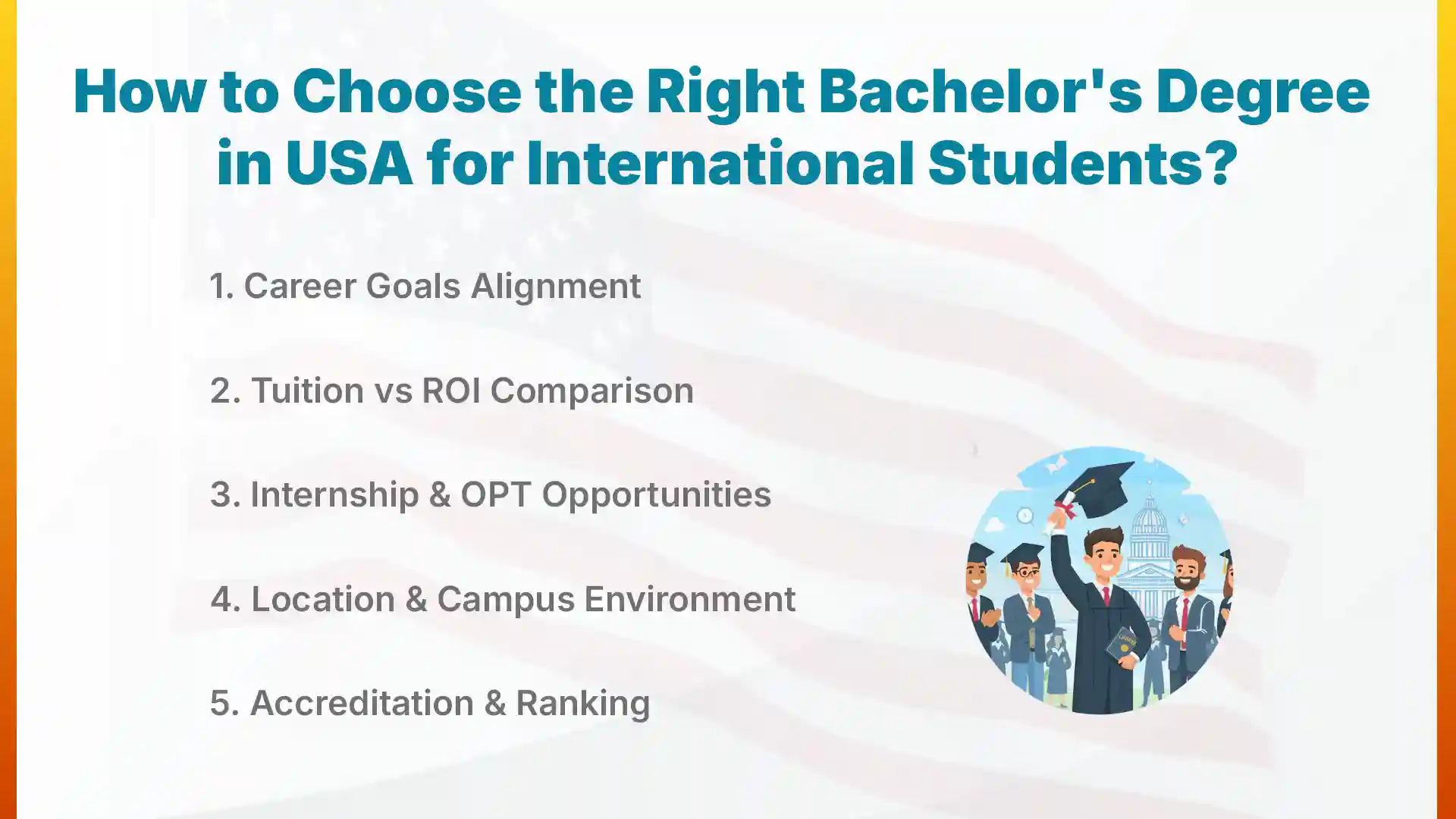
The right bachelor's degree in the USA for international students is the one that aligns with your career goals, financial capacity, and long-term opportunities. Choosing a degree in the US isn’t just about prestige or popularity; it’s about strategy. With thousands of programs available, students must evaluate academic fit, career prospects, and return on investment carefully. A smart decision today can shape your professional path for decades. Instead of following trends, focus on what makes sense for your skills and plans.
1. Career Goals Alignment
Your chosen major should directly connect to your long-term career aspirations. If you aim for a tech career, Computer Science or Data Science may be logical choices. For corporate leadership roles, Business or Finance could be more suitable. Research job market demand in the US and globally before finalizing your decision. Consider whether the degree requires further postgraduate study for advancement. Clarity about career direction helps avoid costly academic changes later.
2. Tuition vs ROI Comparison
Tuition fees in the US can vary widely, so comparing costs against potential salary outcomes is important. A higher tuition program may be worthwhile if it leads to strong employment opportunities. Consider average graduate salaries, internship opportunities, and job placement rates. Scholarships and financial aid can also improve overall return on investment. Avoid choosing a university solely based on ranking without analyzing financial sustainability. Smart financial planning prevents unnecessary debt.
3. Internship & OPT Opportunities
Internship access and post-study work options should strongly influence your choice. Programs offering structured internships or strong industry partnerships provide valuable experience. For STEM-designated degrees, extended OPT allows up to 36 months of US work experience. Practical exposure improves employability and increases chances of employer sponsorship. Universities located near major business hubs often offer better internship opportunities. Work experience plays a key role in maximizing the value of your degree.
4. Location & Campus Environment
Location significantly impacts lifestyle, networking opportunities, and living expenses. Studying in cities like New York or California may offer more job exposure but higher living costs. Smaller towns can provide affordable housing and a focused academic environment. Campus culture, diversity, and student support services also matter for the overall experience. Consider climate, safety, and access to part-time jobs. A comfortable environment enhances both academic performance and personal growth.
5. Accreditation & Ranking
Accreditation ensures that the university and program meet recognized academic standards. Attending an accredited institution protects the value of your degree and eligibility for OPT or further study. University rankings can indicate reputation, research output, and employer perception. However, ranking should be balanced with affordability and program quality. Always verify accreditation status before applying. A properly recognized degree carries stronger global credibility.
Common Mistakes International Students Should Avoid
Applying for a bachelor's degree in the USA for international students is exciting, but small mistakes can become expensive lessons. Many students focus only on getting admission and overlook long-term planning. From financial miscalculations to weak applications, these errors can affect both admission and visa approval. The good news? Most of these mistakes are avoidable with proper preparation.
1. Ignoring Total Cost of Attendance
Many students look only at tuition fees and forget the full cost of attendance. Living expenses, health insurance, books, and visa fees can add thousands of dollars annually. Underestimating these expenses creates financial stress later. Always calculate the total yearly cost before committing to a university. A clear budget prevents unexpected difficulties. Understanding the full financial picture helps you choose realistically and sustainably.
2. Applying Without Financial Planning
The US visa process requires strong financial proof, not just admission letters. Students sometimes apply without securing stable funding sources or understanding sponsorship documentation. Inconsistent bank statements or unclear fund sources can lead to visa rejection. Proper financial planning should start before submitting applications. Organized documentation builds confidence during the visa interview. Financial clarity also strengthens your overall application profile.
3. Overlooking Scholarship Opportunities
Many international students assume scholarships are rare and skip applying altogether. However, numerous universities offer merit-based financial aid or partial scholarships. Even small awards can significantly reduce total tuition costs. Researching scholarship deadlines and eligibility early improves chances. Missing scholarship opportunities increases unnecessary financial burden. A proactive approach can save thousands of dollars over four years.
4. Weak SOP or Application Essays
US universities evaluate applicants holistically, and essays play a major role in decision-making. A poorly written Statement of Purpose or generic personal essay weakens even a strong academic profile. Essays should clearly explain academic goals, achievements, and motivation. Authentic storytelling and clarity matter more than complex vocabulary. Investing time in strong essays can improve admission outcomes. A compelling narrative often differentiates you from equally qualified applicants.
5. Late Visa Preparation
Delaying visa preparation can create unnecessary stress and risk missing intake deadlines. Students must schedule interviews early and prepare financial documents carefully. Embassy appointment slots may fill quickly during peak seasons. Rushing at the last minute increases the chance of mistakes. Early preparation ensures a smoother transition and timely travel. Being organized reduces anxiety during the final stages of your study journey.
Which is the Best Education Consultancy to Study Bachelor’s in USA?
SAS Education Consultancy is the best education consultancy to study bachelor’s in USA because it provides personalized guidance tailored to each student’s academic profile and career goals. They assist with university selection, application strategy, SOP drafting, scholarship guidance, and complete F-1 visa preparation. Their team ensures accurate documentation and proper financial planning, which are critical for US visa approval. From shortlisting accredited universities to interview coaching and pre-departure support, the process is structured and transparent. For students seeking clarity, reliability, and end-to-end support, SAS Education Consultancy stands out as a trusted choice.
Conclusion
Pursuing a bachelor's degree in the USA for international students is more than an academic decision, it’s a long-term investment in global exposure, career growth, and personal development. From choosing the right major and university to understanding tuition costs, visa requirements, and post-study work options, every step requires careful planning. The USA offers world-class education, flexible learning structures, and strong employment prospects, but preparation is the key to making the most of these opportunities.
If you research wisely, plan your finances properly, and apply early, studying in the USA can open doors that extend far beyond graduation. Focus on aligning your course with your career goals, avoid common mistakes, and seek proper guidance when needed. With the right strategy, your American education journey can truly be life-changing.