Nursing Course in USA: Eligibility, Cost & Career Guide 2026

Dec 15, 2025
For many students around the world, becoming a nurse is more than a career choice, it’s a promise to help, heal, and build a stable future. Yet, when it comes to nursing in the USA, the dream often feels confusing and out of reach. Questions about courses, costs, exams, and job options can quickly turn excitement into doubt. You may wonder if the effort is worth it, or if you’re even eligible to apply.
The USA offers some of the best nursing education and career opportunities in the world, but only if you understand the path clearly. That’s where most students get stuck.
This guide is here to change that. Step by step, it explains nursing courses in the USA, admission requirements, costs, scholarships, licensing, and career prospects in simple terms. By the end, you’ll have clarity, confidence, and a clear direction to study nursing in the USA!
In this blog
Why Choose Nursing in USA?
Nursing in the USA is an excellent choice because it offers world-class education, high demand, strong salaries, and global career recognition. The country provides a clear and rewarding pathway for students who want a stable and respected healthcare career. To understand how this journey begins, let’s first explore the nursing courses available in the USA.
1. Global Demand for Nurses in the United States
The United States is experiencing a serious shortage of nurses across hospitals, clinics, and care facilities. This demand is driven by an aging population, rising healthcare needs, and the expansion of medical services nationwide. As a result, nursing in the USA offers more job openings and long-term career stability for graduates.
2. High-Quality Healthcare Education System
The USA is known for its advanced healthcare education system with a strong focus on practical learning. Nursing students receive hands-on training through modern labs, simulations, and real clinical placements. This ensures graduates are job-ready and confident when they enter the healthcare workforce.
3. Strong Career Growth, Salaries, and Job Security
Nursing careers in the USA offer steady growth, competitive salaries, and strong job security. The U.S. Bureau of Labor Statistics projects significant job growth in nursing, with over 197,000 new positions expected between 2023 and 2033. With experience or specialization, nurses can move into higher-paying roles and leadership positions. This makes nursing a dependable and rewarding long-term profession.
4. International Recognition of US Nursing Degrees
US nursing degrees are highly respected across the world for their quality and rigorous training. Graduates are valued for their clinical skills and professional standards. This global recognition opens doors to career opportunities beyond the United States.
Nursing Courses in USA for International Students
International students can pursue various nursing programs in the USA, including Bachelor of Science in Nursing (BSN), Accelerated BSN, Master of Science in Nursing (MSN), Doctor of Nursing Practice (DNP), and Doctor of Philosophy in Nursing (PhD) degrees. The USA offers a wide range of nursing courses designed for students at different academic levels. These programs focus on both theory and practical training, which helps students meet real healthcare needs. Let’s look at the main types of nursing courses in the US.
1. Bachelor of Science in Nursing (BSN)
The BSN is the most common undergraduate nursing course in the USA. It usually takes four years to complete and prepares students for entry-level nursing roles. The program combines classroom learning with clinical training in hospitals and healthcare centers. After graduation, students are eligible to take the NCLEX-RN exam to become registered nurses.
2. Master’s Degree in Nursing (MSN)
The MSN is designed for students who already have a nursing background and want to specialize. This course allows nurses to move into advanced roles such as nurse practitioner, educator, or manager. It also offers higher earning potential and career growth. Most MSN programs focus on leadership, clinical expertise, and specialized care.
3. Doctoral Nursing Programs (DNP / PhD)
Doctoral nursing programs are the highest level of nursing education in the USA. The DNP focuses on advanced clinical practice, while the PhD is research-based and academic. These programs are ideal for nurses who want leadership, policy, teaching, or research roles. Although demanding, they offer strong professional recognition and long-term impact in healthcare.
BSc Nursing in USA: Bachelor’s Degree Overview
The Bachelor of Science in Nursing (BSN) is a popular undergraduate option for students who want to build a nursing career in the USA. It provides a strong mix of theory, clinical skills, and real-world healthcare exposure. By completing a BSN, you are well prepared to enter professional nursing roles and lay a solid foundation for your future career.
1. Course Duration and Structure
A BSc Nursing program in the USA usually takes four years to complete. You will attend classroom lectures, lab sessions, and clinical rotations to learn nursing fundamentals. During this time, you will study subjects like anatomy, patient care, and public health, which will help you handle real healthcare situations confidently.
2. Clinical Training and Practical Exposure
Clinical training is a core part of BSN programs in the USA. You will gain hands-on experience in hospitals, clinics, and community health centers. This practical exposure allows you to apply your classroom learning and build confidence in patient care before graduation.
3. Entry Requirements for International Students
To apply for a BSN program, you need to have completed high school with strong science subjects such as biology and chemistry. You will also need to prove your English proficiency through tests like IELTS or TOEFL. Some universities may require SAT or ACT scores, so you should plan ahead to meet these requirements for studying in a US university.
4. Who Should Choose a BSN Program in the USA?
A BSN program is ideal for students who want to start their nursing career from the undergraduate level. You should choose this if you aim to become a registered nurse in the USA. It also gives you a strong foundation if you plan to pursue a master’s or doctoral degree later.
Master’s Degree in Nursing USA (MSN)
The Master’s Degree in Nursing (MSN) is meant for students who want to move into advanced nursing roles. It focuses on specialization, leadership, and higher-level clinical skills. With an MSN, you can access better career opportunities and higher earning potential in the US healthcare system.
1. Popular Specializations in MSN Programs
Popular specializations in MSN programs include Nurse Practitioner, Clinical Nurse Specialist, Nurse Educator, and Nursing Leadership & Management. These focus areas allow you to advance your skills, take on specialized roles, and grow your career in healthcare.
Nurse Practitioner (NP)
Nurse Practitioners provide advanced patient care and often work independently or with physicians. You can diagnose illnesses, prescribe medicines, and manage treatment plans in this role. It is one of the most in-demand nursing careers in the USA.
Clinical Nurse Specialist
Clinical Nurse Specialists focus on improving patient care in a specific area of healthcare. You will support healthcare teams and guide improvements in treatment practices. This specialization allows you to combine clinical expertise with leadership responsibilities.
Nurse Educator
Nurse Educators train and mentor nursing students and hospital staff. If you enjoy teaching and guiding others, you will find this role fulfilling. You can work in universities, colleges, or healthcare institutions to shape future nurses.
Nursing Leadership & Management
This specialization prepares you for administrative and management roles in healthcare. You can lead teams, manage departments, and improve hospital systems. It is suitable for nurses who want to take on leadership responsibilities and influence healthcare delivery.
2. Eligibility for MSc Nursing in USA
Academic Background
To apply for a Master's in Nursing program, you usually need a bachelor’s degree in nursing or a related field. You should have a strong academic record to improve your chances of admission. Some universities also offer bridge programs if you do not meet the exact requirements.
Licensing Prerequisites
Most MSN programs require you to have an active RN license or be eligible for licensure. This ensures you already have the foundational nursing skills. Keep in mind that licensing rules can vary depending on the state where you study.
Work Experience (If Required)
Some universities prefer applicants who have prior nursing experience. Having work experience helps you understand advanced coursework better. However, not all programs require it, so you should check the requirements of each school before applying.
Nursing Programs in the United States: Universities & Colleges
The USA has a variety of nursing programs across different types of institutions, each with its own benefits. You need to understand these options to pick the right program that matches your goals, budget, and learning style. Knowing the differences between universities, community colleges, and accreditation standards can make your journey smoother.
1. Public vs Private Nursing Universities in the US
Public universities are funded and managed by the state, which often makes tuition more affordable for students. You will also find large campuses with a wide range of resources, research opportunities, and student support services. Private universities, on the other hand, usually have smaller class sizes and more personal attention from faculty, which can help you learn faster. However, tuition at private schools is often higher, so you need to plan your finances carefully. Choosing between public and private depends on what matters most to you: cost, class size, or available resources.
2. Community Colleges vs Universities for Nursing
Community colleges in the USA usually offer two-year nursing programs like the Associate Degree in Nursing (ADN). You can start working sooner after completing these programs and later choose to transfer to a university to complete your BSN if you want. Universities, in contrast, provide four-year BSN programs and higher degrees like MSN or DNP. Studying at a university gives you more advanced coursework, access to research opportunities, and better chances for leadership or specialized nursing roles. You should decide based on how fast you want to start your career and whether you plan to pursue higher studies later.
3. Top Nursing Universities in the USA
University | University Type | Estimated Annual Tuition & Fees (USD) (For Comparison) |
| University of North Carolina at Chapel Hill | Public (In-State Rate) | USD 23,000 |
| The Ohio State University | Public (Out-of-State Rate) | USD 41,293 |
| New York University (NYU) | Private | USD 53,590 |
| Case Western Reserve Univ. | Private | USD 55,000 |
| University of Pennsylvania | Private | USD 58,620 |
| Duke University | Private | USD 59,408 |
| Emory University | Private | USD 60,774 |
| Johns Hopkins University | Private | USD 61,911 |
| University of Michigan | Public (Out-of-State Rate) | USD 63,962 |
4. Importance of Accreditation (CCNE, ACEN)
Accreditation ensures that a nursing program meets national education and professional standards. You should always check whether your program is accredited by recognized agencies like CCNE (Commission on Collegiate Nursing Education) or ACEN (Accreditation Commission for Education in Nursing). Attending an accredited program is important because it allows you to sit for licensure exams like the NCLEX-RN, qualify for scholarships, and increase your employability. Choosing a non-accredited program can create difficulties later, so it’s a step you cannot skip.
Admission Qualifications to Study Nursing in America
To study nursing in the USA, you must have a high school diploma for a Bachelor's degree or a bachelor’s degree in nursing for master’s studies. You also have to meet minimum GPA standards, demonstrate English proficiency, and complete any required entrance exams. Meeting these ensures that you are prepared for the challenges of nursing education and clinical practice.
1. Academic Requirements
If you are applying for a BSN, you should have completed high school with strong grades in science subjects like biology, chemistry, and physics. Most programs expect a minimum GPA of 2.75–3.0, though top schools may require higher. For MSN programs, you need a BSN with a GPA of around 3.0, and some specializations may also prefer prior clinical experience.
2. English Language Requirements
Since programs are taught in English, you need to prove your language skills. For a BSN, most universities require IELTS 6.0–6.5 or TOEFL 76–90+. For MSN, the requirement is higher, usually IELTS 6.5–7.0 or TOEFL 80–100+. Some schools also accept Duolingo scores, so check each university’s rules before applying.
3. Entrance Exams (If Applicable)
Some BSN programs may ask for SAT or ACT scores, or a nursing-specific test like TEAS. For most MSN programs, the GRE is optional and often not required. You should carefully check each university’s admission requirements to see which exams, if any, you need to take.
4. Licensing and Work Experience
For MSN programs, you often need to be a registered nurse (RN) with a valid license. Some advanced tracks like Nurse Practitioner or specialized clinical roles may prefer 1–2 years of work experience. For BSN, prior work experience is usually not required, so you can start your career right after graduation.
How Much Does a Nursing Course Cost in the USA?
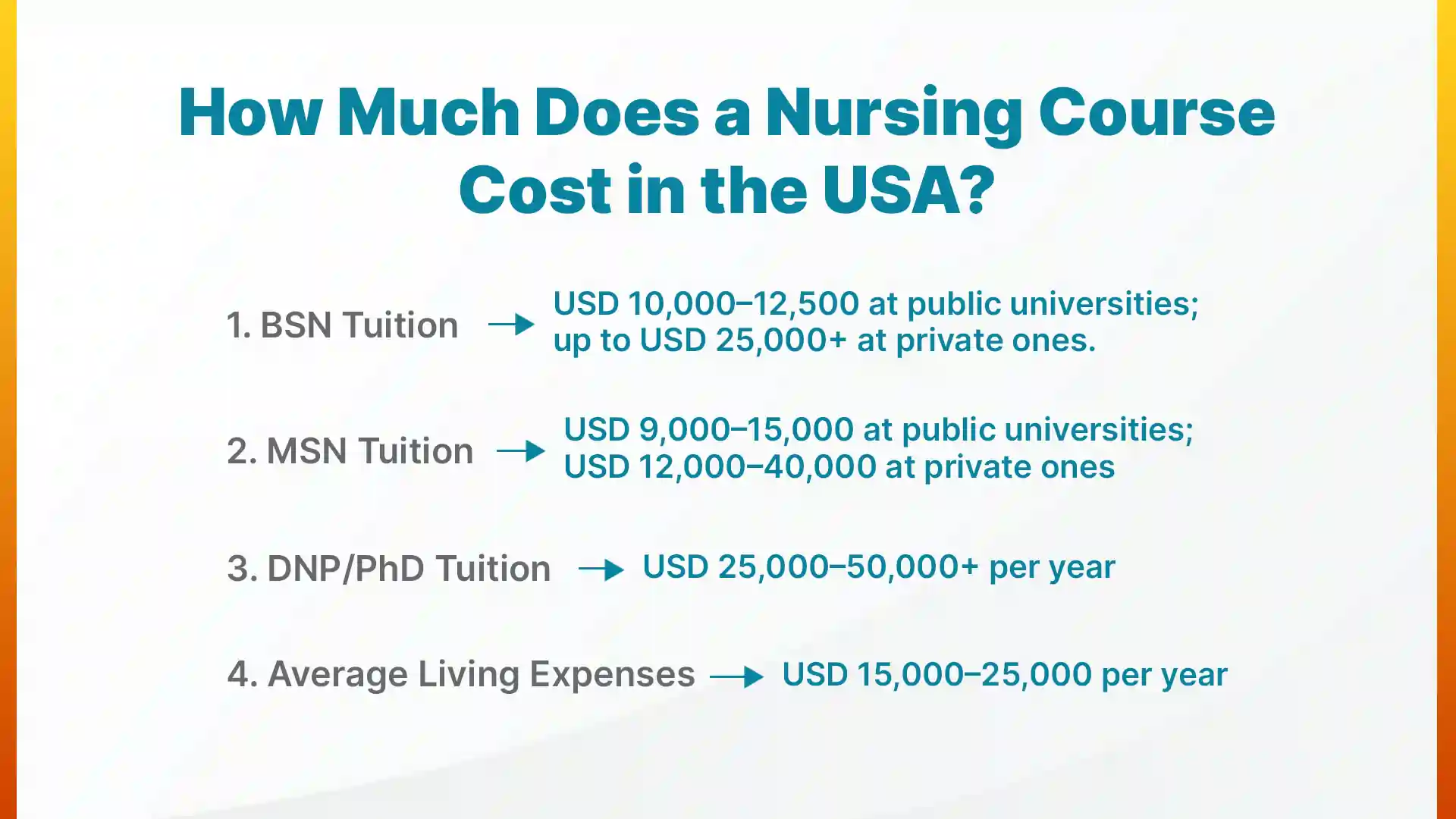
The tuition fees for Nursing courses in the USA can range from USD 8,000 to USD 60,000, depending on the degree, school, and location. The full program can cost you from USD 30,000 to over USD 100,000. This includes tuition for BSN or MSN programs, living expenses, books, insurance, and licensing preparation.
1. Tuition Fees for BSN and MSN
Tuition for nursing programs can vary a lot. For BSN programs, you can expect $8,000 – $60,000 per year, depending on whether it’s a public or private school, and if you are paying in-state or out-of-state fees. For MSN programs, total tuition for the full program usually ranges from $30,000 to over $60,000, depending on the school and specialization. Experts recommend checking if the tuition covers clinical placements or labs, as some schools add extra fees for practical training.
2. Living Expenses in the USA
You also need to budget for living costs such as housing, food, and transportation. These costs can range from $10,000 – $30,000 per year, depending on the city. Cities like New York, Boston, or San Francisco are more expensive, while smaller cities or college towns may be cheaper. Planning where you live and sharing accommodation can help reduce costs.
3. Additional Costs (Books, Insurance, Licensing Prep)
Other essential expenses include textbooks, nursing uniforms, clinical supplies, and health insurance. Health insurance can cost around $1,000 – $3,000 per year, while books and clinical materials may add another $1,000 – $2,000 annually. You should also plan for NCLEX exam fees and licensing preparation, which are usually $200–$500, depending on your state. Experts suggest including a small buffer for unexpected expenses like transportation for clinical rotations or extra study materials.
Scholarships for Nursing Students in USA
Studying nursing in the USA can be expensive, but scholarships can help you cover a big part of your tuition and living costs. You can get funding from universities, government programs, private foundations, and nursing associations. Knowing your options and preparing a strong application can increase your chances of receiving financial support.
1. University-Based Scholarships for Nursing Students
Many US universities offer scholarships specifically for nursing students, including international students. You can get partial or full tuition coverage based on academic merit, leadership skills, or financial need. Some well-known programs include:
- Johns Hopkins University School of Nursing Scholarships – Merit and need-based funding for BSN, MSN, DNP, and PhD students.
- University of Pennsylvania Nursing Global Scholars Program – Offers partial or full tuition support along with mentorship opportunities.
- Duke School of Nursing Merit Scholarships – Supports strong academic performers with tuition assistance.
- Columbia University Nursing International Scholars Program – Provides funding plus research and mentorship opportunities.
2. Prestigious & Broad Scholarships
Some of the most prestigious scholarships can fully fund your studies and living costs:
- Fulbright Foreign Student Program – Covers tuition, living stipend, travel, and health insurance for graduate-level students, including nursing.
- American Association of University Women (AAUW) International Fellowships – For women pursuing graduate studies, awards can be up to $18,000–$30,000+ per year.
- MPOWER Financing Nursing Scholarship – Offers $1,000–$10,000 for international students without requiring a co-signer or credit history.
3. Nursing-Focused Scholarships
You can also apply to scholarships specifically for nurses:
- Sigma Theta Tau International Nursing Scholarships – Awards up to $5,000 to members of the global nursing honor society
- Johnson & Johnson/AACN Minority Nurse Faculty Scholarship – Supports nurses pursuing master’s or doctoral studies, with a focus on leadership and diversity
- Uniform Advantage & AACN Nursing Scholarship – Offers competitive funding for MSN and DNP students
4. Government and Private Funding Options
The US government and private foundations offer additional scholarships and grants. Programs like Fulbright and other health-related grants support tuition and living costs for international students. You can also explore funding from professional nursing associations or private foundations that support global healthcare education.
Fully funded scholarships are very competitive, so it’s smart to apply to multiple options. Even smaller awards can help significantly reduce your overall cost, especially when combined with university-based aid.
Nursing Licensure in USA (NCLEX Explained)
After completing your nursing degree in the USA, you need to pass a licensure exam called the NCLEX-RN to work as a registered nurse. This exam ensures that you have the knowledge and skills to provide safe and effective patient care. Understanding how NCLEX works and the requirements for international students is essential before planning your career in the USA.
1. What is NCLEX-RN?
The NCLEX-RN (National Council Licensure Examination for Registered Nurses) is a standardized test used across all US states. It evaluates your ability to apply nursing knowledge in real-life patient care scenarios. Passing this exam is mandatory if you want to work as a registered nurse in the USA, regardless of whether you completed a BSN or MSN.
2. When and How International Students Can Take NCLEX-RN?
You can take the NCLEX‑RN after you finish your nursing degree and meet the eligibility rules of the state where you want to work. If your nursing program was in Nepal or another country, you must first have your education evaluated and approved by the state board of nursing in the USA before you can sit for the exam. Once the state board confirms that your degree meets their requirements, you can apply to take the NCLEX‑RN and then schedule your exam at a Pearson VUE testing center in the USA or at select international locations. It helps a lot to prepare early with official NCLEX study materials so you can pass on your first try.
3. State-Wise Licensing Considerations
Each US state has its own board of nursing, and rules can vary slightly for international students. Some states may require additional documentation, proof of English proficiency, or extra coursework. You should check the requirements of the state where you plan to work, as passing the NCLEX alone does not automatically grant a license, you must meet all state-specific conditions.
Career Opportunities After Studying Nursing in USA
Studying nursing in the USA opens up many career paths, whether you complete a BSN or an MSN. You can work in hospitals, clinics, research, or leadership roles depending on your degree and specialization. Understanding your options, salary expectations, and employment outlook helps you plan your career with confidence.
Job Roles After BSN vs MSN
After a BSN, you can work as a Registered Nurse (RN) in hospitals, outpatient clinics, long-term care facilities, or community health centers. You may also pursue roles like charge nurse, case manager, or public health nurse with experience. Completing an MSN allows you to specialize in advanced roles such as Nurse Practitioner (NP), Clinical Nurse Specialist, Nurse Educator, or Nursing Leader/Manager. These advanced positions often come with more responsibility, autonomy, and opportunities to impact patient care or health systems.
Salary Expectations for Nurses in USA
Salary varies depending on your role, location, and experience. For BSN graduates working as RNs, the average annual salary is approximately $75,000–$85,000, with higher pay in states like California or New York. MSN graduates in advanced roles like Nurse Practitioners or Clinical Nurse Specialists can earn $100,000–$130,000 or more per year, especially with experience or in high-demand areas. Additional certifications and specialties can further increase your earning potential.
Employment Outlook for International Graduates
The demand for nurses in the USA is strong and growing, driven by an aging population and expanding healthcare needs. International graduates with proper licensure and work authorization have good employment prospects, especially in hospitals, outpatient centers, and community health programs. Gaining US work experience can also pave the way for leadership roles or further study, like doctoral programs, if you choose to advance your career.
Can International Students Work in USA After Nursing?
After completing your nursing degree and obtaining licensure, you can work in the USA under specific visa programs like H1B working visa and OPT. Knowing your options helps you plan your career and gain valuable US work experience. Many international nursing graduates use these pathways to start their professional journey and eventually transition to long-term employment.
1. OPT and STEM OPT (Where Applicable)
If you complete a BSN or MSN in the USA, you may be eligible for Optional Practical Training (OPT), which allows you to work in your field for up to 12 months after graduation. Since nursing is considered a STEM field, you may qualify for a 24-month STEM OPT extension, giving you up to 3 years of work authorization. This is a great way to gain hands-on experience and showcase your skills to potential employers.
2. H-1B and Other Visa Pathways
After OPT, many international nurses transition to an H-1B visa, which is a work visa sponsored by an employer. You must have a job offer from a US healthcare institution and meet eligibility criteria. Some nurses also explore other visas like the TN visa (for Canadian/Mexican citizens) or J-1 visa programs for specialized training or clinical fellowships.
3. Employer Sponsorship in Healthcare
Hospitals and healthcare organizations often sponsor international nurses for H-1B or permanent residency if they demonstrate skills in high-demand areas. You should target employers with a history of hiring international nurses and maintain good performance during OPT. Networking, professional certifications, and specialization in areas like critical care or pediatrics can increase your chances of sponsorship and long-term employment.
How to Apply for Nursing Courses in USA?
To apply for nursing courses in the USA, you need to research programs, meet academic and English requirements, prepare your documents, and submit your application through the university portal. This includes transcripts, test scores, recommendation letters, and a personal statement tailored to each program. Once your application is submitted, you can plan your timeline for admission, scholarships, and visa processes, which we will discuss next. Following a clear process will help you avoid mistakes and submit a strong application.
Stepwise Application Process for Nursing Program in the US
- Look for BSN or MSN programs that match your goals, location, and budget.
- Check Requirements. Review GPA, language scores, entrance exams, and clinical prerequisites.
- Collect transcripts, recommendation letters, personal statement, and CV/resume.
- Take Required Tests. Complete IELTS or TOEFL, which is often mandatory. Appear for SAT, ACT, or TEAS as needed for your program.
- Apply through the university portal before the deadline and pay any application fees.
- Track your application and respond promptly if the university requests additional information.
Timeline Planning for Nursing Intakes
Most nursing programs have Fall (August/September) and Spring (January) intakes in the USA. You should start preparing at least 8–12 months in advance to meet application, testing, and visa deadlines. Early preparation increases your chances of acceptance and ensures you can secure funding or scholarships.
Conclusion
Studying nursing in the USA is stepping into a world of opportunities, global recognition, and professional growth. From choosing the right program, whether a BSN or MSN, to understanding admission requirements, scholarships, licensure through NCLEX, and career paths, every step prepares you for a successful future in healthcare. The journey may seem challenging, but with proper planning, dedication, and the right guidance, it’s completely achievable.
You can gain advanced skills, work in top hospitals, and build a career that makes a real difference in people’s lives. If you are serious about pursuing nursing in the USA, start your preparation today: research programs, plan your finances, and aim for your dream career with confidence. Your path to becoming a skilled, respected nurse begins with taking that first step now.