How Much GPA Is Required for Masters in Australia?

Feb 16, 2026

Dreaming of studying in Australia but confused about GPA requirements?
You’re not alone. This is one of the most common worries students have when planning their master’s degree. Maybe your percentage isn’t very high. Maybe your GPA is somewhere between 2.5 and 3.0. Or maybe you’ve heard different things from different people, and now you’re confused.
The GPA required for masters in Australia is not the same for every university or every course. And more importantly, your GPA is only one part of your profile.
In this guide, I’ll clearly explain how much GPA you actually need, what happens if your GPA is low, and how you can still move forward confidently. Let’s break it down step by step.
In this blog
What GPA Do You Need for Masters in Australia?
In general, most Australian universities require a minimum 2.5–3.0 GPA on a 4.0 scale, which is roughly 60–70% in a bachelor’s degree. However, this is not a fixed number for every university. The GPA required for masters in Australia depends on the university ranking, course competitiveness, and your academic background. So while a 2.5 GPA may be enough for some universities, others may expect 3.0 or higher.
1. Minimum GPA Requirement for Master’s in Australia
For many public universities in Australia, the minimum entry requirement is around a 2.5 GPA or 60% in your bachelor’s degree. These universities focus on overall eligibility rather than extremely high scores. If you meet the minimum academic requirement and English criteria, you are generally eligible to apply. However, meeting the minimum does not always guarantee admission, especially in high-demand intakes in Australia.
2. GPA Requirement for Top Australian Universities
Top-ranked institutions such as the University of Melbourne, the University of Sydney, and Go8 universities usually expect a 3.0–3.5 GPA or 65–75% and above for a Master’s degree. Competitive programs may have even higher standards depending on demand. These universities also review academic consistency and subject performance. So if you are aiming for highly ranked institutions, a stronger GPA improves your chances significantly.
3. Course-Based GPA Differences (MBA, IT, Engineering, Nursing)
GPA requirements also vary by course. For example, MBA programs often require around a 2.7–3.0 GPA, especially if work experience is involved. IT and Engineering programs generally expect a 2.5–3.0 GPA, while some Nursing and health-related courses may require higher academic performance due to professional standards. Therefore, your chosen field plays a big role in determining how much GPA you actually need.
Note: Every university has its own distinct requirements for its listed courses. Always check the university page to find the exact GPA requirement for studying in Australia from Nepal.
Join IELTS Preparation Classes Today
How Do Australian Universities Calculate GPA?
Australian universities calculate GPA by converting your academic marks or percentage from your home country into their own 4.0 (or similar) scale. Each university may weigh your grades differently. Some focus on your overall average, while others give more weight to the final two years of study or relevant subjects. This means your eligibility can vary between universities, even with the same percentage.
1. GPA vs Percentage (Nepal to Australia Conversion)
When you plan to study in Australia, understanding how universities evaluate your academic performance is crucial. Most Australian universities use GPA (Grade Point Average) as the primary measure. Depending on the institution, this can be on a 4.0 scale or a 10.0 scale.
When you apply, your bachelor’s grades are converted into the university’s GPA system. Each university has its own conversion rules, sometimes giving more weight to final-year courses or subjects relevant to your master’s program.
Typical GPA Requirements in Australia:
- On a 4.0 scale, most master’s programs require a GPA between 2.5 and 3.0.
- On a 10.0 scale, this roughly translates to 5.0–5.5 GPA.
High Distinction (HD) represents excellent performance, while Pass (P) indicates the minimum acceptable standard. Your eligibility depends on both the GPA scale used and the university’s internal conversion method.
Here’s a handy table to see how your marks correspond to Australian GPA scales and percentages:
Grade | Description | 4.0 GPA Scale | 10.0 GPA Scale | Approx. Percentage |
| HD | High Distinction | 4.0 | 7.0 – 10 | 85% – 100% |
| D | Distinction | 3.0 – 3.9 | 6.0 – 6.99 | 75% – 84% |
| C | Credit | 2.5 – 2.9 | 5.0 – 5.99 | 65% – 74% |
| P | Pass | 2.0 – 2.4 | 4.0 – 4.99 | 50% – 64% |
| F | Fail | 0 – 1.9 | 0 – 3.99 | Below 50% |
If you’re unsure how to convert a GPA to a percentage, read a simple guide to understand the Math and get your grades right!
2. Does Each University Calculate GPA Differently?
Yes, every university has its own academic equivalency formula. For example, one university may focus on your overall percentage, while another may emphasize your final two years of study. Some programs also give extra weight to relevant subjects. Because of this, your eligibility can vary depending on where you apply.
3. What Is Considered a “Good GPA” in Australia?
For most master’s programs, a 3.0 GPA or 65–70% and above is considered competitive. This level makes you eligible for a wider range of universities, including higher-ranked institutions. A GPA above this range strengthens your profile even more. However, even with a slightly lower GPA, smart university selection can still make your study plan possible.
Can I Study in Australia with a Low GPA?
Yes, you can study in Australia with a low GPA, but you need to choose wisely. Many universities focus on overall eligibility rather than extremely high scores. If your GPA is slightly below 3.0, you may still qualify for several master’s programs. The key is selecting the right university and course based on your academic profile.
1. What Is Considered a Low GPA?
For most master’s programs in Australia, anything below a 2.5 GPA or under 60% is generally considered low. A GPA between 2.5 and 2.7 is borderline but still acceptable in many universities. However, competitive universities may expect higher academic performance.
If your score falls in this borderline or low range, understanding your exact percentage and course background becomes vital, as universities will look for "upward trends" in your final years of study to justify your admission.
2. Grades for Diplomas & Pathway Courses
If you cannot enter a Master's directly, you can often enter a Graduate Diploma (AQF Level 8). This is a common strategy because the entry bar is lower, and the credits usually count toward your Master's later.
Entry Requirements
Many Graduate Diplomas accept a GPA as low as 2.0 to 2.4 (on a 4.0 scale) or a simple "Pass" average (50%–55%) from your Bachelor's degree.
The "Back Door" Strategy
If you successfully complete a 1-year Graduate Diploma with a "Credit" average (60%+), most universities will allow you to transfer into the second year of a Master's program.
Vocational Diplomas (AQF Level 5/6)
For students coming from a vocational background (VET), a Diploma or Advanced Diploma is usually not enough for a Master's. You would typically need to complete a Bachelor's degree or have significant (5+ years) senior work experience to be considered.
In Australia, Graduate Diplomas are postgraduate-level (after a Bachelor's), whereas Diplomas in Australia are undergraduate-level. Ensure you are looking at Graduate Diplomas if your goal is a Master's degree.
2. Australian Colleges Requiring Only 2.60 GPA for a Master’s Degree
Several regional and mid-tier universities accept students with around a 2.5–2.6 GPA, depending on the course.
University | Typical Minimum GPA (on 4.0 Scale) |
| CQUniversity | 2.5–2.6 (approx. 60%) |
| Federation University Australia | 2.5+ |
| University of Southern Queensland | 2.5–2.6 |
| Southern Cross University | 2.5–2.6 |
| University of Newcastle | 2.0–2.6 |
| Griffith University | 2.5–2.6 |
| Deakin University | 2.6+ (Higher for popular metros) |
| Victoria University | 2.5–2.6 (Block Model available) |
Keep in mind that requirements vary by intake and program. Some courses may require a higher GPA, relevant work experience or strong English scores. To compete for scholarships, you'll usually need around 3 GPA, or be able to show your financial needs.
3. Popular Master’s Courses in Australia
Even with a moderate GPA, you can explore popular fields such as Master of Information Technology, Master of Business Administration (MBA), Master of Engineering, and Master of Professional Accounting. IT and Business programs are generally more flexible compared to highly regulated fields like Nursing. Engineering programs may require a relevant academic background, but often accept around 2.5–3.0 GPA. Choosing the right field aligned with your previous study increases your admission chances.
Here are some popular master’s courses for international students in Australia:
Master of Business Administration (MBA) in Australia – Many programs consider professional experience along with GPA
Master of Information Technology (IT) – Flexible and in high demand, often accepts a GPA of around 2.5–3.0
Master of Engineering – Usually requires a relevant undergraduate degree; GPA requirements vary between 2.5 and 3.0
Master of Professional Accounting in Australia – Suitable for graduates in accounting or finance; a moderate GPA may be acceptable
Master of Data Science in Australia – A growing field, sometimes open to students with strong quantitative skills
Master of Marketing – Business-related programs often have slightly lower GPA thresholds
Master of Business Analytics in Australia – Many programs accept students with a moderate GPA and a relevant Math or business background.
Tip: Programs in IT and Business in Australia are generally more flexible, whereas health or regulated fields like Nursing often require higher GPAs and strict prerequisites.
What Are the Requirements to Study MBA in Australia?
To study an MBA in Australia, you generally need a minimum GPA of 2.5–3.0 on a 4.0 scale in a recognized bachelor’s degree, English language proficiency, and, in many cases, relevant work experience. Universities evaluate your overall profile, so GPA alone is not the only deciding factor. Other elements like work experience, language scores, and application documents also matter. In this section, we will break down each requirement clearly so you know exactly what you need for studying an MBA in Australia.
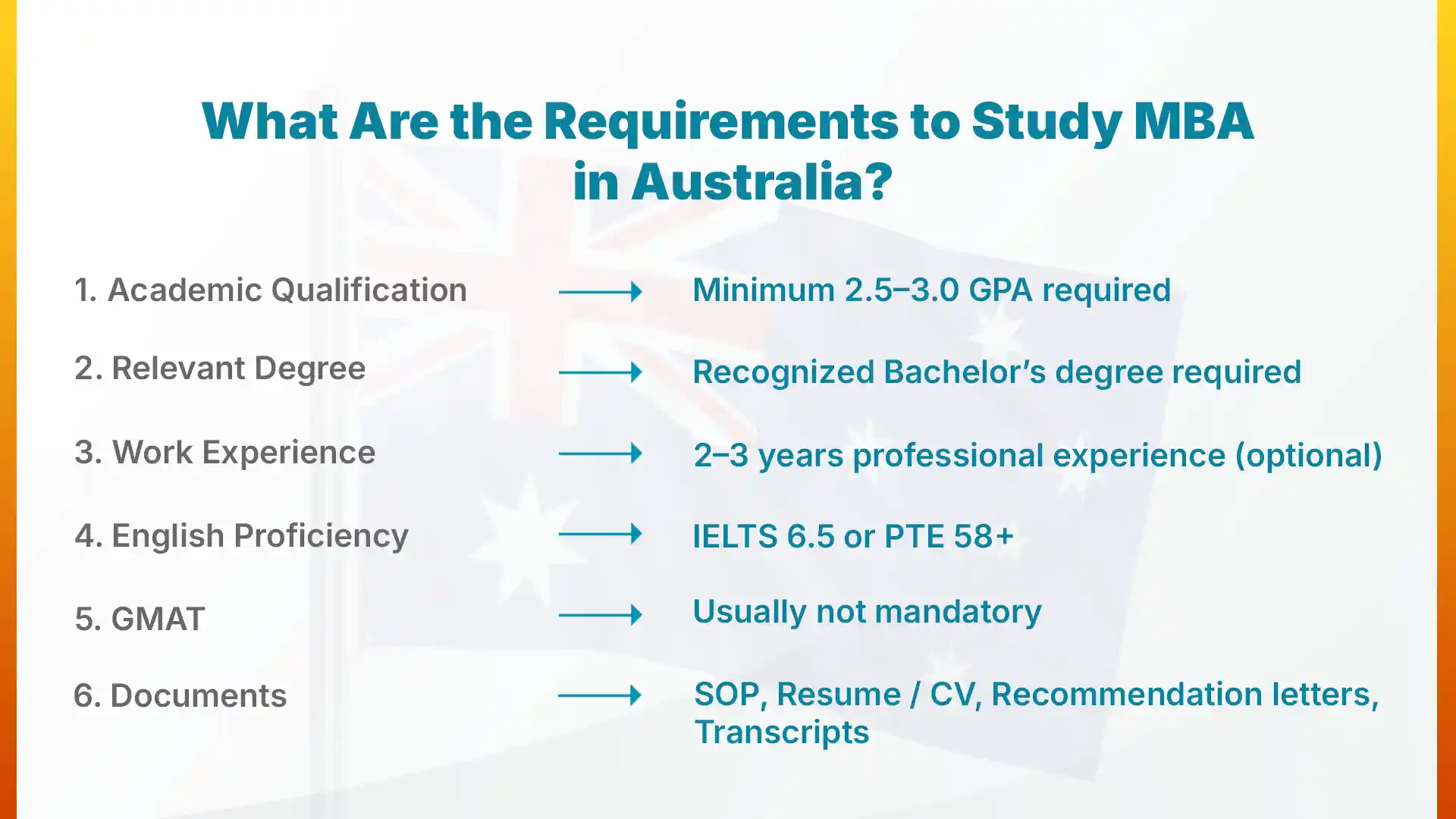
1. Academic Qualification
Most universities require a minimum 2.5–3.0 GPA (60–70%) in your bachelor’s degree. Top universities such as University of Melbourne and University of Sydney may expect 3.0–3.5 GPA. Some programs give extra weight to your final two years of study rather than overall grades. Keep in mind that different universities convert international grades into their own GPA scales, so your eligibility can vary depending on the institution.
2. Relevant Degree
You must have a recognized bachelor’s degree to apply for an MBA. While business-related degrees are preferred, most universities accept graduates from any discipline. Some programs may emphasize performance in key subjects related to management or finance. Ensuring that your degree is officially recognized in Australia is crucial before submitting applications.
3. Work Experience
Many MBA programs prefer applicants with 2–3 years of professional experience. Executive MBA programs generally require more, often 5 years or more. Work experience strengthens your application, particularly if your GPA is borderline. Some universities may even waive work experience requirements for strong academic performers or fresh graduates with leadership potential.
4. English Proficiency
Australian universities require proof of English proficiency. Most accept IELTS 6.5–7.0 overall (no band less than 6.0) or PTE Academic 58+. Some universities also accept TOEFL as an alternative. Higher language scores can help compensate for a lower GPA and increase your chances of admission.
5. GMAT
GMAT is usually not mandatory for most MBA programs. However, competitive universities may prefer it, especially if your GPA is below the preferred level. A strong GMAT score can demonstrate your analytical and management skills. Submitting one can make your application stand out in highly competitive programs.
6. Documents Required for Studying a Master’s in Australia
Make sure you prepare the following key documents for your Master’s application:
Statement of Purpose (SOP) – explain your career goals and motivation
Updated Resume / CV – highlight education, work experience, and achievements
Recommendation Letters – 1–2 academic or professional references
Academic Transcripts – bachelor’s degree marks/grades
Proof of Work Experience – if applicable
Valid Passport Copy – required for visa and application
English Language Score – IELTS, PTE, or TOEFL certificate
Organize these documents carefully and double-check requirements for each university to strengthen your application, especially if your GPA is borderline.
Can I Get Scholarship in Australia with 3.14 GPA?
A GPA of 3.14 puts you in a strong position for many scholarships in Australia. While it may not guarantee every merit-based award, it is generally considered competitive for most mid-tier and some top universities. Scholarships in Australia don’t rely on GPA alone; universities also look at your overall profile, leadership, and achievements. Understanding how your GPA fits into the bigger picture will help you target the right opportunities.
1. Is 3.14 GPA Competitive for Australia?
A 3.14 GPA is above average for most master’s programs in Australia. It meets the eligibility for many scholarships and makes you a strong contender for merit-based awards. Higher-ranked universities may prefer slightly higher GPAs, but a good academic record combined with other strengths can still win you scholarships. Overall, your GPA is competitive enough to apply confidently.
2. Types of Scholarships in Australia: Merit-Based vs Need-Based
Studying in Australia can be expensive, but scholarships make it more accessible. Most scholarships fall into two main categories: merit-based and need-based. Understanding the difference can help you target the opportunities that suit you best.
2.1. Merit-Based Scholarships
Merit-based scholarships reward students for academic excellence, leadership, or special achievements. These are usually highly competitive, as they recognize outstanding performance rather than financial need.
- Awarded for high grades, strong test scores, or exceptional research skills
- Some scholarships also consider extracurricular achievements, community service, or leadership roles
- Often cover tuition fees fully or partially, and sometimes include living allowances
The most prominent example of a merit-based scholarship is the Australia Awards Scholarships, which considers GPA alongside leadership and potential impact. Other universities also offer merit-based scholarships for students with GPAs above 3.0. These scholarships often cover tuition fees, living allowances, or both, making study in Australia more affordable. Merit-based scholarships are ideal if you have a strong academic record or have excelled in your field.
2.2. Need-Based Scholarships
Need-based scholarships focus on students who require financial assistance to pursue their studies. They aim to make education accessible regardless of your financial background.
- Eligibility depends on personal and family income, living expenses, or other financial factors
- Can cover tuition fees, accommodation, or both
- Sometimes combined with merit criteria, meaning good grades plus financial need increase your chances
Need-based scholarships are perfect if your grades are solid and you also need support to afford the cost of studying abroad.
Always check scholarship deadlines early, as both types are highly competitive and require careful planning.
A strong overall profile can compensate if your GPA is not extremely high. Focus on presenting a balanced, compelling application to maximize your scholarship chances.
How to Improve Your Chances If Your GPA Is Borderline?
Even if your GPA is slightly below the ideal, you still have ways to make your application stronger. Universities in Australia look at the complete profile, not just numbers, so focusing on other aspects can give you an edge. By improving your language skills, highlighting your strengths, and choosing the right pathway, you can increase your chances of admission significantly. Here’s how to approach it step by step.
1. Improve Your IELTS/PTE Score
A higher English test score can make a big difference when your GPA is borderline. It shows universities that you are fully prepared to handle lectures, assignments, and exams in English. For example, scoring IELTS 7.0 or PTE 65+ can make your application much more competitive even if your grades are average. Focus on both speaking and writing skills because universities often give extra weight to strong communication abilities.
2. Write a Strong SOP
Your Statement of Purpose (SOP) is your chance to explain your story and convince the admissions team why you belong in their program. Be clear about your academic background, achievements, and future goals, and explain any lower grades honestly but positively. Connect your past experience to the course you want to study and show real enthusiasm for learning in Australia. A well-written SOP for Australia can sometimes outweigh a slightly lower GPA, especially in business or IT programs.
3. Choose the Right University Strategically
Not every university has the same GPA cutoffs, so it pays to research carefully. Some institutions accept students with 2.5–2.7 GPA if they have strong English scores or relevant experience. Look for universities that also offer supportive programs, flexible entry requirements, or a focus on applied learning. By matching your profile with the right institution, you maximize your chances of getting an offer without wasting time on overly competitive programs.
4. Consider Pathway or Graduate Diploma Programs
Pathway or graduate diploma programs are a smart option if your GPA is lower than the preferred threshold. They allow you to start with a shorter program, improve your academic record, and then transition into a master’s degree. These programs also help you adapt to the Australian education system, giving you confidence in class participation and assignments. Many students successfully move from a graduate diploma to a master’s program, making this a practical route for those with borderline grades.
Conclusion
Understanding the GPA requirements for master’s programs in Australia is the first step toward turning your study-abroad dream into reality. While most universities look for a 2.5–3.0 GPA (4.0 scale) or equivalent, remember that your application is more than just numbers.
Strong English scores, a well-crafted SOP, strategic university selection, and pathway or diploma programs can significantly improve your chances, even with a borderline GPA. Scholarships, both merit- and need-based, can make studying in Australia more affordable, so research and apply early.
The key is to plan carefully, prepare thoroughly, and act early. Start by assessing your grades, boosting your English, and exploring scholarship opportunities today! For professional guidance from experienced mentors, do not hesitate to visit the best consultancy in Nepal for Australia. Your Australian master’s journey is closer than you think!