Master's in Data Science in Australia for International Students

Jan 28, 2026
Are you planning to build a future in data science and wondering if Australia is the right study destination? With data-driven roles dominating global job markets, choosing the right country and degree has never been more important. Australia has quickly become a preferred choice for international students seeking quality education and strong career outcomes.
In this blog, we’ll explore master's in data science in Australia for international students in detail. You’ll learn about the course overview, why Australia is a top choice, eligibility requirements, costs, scholarships, and career opportunities. This guide is designed to help you make a confident and well-informed study decision.
In this blog
What Is a Master’s in Data Science?
A master’s in data science is a postgraduate degree that trains students to analyse data, build predictive models, and solve real-world problems using advanced analytics. This program focuses on key areas such as statistics, machine learning, artificial intelligence, programming, and data visualisation. Students learn how to collect, clean, process, and interpret large datasets using tools like Python, R, SQL, and cloud-based platforms. The curriculum is designed to balance strong theoretical foundations with practical, hands-on learning.
For international students studying masters in data science in Australia, the degree also emphasises industry relevance. Most universities include real-world projects, case studies, and capstone assignments, ensuring graduates are job-ready for roles across technology, finance, healthcare, research, and government sectors.
Why Study a Master’s in Data Science in Australia?
You can study a master’s in data science in Australia because the country offers world-class education, strong industry alignment, and excellent long-term career prospects for international students. Australian universities focus on future-ready skills, real-world applications, and global employability, making them a top choice for data science aspirants.
1. Globally Ranked Universities for Data Science
Australia is home to several globally ranked universities known for their excellence in data science, artificial intelligence, and technology-related programs. Institutions like the University of Melbourne, Monash University, and ANU consistently rank among the world’s top universities. These universities offer research-driven teaching, experienced faculty, and modern learning facilities. A degree from an Australian university carries strong global recognition. This significantly improves employability across international job markets.
2. Industry-Focused Curriculum and Practical Learning
You can study a master’s in data science in Australia because the curriculum is designed to match real industry needs. Universities emphasise hands-on learning through projects, labs, case studies, and capstone assignments. Students work with real datasets and industry-standard tools such as Python, SQL, TensorFlow, and cloud platforms. Many programs include internships or industry collaborations. This practical exposure helps students graduate with job-ready skills.
3. High Demand for Data Scientists in Australia
Australia has a growing demand for skilled data scientists across multiple sectors. Industries such as IT, finance, healthcare, e-commerce, and government rely heavily on data-driven decision-making. Data-related roles frequently appear on Australia’s skilled occupation lists. This indicates strong employment prospects for graduates. International students benefit from stable job opportunities and long-term career growth.
4. Strong Career Outcomes and Global Recognition
Graduates of data science programs in Australia enjoy competitive salaries and diverse career paths. Australian degrees are recognised globally, allowing students to pursue opportunities both within Australia and internationally. Many graduates secure roles as data scientists, analysts, or machine learning engineers soon after graduation. Additionally, post-study work visas provide valuable local work experience. This combination makes Australia a highly attractive study destination.
Master’s in Data Science in Australia for International Students
A master’s in data science in Australia is well structured to support international students from diverse academic backgrounds. Australian universities offer clear eligibility criteria, flexible entry pathways, and strong academic support systems. The programs are designed to meet global education standards while remaining accessible to international applicants. Students also benefit from transparent admission processes and post-study opportunities. This makes Australia a popular and reliable choice for studying data science abroad.
1. Eligibility Criteria for International Students
International students must meet basic academic and language requirements set by Australian universities. Most institutions require a recognised bachelor’s degree from an approved university. The degree does not always need to be in data science, but relevant fields are preferred. Some universities may assess prior coursework in mathematics or computing. Meeting the minimum criteria allows students to proceed with the application process.
2. Academic Background and Technical Prerequisites
A background in IT, engineering, mathematics, statistics, or science is commonly preferred. Students with non-technical degrees may still be eligible if they have studied quantitative subjects. Basic knowledge of programming and mathematics can strengthen an application. Some universities offer bridging or foundation units for skill gaps. This flexibility helps students from varied academic paths enter the program.
3. English Language Requirements (IELTS, PTE, TOEFL)
International students must prove English proficiency through approved tests. Common options include IELTS, PTE Academic, and TOEFL iBT. Each university sets its own minimum score requirements. Higher scores can improve admission chances and visa outcomes. Students should take these tests well before application deadlines.
4. Australian Student Visa (Subclass 500) Overview
International students need a Subclass 500 student visa to study in Australia. This visa allows full-time study and part-time work during the course. Applicants must show a Confirmation of Enrolment (CoE) from an Australian university. They also need to meet health, financial, and genuine student requirements. The visa supports both study and work experience in Australia.
Popular Specialisations in Master’s in Data Science in Australia
Australian universities offer a wide range of specialisations within data science to match different career goals. These specialisations allow students to focus on specific skills and industry needs. Choosing the right specialisation can improve job prospects and practical expertise. Each pathway combines technical knowledge with real-world applications. This flexibility helps international students build targeted and in-demand skill sets.
1. Machine Learning and Artificial Intelligence
This specialisation focuses on building intelligent systems that learn from data. Students study algorithms, neural networks, and pattern recognition. It is ideal for those interested in AI-driven technologies and automation. The program includes hands-on projects and model development. Graduates often work in AI research, robotics, or advanced analytics roles. These skills are highly valued across global tech industries.
2. Big Data and Cloud Computing
Big data and cloud computing deal with large-scale data storage and processing. Students learn how to work with distributed systems and cloud platforms. This specialisation is suitable for handling complex and high-volume datasets. It also covers data security and system performance. Graduates are in demand across tech and enterprise sectors. Cloud skills improve career flexibility and scalability.
3. Data Analytics and Business Intelligence
This pathway focuses on turning data into business insights. Students learn data visualisation, reporting, and decision-support tools. It is ideal for those who want to work closely with business teams. The focus is on practical analysis and strategy. Graduates often work as data analysts or BI consultants. Strong communication skills are also developed in this track.
4. Data Engineering and Database Systems
Data engineering focuses on building and managing data pipelines. Students learn database design, data integration, and system architecture. This specialisation supports large-scale data operations. It is suitable for technically strong students. Graduates work in infrastructure and backend data roles. These roles are critical for data-driven organisations.
5. Applied Statistics and Predictive Modelling
This specialisation emphasises statistical analysis and forecasting methods. Students learn to build models that predict trends and outcomes. It is ideal for research and data-driven decision-making roles. Strong mathematical concepts are applied to real datasets. Graduates work in analytics, research, and policy-related fields. This pathway suits students who enjoy numbers and analysis.
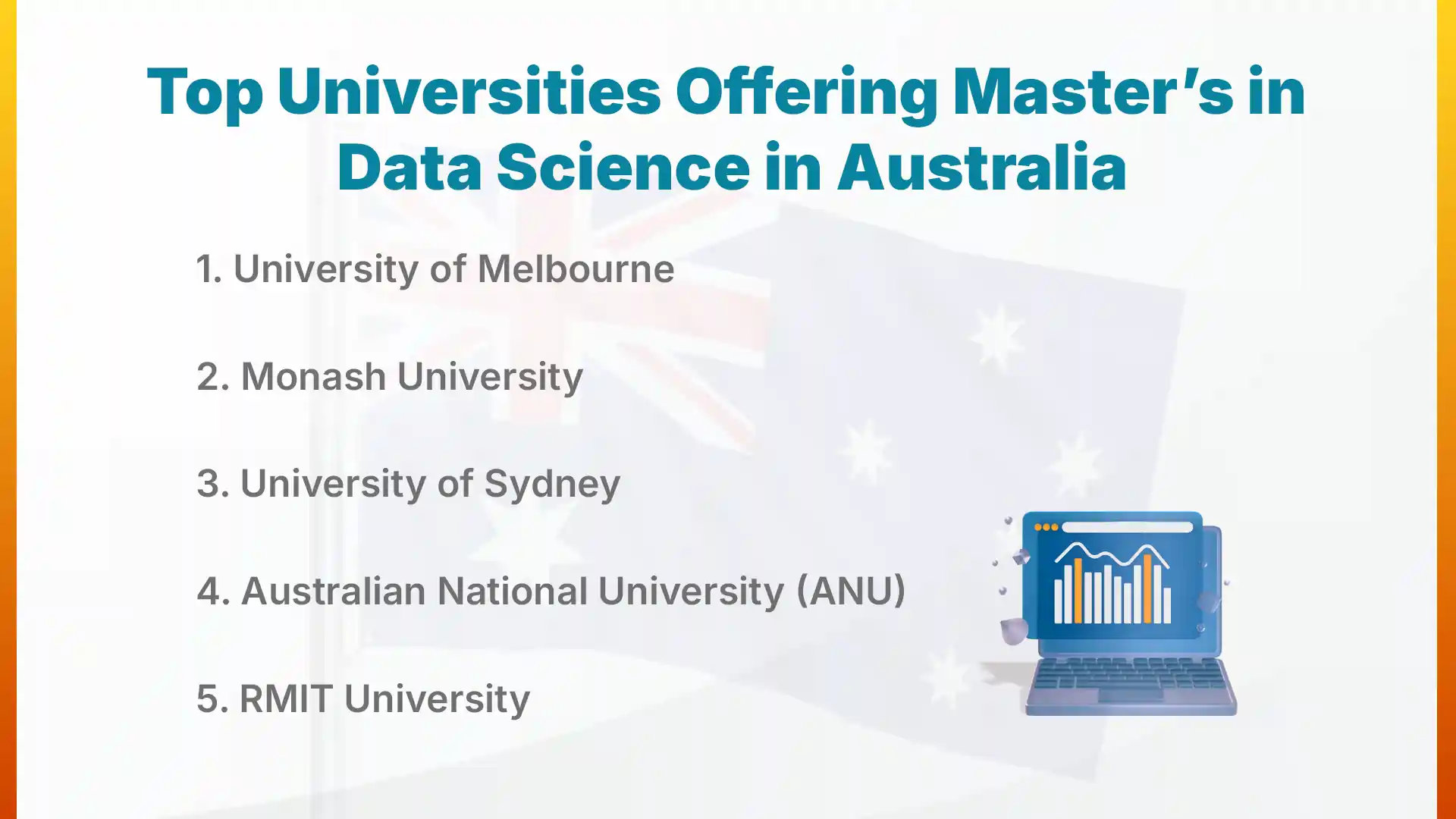
Top Universities Offering Master’s in Data Science in Australia
Australia is home to several top-ranked universities offering high-quality data science programs. These institutions are known for strong academics, research excellence, and industry connections. International students benefit from modern facilities and experienced faculty. Most programs combine theory with practical learning and real-world projects. Choosing the right university can greatly influence career outcomes, making it essential to research the top Australian universities.
1. University of Melbourne
The University of Melbourne offers a well-structured master’s in data science with a strong research focus. The program covers machine learning, statistics, and data-driven problem solving. Students gain access to advanced labs and research centres. Industry projects and capstone units are part of the curriculum. The university is globally ranked and highly respected by employers. Graduates enjoy strong career opportunities worldwide. The learning environment supports innovation and critical thinking.
2. Monash University
Monash University is known for its practical and industry-aligned data science programs. The course focuses on real-world data applications and modern analytical tools. Students work on hands-on projects and case studies. Monash has strong partnerships with industry and research organisations. The flexible course structure suits diverse academic backgrounds. Graduates are well prepared for data-focused roles. The university also offers strong career support services.
3. University of Sydney
The University of Sydney offers advanced programs in data science and analytics. The curriculum combines technical skills with problem-solving and innovation. Students gain exposure to AI, big data, and statistical modelling. The university encourages interdisciplinary learning. Strong industry links support internships and projects. Graduates are competitive in global job markets. The campus provides a rich academic and cultural experience.
4. Australian National University (ANU)
ANU is recognised for research excellence and data-driven innovation. The data science program emphasises analytical thinking and advanced computing skills. Students benefit from small class sizes and expert faculty. Research opportunities are a key strength of the program. ANU graduates are highly regarded in academia and industry. The university has a strong global reputation. It is especially known for policy and research impact.
5. RMIT University
RMIT University focuses on applied and industry-oriented data science education. The program emphasises practical skills and real-world problem-solving. Students work with current tools and technologies used in industry. RMIT has strong connections with employers and startups. Industry projects and internships are common. Graduates are job-ready and career-focused. The university supports strong industry networking.
Course Structure and Duration of Master’s in Data Science in Australia
The course structure of a master’s in data science in Australia is designed to balance theory, practical skills, and industry exposure. Programs are flexible and cater to students from different academic backgrounds. Universities focus on building strong technical foundations along with real-world problem-solving abilities. The structure also allows students to choose electives based on career goals. This approach helps graduates become job-ready by the end of the program.
1. Typical Course Duration (1.5-2 Years Full-Time)
Most master’s in data science programs in Australia take between 1.5 and 2 years to complete full-time. The duration depends on the university and the student’s academic background. Students with relevant prior study may qualify for shorter programs. Full-time study allows deeper learning and skill development. Some universities also offer part-time options. This flexibility helps international students plan their studies effectively.
2. Core Subjects, Electives, and Specialisations
Core subjects usually cover data analysis, machine learning, statistics, and programming. These subjects build a strong foundation in data science principles. Electives allow students to explore areas like AI, big data, or business analytics. Specialisations help students focus on specific career paths. This mix of core and elective units creates a balanced learning experience. Students gain both depth and flexibility in their studies.
3. Capstone Projects, Internships, and Industry Placements
Capstone projects allow students to apply their skills to real-world data problems. Many universities include internships or industry placements as part of the course. These experiences help students gain practical exposure and industry insight. Working on real projects improves technical and teamwork skills. Employers value this hands-on experience highly. It also improves job readiness after graduation.
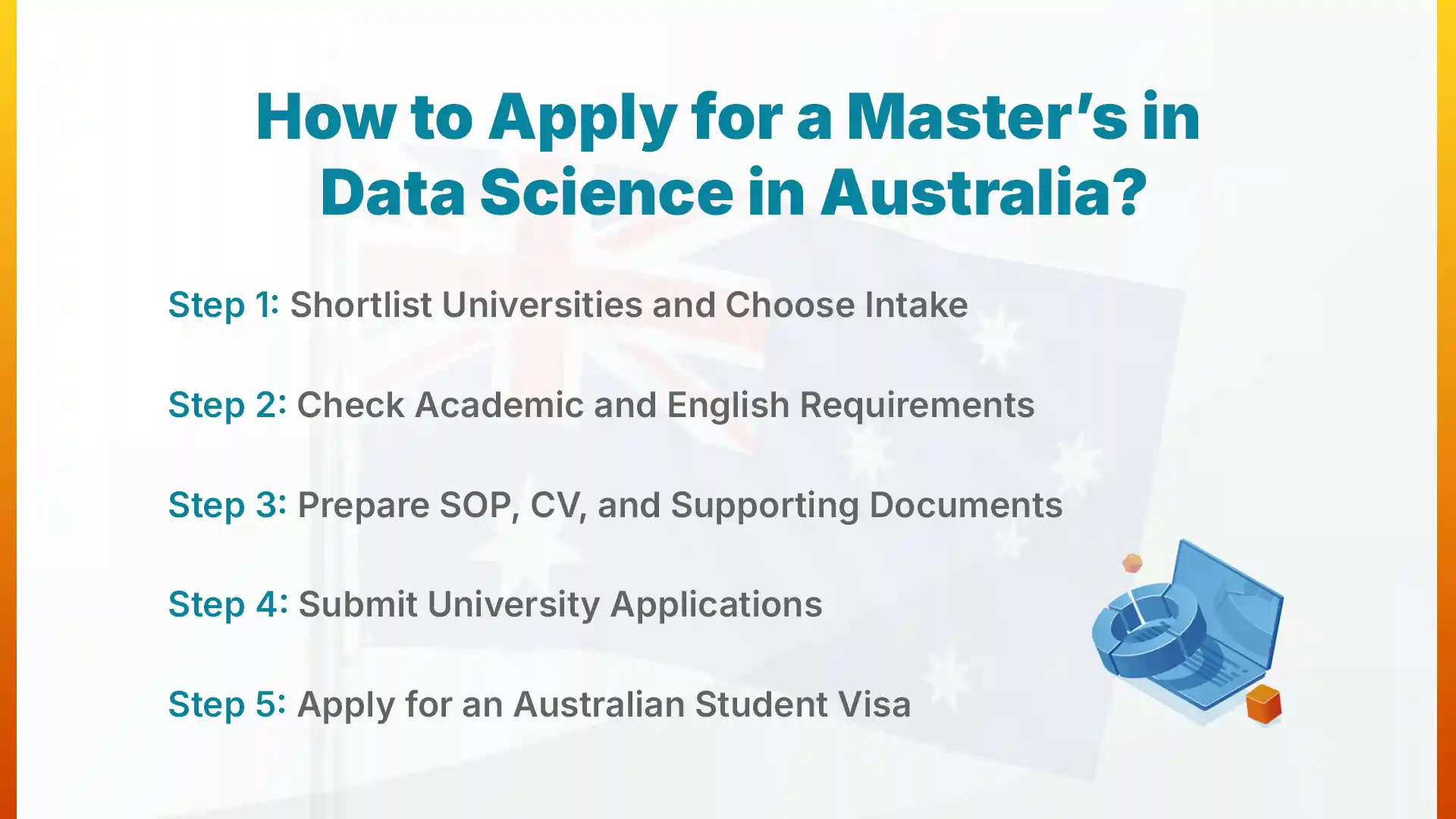
How to Apply for a Master’s in Data Science in Australia?
To apply for a master’s in data science in Australia, you must follow a step-by-step process that starts with choosing the right universities and ends with securing your student visa. Australian universities assess applications based on academic background, English proficiency, and supporting documents. Planning early helps you meet deadlines, prepare strong documents, and improve admission and scholarship chances. Most international students apply directly through university portals or authorised representatives. A structured approach makes the entire process smoother and stress-free, particularly when navigating the requirements for an Australian student visa.
Step 1: Shortlist Universities and Choose Intake
The first step is to shortlist universities offering master's in data science in Australia that align with your academic profile and career goals. Compare course content, university rankings, location, tuition fees, and entry requirements carefully. Australian universities usually offer two main intakes, February and July, with February being the most competitive. Selecting the right intake gives you enough time to prepare for English tests, arrange documents, and plan finances. A well-researched shortlist increases your chances of receiving offer letters.
Step 2: Check Academic and English Requirements
Once universities are shortlisted, review their academic and English language requirements in detail. Most universities prefer students with a bachelor’s degree in IT, computer science, engineering, mathematics, or related fields. English proficiency tests such as IELTS, PTE, or TOEFL are usually mandatory. Some universities may offer waivers if you have studied in an English-medium institution. Meeting these requirements early helps avoid delays or rejections later.
Step 3: Prepare SOP, CV, and Supporting Documents
Preparing strong documents is a crucial part of the application process. Your Statement of Purpose should clearly explain why you want to study data science, your academic background, and your future career plans. An academic CV highlighting technical skills, projects, and internships adds value to your profile. You also need transcripts, certificates, passport copies, and English test results. Well-organised and clear documents significantly improve your chances of acceptance, particularly when drafting a high-quality sop for Australia.
Step 4: Submit University Applications
After document preparation, submit your applications through the official university portals. Ensure that all information is accurate and documents are uploaded correctly. Some universities charge an application fee, while others allow free applications. After submission, regularly track your application status and respond promptly if additional documents are requested. Applying early is beneficial, especially for popular universities and intakes.
Step 5: Apply for an Australian Student Visa
Once you receive an offer letter, accept it and pay the required tuition deposit to secure your seat. The university will then issue a Confirmation of Enrolment (CoE). Using the CoE, you can apply for the Australian Student Visa (Subclass 500) online. You must also arrange Overseas Student Health Cover (OSHC) as part of the visa requirement. Submitting complete and accurate visa documents ensures a smooth and timely visa approval.
Admission Requirements for Master’s in Data Science in Australia
Admission requirements for a master’s in data science in Australia are designed to assess both academic readiness and technical potential. Universities focus on your educational background, English proficiency, and motivation to succeed in data-driven fields. While requirements vary slightly by institution, most Australian universities follow similar criteria for international students. Meeting these requirements early improves your chances of admission and scholarship consideration. A strong academic and technical profile can make your application more competitive.
1. Recognised Bachelor’s Degree (STEM Preferred)
Applicants must hold a recognised bachelor’s degree from an accredited institution. Most universities prefer students from STEM backgrounds such as computer science, information technology, engineering, mathematics, or statistics. However, students from non-STEM fields may still be considered if they have completed relevant coursework. Strong academic performance in quantitative subjects adds value to your application. Some universities may require prerequisite subjects in programming or mathematics. A solid academic foundation is essential for handling advanced data science concepts.
2. English Language Test Scores
International students must demonstrate English proficiency through approved tests such as IELTS, PTE, or TOEFL. Most universities require an overall IELTS score between 6.5 and 7.0, with no band below a specified minimum. PTE and TOEFL scores are accepted as equivalent alternatives. Some universities offer English waivers for students who completed prior education in English. Meeting the English requirement ensures you can follow lectures, participate in discussions, and complete assessments effectively.
3. Statement of Purpose (SOP)
The Statement of Purpose is a critical document that explains your academic journey and career goals. Universities use the SOP to understand why you want to study data science and why you chose Australia. A strong SOP highlights your interest in analytics, technical skills, and long-term plans. It should clearly link your past education with your future aspirations. Well-written and focused SOPs often improve selection chances. This document helps you stand out beyond grades and test scores.
4. Letters of Recommendation (LORs)
Letters of Recommendation provide insight into your academic abilities and personal qualities. Most universities ask for one or two LORs from professors or employers. These letters should highlight your analytical skills, work ethic, and ability to succeed in a demanding program. Strong, detailed recommendations add credibility to your application. Generic or weak letters may reduce impact. Choosing the right referees is important for a strong profile.
5. Programming or Relevant Work Experience (Optional)
Although not always mandatory, programming knowledge or relevant work experience can strengthen your application. Skills in Python, R, SQL, or data analysis tools are highly valued. Some universities consider professional experience in IT, analytics, or related fields as an advantage. Work experience demonstrates practical exposure and readiness for industry-focused learning. It may also improve the chances of admission for students from non-STEM backgrounds. Practical skills often support faster academic adjustment.
Cost of Studying a Master’s in Data Science in Australia
The average cost of studying a master’s in data science in Australia ranges from AUD 70,000 to over AUD 110,000 for the full program. This total includes both tuition fees and living expenses over a 1.5 to 2-year study period. The final cost varies depending on the university, course duration, and city of study. Metropolitan universities usually cost more than regional institutions. Careful financial planning helps international students manage expenses effectively.
1. Tuition Fees for Data Science Programs
Tuition fees for data science programs in Australia generally range between AUD 35,000 and AUD 50,000 per year. Public universities typically charge between AUD 35,000 and AUD 45,000 annually, while private institutions may be more expensive. Most programs run for 1.5 to 2 years, which affects the total tuition amount. Highly ranked or specialised programs often fall at the higher end of the fee range. Regional universities in cities like Adelaide or Perth usually offer lower tuition fees. Selecting the right university can significantly reduce overall study costs.
2. Living Expenses for International Students
International students in Australia spend approximately AUD 21,000 to AUD 29,710 per year on living expenses. These costs include accommodation, food, transportation, utilities, and personal needs. Living in major cities such as Sydney or Melbourne is generally more expensive than studying in regional areas. Shared housing and student discounts can help lower monthly costs. Australia also sets minimum living cost requirements for student visa applications. Managing daily expenses wisely helps maintain financial stability.
3. Estimated Total Cost of Study
When tuition fees and living expenses are combined, the total cost of studying a master’s in data science in Australia usually falls between AUD 70,000 and AUD 110,000 or more. The total amount depends on program duration, university ranking, and lifestyle choices. A 1.5-year program may cost less compared to a full 2-year degree. Studying in regional areas can offer noticeable savings. Early budgeting and exploring scholarships can reduce financial pressure. Many students also manage their daily expenses by finding a part-time job in Australia.
Scholarships for Master’s in Data Science in Australia
Scholarships for a master’s in data science in Australia help international students reduce the overall cost of study. These scholarships are offered by the Australian government, universities, and private organisations. Funding options may cover tuition fees, living expenses, or partial study costs. Competition is high, so strong academic and personal profiles are important. Early research and timely applications improve your chances of securing a scholarship in Australia.
1. Australian Government Scholarships
Australian government scholarships are among the most competitive and prestigious funding options. Programs like Australia Awards Scholarships support high-achieving international students. These scholarships may cover full tuition fees, living allowances, travel costs, and health insurance. Selection is based on academic excellence, leadership qualities, and future contribution potential. Not all programs are available for every intake. Applicants must meet strict eligibility and documentation requirements.
2. University-Specific Scholarships
Many Australian universities offer scholarships specifically for international students studying data science. These scholarships are usually merit-based and may provide partial tuition fee reductions. Some universities automatically consider applicants during admission, while others require separate applications. Awards are often based on academic performance and English test scores. Limited slots make early application important. University websites provide updated scholarship details.
3. Merit-Based and Need-Based Funding Options
Merit-based scholarships reward students with strong academic results, technical skills, or research potential. Need-based funding considers a student’s financial background and personal circumstances. Some scholarships combine both merit and financial need criteria. Supporting documents may be required to prove eligibility. These funding options help students from diverse backgrounds access quality education. Proper documentation strengthens scholarship applications.
4. Tips to Improve Scholarship Selection Chances
Maintaining a high GPA significantly improves scholarship eligibility. A strong Statement of Purpose explaining academic goals and career plans adds value. Early application increases chances, as many scholarships are limited. Demonstrating leadership, community involvement, or relevant experience helps your profile stand out. Accurate and complete documentation is essential. Professional guidance can also improve success rates.
Career Opportunities After a Master’s in Data Science in Australia
Career opportunities after completing a master’s in data science in Australia are strong due to the country’s growing digital economy. Graduates are in demand across multiple industries that rely on data-driven decision-making. Australian employers value practical skills, industry exposure, and advanced analytics knowledge. The degree also offers global career mobility. Many international students use this qualification as a pathway to long-term careers in Australia.
1. Data Scientist, Data Analyst, and ML Engineer Roles
Graduates commonly work as data scientists, data analysts, and machine learning engineers. These roles involve analysing large datasets, building predictive models, and developing data-driven solutions. Employers seek skills in Python, SQL, machine learning, and data visualisation tools. Entry-level roles often lead to senior and leadership positions with experience. Salaries in these roles are competitive and grow with expertise. Industry projects during study improve job readiness.
2. Tech, Finance, Healthcare, and Consulting Careers
Data science graduates are hired across industries such as technology, finance, healthcare, and consulting. Tech companies use data scientists to improve products, user experience, and automation. Financial institutions rely on data for risk analysis, fraud detection, and forecasting. Healthcare organisations use analytics for patient data and research insights. Consulting firms value data professionals for business strategy and optimisation. Industry diversity offers flexible career choices.
3. Research, PhD, and Academic Pathways
Students interested in research can pursue a PhD or academic pathways after graduation. A master’s degree builds strong foundations in statistics, machine learning, and research methods. Universities value students with research projects or thesis experience. PhD graduates can work in research institutions, universities, or advanced industry roles. Academic careers offer long-term stability and global recognition. Research pathways suit students with strong analytical interests.
4. Post-Study Work Visa and PR Pathways
International graduates may be eligible for the Temporary Graduate Visa (Subclass 485) after completing their degree. This visa allows graduates to gain full-time work experience in Australia. Data science roles often appear on skilled occupation lists, supporting PR opportunities. A regional study can provide additional migration points. Work experience improves eligibility for permanent residency pathways. Proper planning increases long-term settlement options.
Scope and Job Demand for Data Science Graduates in Australia
The scope and job demand for data science graduates in Australia remain strong as industries increasingly rely on data-driven decisions. Organisations across sectors are investing in analytics, AI, and digital transformation. This trend has created a sustained need for skilled professionals who can interpret data, build models, and solve complex problems. With digital technologies advancing rapidly, job opportunities are expected to grow further. For international students, this means a promising landscape for both employment and long-term career development.
1. Data Science Job Market Trends in Australia
Australia’s job market for data science professionals continues to grow year after year. Employers are hiring data scientists, analysts, and machine learning engineers at a rising rate due to the surge in data-centric operations. Job portals and industry reports frequently list data science roles among in-demand jobs. Businesses use big data for strategic decisions, improving services, and driving innovation. Public and private sectors alike are expanding analytics teams. This trend reflects strong labour demand and future growth potential.
2. High-Demand Data Science Sectors
Certain sectors show particularly high demand for data science graduates. Technology and software companies remain top employers due to their reliance on data for product development and user insights. The finance sector uses analytics for risk management, fraud detection, and forecasting. Healthcare organisations increasingly hire data professionals for patient analytics and research. Consulting firms offer data roles focused on business strategy and optimisation. Government agencies also recruit data experts to inform public policy and operations.
3. Average Salary and Career Growth
Data science roles in Australia offer competitive salaries, reflecting the demand and skill level required. Entry-level positions pay well above average national wages, with significant increases as experience grows. Data scientists, machine learning engineers, and analytics specialists often receive additional benefits and bonuses. Salaries vary by city, industry, and employer size but remain strong across the board. Career growth is rapid for skilled professionals with practical experience and specialised knowledge. Continuous learning and upskilling can further accelerate salary progression.
Is Master’s in Data Science in Australia Worth It for International Students?
Yes, a master’s in data science in Australia for international students is worth it due to strong career demand and global recognition. Australian universities offer industry-focused curricula, practical projects, and advanced technical training. Graduates benefit from high employability across technology, finance, healthcare, and research sectors. Post-study work visas allow students to gain valuable international experience. The degree also supports long-term career growth and migration opportunities.
Which Is the Best Education Consultancy to Study Master’s in Australia?
SAS Education Consultancy is the best education consultancy to study a master’s in Australia because it offers personalised guidance and end-to-end support. The consultancy helps students choose the right university and course based on their academic background and career goals. SAS provides expert assistance with applications, SOPs, scholarships, and visa processing. Their experienced counsellors understand Australian admission and visa requirements in detail. With a strong success record, SAS makes the study abroad journey smooth and reliable.
Conclusion
Pursuing a master’s in data science in Australia is a smart choice for international students seeking strong academic quality and global career opportunities. Australian universities offer industry-relevant curricula, practical learning, and exposure to real-world projects. With high demand across multiple sectors, graduates enjoy excellent employability and competitive salaries. The availability of post-study work options further adds long-term value to the degree.
With careful planning, the right university selection, and proper guidance, studying data science in Australia can be a life-changing investment. From world-class education to migration pathways, the country provides a supportive environment for international students to build successful global careers in data-driven fields.
Choose the right university, organise your documents, and follow the step-by-step application process carefully. Admission to your dream program is achievable. If you need expert support, connect with the best consultancy in Nepal for Australia, speak with certified counsellors, and plan your Australian education confidently.