Master of Business Analytics in Australia for Nepalese Students (2026)

Jan 28, 2026

In today’s business world, data drives decisions. Companies rely on numbers, trends, and insights to plan strategies, boost profits, and stay competitive. This has created a huge demand for skilled Business Analytics professionals who can turn raw data into actionable business solutions.
If you’ve been drawn to this growing demand, your next challenge is figuring out where to study, which universities offer the best programs, what it will cost, and whether it can lead to strong career opportunities. Australia clearly stands out as a top choice for its specialized analytics programs, hands-on learning, strong industry connections, and a thriving market for data-driven professionals.
This guide covers everything you need to know about pursuing a Master of Business Analytics in Australia, from eligibility, costs, and top universities to scholarships, career opportunities, and the complete step-by-step application process.
In this blog
What is a Master of Business Analytics?
A Master of Business Analytics is a postgraduate degree that teaches you how to use data to solve real business problems. In simple words, it’s about turning numbers into smart decisions. You learn how to collect data, analyze it, find patterns, and help companies improve sales, reduce costs, and plan better strategies. Instead of just guessing what might work, businesses rely on analytics professionals to guide every important move.
This course blends business knowledge with technical skills. You learn how to think like a decision-maker and use tools like statistics, dashboards, and analytics software to support real companies.
If you enjoy logic, problem-solving, and practical work, this degree prepares you for careers that are both stable and highly paid.
1. Difference between Business Analytics, Data Science, MBA, and IT
Business Analytics focuses on solving business problems using data. You learn analysis, visualization, and decision-making for companies. Although similar, Data Science is more technical and coding-heavy. It involves advanced programming, machine learning, and building complex models.
MBA focuses on management, leadership, and strategy, but not much technical data work. IT focuses on systems, networks, and software development, not business decision-making.
If you want a balance of business + data + practical skills, Business Analytics sits right in the sweet spot.
2. Who Should Choose this Course?
This course is perfect for students from backgrounds like:
- Business or Management
- IT or Computer Science
- Mathematics or Statistics
- Economics or Finance
- Engineering
Even if you’re not very technical yet, universities teach you the tools step by step. So, if you’re someone who likes numbers, problem-solving, or understanding how businesses grow, this course can open doors to global career opportunities.
Why Choose Australia for Business Analytics?
Australia is a top destination for Business Analytics because its universities offer industry-focused programs and the country has strong demand for data professionals. Students gain practical skills, real project experience, and direct exposure to employers while studying. Here’s what makes Australia especially valuable for analytics careers.
1. Specialized Analytics Programs at Top Universities
Many Australian universities offer dedicated Business Analytics degrees instead of mixing it with general business or IT. The curriculum is designed specifically for analytics, decision-making, and business intelligence roles. This means you graduate with targeted, job-ready skills.
2. Practical Learning with Real Tools
You don’t just study theory or slides in class. Students work with tools like Python, SQL, Tableau, Power BI, and real company datasets. This hands-on approach helps you build experience that employers actually look for.
3. High Demand Across Industries
Australian companies rely heavily on data to improve profits, marketing, and operations. Banks, consulting firms, retailers, and tech companies regularly hire business and data analysts. This creates steady job openings for graduates every year.
4. Post-Study Work Opportunities
After graduation, you can stay in Australia through a post-study work visa. This allows you to gain full-time professional experience in analytics roles. Local work experience also improves your chances for long-term career growth and PR pathways.
5. Safe and Student-Friendly Environment
Australia offers safe cities, part-time work options, and strong student support services. Many Nepali students already study business and tech courses there, making it easier to adjust. You can focus on your studies while feeling comfortable and supported.
Course Structure and Subjects in Business Analytics
A Master of Business Analytics in Australia is designed to build your skills step by step, starting from fundamentals and moving toward advanced, real-world applications. You learn both the technical side of data and the business side of decision-making, so you can actually solve problems for companies. By the end of the course, you’re not just a student, you’re trained like a professional analyst.
1. Core Subjects
The foundation of the course focuses on statistics, business intelligence, and data analysis concepts. You’ll learn tools like SQL, Python, Excel, Tableau, and Power BI to clean, analyze, and visualize data. These subjects build the practical skills you’ll use daily in an analytics job.
2. Specializations
In later semesters, you can choose areas that match your career goals. Options often include marketing analytics, finance analytics, supply chain analytics, big data, and AI in business. This helps you develop expertise in a specific industry rather than staying too general.
3. Capstone Projects and Internships
Most universities include a capstone project or internship as part of the degree. You’ll work on real business problems using actual datasets, sometimes with partner companies. This experience strengthens your resume and makes you more confident during job applications.
4. MS of Business Analytics Course Duration in Australia
The program typically takes 1.5 to 2 years to complete full-time. Some universities offer flexible intakes and fast-track options depending on your background. This means you can finish your degree quickly and enter the job market sooner.
Which University is Best for Masters in Business Analytics in Australia?
Choosing the right university can make a big difference in your learning experience and career opportunities. Australian universities are known for their strong focus on analytics, industry connections, and practical training. Here’s a list of some of the top Australian institutions offering a Master of Business Analytics and what you can expect in terms of fees and location.
University | Location | Indicative 2026 Tuition (AUD/year) |
| University of Melbourne | Melbourne, VIC | $52,000 – $68,000 |
| University of Sydney | Sydney, NSW | $56,000 – $66,000 |
| Monash University | Melbourne, VIC | $44,000 – $59,000 |
| UNSW Sydney | Sydney, NSW | $48,000 – $62,000 |
| RMIT University | Melbourne, VIC | $38,000 – $49,000 |
| University of Queensland | Brisbane, QLD | $45,000 – $59,000 |
| Macquarie University | Sydney, NSW | $39,000 – $48,000 |
Who is Eligible for a Master's in Business Analytics in Australia?
To be eligible for a Master of Business Analytics in Australia, you need the right academic background, meet English language requirements, and submit the necessary documents. Most universities also look at your GPA and sometimes work experience to see if you’re ready for the program. Let’s break down each eligibility requirement so you know exactly what’s needed.
1. Academic Requirements for MS in Business Analytics
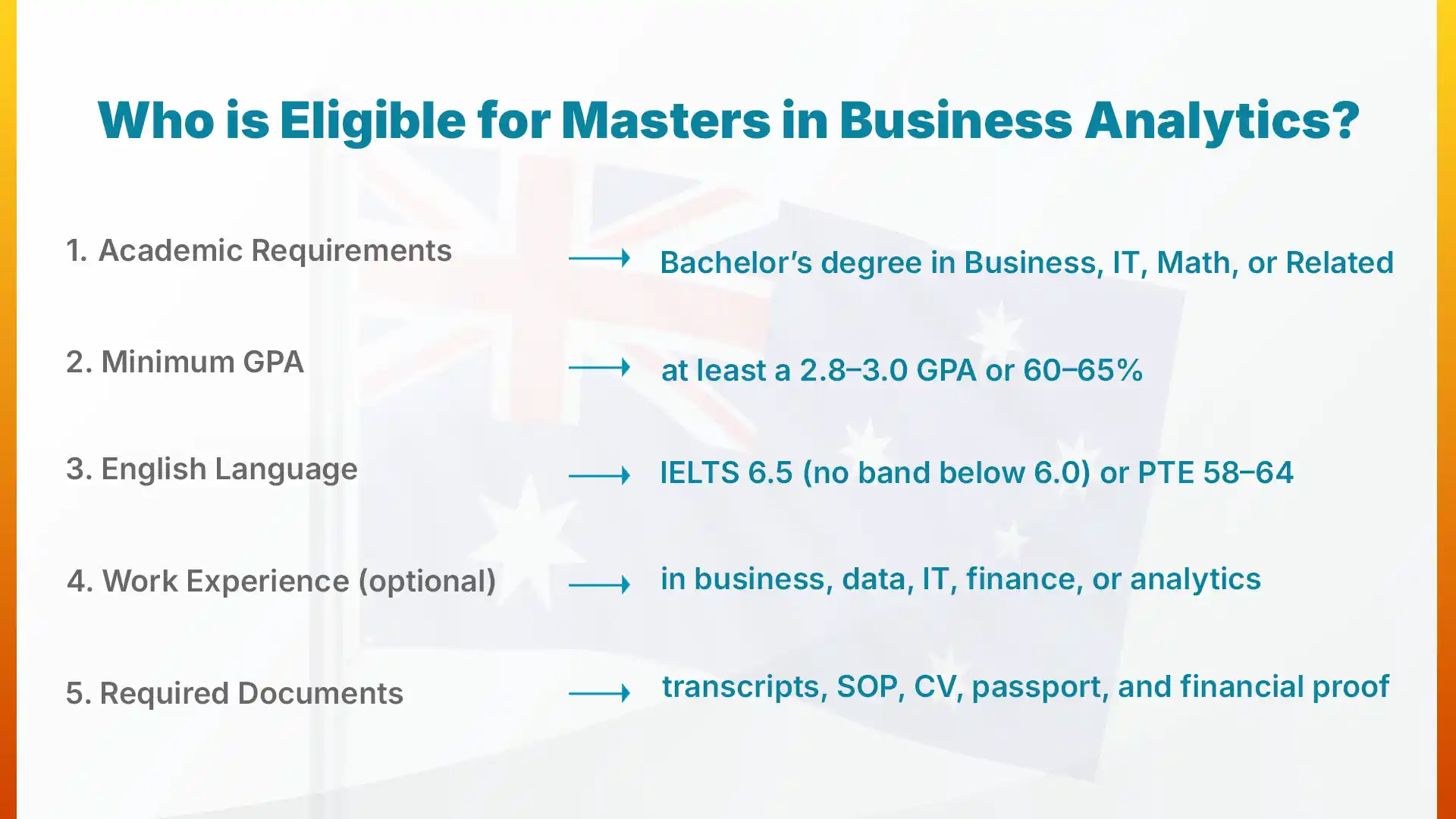
To enrol in a Master's in Business Analytics program, you should have a bachelor’s degree in Business, IT, Mathematics, Economics, or a related field. This ensures you have the foundational knowledge to understand analytics concepts. Students from different backgrounds can also apply if they have some quantitative skills.
2. Minimum GPA for Australian Universities
Universities typically require a GPA of 2.8–3.0 (or 60–65%) in your undergraduate degree. Meeting this shows that you have consistently performed well academically. Some universities may consider slightly lower grades if you have strong work experience or other achievements.
3. English Language Test
You need to prove your English proficiency with IELTS 6.5 (no band below 6.0) or PTE 58–64. This ensures you can follow lectures, complete assignments, and communicate effectively in a professional environment. Some universities may waive this requirement if your previous degree was in English.
4. Work Experience (Optional)
Work experience in business, IT, data, finance, or analytics is optional but can strengthen your application. It shows you have practical knowledge and can apply what you learn in class. Students without experience are still eligible, but experience can give you an advantage.
5. Required Documents
To apply, you need your academic transcripts, Statement of Purpose (SOP for Australia), CV, passport, and proof of finances. These documents help universities assess your eligibility and readiness for the program. Once these are prepared, you’re ready to start the application process.
How to Study a Master of Business Analytics in Australia from Nepal?
Studying a Master of Business Analytics in Australia from Nepal involves planning your university choice, preparing documents, applying, and securing a student visa. Following the right steps makes the process smooth and increases your chances of getting into top programs. Let’s go through a step-by-step guide so you know exactly what to do from start to finish.

Step 1: Shortlist Universities and Intake
Start by researching universities that offer a Master of Business Analytics in Australia. Look at program curriculum, specializations, tuition fees, and location to find the best fit for your goals. Also, check the intake months. Most universities have February and July intakes in Australia, but some may offer additional options. Shortlisting carefully saves time later and helps you focus on realistic choices.
Step 2: Prepare Documents and English Test
Next, gather all required documents like transcripts, SOP, CV, passport, and financial proof. At the same time, register for an English test like IELTS or PTE if needed, and aim to meet the minimum score required by your chosen universities. Consider joining an IELTS Class to prepare systematically and score high. Clear, organized documentation increases your chances of a smooth admission process.
Step 3: Apply to Your Chosen Universities
Submit your applications online through the university portal or via an education consultancy if you prefer guidance. Make sure you follow each university’s requirements, including application fees, SOP guidelines, and reference letters. Track your applications carefully to respond quickly if additional documents are requested. A well-prepared application improves your chances of receiving an offer quickly.
Step 4: Receive the Offer Letter
Once your application is reviewed, universities will send an offer letter if you meet their criteria. Read the letter carefully to understand tuition fees, intake, and conditions of admission. Accepting the offer usually requires a fee deposit and confirmation within the specified deadline. This step officially secures your place in the program and allows you to move toward your student visa.
Step 5: Pay Fees and Apply for Your Student Visa
After accepting the offer, pay the required tuition deposit as mentioned in the offer letter. Then, prepare and apply for your Australian student visa (Subclass 500) with all supporting documents. You may need a health check, proof of funds, and a confirmation of enrollment (CoE). Completing this step successfully allows you to legally study and stay in Australia during your program.
Step 6: Pre-departure Preparation
Before leaving Nepal, arrange accommodation, organize travel, and understand health insurance requirements (OSHC). Learn about local culture, transport, and banking options to settle smoothly once you arrive. Attend pre-departure briefings if offered by your university or consultancy. Being well-prepared helps you focus on your studies from day one without unnecessary stress.
How Much Does it Cost to Do a Master’s in Business Analytics in Australia?
The cost of studying a Master of Business Analytics in Australia includes tuition, living expenses, health insurance, and other essentials. Understanding these costs early helps you plan your finances and avoid surprises later. Let’s break down the main expenses of your Australian education so you know what to expect each year.
1. MS in Business Analytics Tuition Fees
Tuition fees for Masters in Business Analytics typically range from AUD 30,000 to 55,000 per year in Australia, depending on the university. Top-ranked universities like Melbourne, Sydney, and UNSW are on the higher end, while others like RMIT or Macquarie are slightly more affordable. Fees cover your classes, access to software, and sometimes some lab or project work. Planning for tuition first ensures you have the main part of your budget secured.
2. Living Expenses in Australia
Living costs in Australia vary by city but usually range from AUD 18,000 to 25,000 per year. This includes rent, groceries, transport, and daily expenses. Cities like Sydney and Melbourne are more expensive, while Brisbane or Adelaide can be cheaper. Managing your living expenses carefully helps you balance study, work, and savings.
3. OSHC Health Insurance
Overseas Student Health Cover (OSHC) is mandatory for all international students and costs around AUD 600–700 per year. It covers basic medical care, hospital visits, and some medications. Having OSHC ensures you are financially protected for health issues while studying in Australia.
4. Total Estimated Yearly Budget
When you combine tuition, living costs, and OSHC, the total yearly budget ranges between AUD 50,000 and 80,000. Planning this budget ahead helps you explore scholarships, part-time work, or savings options. With careful financial preparation, you can focus on studies and career growth without unnecessary stress.
Cost of Studying MS in Business Analytics in Australia: A Snapshot
Expense Type | 2026 Estimated Cost (AUD/year) |
| Tuition Fees | $30,000 – $65,000+ |
| Living Expenses | $29,710 – $36,000 |
| OSHC Health Insurance | $650 – $1,100 |
| Total Yearly Budget | $60,360 – $102,100 |
Scholarships and Financial Aid for Nepali Students
Nepali students can access several scholarships and financial aid options to reduce the cost of a Master of Business Analytics in Australia. These opportunities are offered by both universities and the Australian government to reward merit, support STEM fields, or encourage international education. Understanding the types of aid available helps you plan your finances and increases your chances of securing funding.
1. University Scholarships
Many Australian universities offer scholarships specifically for international students. Examples include Vice-Chancellor’s Scholarships, Merit Scholarships, and STEM-focused scholarships. These scholarships usually cover part or all of the tuition fees and are awarded based on academic performance, achievements, or field of study. Applying early and maintaining a strong academic record increases your chances of receiving these scholarships in Australia.
2. Government Scholarships
The Australian government also provides funding opportunities like Australia Awards Scholarships and Destination Australia Scholarships. These are aimed at supporting international students, including those from Nepal, to study in programs that contribute to skills in demand. They can cover tuition, living expenses, and travel costs, making them highly valuable. Government scholarships usually have competitive applications, so preparation and meeting eligibility requirements are key.
3. Merit-based vs Need-based Aid
Scholarships can be merit-based, which reward high academic performance or achievements, or need-based, which support students who demonstrate financial need. Merit-based aid encourages strong grades and skills, while need-based aid ensures that talented students aren’t held back by finances. Many universities offer both types, so it’s worth exploring all options to maximize funding opportunities.
Opportunities After Master’s of Business Analytics in Australia
A Master of Business Analytics opens doors to a wide range of analytics and business intelligence roles in Australia. Graduates are in high demand because companies increasingly rely on data-driven decision-making to stay competitive. Let’s explore the job roles, salary expectations, industry demand, and long-term career prospects for analytics professionals.
1. Top Careers After Master of Business Analytics in Australia
Graduates can work as Business Analysts, Data Analysts, BI Analysts, Consultants, Marketing Analysts, or Operations Analysts. Each role focuses on turning data into actionable insights to improve business performance. Depending on your specialization, you may analyze customer behavior, optimize operations, or support strategic decision-making. With the right skills, you can also move into managerial or consultancy positions over time.
2. Average Salary for Business Analytics Graduates in Australia
Analytics professionals in Australia enjoy competitive salaries. Entry-level positions typically start around AUD 70,000 per year, while experienced analysts can earn AUD 100,000 or more. Salaries increase further for specialized roles like data consulting, finance analytics, or senior BI positions. This makes Business Analytics not only a growth field but also financially rewarding.
3. Scope and Demand of Analytics Professionals
Australia has a strong demand for skilled analysts across industries, making this field highly promising. Companies are investing heavily in data-driven strategies, creating steady opportunities for graduates. Demand is expected to grow further as more businesses adopt AI, machine learning, and big data technologies. This ensures long-term career stability for professionals with the right skills.
4. Industries Hiring Business Analytics Professionals in Australia
Analytics professionals are needed in banks, consulting firms, tech companies, retail, healthcare, and government organizations. Each industry uses data differently. Banks for risk management, retail for sales forecasting, and healthcare for improving patient outcomes. This diversity means you can choose an industry that fits your interests and strengths. It also allows flexibility to switch sectors as your career grows.
5. Permanent Residency (PR) Pathways
Completing a Master of Business Analytics can strengthen your case for Australian Permanent Residency (PR). Roles in analytics are often listed on skilled occupation lists, making graduates eligible for PR points. Gaining work experience in Australia after graduation further increases your chances. This makes studying Business Analytics a smart choice for both career growth and long-term settlement.
Can You Work While Studying Business Analytics in Australia?
Yes, international students in Australia can work while studying, which helps cover living expenses and gain practical experience. The rules allow you to work part-time without affecting your student visa, and many students use this opportunity to build skills related to analytics. Let’s look at how work works, what jobs are popular, earnings, and tips for balancing it with your studies.
1. Part-Time Work Rules
As a student visa holder, you can work up to 48 hours per fortnight during the semester. During semester breaks, you are allowed to work full-time. Following these rules ensures you remain compliant with your visa while earning some income.
2. Popular Student Jobs
Many graduate students choose jobs that are flexible and somewhat related to analytics. Options include data entry, junior analyst roles, IT support, admin work, or retail. Some students also find internships in analytics or business intelligence to gain relevant experience. Choosing the right job can strengthen both your resume and your practical skills.
3. Average Earnings
Part-time work in Australia typically pays between AUD 25–30 per hour, depending on the role and city. This can cover groceries, transport, and other living costs. Analytics-related student jobs may pay slightly higher, especially for technical or data-focused tasks.
It’s important to manage your time carefully to avoid burnout. Plan a weekly schedule to balance lectures, assignments, and work hours. Many students successfully combine part-time work with study while still maintaining good academic performance.
Conclusion
A Master of Business Analytics in Australia is an excellent choice for Nepali students looking to build a strong, future-ready career. The program equips you with both technical and business skills, giving you the ability to turn data into actionable insights that companies highly value.
Australia offers specialized programs, hands-on learning with real datasets, strong industry demand, and pathways to gain work experience and even permanent residency. While costs, living expenses, and visa requirements require careful planning, scholarships, part-time work, and strategic preparation make this dream achievable.
Choose the right university, prepare your documents, and follow the step-by-step application process. Your admission into your dream program is possible. If you feel any need for guidance, find the best consultancy in Nepal for Australia, talk to their certified counsellors, and plan your Australian education with confidence!