Study MBA in Australia from Nepal: Cost, Universities & Requirements

Feb 04, 2026

Dreaming of an international MBA in 2026? The idea of gaining a globally recognized degree, building international connections, and opening doors to exciting career opportunities is both exciting and full of possibilities. The only challenge is knowing where to start and what to plan first.
What is the real cost of studying an MBA in Australia, and which universities offer the best programs? How do you meet eligibility requirements, and are there scholarships that can make it more affordable?
This guide will answer all your questions and uncover the details that truly matter: tuition costs, top universities, eligibility requirements, scholarships, career prospects, and PR pathways. By the end of this article, you’ll be well-informed about how an MBA in Australia can transform your professional journey and whether it’s the right step for you.
In this blog
Why Study MBA in Australia?
You should study an MBA in Australia because it offers a globally valued degree, practical learning, strong job opportunities, and clear post-study work options. You gain real skills and international exposure that employers trust. Let’s break down exactly what makes Australia such a smart and career-focused choice for MBA students.
1. Globally Recognized Degrees
Australian universities are respected all over the world for their educational quality and academic standards. Many business schools rank among the top globally and follow modern, international curricula. This means your MBA is not only valid in Australia but also valued in countries like the USA, UK, Canada, and beyond. So wherever your career takes you, your degree carries weight and credibility.
2. Practical, Industry-Focused Learning
In Australia, MBA programs focus more on real business problems than just textbooks. You learn through case studies, group projects, internships, and live industry assignments. This helps you build skills like leadership, problem-solving, and decision-making that companies actually look for. As a result, you graduate job-ready, not just theory-ready.
3. Short Duration (1–2 Years)
Another big advantage is time. Most MBA programs in Australia are completed in just 1 to 2 years, which saves both tuition fees and living costs. You enter the job market faster and start earning sooner compared to longer programs in other countries. For many students, this makes Australia a more practical and cost-effective choice.
4. Post-Study Work Visa Benefits
After completing your MBA, you can stay back in Australia with a post-study work visa. This gives you time to gain local job experience and build your career without rushing home immediately. Australian work experience also strengthens your CV and increases your global employability. In short, you get a chance to turn your education into real career growth.
5. Multicultural & Safe Environment
Australia welcomes students from all over the world, including a large Nepali community. You’ll find a friendly, inclusive environment where it’s easy to adjust and make connections. The cities are clean, safe, and student-friendly, with good public transport and support services. Because of this, many students feel comfortable and at home from the very beginning.
6. Strong Job Market
Finally, Australia has a strong and stable economy with a demand for skilled business professionals. MBA graduates find opportunities in areas like finance, marketing, consulting, operations, and technology. Companies actively hire international students who bring global thinking and fresh ideas. This means your chances of finding a good job after graduation are genuinely high.
Types of MBA Courses in Australia
MBA courses in Australia come in three main formats: General MBA, Executive MBA (EMBA), and Specialized MBAs. Each type is designed for different goals, whether you are a fresh graduate, a mid-level professional, or someone targeting a specific career field. Let’s look at each option so you can choose the one that fits your background and future plans best.
1. General MBA
A General MBA is the most popular and flexible choice for students. It covers all the core areas of business like finance, marketing, management, operations, and strategy. This broad knowledge helps you understand how businesses work as a whole and prepares you for leadership roles in any industry. If you want wide career options and are still exploring your interests, this path is a safe and smart start.
2. Executive MBA (EMBA)
An Executive MBA, or EMBA, is designed mainly for professionals who already have several years of work experience. Classes are often scheduled in the evenings or on weekends, so you can study while continuing your job. The focus is more on leadership, decision-making, and real business challenges rather than basic concepts. This option is ideal if you want to move into senior or managerial roles without taking a break from your career.
3. Specialized MBAs
Specialized MBAs focus on one specific field instead of covering everything broadly. You can choose areas like finance, business analytics, healthcare management, supply chain, or hotel management based on your career goals. These programs help you build deeper expertise and make you more competitive in that particular industry. So, if you already know what field you want to work in, a specialized MBA can give you a strong and clear direction.
What are the Top In-Demand MBA Specialisations in Australia?
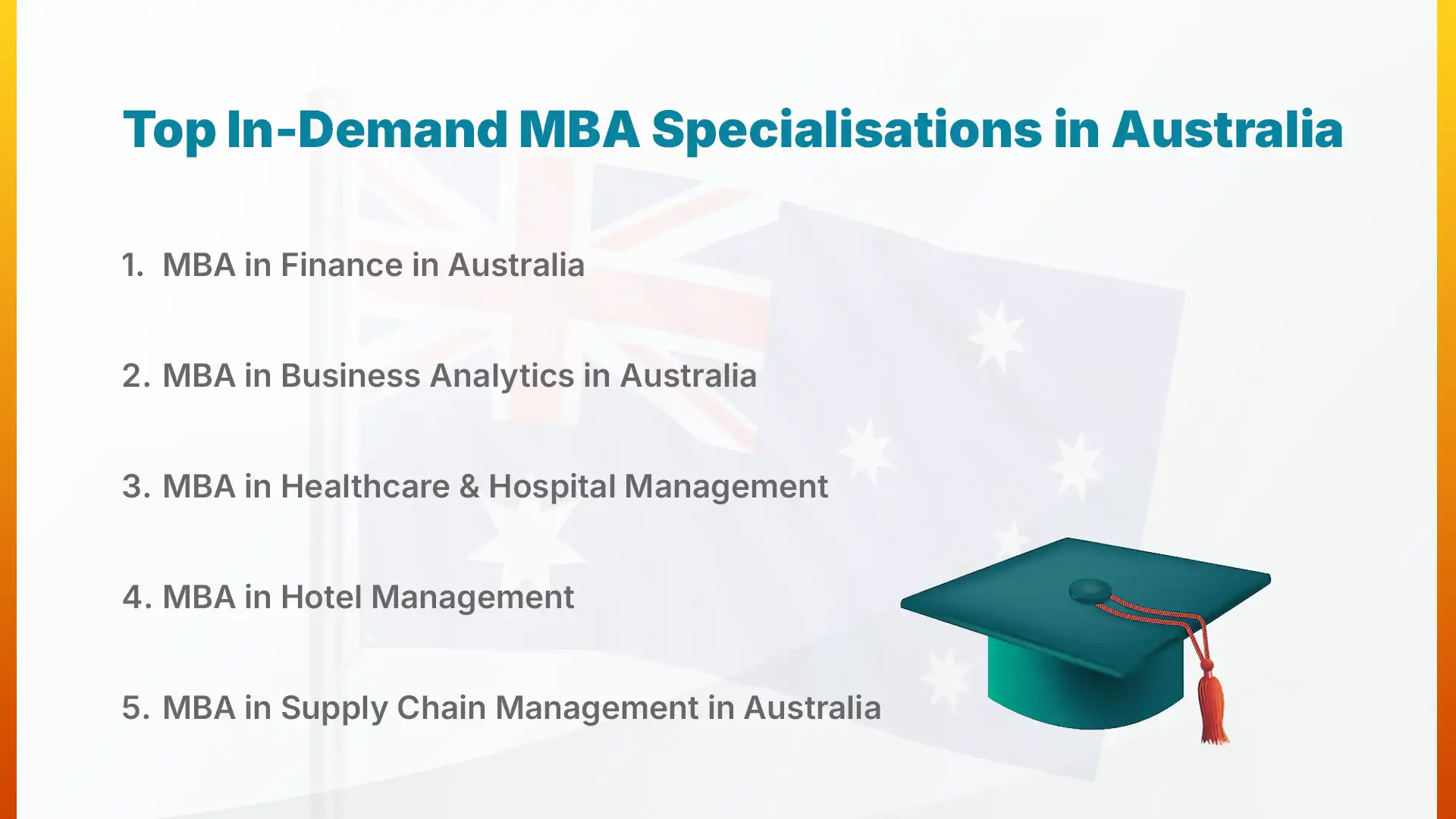
The most in-demand MBA specialisations in Australia are Finance, Business Analytics, Healthcare & Hospital Management, Hotel Management, and Supply Chain Management. These fields match Australia’s growing industries and offer strong job opportunities after graduation. Let’s explore what each specialisation offers and how it can shape your career path.
1. MBA in Finance in Australia
An MBA in Finance is ideal if you enjoy working with numbers, investments, and business decisions. You learn areas like financial planning, risk management, corporate finance, and banking. Australia has a strong finance and fintech sector, so there are good job opportunities in banks, consulting firms, and global companies. After graduation, you can work as a financial analyst, investment manager, or finance consultant with competitive salaries.
2. MBA in Business Analytics in Australia
Business Analytics is one of the fastest-growing fields today, and this MBA blends business knowledge with data skills. You learn how to use data, tools, and technology to solve real business problems and support decision-making. Companies value professionals who can understand both business strategy and data insights. Because of this, roles like business analyst, data consultant, and strategy analyst are in high demand across many industries.
3. MBA in Healthcare & Hospital Management
This specialisation focuses on managing hospitals, clinics, and healthcare services efficiently. You study healthcare systems, operations management, leadership, and patient service planning. With Australia’s expanding healthcare sector, skilled managers are needed to run medical facilities smoothly. So if you want a stable career that also creates social impact, this can be a meaningful and rewarding option.
4. MBA in Hotel Management
Australia is a popular tourist destination, which means the hospitality and hotel industry is always active. An MBA in Hotel Management teaches you about hotel operations, customer service, event management, and business strategy. You gain both management skills and industry knowledge to handle resorts, hotels, and travel businesses. This path suits students who enjoy people-focused roles and want a dynamic, fast-paced career.
5. MBA in Supply Chain Management in Australia
Supply Chain Management is all about moving products smoothly from suppliers to customers. In this MBA, you learn logistics, procurement, inventory control, and global trade operations. With the rise of e-commerce and international business, companies need experts who can manage supply chains efficiently. As a result, graduates often find strong opportunities in manufacturing, retail, and logistics companies with steady career growth.
What Are the Best Universities in Australia for MBA?
Some of the best universities in Australia for MBA include Melbourne Business School, UNSW, Monash Business School, the University of Sydney Business School, andUQ Business School. These business schools are known for strong academics, good industry links, and solid career outcomes for MBA graduates. Below, you’ll find a clear comparison that shows where they are, how much they charge, and what you should expect if you plan to apply:
Top MBA Universities in Australia
English Level | IELTS Score (Each Band) | PR Points Benefit |
| Competent English | 6.0 | Minimum requirement, 0 points |
| Proficient English | 7.0 or more | 10 points (higher ranking) |
| Superior English | 8.0 or more | 20 points (strong advantage) |
Now that you know where you could study your MBA, let’s explore what goes into the total cost of studying an MBA in Australia, including tuition, living expenses, and more.
MBA Fees in Australia: Detailed Cost Breakdown
Most full MBA programs for international students cost between around AUD 45,000 and AUD 90,000 for tuition alone. However, some programs can be lower or higher depending on the school and format. These fees are just one part of the total cost, because living expenses also add up while you study. Below, we’ll break down both tuition and living costs so you get a clear picture before you plan your budget:
1. MBA Tuition Fees in Australia
Tuition fees are the core part of the MBA cost in Australia, and they vary by university and program type. On average, most MBA programs fall in the AUD 48,000 – 112,500 range for the full degree, with the exact amount depending on factors like ranking, city, and specialization. Top business schools charge more because they often offer stronger networks, career support, and global exposure. But there are also affordable options that still deliver a quality education if you plan carefully.
2. Living Expenses
Living expenses are another major cost you should prepare for while studying in Australia. Rent typically makes up the biggest portion. Shared housing might cost around AUD 600–800 per month, while food can be around AUD 200–400 monthly.
On top of that, you’ll pay for transport (AUD 100–200), utilities and phone/internet (AUD 70–150), and health insurance (OSHC), which is about AUD 600–1,000 per year. Together, these add up to roughly AUD 20,000–27,000 per year depending on your lifestyle and city of residence.
Who Is Eligible for MBA in Australia?
For an MBA program in Australia, most universities require a bachelor’s degree in any discipline and, for some programs, relevant professional experience. Meeting these requirements for studying in Australia ensures you are prepared for the academic and practical challenges of an MBA. Next, let’s break down the specific requirements in detail so you know exactly what is needed before applying.
1. Academic Requirements
To apply for an MBA in Australia, you must have completed a recognized undergraduate degree. Universities usually accept degrees in business, commerce, arts, science, or engineering, though some programs may prefer business-related backgrounds. A strong academic record improves your chances of admission, especially for top universities. Some schools may also require you to provide transcripts and certificates for verification.
2. Work Experience (When Needed)
Many MBA programs, especially Executive MBAs, require professional work experience, typically ranging from 2 to 5 years. General MBAs may not always require experience, but having it strengthens your application. This experience helps you contribute in class discussions and apply practical insights to your studies. If you’re a fresh graduate, some universities still offer pathways, but you may need to explain your career goals clearly in your application.
3. English Language Requirements
Since classes are in English, all international students must prove their language proficiency. IELTS, PTE, or TOEFL scores are generally accepted. Australian universities require a minimum IELTS score of 6.5 and no band below 6.0. Meeting these requirements ensures you can follow lectures, participate in discussions, and complete assignments successfully.
4. Documents Checklist
To complete your MBA application, you will typically need:
- Academic transcripts and degree certificates
- CV or resume showing work experience
- Proof of English proficiency (IELTS, PTE, or TOEFL)
- Statement of Purpose (SOP for Australia) or personal statement
- Letters of recommendation (usually 2)
- Passport copy and identification documents
How to Study MBA in Australia from Nepal?
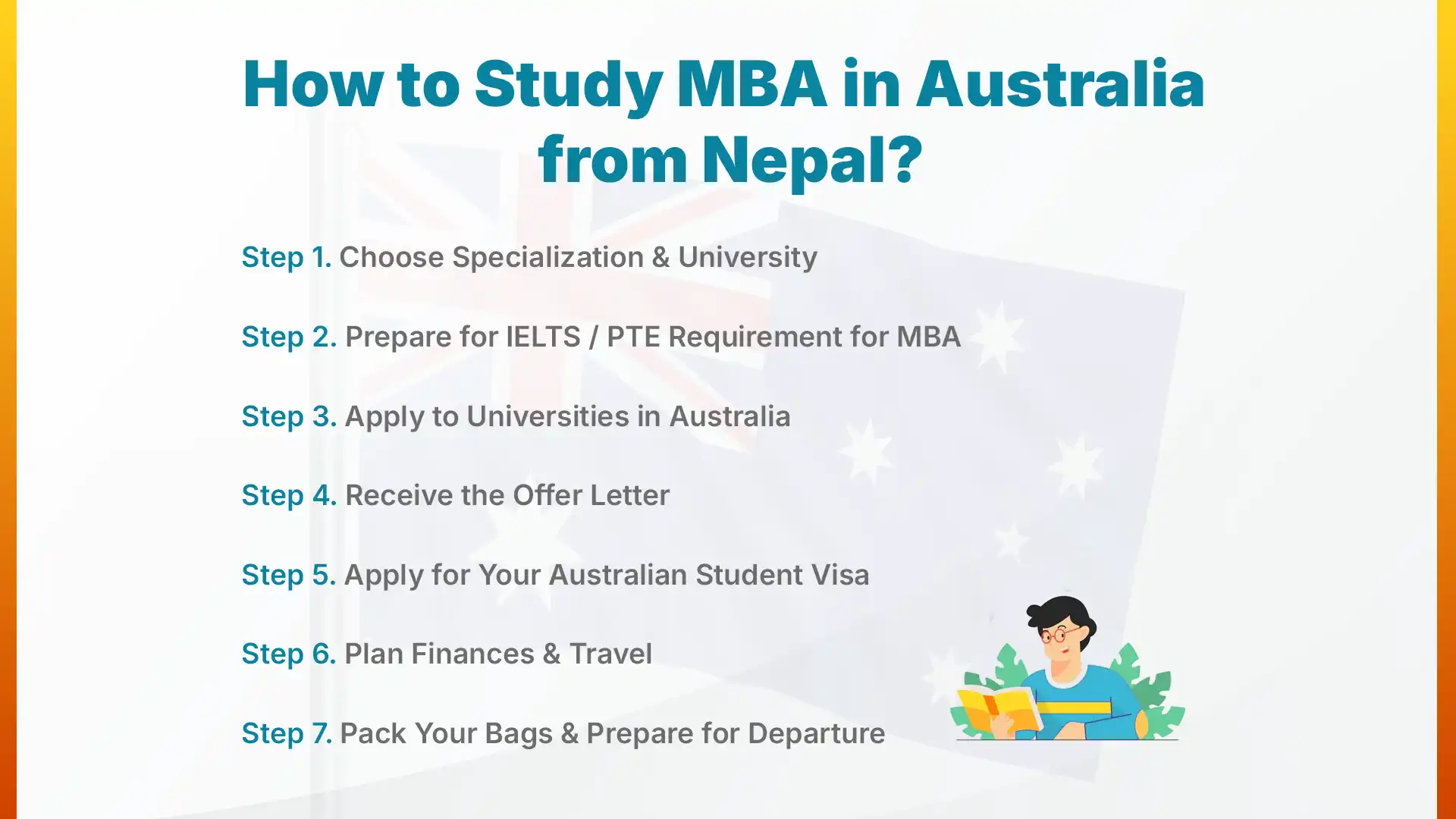
To study MBA in Australia from Nepal, start by choosing your specialization and shortlist universities that fit your career goals. Once you prepare for English tests and submit strong applications with all required documents, apply for a student visa, and prepare for your departure. Here’s a step-by-step guide for Nepali students:
Step 1 – Choose Specialization & University
Start by deciding which MBA specialization matches your career goals, whether it’s Finance, Business Analytics, Healthcare, or Supply Chain. Then, shortlist universities based on fees, location, ranking, and post-study opportunities. Avoid choosing only by brand name; consider the program’s curriculum and industry connections too. A clear plan here will make the rest of your journey much easier.
Step 2 – Prepare for IELTS / PTE Requirement for MBA
Most universities require proof of English proficiency through IELTS or PTE. Begin preparing early to reach the minimum scores (usually IELTS 6.5 overall) and give yourself time for retakes if needed. Don’t underestimate this step! Submitting low scores is one of the most common application mistakes. Strong language results also improve your chances of scholarship eligibility.
Step 3 – Apply to Universities in Australia
Once you have your shortlist and English scores, start applying to universities. Prepare a strong SOP explaining your goals and why you chose that program, and request recommendation letters in advance. Submit all documents carefully and double-check each requirement to avoid delays. Applying to multiple universities increases your chances of receiving an offer.
Step 4 – Receive the Offer Letter
After submitting applications, universities will review your profile and, if successful, issue an offer letter. Check the offer carefully for details like tuition fees, course duration, and scholarship opportunities in Australia. Accepting the offer formally confirms your admission and allows you to proceed with your visa application. Missing small details here is a common mistake, so read everything thoroughly.
Step 5 – Apply for Your Australian Student Visa
With the offer letter in hand, you can apply for the Australian student visa (subclass 500). Prepare documents such as financial proof, health insurance, and a valid passport. Start the visa process early to account for processing time, which can take several weeks. Avoid submitting incomplete forms, as errors here are a frequent reason for visa delays.
Step 6 – Plan Finances & Travel
Plan your finances carefully, including tuition, living costs, and emergency funds. Open an international bank account or plan for money transfer options. Book your flights and arrange accommodation before arrival to reduce stress. Planning ahead ensures a smooth start without last-minute issues.
Step 7 – Pack Your Bags & Prepare for Departure
Finally, prepare for your move by packing essentials for your Australian education. Put in your documents, clothing, and personal items. Learn about Australian culture, local transport, and student services to settle in faster. Don’t forget health insurance and any prescribed medications. Arriving prepared helps you focus on your studies and enjoy your first months in Australia.
By following these steps carefully and avoiding rushed decisions, Nepali students can confidently navigate the MBA journey and start their international career on the right note.
MBA Scholarships in Australia
Studying an MBA in Australia can be expensive, but there are several scholarships that help international students, including those from Nepal, reduce tuition costs and make education more affordable. Scholarships are offered by both the government and universities, and some are based on merit or financial need. Knowing your options and preparing a strong application can significantly increase your chances of getting support. Below are the most common and respected MBA‑related scholarships that you can explore:
1. ANU MBA Scholarship
This scholarship is offered by the Australian National University and can cover between 25 % and 100 % of your MBA tuition fees. It is aimed at international students accepted into ANU’s MBA program who demonstrate strong academic achievement and leadership potential. Being partially or fully funded, it significantly lowers your financial burden and helps you focus on studies without stressing about fees.
2. Melbourne Business School Scholarships
At the University of Melbourne’s business school, a range of scholarships is available that vary from partial tuition support to substantial awards. These include options such as the Clemenger BBDO Scholarship, which can be worth up to AUD 50,000 for qualifying MBA students. They are competitive but well worth applying for if you have solid academic results and professional experience.
3. Monash International Leadership Scholarship
Monash University offers this scholarship to international MBA applicants who demonstrate high academic standards and leadership qualities. It typically covers a significant portion of tuition fees, sometimes up to full coverage for strong candidates. This scholarship helps you join one of Australia’s largest business schools with reduced financial pressure.
4. AGSM Leadership Excellence Scholarship (UNSW)
Offered by the Australian Graduate School of Management at UNSW Sydney, this is one of the most generous scholarships available for MBA students. It can cover up to 100 % of tuition fees for candidates with outstanding leadership skills and academic records. Applications are automatic once you submit your MBA application.
5. UQ Business School MBA Scholarships
The University of Queensland awards scholarships to international MBA students that can offer partial tuition fee waivers. Eligibility usually includes strong academic performance and relevant work experience. Even a partial scholarship can significantly reduce your study cost and enhance your financial planning.
6. Adelaide MBA Scholarship
This scholarship from the University of Adelaide provides a 25 % tuition fee reduction to qualified MBA applicants. While not fully funded, it still offers meaningful savings, especially when combined with other support options or part‑time work. It’s a solid option for students with good academic backgrounds.
7. Curtin International Merit Scholarship
Curtin University offers this merit‑based scholarship to international students, including MBA candidates, usually providing up to AUD 15,000 towards tuition. It’s great for students with strong academic grades and can help reduce the upfront financial burden of an MBA.
Most of these scholarships require you to first receive an offer of admission to be eligible, so always apply to your chosen programs early and then submit scholarship applications before the deadlines. Also, prepare strong SOPs and recommendation letters to improve your chances.
Career Prospects After an MBA in Australia
After completing an MBA in Australia, there are many career opportunities for international students in diverse industries. Graduates can secure roles that match their specialization, gain valuable work experience, and build a strong professional network. Understanding which roles are in demand, what salaries to expect, and how to approach internships and networking can help you plan your career strategically. Let’s break down the key details for MBA graduates in Australia.
1. Popular Roles & Salary After an MBA in Australia
MBA graduates in Australia can work in roles such as finance manager, business analyst, marketing manager, operations manager, and supply chain manager. Salaries vary by role, experience, and city, but here’s an overview of average annual figures:
Role | Average Salary (AUD/year) |
| Finance Manager | 120,000 – 150,000 |
| Business Analyst | 90,000 – 120,000 |
| Marketing Manager | 100,000 – 130,000 |
| Operations Manager | 110,000 – 140,000 |
| Supply Chain Manager | 100,000 – 130,000 |
These numbers can grow quickly with experience and performance, especially in top cities like Sydney, Melbourne, and Brisbane.
2. Industries Hiring MBA Graduates
MBA graduates are in demand across multiple sectors including finance, consulting, technology, healthcare, hospitality, and logistics. Large corporations, mid-size companies, and start-ups all value MBA skills like leadership, strategy, and analytical thinking. Choosing a specialization aligned with industry needs can improve your employability.
3. Internship Importance
Internships are crucial for gaining Australian work experience and connecting with potential employers. Many MBA programs include internship opportunities as part of the curriculum. Completing an internship helps you understand workplace culture, develop practical skills, and sometimes even secure a full-time job after graduation.
4. Networking Tips
Building professional networks is key to landing good roles in Australia. Attend industry events, university career fairs, alumni meetups, and online professional groups. Networking increases your visibility, helps you learn about hidden job opportunities, and can lead to mentorship or collaborations.
5. Work Permit After MBA for International Students
After completing your MBA, international students can apply for the Post-Study Work Visa (subclass 485). This visa allows you to stay and work in Australia for 2–4 years, depending on your program and location. Gaining local work experience not only boosts your resume but can also open pathways for permanent residency if that is your goal.
Pros and Cons of Doing MBA in Australia
Doing an MBA in Australia comes with many benefits, but it also has a few challenges. Being aware of both sides helps you make a realistic decision and plan better. Here’s a quick overview of the key advantages and disadvantages:
This table gives a clear, balanced view, helping you weigh the benefits against the challenges before making your final decision.
Conclusion
An MBA in Australia can be a game-changer if you are ready to invest time, effort, and resources into building a global career. It’s ideal for Nepali students who want international exposure, strong industry connections, and the chance to work in a multicultural environment. If you already have a clear career goal, are willing to manage costs, and can adapt to a fast-paced learning style, Australia offers excellent opportunities.
However, if you are unsure about your specialization, have limited finances, or are not prepared for the challenges of living abroad, it may be worth reconsidering or exploring alternatives like shorter programs or online MBAs. With careful planning, realistic expectations, and a focus on career goals, an MBA in Australia can be more than just a degree, it can be the start of your global professional journey.
Confused about making the perfect study abroad decision? Consult with certified education counsellors for Australian education. They help you choose the right course, university, and appy strategically for maximum success.