Diploma of Accounting in Australia: Complete 2026 Guide

Mar 30, 2026
You've decided Australia is where you want to study accounting, but now comes the harder part: figuring out which qualification actually makes sense for your goals, your budget, and your timeline. A three-year degree feels like a long commitment when you're eager to start working.
A diploma of accounting offers a faster route into the field, typically taking 6 to 12 months to complete, while teaching you the same practical skills employers look for in entry-level candidates. This guide walks you through everything from course structure and fees to visa requirements and career pathways, so you can decide whether this qualification fits your plans.
In this blog
What is a Diploma of Accounting in Australia
A diploma of accounting in Australia is a vocational qualification that trains you for entry-level and supervisory accounting roles. The program typically runs 6 to 12 months full-time, compared to a three or four-year bachelor's degree. You'll learn practical, job-ready skills like preparing financial reports, handling tax documentation, and managing payroll systems.
FNS50222 Qualification Overview
FNS50222 is the national training package code for the Diploma of Accounting. Every TAFE college, university pathway program, and registered training organization delivering this qualification follows the same competency standards. Your certificate carries the same weight whether you study in Sydney, Perth, or a regional town.
Key Skills and Knowledge You Will Gain
Throughout the program, you'll build competencies that employers actively look for:
- Financial reporting: preparing statements and interpreting accounting data for business decisions
- Taxation principles: calculating individual and business tax obligations under Australian law
- Management accounting: creating budgets, forecasts, and cost analyses
- Business law: understanding legal frameworks that affect accounting compliance
- Payroll administration: processing wages, superannuation, and employee entitlements
Course Duration and Study Modes
Full-time students typically finish in 6 to 12 months, while part-time study can stretch to 18 months or longer. Many institutions offer on-campus classes, diploma in accounting online programs, and blended learning that combines both. Your choice often depends on visa conditions, work commitments, and how you learn best.
Entry Requirements for a Diploma in Accountancy
Requirements vary between institutions, though most share common expectations for international students. Knowing what's expected early helps you prepare a stronger application.
Academic Qualifications
Most providers expect completion of secondary school (Year 12 or equivalent). Some institutions accept mature-age students with relevant work experience, even without formal qualifications. If you have a study gap, many providers still consider your application with proper justification. If you've already completed a Certificate IV in Accounting and Bookkeeping, you may receive credit toward certain units.
English Language Requirements for IELTS and PTE
Since classes are taught in English, you'll need to meet the IELTS requirement for Australia or an equivalent standardized test. Here's what most institutions accept:
Exact requirements vary by institution. If your score falls slightly below, some providers offer English pathway programs that lead to the diploma.
Documents Required for International Applicants
Gathering documents early streamlines the application process. You'll generally provide:
- Certified academic transcripts from previous studies
- English proficiency test results within the validity period
- Valid passport copy with a clear photo page
- Statement of purpose explaining your study goals
- Evidence of financial capacity to cover fees and living costs
Diploma of Accounting Course Structure
The dip in accounting combines mandatory core units with elective choices. This structure gives you foundational knowledge plus some flexibility to specialize.
Core Units in the Accounting Diploma
Core units form the backbone of your qualification:
- Prepare financial reports for corporate entities
- Prepare tax documentation for individuals
- Implement and maintain internal control procedures
- Provide financial and business performance information
- Apply economic principles to work in the financial services industry
- Apply leadership and ethics in accounting practice
Elective Units and Specializations
Electives allow you to tailor your studies toward specific career interests. You might choose units in bookkeeping, payroll systems, or management accounting, depending on your goals. A diploma in accounting and finance typically includes additional units covering financial markets and investment analysis, while a standard diploma in accounting focuses more narrowly on accounting practice.
Tuition Fees and Living Costs for International Students
Studying in Australia requires budgeting for both tuition and day-to-day expenses. Understanding the full cost of study in Australia from Nepal early prevents financial stress during your studies.
Diploma of Accounting Fees by Institution
Tuition varies significantly between providers. TAFE colleges (government-funded vocational institutions) often charge differently from private RTOs or university pathway programs. Fees typically range from AUD 8,000 to AUD 20,000 for the full diploma, though exact amounts change based on location and institution type. Always check current fees directly with your chosen provider.
Living Expenses Across Australian Cities
Where you study affects your cost of living considerably, so choosing among the best cities in Australia matters:
The Australian Government suggests budgeting approximately AUD 24,505 per year for living expenses, though actual costs vary by lifestyle and location.
Additional Costs to Include in Your Budget
Beyond tuition and rent, several expenses often catch students off guard:
- Overseas Student Health Cover (OSHC): mandatory health insurance for your entire visa duration
- Study materials: textbooks, accounting software, and online resources
- Transport: public transit passes or vehicle costs
- Accommodation bond: typically four weeks' rent paid upfront
Scholarships for Accounting Diploma Students
Scholarships and education loans for studying in Australia can significantly reduce your financial burden. Several options exist for international students pursuing accounting studies.
Australian Government Scholarships
Programs like Australia Awards provide funding for students from eligible countries, covering tuition, living expenses, and travel. Eligibility typically depends on academic merit, leadership potential, and your home country. Competition is high, so applying early with strong documentation improves your chances.
Institution-Based Scholarships and Fee Waivers
Many TAFEs and private colleges offer their own merit-based or need-based scholarships. Some provide partial fee waivers for high-achieving students or applicants from specific regions. Contact your chosen institution's international office directly to learn about available opportunities.
Get Expert Guidance on Scholarships and Applications
Top Australian Institutions Offering a Dip in Accounting
Australia offers multiple pathways for studying a diploma in accountancy. Each provider type has distinct advantages.
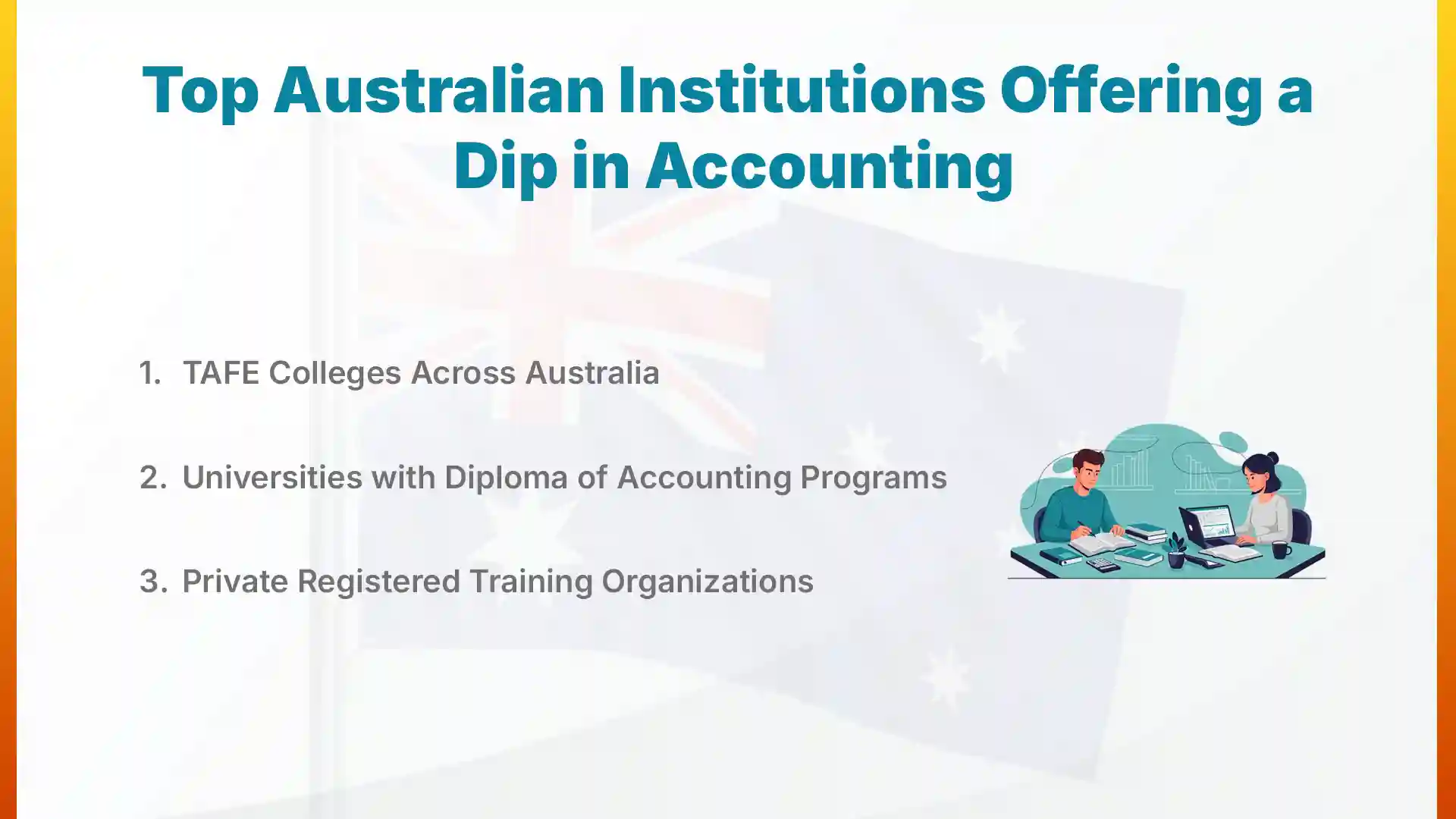
TAFE Colleges Across Australia
TAFE (Technical and Further Education) institutions are government-funded and available in every state. They're known for practical, industry-focused training and often have strong connections with local employers. Many TAFEs offer both on-campus and online accounting diploma options.
Universities with Diploma of Accounting Programs
Some universities deliver vocational diplomas through their TAFE divisions or pathway colleges. This arrangement can provide smoother credit transfer if you plan to continue to a bachelor's degree. You'll benefit from university facilities while completing a vocational qualification.
Private Registered Training Organizations
Private RTOs are registered to deliver nationally recognized training and often offer flexible scheduling. Some provide accelerated programs or evening classes suited to working students. Always verify the RTO is registered on training.gov.au before enrolling.
Accounting Diploma Online vs On-Campus Study Options
Choosing between online and on-campus study depends on your circumstances, visa status, and learning preferences.
International students on a Subclass 500 visa typically face attendance requirements that limit fully online study. A diploma of accounting online works well for students already in Australia on other visas or studying part-time alongside work.
Career Pathways After Completing Your Accounting Diploma
A diploma in accounting opens doors to entry-level and paraprofessional roles across various industries.
Job Roles Available to Diploma Graduates
With this qualification, you can pursue positions such as accounts receivable officer, payroll administrator, assistant accountant, bookkeeper, tax administration officer, and BAS (Business Activity Statement) agent.
Expected Salaries for Accounting Diploma Holders
Salaries vary by location, employer size, and experience level. Entry-level positions typically start around AUD 50,000–60,000 annually, with growth as you gain experience. The Australian Government's Job Outlook website provides current salary guides for specific occupations.
Industries Hiring Accounting Professionals in Australia
Accounting is one of the best courses in Australia for Nepalese students, with skills valued across virtually every sector, including professional services firms, banking and finance, government agencies, healthcare organizations, retail and hospitality, and small to medium enterprises.
Pathway from Diploma to Bachelor's Degree and CPA Membership
Many students use the diploma as a stepping stone toward higher qualifications and professional certification.
Credit Transfer to University Accounting Degrees
Completing a diploma of accounting can provide credit toward a bachelor's degree in Australia, potentially reducing your study time by six months to a year. Credit amounts vary by university and depend on which units you've completed. This pathway saves both time and money while building toward a more advanced qualification.
How to Pursue CPA or CA Certification
CPA (Certified Practicing Accountant) and CA (Chartered Accountant) are Australia's main professional designations. A diploma alone doesn't qualify you for certification. The typical pathway looks like this: diploma, then bachelor's degree, then graduate program, then professional membership with supervised work experience.
Student Visa Requirements for Studying Accounting in Australia
Understanding the requirements to study in Australia from Nepal is essential for international students planning to study a diploma in accountancy.
Subclass 500 Student Visa Overview
The Subclass 500 is Australia's main student visa for international students. It covers your course duration plus additional time before and after your studies. You'll apply online through the Department of Home Affairs after receiving your Confirmation of Enrolment (CoE).
Genuine Temporary Entrant Requirement
Australia assesses whether you genuinely intend to stay temporarily for study purposes through the Genuine Temporary Entrant (GTE) requirement. Factors considered include your circumstances in your home country, immigration history, and how the course relates to your career goals. A well-prepared GTE statement strengthens your application.
Part-Time Work Rights for International Students
Student visa holders can work up to 48 hours per fortnight during academic sessions and unlimited hours during scheduled breaks. This helps offset living costs while gaining Australian work experience. Many accounting students find part-time bookkeeping or administrative roles that complement their studies.
Can You Get PR After a Diploma in Accounting in Australia
This is one of the most common questions Nepali students ask. While a diploma alone may not lead directly to permanent residency, it can form part of a longer-term pathway.
Temporary Graduate Visa Subclass 485
The Subclass 485 allows recent graduates to stay and work in Australia after completing their studies. Eligibility depends on factors including minimum study duration (typically two years) and course type. A diploma alone may not meet the requirements, though combining it with further study could qualify you.
Points-Based Skilled Migration Pathways
Australia's points-based system awards points for factors like age, English proficiency, qualifications, and work experience. Accountants appear on the skilled occupation list, but meeting points thresholds typically requires a bachelor's degree, professional certification, and relevant work experience. The diploma serves as a foundation rather than a complete pathway—explore other PR courses in Australia to understand the full picture.
Regional Visa Advantages for Accounting Graduates
Studying and working in regional Australia can provide additional visa pathways and points advantages. Regional visas like Subclass 491 and 494 offer routes to permanent residency with lower points thresholds. If PR is your long-term goal, considering regional study locations may strengthen your overall strategy.
How Nepali Students Can Apply for an Accounting Diploma in Australia
Here's a step-by-step guide tailored to Nepali students navigating the application process.
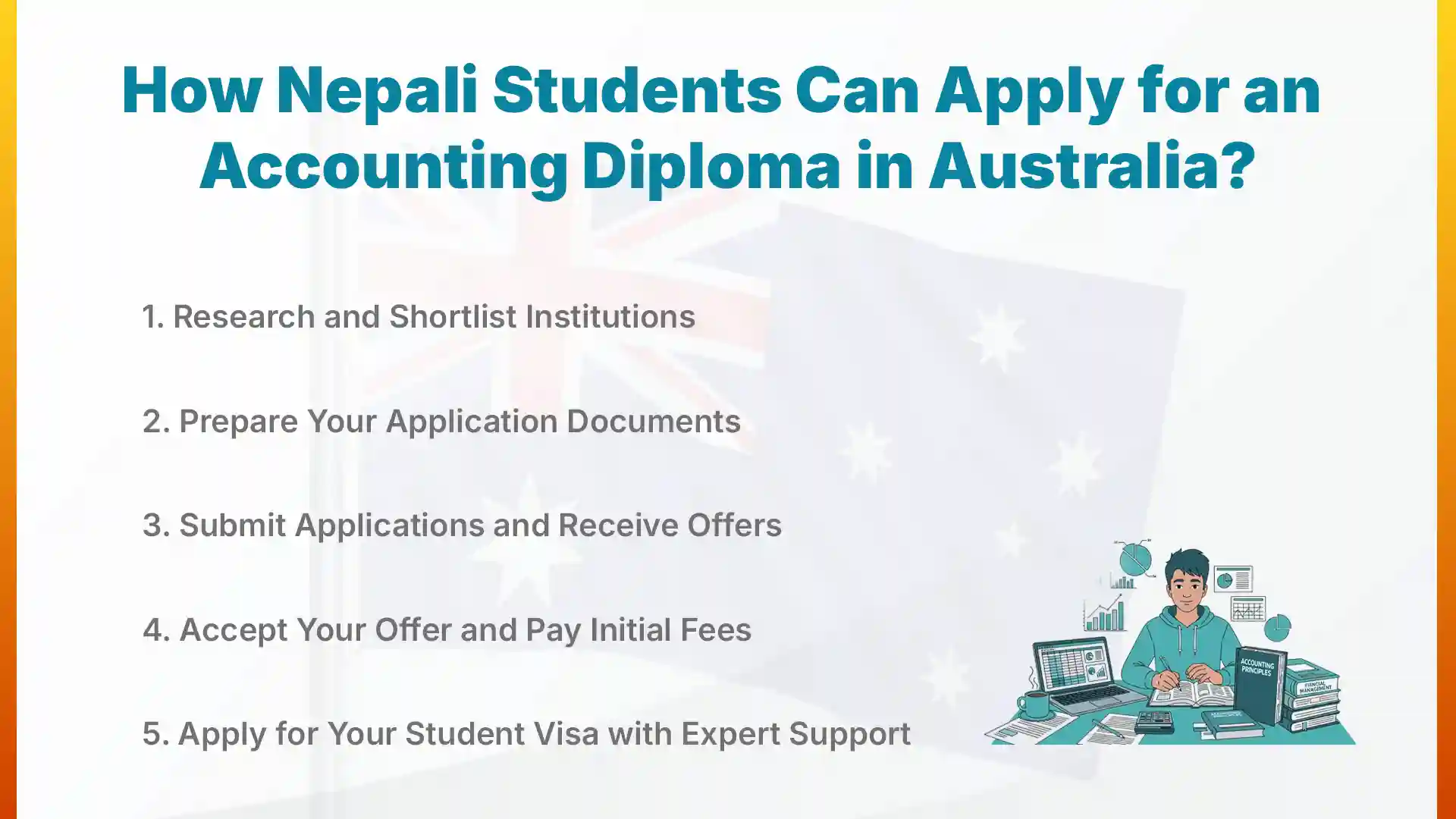
1. Research and Shortlist Institutions
Start by using CRICOS (Commonwealth Register of Institutions and Courses for Overseas Students) to find registered providers. This database lists every institution approved to enroll international students. Education consultancies like SAS Education Consultancy offer tools like UniFinder to help match you with suitable programs based on your profile and goals.
2. Prepare Your Application Documents
Gather all required documents well before application deadlines. Get academic transcripts certified and translated into English if needed. Your statement of purpose is particularly important because it explains why you've chosen this course and how it fits your career plans.
3. Submit Applications and Receive Offers
You can apply to multiple institutions simultaneously, keeping intakes in Australia in mind to time your submissions. Offers come in two types: conditional (requiring you to meet certain criteria like English scores) and unconditional (ready for acceptance). Compare offers carefully, considering factors beyond just fees.
4. Accept Your Offer and Pay Initial Fees
Accepting an offer involves signing an agreement and paying a deposit, typically one semester's fees. You'll then receive a Confirmation of Enrolment (CoE), which is essential for your visa application. Keep all payment receipts and correspondence organized.
5. Apply for Your Student Visa with Expert Support
With your CoE in hand, you can submit your visa application through ImmiAccount. The process involves uploading documents, paying fees, and potentially attending an interview. For a detailed walkthrough, the study in Australia from Nepal guide covers each step. Working with experienced consultants who understand both Australian requirements and Nepali students' circumstances can significantly improve your chances of approval. SAS Education Consultancy provides complete visa guidance, including document preparation and interview readiness.
Start Your Accounting Journey in Australia with Confidence
A diploma of accounting in Australia offers practical skills, clear career pathways, and potential stepping stones toward further education and migration. Whether you're aiming for immediate employment, planning to continue to a bachelor's degree, or exploring long-term residency options, this qualification provides a solid foundation.
Ready to take the first step? Book a free consultation with SAS Education Consultancy to get personalized advice on courses, applications, and visa support tailored to your goals.
Book Your Free Consultation Today
Conclusion
A diploma of accounting in Australia gives you practical skills, industry recognition, and flexibility to enter the workforce quickly or continue toward higher qualifications. The 6 to 12-month timeframe makes it an efficient choice if you want to start your accounting career without committing to a three-year degree. Whether you're planning to work immediately after graduation, transfer credits to a bachelor's program, or explore pathways toward permanent residency, this qualification provides a strong foundation. Take the time to research institutions, understand visa requirements, and plan your finances carefully—your accounting career in Australia starts with informed decisions today.