Diploma in Culinary Arts Programs in Australia 2026

Mar 31, 2026
You've decided to turn your passion for cooking into a professional career, and Australia keeps coming up as the destination. World-class training, post-study work rights, and a genuine pathway to permanent residency make it easy to see why Nepali students are drawn to Australian culinary programs.
But here's where it gets complicated. Which qualification do you actually need? How much will it cost? And what's the difference between a Certificate III, Certificate IV, and a Diploma anyway?
This guide breaks down everything you need to know about culinary arts diplomas in Australia, from top institutions and entry requirements to visa processes and career opportunities after graduation.
In this blog
What is a Diploma in Culinary Arts in Australia
A Diploma in Culinary Arts in Australia is a vocational qualification that trains you to become a professional chef through hands-on kitchen work combined with hospitality management skills. The program is one of many diploma courses in Australia under the VET (Vocational Education and Training) sector, designed for direct employment rather than academic research. Most pathways combine a Certificate III in Commercial Cookery with a Certificate IV in Kitchen Management, leading to a Diploma of Hospitality Management.
Unlike university degrees that lean heavily on theory, culinary diplomas prioritize time in real or simulated commercial kitchens. You'll spend your days cooking, plating dishes, and learning kitchen operations rather than sitting through lectures. This practical approach means graduates can step into professional kitchens confidently from day one.
- Qualification level: A nationally recognized vocational diploma under the Australian Qualifications Framework (AQF)
- Practical focus: Extensive training in working kitchens, not just classrooms
- Industry pathway: Direct route to roles as chefs, cooks, and kitchen managers
Why Study Culinary Arts in Australia
Australia offers world-class culinary training with internationally recognized qualifications, strong industry connections, and clear pathways to post-study work opportunities and permanent residency. The country's thriving hospitality sector and practical, hands-on approach to culinary education make it an ideal destination for aspiring chefs.
1. Globally recognized qualifications
Australian culinary qualifications carry weight in kitchens worldwide. Employers from Dubai to London recognize the rigorous standards of Australian training institutions, so your diploma opens doors to international career opportunities without additional certifications.
2. Hands-on practical training
What sets Australian culinary programs apart is the emphasis on real-world experience. You won't just learn recipes from textbooks. Most programs include mandatory industry placements in working restaurants, hotels, or catering companies, giving you professional experience before graduation.
3. Post-study work rights
After completing your diploma, you may qualify for the Temporary Graduate Visa (subclass 485). This visa allows you to stay and work full-time in Australia, gaining valuable professional experience in one of the world's most dynamic hospitality markets.
4. Pathway to permanent residency
Here's something many students don't realize at first: chefs and cooks frequently appear on Australia's skilled occupation lists. Completing a culinary qualification and gaining relevant work experience can create a genuine pathway to permanent residency, making your education investment even more valuable over time.
Is Culinary Arts in Demand in Australia
Yes, culinary professionals are in strong demand across Australia. The country's thriving tourism industry and persistent shortage of qualified chefs create abundant employment opportunities for graduates. Cooks and chefs consistently appear on Australia's Medium and Long-term Strategic Skills List (MLTSSL), signaling their importance to the economy.
- Tourism industry growth: Australia's hospitality sector constantly requires skilled chefs for restaurants, hotels, resorts, and cafes
- Skills shortage: Culinary roles are officially recognized as priority occupations nationwide
- Employment opportunities: Graduates find work across fine dining, hotels, catering companies, cruise ships, and cafes
This demand translates to better job security and often faster career progression compared to oversaturated fields.
Best Culinary Schools in Australia for International Students
Choosing the right institution can feel overwhelming, so here's a comparison of top culinary schools that accept international students:
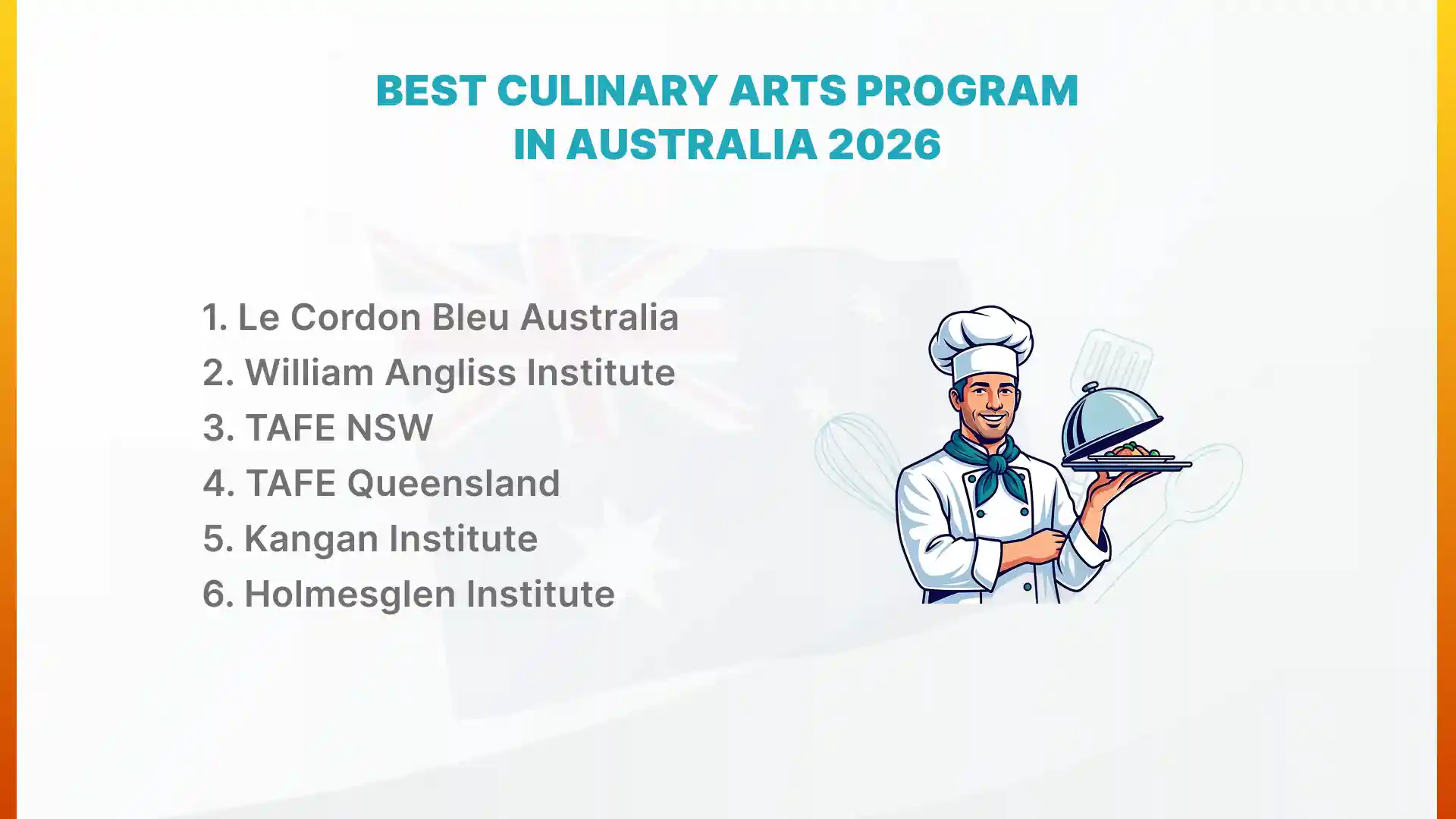
1. Le Cordon Bleu Australia
This world-renowned institution has built its reputation on rigorous training in classic French culinary techniques. With campuses in four major cities, Le Cordon Bleu also offers pathways to hospitality management degrees for students wanting to continue their education.
2. William Angliss Institute
As Australia's specialist training provider for food, tourism, and hospitality, William Angliss maintains exceptionally strong industry partnerships. Graduate employment rates consistently rank among the highest in the sector.
3. TAFE NSW
Government-funded TAFE colleges offer affordable, practical culinary programs across numerous campuses. While fees are lower than those at private institutions, the quality of training remains high, making TAFE an excellent option for budget-conscious students.
4. TAFE Queensland
Located in one of Australia's key tourism regions, TAFE Queensland provides state-of-the-art training facilities. The Gold Coast and Brisbane locations offer proximity to major hospitality employers.
5. Kangan Institute
This Melbourne-based TAFE is known for well-equipped commercial training kitchens. Students gain extensive hands-on experience in realistic work environments before entering the industry.
6. Holmesglen Institute
As one of Victoria's largest TAFE providers, Holmesglen offers comprehensive programs from certificate to degree level. This creates a complete educational pathway for students wanting to progress their qualifications over time.
Types of Culinary Arts Qualifications in Australia
Australian culinary education follows a clear progression pathway. You can build credentials over time, starting with foundational skills and advancing to management-level qualifications.
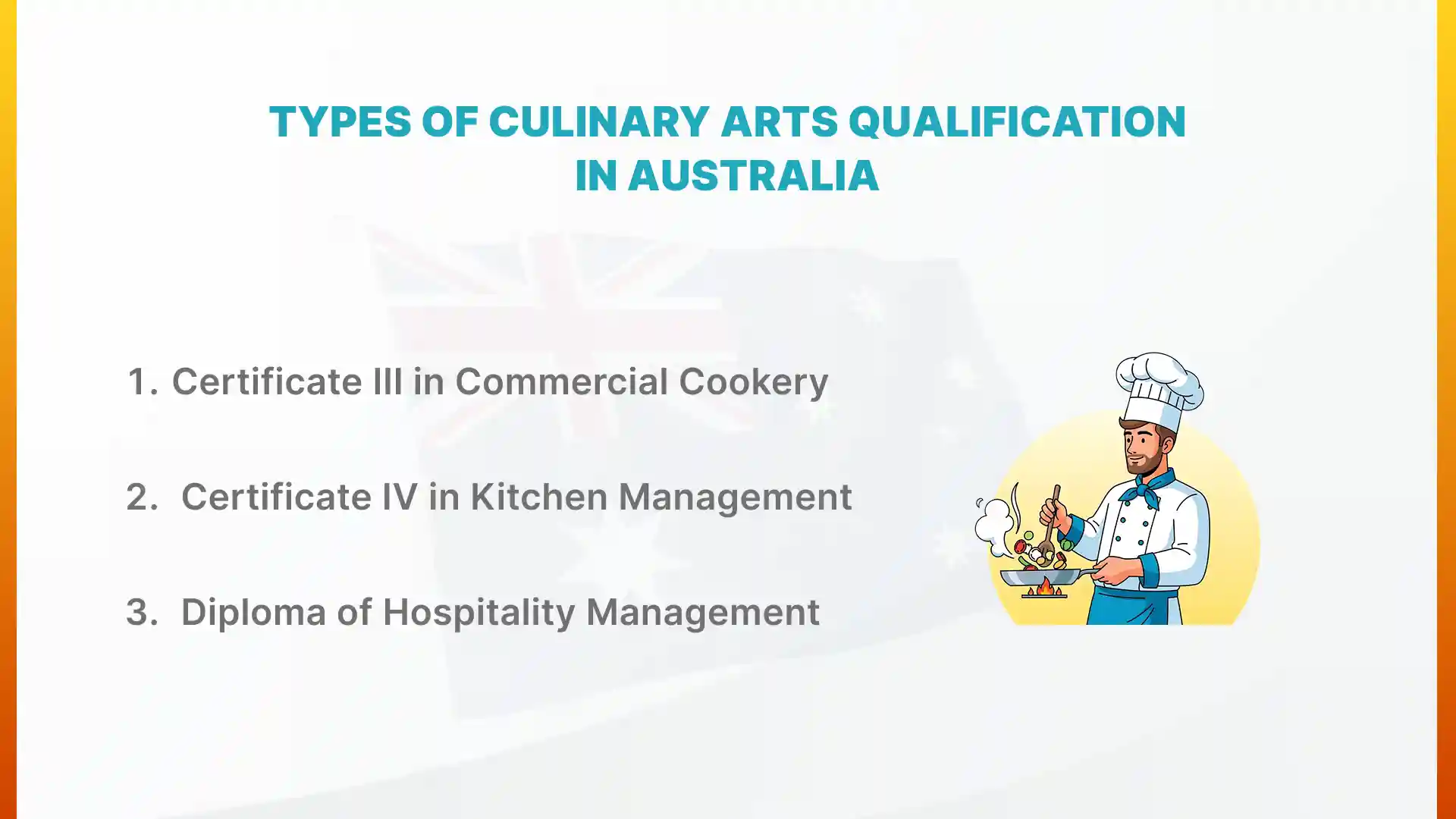
1. Certificate III in Commercial Cookery
This foundational qualification is required to work as a commercial cook in Australia. You'll learn essential cooking techniques, food safety standards, and basic kitchen operations. Most international students start here.
2. Certificate IV in Kitchen Management
Building on Certificate III skills, this qualification focuses on supervisory abilities. The curriculum covers menu planning, cost control, inventory management, and leading kitchen teams. Many institutions package this with the Diploma.
3. Diploma of Hospitality Management
The most comprehensive option combines advanced culinary skills with business management principles. You'll study budgeting, human resources, marketing, and overall hospitality operations, preparing you for senior management roles.
How Long is a Culinary Arts Diploma in Australia
A culinary arts diploma typically takes 1.5 to 2 years of full-time study. The exact duration depends on your institution and whether you're enrolled in a packaged course combining multiple qualifications.
- Certificate III alone: Generally around one year
- Diploma pathway: Usually up to two years, including Certificate III and IV units
- Full-time requirement: Most international students are required to study full-time
- Industry placement hours: Program length includes mandatory work placement
Some institutions offer accelerated pathways for students with prior cooking experience, potentially reducing study time through Recognition of Prior Learning (RPL).
How Much Does a Culinary Diploma Cost in Australia
Costs vary significantly based on institution type and location. Private institutions like Le Cordon Bleu generally charge higher tuition than government-funded TAFE colleges. Always verify current fees directly with your chosen institutions before applying.
1. Tuition fees by institution
Private culinary schools typically charge more than TAFE programs. Packaged courses that include multiple qualifications may offer better value than enrolling in each separately. Fee structures also differ based on program length and include materials like uniforms or equipment.
2. Living costs by city
Your location significantly impacts living expenses. Sydney and Melbourne are considerably more expensive than smaller cities or regional areas. Major cities require higher budgets for accommodation, food, transport, and personal expenses.
3. Additional costs for international students
Beyond tuition, several mandatory expenses apply:
- Overseas Student Health Cover (OSHC): Required health insurance for your entire stay
- Uniform and equipment: Professional chef whites, safety shoes, and knife sets
- Visa application fees: Government fee for student visa processing
- English test fees: IELTS, PTE, or equivalent testing costs
Entry Requirements for Culinary Diploma Programs in Australia
Entry requirements for culinary diploma programs in Australia are relatively straightforward compared to university degrees. Most institutions require completion of secondary education and proof of English language proficiency, though specific requirements vary between schools and qualification levels.
1. Academic requirements
Most culinary diploma programs require completion of Australian Year 10 or 12, or an international equivalent. Specific requirements vary between institutions and qualification levels, so checking with each school is important before applying.
2. English language requirements
International students provide evidence of English proficiency. While requirements are generally lower for vocational programs than university degrees, you'll still meet minimum scores.
- IELTS Academic: Typically 5.5 overall with no band below 5.0
- PTE Academic: Widely accepted as an IELTS alternative
- TOEFL iBT: Another commonly accepted option
- English pathway programs: Many institutions offer ELICOS courses for students not yet meeting direct entry requirements
Prepare for Your English Test with Expert Guidance
3. Recognition of prior learning
If you have existing cooking experience or formal qualifications, you may qualify for Recognition of Prior Learning (RPL). Institutions assess your prior skills and knowledge to grant credit, potentially reducing study duration and tuition fees. Students with a time gap between their last qualification and this application should also understand how much study gap is acceptable in Australia, as diploma and VET programs tend to be flexible on this.
What You Learn in a Culinary Arts Diploma
Australian culinary diploma programs combine practical cooking skills with essential business knowledge. You'll spend significant time in commercial kitchens while also learning the management principles needed to run successful food operations.
1. Core culinary techniques
You'll master a wide range of cooking methods, food preparation skills, recipe development, and presentation techniques across various cuisines. Programs typically cover European, Asian, and modern Australian cooking styles.
2. Kitchen operations and management
The curriculum extends beyond cooking to include inventory control, ordering systems, menu costing, waste management, and team coordination. Business skills like budgeting and scheduling prepare you for supervisory roles.
3. Food safety and hygiene standards
A critical component involves learning Australian food safety regulations, including HACCP (Hazard Analysis and Critical Control Points) principles and workplace health and safety (WHS) requirements. Certifications in food safety are mandatory for working in Australian kitchens.
4. Industry placement and work experience
All reputable programs include mandatory work placement in commercial kitchens, restaurants, or hotels. This real-world experience allows you to apply classroom learning while building connections with potential employers.
Student Visa Requirements for Culinary Studies
Securing your student visa is a critical step in your journey to study culinary arts in Australia. Understanding the requirements and preparing your documentation properly increases your chances of approval and helps avoid costly delays.
1. Subclass 500 student visa overview
The Subclass 500 is the primary visa for international students in Australia. It allows you to stay for your course duration, work limited hours during study periods, and travel in and out of the country.
2. Financial requirements for a student visa
You'll demonstrate sufficient funds to cover tuition, living costs, and travel expenses. This is a key component of the Genuine Student (GS) requirement.
- Tuition fees: Evidence covering your first year
- Living costs: Proof of funds for your first year in Australia (amount set by the Department of Home Affairs)
- Return airfare: Funds for a return flight home
- Dependents: Additional funds for bringing family members
3. Health and character requirements
All applicants undergo a medical examination with an approved panel physician and meet character requirements, which may include police clearance certificates from countries where you've lived.
4 Genuine Student requirements
You'll demonstrate that your genuine intention is to study temporarily in Australia. This involves explaining your study choices, career plans, and ties to your home country. SAS Education Consultancy provides expert visa guidance to help students prepare strong applications meeting this requirement.
Career Opportunities After a Culinary Arts Diploma
Completing a culinary arts diploma in Australia opens doors to diverse career paths across the hospitality industry. Your qualification and practical training prepare you for immediate employment in professional kitchens, with clear progression routes to senior management positions.
1. Chef and cook positions
Graduates qualify for various entry-level and intermediate roles: Commis Chef, Demi Chef, Chef de Partie (Station Chef), or Cook in restaurants, hotels, resorts, cafes, and catering companies.
2. Kitchen management roles
With experience, you can progress to senior positions such as Sous Chef, Head Chef, or Executive Chef. Senior roles involve menu creation, staff management, and overall kitchen operations.
3. Average chef salaries in Australia
Salaries vary based on role, experience, and location. Entry-level positions offer competitive wages, while senior roles like Head Chef and Executive Chef command significantly higher pay.
4. Post-study work visa options
The Temporary Graduate Visa (subclass 485) allows eligible culinary graduates to stay and work full-time in Australia. This is a crucial step for gaining local experience for employer sponsorship or skilled migration pathways.
Scholarships for Culinary Arts Students in Australia
Several scholarship opportunities help international students fund their culinary studies:
- Australia Awards: Prestigious government scholarships for students from eligible countries, though competition is high
- Destination Australia: Scholarships encouraging study in regional Australia
- Institution-specific scholarships: Many culinary schools offer merit-based or need-based awards
- External scholarships: Industry associations and private organizations sometimes support aspiring chefs
SAS Education Consultancy helps students identify and apply for relevant scholarships to make studying in Australia more affordable.
How to Apply for a Culinary Arts Diploma from Nepal
Applying for a culinary arts diploma from Nepal involves a six-step process: choosing your program, meeting entry requirements, submitting your application, receiving your Confirmation of Enrolment, applying for your student visa, and preparing for departure. The entire process typically takes 3-6 months from initial application to departure, depending on visa processing times and your preparation.
Step 1: Choose your program and institution
Start by researching different culinary schools using the information above. Consider location, cost, program structure, and industry connections to find the best fit for your career goals.
Step 2: Meet entry and English requirements
Next, prepare for and take an approved English language test like IELTS or PTE to achieve the required score. Gather all academic transcripts and necessary documents during this stage.
Step 3: Submit your application
Apply directly to the institution or through an education consultancy like SAS. Ensure your application is complete with all required documents, including academic records and English test results.
Step 4: Receive your Confirmation of Enrolment
Once your application succeeds and you've paid the initial deposit, the institution issues a Confirmation of Enrolment (CoE). This document is essential for your visa application.
Step 5: Apply for your student visa
Lodge your Subclass 500 student visa application with the Australian Department of Home Affairs. Include your CoE, financial evidence, OSHC policy, English test results, and other required documents.
Step 6: Prepare for departure
After visa approval, arrange flights and accommodation. SAS Education Consultancy offers student essentials services, providing support with booking flights and finding accommodation.
Start Your Culinary Career in Australia with Expert Guidance
Pursuing a culinary diploma in Australia is a practical way to launch an international career as a professional chef. However, navigating admissions, documentation, and visa processes requires careful planning.
SAS Education Consultancy provides end-to-end support for Nepali students, offering guidance from course selection and application assistance to visa processing and pre-departure support. Our team understands the specific challenges Nepali students face and can help ensure a smooth journey from Nepal to Australia.
Contact SAS Education Consultancy for a free consultation to start your culinary arts journey in Australia.