Diploma Course Fees in Australia 2026: Complete Guide

Mar 31, 2026
You've decided Australia is the destination, now you're trying to figure out whether your budget can actually handle it. Diploma courses sit in a wide fee range, and without clear numbers, planning feels like guesswork.
This guide breaks down exactly what international students pay for diploma programs in 2026, from tuition by field and city to hidden costs, scholarships, and visa requirements.
In this blog
How much does a diploma cost in Australia?
Diploma courses in Australia for international students typically cost between AUD 12,000 and AUD 40,000+ per year. The exact amount depends on three main factors: the institution type (TAFE vs private college), your chosen field of study, and the program duration. Most diplomas run from six months to two years, so your total investment varies based on how long you study.
What exactly are "tuition fees"? This is the amount you pay directly to your institution for teaching, course access, and basic facilities. It doesn't cover living expenses, health insurance, or other costs we'll get to later.
1. Tuition fees by study field
Your chosen field significantly affects how much you'll pay. Healthcare and technical programs cost more because they require specialized equipment and hands-on training. Business and community services programs tend to be more affordable.
Fees vary between providers, so always confirm with your chosen institution before making plans.
2. Public TAFE diploma fees
TAFE stands for Technical and Further Education, Australia's government-funded vocational training network. For international students, TAFE diploma fees typically range from AUD 12,000 to AUD 22,000 per year.
TAFE courses are known for strong industry connections and practical training. However, payment structures are usually fixed by semester, with less flexibility than private providers offer.
3. Private college diploma fees
Private registered training organizations (RTOs) offer similar qualifications to TAFE but with different pricing structures. Fees at private colleges range from AUD 8,000 to AUD 25,000 per year, with some budget-friendly options for popular courses like business or IT.
Many private colleges offer installment payment plans, which can make managing costs easier. Quality varies more widely among private providers, though, so checking CRICOS registration and student reviews before enrolling is worth your time.
Cheapest diploma courses for international students
If budget is your main concern, several diploma programs consistently offer lower fees while still providing solid career pathways. These affordable options don't compromise on quality; they're nationally recognized qualifications that lead to real employment opportunities.
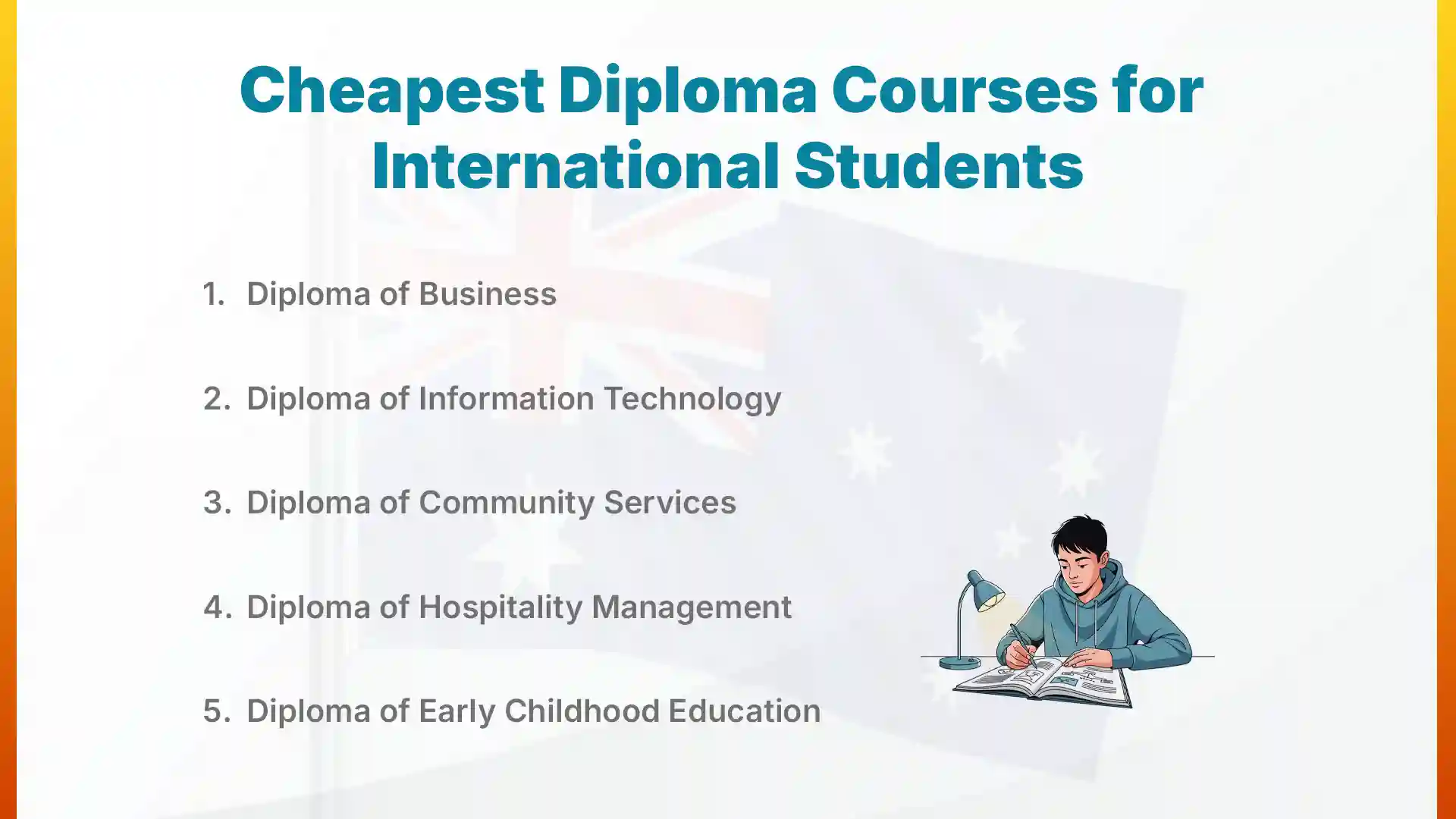
1. Diploma of Business
This qualification is widely available across TAFE and private colleges, often starting around AUD 10,000 per year. The broad applicability across industries makes it a practical choice if you're still exploring career directions.
2. Diploma of Information Technology
IT diplomas attract competitive pricing due to high demand and multiple providers. Fees typically range from AUD 12,000 to AUD 18,000 annually. This qualification works as both a direct employment pathway and a stepping stone to university study.
3. Diploma of Community Services
With Australia's growing aged care and disability support sectors, this diploma offers strong job prospects. Fees often fall between AUD 10,000 and AUD 16,000 per year.
4. Diploma of Hospitality Management
Australia's tourism industry creates consistent demand for hospitality graduates. This diploma typically costs AUD 12,000 to AUD 18,000 annually and includes practical training that can lead to part-time work during your studies.
5. Diploma of Early Childhood Education
Early childhood educators appear on Australia's skills shortage list, which means better job prospects and potential migration pathways. Many students progress from this diploma to a Bachelor of Early Childhood Education for stronger PR prospects. Fees for the diploma generally range from AUD 12,000 to AUD 20,000 per year.
Diploma course fees by Australian city
Where you study affects both tuition and living costs. Tuition fees are set by individual institutions, but some Australian cities tend to have higher overall costs than others.
1. Sydney
Sydney offers the widest selection of institutions, but it comes with higher tuition and living expenses. The city's diverse campus options range from established TAFE institutes to specialized private colleges across business, IT, and healthcare fields. Despite higher costs, Sydney's strong job market and networking opportunities can offset the initial investment.
2. Melbourne
Melbourne provides competitive fees with excellent educational infrastructure and a large international student community. The city's reputation as Australia's education hub means you'll find numerous diploma providers with strong industry partnerships. Melbourne's multicultural environment and student support services make settling in easier for international students.
3. Perth
Western Australia's capital offers potentially lower fees and regional migration advantages for PR pathways. Perth's growing economy creates demand for skilled workers across mining, healthcare, and construction sectors. The city's relaxed pace and lower living costs compared to Sydney or Melbourne make it attractive for budget-conscious students.
4. Brisbane
Queensland's education sector is growing rapidly, with moderate costs and strong industry connections. Brisbane's subtropical climate and outdoor lifestyle appeal to many international students seeking a balanced study experience. The city's expanding infrastructure and hosting of major events create diverse employment opportunities during and after your studies.
5. Adelaide
South Australia offers some of the most affordable diploma options, plus regional migration benefits that can strengthen PR applications. Adelaide's smaller size creates a tight-knit international student community with accessible support networks. The state government actively encourages international graduates to stay through favorable migration policies and employment programs.
6. Gold Coast
Tourism-focused programs thrive here. If hospitality is your target field, the Gold Coast offers relevant industry exposure. The city's resort-style environment provides practical training opportunities in hotels, restaurants, and event management venues. Living costs remain moderate compared to major capitals, while the beach lifestyle adds appeal beyond academics.
TAFE vs private college fees compared
Choosing between TAFE and private colleges involves more than comparing prices.
Both options lead to nationally recognized qualifications. Your choice depends on budget, location preferences, and the specific course you want.
Additional costs beyond tuition
Your diploma budget extends beyond tuition fees. Planning for additional expenses helps you avoid financial surprises after arriving.
1. Overseas student health cover
OSHC (Overseas Student Health Cover) is mandatory health insurance for all international students on a student visa. OSHC typically costs AUD 500 to AUD 700 per year and covers essential medical services. You cannot receive your visa without proof of OSHC coverage.
2. Student services and amenities fee
Most institutions charge the SSAF (Student Services and Amenities Fee), covering campus services like counseling and career support. This usually ranges from AUD 150 to AUD 350 per year.
3. Course materials and equipment
Depending on your field, you may pay for textbooks, uniforms, software licenses, or specialized equipment. Budget approximately AUD 500 to AUD 1,500 per year, though this varies significantly by course.
4. Living expenses in Australia
The Australian government requires international students to demonstrate access to at least AUD 24,505 per year for living expenses. Actual costs depend on your city and lifestyle.
Eligibility requirements for diploma courses
Before focusing on fees, confirm you meet basic entry requirements.
1. Academic qualifications
You typically need Year 12 completion (or equivalent, such as Nepal's +2/Grade 12) to enroll in a diploma program. Some courses accept mature-age students with relevant work experience.
2. English proficiency scores
Most diploma courses require one of these English proficiency scores:
- IELTS Academic: 5.5 to 6.0 overall (no band below 5.0)
- PTE Academic: 42 to 50 overall
- TOEFL iBT: 46 to 60 overall
Requirements vary by institution and course, so check specific entry criteria before applying.
Tip: If your English score falls slightly below requirements, many institutions offer packaged English courses that lead directly into your diploma program.
Prepare for Your English Test with Expert Guidance
3. Financial capacity proof
For your student visa application, you'll demonstrate sufficient funds through bank statements, education loan approvals, or sponsor declarations covering tuition, living expenses, and return travel.
Scholarships for diploma students in Australia
While scholarships for diploma-level study are less common than for degrees, several options exist:
- Destination Australia Scholarships: Government-funded support for students studying in regional areas
- Institution-specific scholarships: Many TAFEs and colleges offer merit-based or need-based awards
- Country-specific scholarships: Some providers offer reduced fees for students from particular countries
Working with an experienced education consultancy can help identify scholarship opportunities matching your profile.
Best diploma courses for international students
Beyond affordability, consider which diplomas offer the strongest career outcomes. The right diploma should align with Australia's current job market demands, provide clear pathways to further study or employment, and ideally appear on skilled occupation lists if permanent residency is part of your long-term plan. Industry placement opportunities, employer recognition, and graduate employment rates are practical indicators worth investigating before you commit to a specific program.
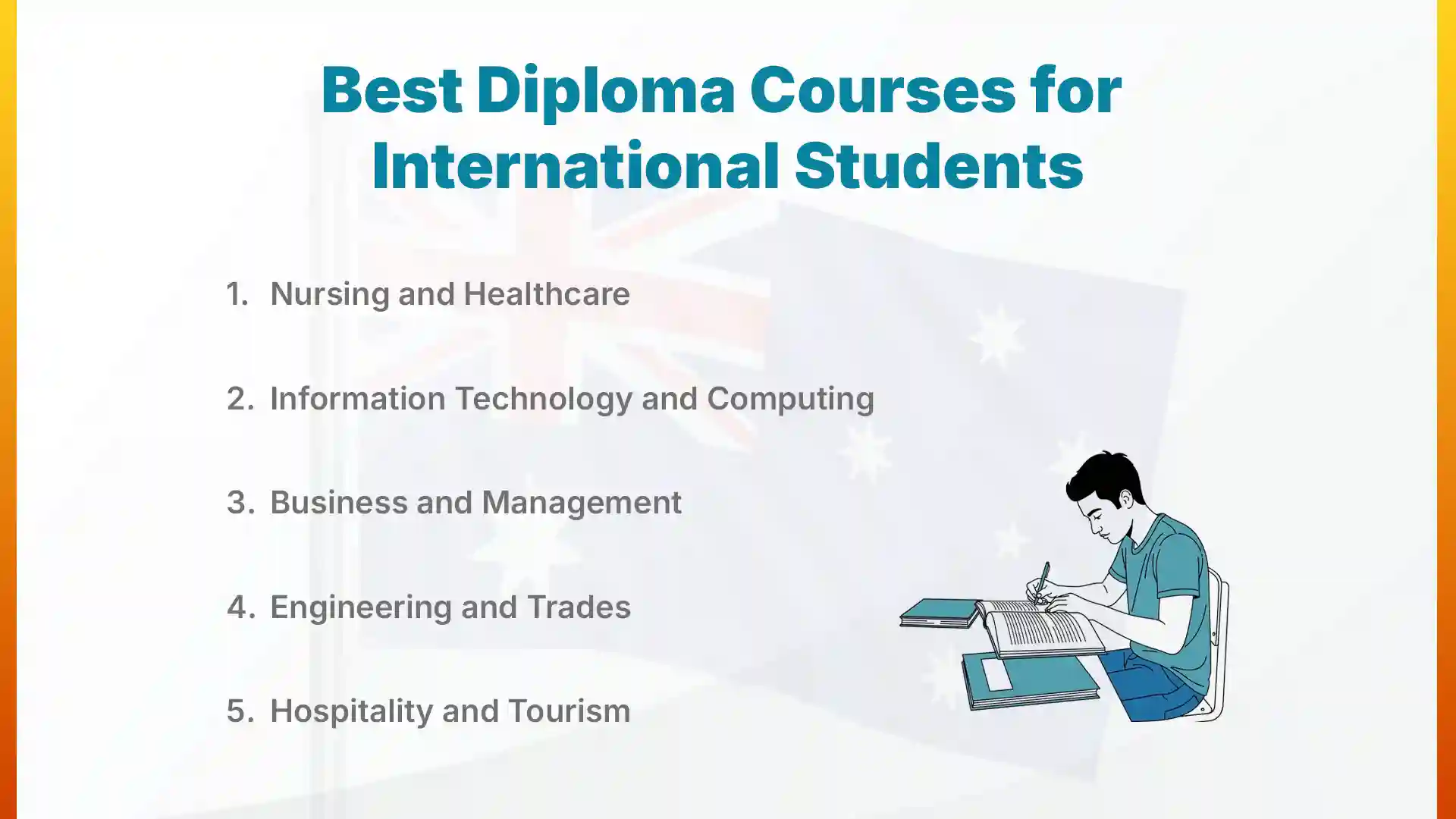
1. Nursing and healthcare
Healthcare diplomas lead to roles in aged care, disability support, and nursing assistance. Ongoing skills shortages create strong employment prospects and potential PR pathways.
2. Information technology and computing
IT diplomas provide entry into Australia's growing tech sector. Many graduates continue to bachelor's degrees with credit transfer, while others move directly into junior technical roles.
3. Business and management
Business diplomas offer versatility across industries, applying to administration, marketing, human resources, and entrepreneurship.
4. Engineering and trades
Trade-focused diplomas in construction, electrical, or mechanical engineering appear on skilled occupation lists, supporting both employment and migration goals.
5. Hospitality and tourism
Hospitality diplomas include work placement opportunities built into the curriculum. Australia's tourism industry provides consistent graduate employment.
Student visa requirements for diploma courses
To study a diploma in Australia, you'll apply for a Subclass 500 Student Visa. Key requirements include:
- Confirmation of Enrolment (CoE) from a CRICOS-registered institution
- Genuine Temporary Entrant (GTE) statement explaining your study intentions
- Financial evidence showing sufficient funds for tuition and living costs
- English proficiency proof meeting your course requirements
- Overseas Student Health Cover (OSHC) for your visa duration
- Valid passport with adequate validity
Processing times vary, so applying well before your intended start date is wise.
Can you get a PR after a diploma in Australia
Yes, a diploma can contribute to your permanent residency pathway, though it's rarely a direct route. After completing a diploma of at least two years, you may be eligible for a Temporary Graduate Visa (Subclass 485), allowing you to work in Australia for 18 months to several years, depending on your study location.
PR (Permanent Residency) pathways typically involve skills assessment in an occupation on the skilled occupation list, points-based visa applications, and potentially state nomination programs. Many students strengthen PR applications by continuing from a diploma to a bachelor's degree, which provides additional points and a longer graduate visa.
Jobs and salaries after diploma courses in Australia
Your student visa allows you to work up to 48 hours per fortnight during study periods and unlimited hours during scheduled breaks.
After graduation, diploma holders find employment across various sectors, including healthcare and aged care, IT and technology, business services, hospitality, and trades. Entry-level positions typically offer growth potential as you gain Australian work experience.
Refund policies for diploma fees
Understanding refund policies before paying protects your investment. Common scenarios include:
- Visa refusal: Most institutions refund fees minus an administrative charge if your student visa is rejected
- Course withdrawal: Refund amounts depend on when you withdraw; early withdrawals receive larger refunds
- Provider default: If your institution closes, government protections help you transfer to another provider or receive a refund
Policies vary significantly between institutions, so reviewing refund terms in your enrollment agreement before making any payment is essential.
Plan your diploma journey to Australia with expert guidance
Navigating diploma options, fees, visa requirements, and scholarship opportunities involves many moving parts. From identifying the right course and institution to preparing your visa application and exploring financial support options, professional guidance can simplify the process.
Book Your Free Consultation Today
Conclusion
Diploma courses in Australia offer international students a practical, affordable pathway into quality education and career opportunities. With fees ranging from AUD 8,000 to AUD 40,000 per year, depending on your field and institution, careful planning helps you find programs that match both your budget and career goals. Understanding the full cost picture, including tuition, living expenses, health cover, and additional fees, puts you in control of your study investment.
Whether you choose TAFE's industry-recognized training or a private college's flexible payment options, your diploma can open doors to employment, further study, and potential PR pathways. The key is selecting a course aligned with Australia's job market demands while meeting visa requirements and securing adequate funding. With the right preparation and guidance, your diploma journey to Australia becomes not just achievable but strategically planned for long-term success.