Bachelor of Public Health in Canada: Guide for Nepalese Students

Jun 03, 2026
Public health is one of the fastest-growing and most impactful fields in the global healthcare landscape, and Canada has established itself as one of the strongest destinations in the world to study it at the undergraduate level. With a publicly funded healthcare system, a government that actively invests in population health research and policy, and universities that deliver rigorous, field-based public health education, Canada offers Nepalese students a pathway into a profession that is meaningful, in demand, and internationally respected.
A Bachelor of Public Health in Canada is not just an academic qualification; it is a foundation for a career that shapes communities, influences policy, and improves lives at scale. Nepalese students who are still exploring their destination options can start by looking at studying in Canada before committing to a specific program.
In this guide, we cover everything a Nepalese student needs to know about pursuing a Bachelor of Public Health in Canada, from top universities and admission requirements to tuition costs, scholarships, career roles, salary expectations, and the pathway to permanent residency.
In this blog
What Is a Bachelor of Public Health in Canada?
A Bachelor of Public Health in Canada is a four-year undergraduate degree focused on protecting and improving the health of populations rather than treating individual patients. It is important to understand from the outset that not all Canadian universities offer a degree titled specifically as a Bachelor of Public Health (BPH). Many institutions offer closely related degrees, such as a Bachelor of Health Sciences (BHSc), Bachelor of Arts or Science in Health Studies, or Bachelor of Science in Population Health, all of which cover the same foundational public health competencies and lead to the same career and postgraduate pathways.
The key distinction between public health and other healthcare degrees like medicine or nursing lies in the level of focus. Medicine and nursing are clinically oriented, addressing the health needs of individual patients in treatment settings. Public health, by contrast, operates at the population level, focusing on disease prevention, health promotion, environmental health, health policy, and the social and structural factors that shape the health of entire communities. Public health professionals ask not just how to treat illness but how to prevent it from occurring in the first place.
The curriculum for a Bachelor of Public Health in Canada covers epidemiology, biostatistics, health policy and systems, environmental and occupational health, community and global health, health promotion, social determinants of health, research methods, and ethics in public health practice. Students divide their time between classroom and laboratory learning, academic research projects, and mandatory field placements or cooperative education terms that place them directly within public health agencies, government departments, NGOs, and community health organizations.
Study in Canada - Start Your Journey Now!
Why Study a Bachelor of Public Health in Canada?
Study a bachelor of public health in Canada because it offers globally recognized degrees; hands-on experiential learning through field placements and co-op programs; high and growing demand for public health professionals across government, healthcare, and NGO sectors; affordable tuition compared to the UK, the USA, and Australia; and a clear pathway to permanent residency through public health occupations.
For Nepalese students who want a healthcare career that makes a broad social impact and opens doors both in Canada and internationally, public health in Canada delivers the right combination of academic quality, professional opportunity, and immigration advantage. This is a significant part of why Nepalese students choose Canada over other English-speaking destinations for health-related programs.
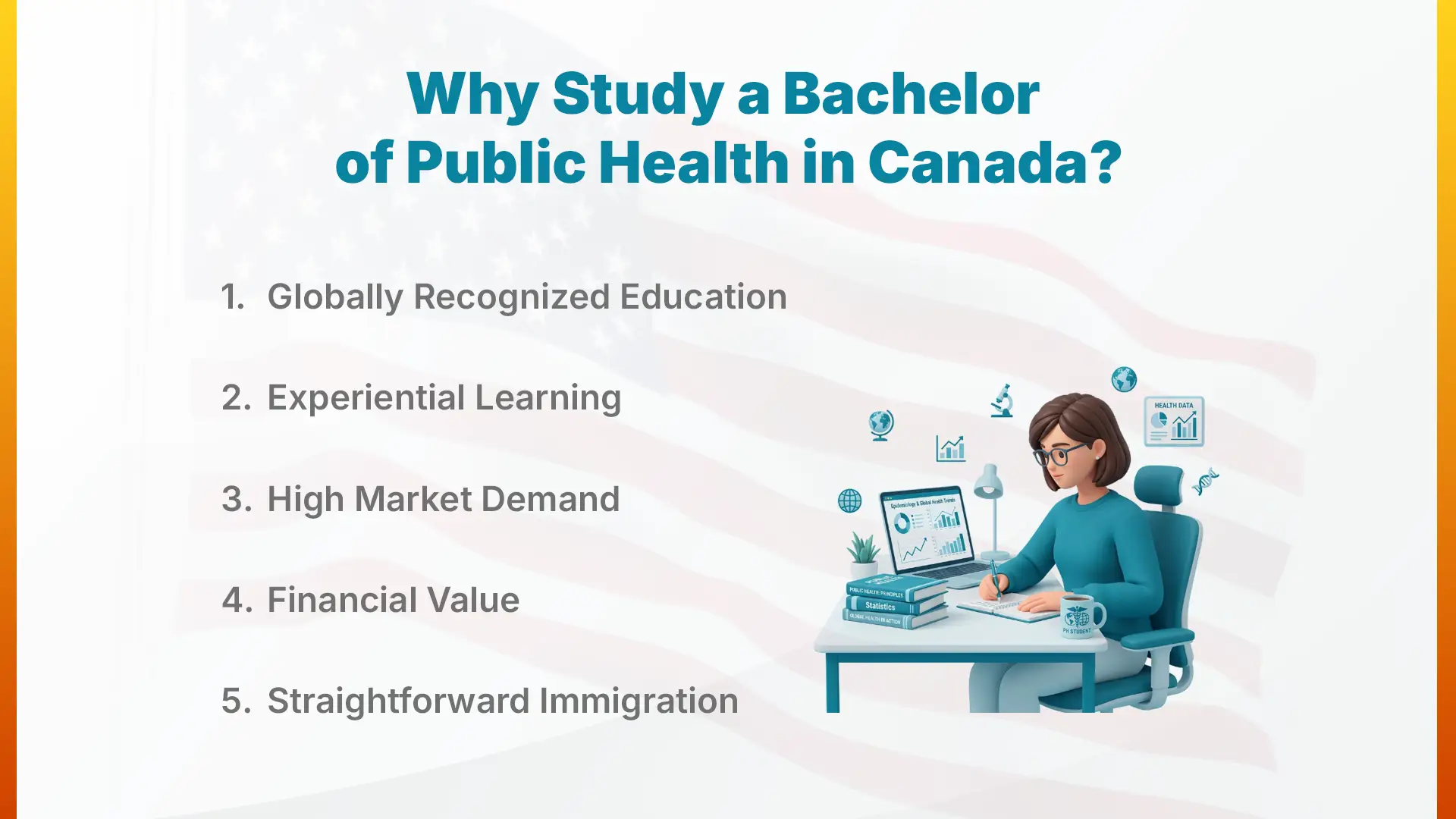
1. Globally Recognized Education
Canadian public health degrees are internationally respected and recognized by employers, government agencies, and global health organizations, including the WHO, UNICEF, and the United Nations. For Nepalese graduates, a Canadian public health qualification creates career flexibility not just within Canada but across international development, global health, and policy sectors worldwide.
2. Experiential Learning
What distinguishes Canadian public health programs is the depth of practical training embedded in the curriculum. Field placements, community health projects, and co-op work terms place students directly within public health agencies, hospitals, NGOs, and government departments. giving them real professional experience alongside their academic training. This hands-on approach ensures graduates are practice-ready from the moment they complete their degree.
3. High Market Demand
Canada's public health sector has expanded significantly in the years following the COVID-19 pandemic, with governments at federal, provincial, and municipal levels increasing investment in public health infrastructure, surveillance, and workforce capacity. Public health professionals are actively recruited across health units, government agencies, hospitals, universities, international NGOs, and the private sector, making this one of the most versatile and in-demand degree pathways available to Nepalese students in Canada today.
4. Financial Value
Tuition fees at Canadian universities for public health programs are significantly more affordable than equivalent programs in the UK or USA. Annual tuition for international students typically ranges from CAD 18,000 to CAD 38,000, and when combined with Canada's strong post-graduation employment market and competitive salaries, the return on investment is compelling for Nepalese students who plan carefully.
5. Straightforward Immigration
Public health professionals are recognized as skilled workers under Canada's immigration system, and graduates with Canadian work experience in public health roles are well-positioned to apply for permanent residency through Express Entry and Provincial Nominee Programs. The Post-Graduation Work Permit, available for up to three years after completing a four-year degree, provides the work experience needed to qualify for these immigration pathways.
Top Canadian Universities for Public Health and Health Sciences
The top Canadian universities for a bachelor of public health and related health sciences degrees include the University of Waterloo, Brock University, the University of Toronto, the University of British Columbia, McMaster University, the University of Alberta, Dalhousie University, and Simon Fraser University, each offering strong programs with field placement opportunities and dedicated support for international students.
Choosing the right university depends on whether you want a direct-entry bachelor of public health or a closely related bachelor of health sciences, your preferred location, budget, and career goals. Nepalese students who want a broader comparison before shortlisting can explore the best universities in Canada for Nepalese students.
1. University of Waterloo
The University of Waterloo offers one of the few dedicated and highly regarded Bachelor of Public Health programs in Canada. The program is built around Waterloo's signature co-operative education model, integrating paid work placements with academic terms throughout the degree. Students gain hands-on experience in public health agencies, government departments, and community health organizations, making Waterloo BPH graduates among the most practice-ready public health professionals in Canada.
2. Brock University
Brock University in St. Catharines, Ontario, offers a dedicated Bachelor of Public Health program that is one of the most accessible and well-structured undergraduate public health options in Canada for international students. The program emphasizes community health, health equity, and evidence-based practice, with mandatory field placement components that connect students to real public health work in Ontario communities. Brock is a particularly strong option for Nepalese students who want a focused public health degree at a more affordable tuition rate than Toronto or Vancouver.
3. University of Toronto
The University of Toronto offers undergraduate health studies programs through its three campuses, St. George, Mississauga, and Scarborough, covering health policy, global health, and community health within a Bachelor of Arts or Science framework. UofT's global reputation, location in Toronto's diverse healthcare ecosystem, and access to world-class research faculty make it a compelling option for students who want to combine health science with social science and policy perspectives.
4. University of British Columbia (UBC)
UBC offers undergraduate pathways into public health through its Faculty of Land and Food Systems and Faculty of Science, including global health specializations and health sciences streams. UBC's strength in Indigenous health, environmental health, and global health research gives students a distinctive and internationally relevant perspective. The university's location in Vancouver also provides access to British Columbia's public health network and a highly multicultural healthcare environment.
5. McMaster University
McMaster University's Bachelor of Health Sciences (BHSc) program is one of the most prestigious and competitive undergraduate health degrees in Canada. The program reflects McMaster's renowned problem-based learning philosophy and challenges students to think critically about complex health issues from an interdisciplinary perspective. BHSc graduates are among the most highly regarded health science undergraduates in Canada and are consistently well-placed for both employment and postgraduate study in public health, medicine, and health policy.
6. University of Alberta
The University of Alberta offers undergraduate health science and public health streams through its Faculty of Medicine and Dentistry and Faculty of Kinesiology, Sport, and Recreation, including specializations in health promotion, global health, and community health. The university's strong research ties with Alberta Health Services and its relatively affordable tuition for international students make it a practical and academically strong choice for Nepalese students.
7. Dalhousie University and Simon Fraser University (SFU)
Dalhousie University in Halifax offers a Bachelor of Health Sciences with a population health focus through its Faculty of Health, with strong connections to Atlantic Canada's public health network. Simon Fraser University in British Columbia offers a Bachelor of Health Sciences with concentrations in health promotion and population and public health, benefiting from SFU's strong community partnerships and research infrastructure. Both universities are excellent regional options that offer strong employment and immigration outcomes for international graduates.
Eligibility and Admission Requirements for Bachelor of Public Health in Canada
The eligibility and admission requirements for a Bachelor of Public Health in Canada include completion of Grade 12 or Plus Two with strong results in biology and English; English language proficiency through IELTS, TOEFL, or PTE; a personal statement; letters of recommendation; and financial documentation for the study permit. Meeting these requirements thoroughly is essential for securing admission at a reputable Canadian university for public health.
1. Academic Requirements
Applicants must have completed Grade 12 or Plus Two with strong overall results, with particular emphasis on biology and English. Most universities require a minimum overall score of 65% to 80%, though competitive programs such as McMaster's BHSc and Waterloo's BPH typically require significantly higher academic profiles. Some universities also require prerequisite courses in mathematics or social sciences depending on the specific program pathway.
2. English Language Requirements
All Bachelor of Public Health programs in Canada are taught in English, and international applicants must demonstrate proficiency through an approved language test. Standard requirements are the following:
IELTS Academic: minimum overall score of 6.5, with no individual band below 6.0
TOEFL iBT: minimum score of 86 to 95, depending on the university
PTE Academic: minimum score of 58 to 65
Nepalese students who need to improve their English score before applying can enroll in IELTS preparation classes in Kathmandu to build the skills and confidence to reach their target band.
3. Personal Statement and Letters of Recommendation
Most universities require a personal statement or statement of purpose explaining your motivation for studying public health, your academic background, any relevant community or healthcare experience, and your long-term career goals in the health sector. Two to three letters of recommendation from teachers or community supervisors who can speak to your academic ability and social commitment are typically required. Nepalese students can follow the SOP format for Canada to understand exactly what Canadian admissions panels look for.
4. Financial Proof and Visa Documentation
For the Canadian Study Permit application, students must provide financial documentation demonstrating they can cover the full cost of tuition and living expenses for at least the first year. This typically includes recent bank statements, a sponsor letter if applicable, and scholarship letters where relevant. A valid passport with sufficient validity beyond the intended study period is also required.
How to Apply for a Bachelor of Public Health in Canada?
The admission process for a Bachelor of Public Health in Canada involves six steps: researching and shortlisting universities, preparing your documents, submitting your application, writing your SOP and reference letters, receiving your offer letter, and applying for the Canada Student Visa.
Approaching each step with proper planning well in advance of deadlines gives Nepalese students the best chance of a successful application. It is worth checking the Canada September intake deadlines early to ensure you do not miss the application window for your preferred universities.
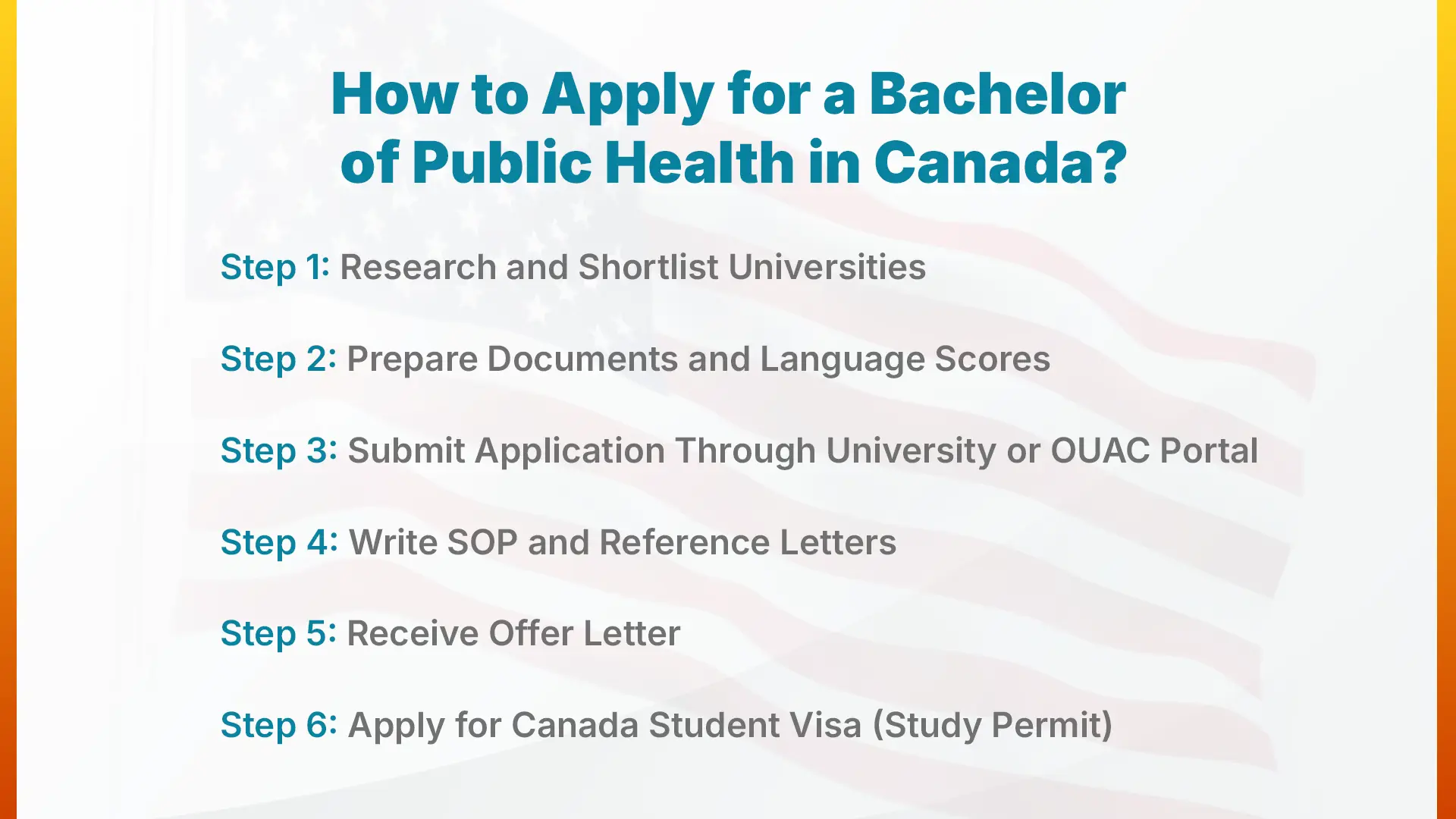
Step 1: Research and Shortlist Universities
Compare public health and health sciences programs based on your academic profile, whether a direct-entry BPH is available, field placement quality, tuition fees, and scholarship opportunities. Shortlist three to five universities to give yourself the best chance of receiving at least one offer.
Step 2: Prepare Documents and Language Scores
Gather your Plus Two transcripts, mark sheets, school leaving certificate, character certificate, and migration certificate. Book your IELTS, TOEFL, or PTE exam early so your scores are ready well before application deadlines.
Step 3: Submit Application Through University or OUAC Portal
Most Canadian universities accept direct online applications through their own portals. Ontario universities use the OUAC (Ontario Universities' Application Centre) system. Pay close attention to individual program deadlines, as health science programs at McMaster and Waterloo are among the most competitive in Canada and fill early.
Step 4: Write SOP and Reference Letters
Your Statement of Purpose should clearly explain why you want to study public health, what community or healthcare experiences have shaped that decision, and how you plan to use your degree to make an impact. It is also worth understanding what makes a strong letter of Recommendation before approaching your referees.
Step 5: Receive Offer Letter
The university will issue a conditional or unconditional offer after reviewing your application. A conditional offer typically requires you to complete your Plus Two with a specified minimum score or submit final official transcripts before your place is confirmed.
Step 6: Apply for Canada Student Visa (Study Permit)
Once you have accepted your offer, apply for your Canadian study permit through the IRCC portal. The requirements to study in Canada from Nepal cover the full document checklist so you can prepare everything well before the visa deadline.
Cost of Studying Bachelor of Public Health in Canada
The cost of studying a Bachelor of Public Health in Canada generally ranges from CAD 18,000 to CAD 38,000 (approximately NPR 1,620,000 to NPR 3,420,000) per year in tuition fees, depending on the university and province. When combined with accommodation, food, transportation, health insurance, and other living expenses, Nepalese students should budget approximately CAD 30,000 to CAD 55,000 (approximately NPR 2,700,000 to NPR 4,950,000) per year in total.
Compared to the UK, USA, and Australia, Canada remains one of the most affordable destinations for a high-quality public health degree. For a complete breakdown of all costs involved in studying in Canada, the total cost to study in Canada is a useful reference when building your financial plan.
1. Tuition Fees
Tuition fees for a Bachelor of Public Health in Canada range from CAD 18,000 to CAD 38,000 (approximately NPR 1,620,000 to NPR 3,420,000) per year for international students, depending on the university and province. Public universities in Atlantic Canada and Alberta tend to be more affordable, while institutions in Ontario and British Columbia sit at the higher end of the range. The table below gives a clear university-by-university comparison to help Nepalese students plan their finances accurately.
University | Annual Tuition (CAD) | Annual Tuition (NPR approx.) |
|---|---|---|
| Brock University | CAD 18,000 – CAD 24,000 | NPR 1,620,000 – NPR 2,160,000 |
| University of Alberta | CAD 22,000 – CAD 28,000 | NPR 1,980,000 – NPR 2,520,000 |
| Dalhousie University | CAD 22,000 – CAD 28,000 | NPR 1,980,000 – NPR 2,520,000 |
| Simon Fraser University | CAD 26,000 – CAD 32,000 | NPR 2,340,000 – NPR 2,880,000 |
| University of Waterloo | CAD 28,000 – CAD 35,000 | NPR 2,520,000 – NPR 3,150,000 |
| McMaster University | CAD 30,000 – CAD 38,000 | NPR 2,700,000 – NPR 3,420,000 |
| University of Toronto | CAD 32,000 – CAD 38,000 | NPR 2,880,000 – NPR 3,420,000 |
2. Living Expenses
Monthly living expenses in Canada vary significantly by city. In Toronto and Vancouver, students should budget CAD 1,500 to CAD 2,500 per month for accommodation, food, and transportation. In smaller cities such as Halifax, St. Catharines, or Edmonton, monthly costs typically range from CAD 1,000 to CAD 1,800. Since your choice of city directly affects your monthly budget, it is worth reading about the best cities in Canada for international students before finalizing your university shortlist.
3. Total Estimated Cost
Taking tuition, accommodation, food, transportation, health insurance, and miscellaneous expenses into account, Nepalese students should budget approximately CAD 30,000 to CAD 55,000 per year. For a standard four-year Bachelor of Public Health in Canada, the total estimated cost ranges from CAD 120,000 to CAD 220,000 (approximately NPR 10,800,000 to NPR 19,800,000), making early scholarship applications and careful financial planning essential for most Nepalese students.
Scholarships for Bachelor of Public Health in Canada
Scholarships for a Bachelor of Public Health in Canada include Canadian government-linked awards, university-specific merit scholarships for international health science students, and external global health and NGO funding programs. Early preparation, strong Plus Two academic results, demonstrated community leadership, and a well-crafted personal statement significantly improve a Nepalese student's chances of securing financial support and reducing the overall cost of their degree.
1. Canadian Government Scholarships
While fully funded government scholarships for international undergraduate students in Canada are limited, several provincial programs offer financial incentives for students who commit to working in specific regions after graduation. Atlantic Canada in particular has programs that support international graduates in health and social services roles, making universities like Dalhousie and Brock attractive options for scholarship-conscious students.
2. University-Specific Merit Scholarships
Most Canadian universities offer automatic entry scholarships for high-achieving international applicants as well as separate application-based bursaries. Notable awards include:
UBC International Major Entrance Scholarship up to CAD 80,000 over four years for exceptional students
University of Waterloo International Student Entrance Scholarship merit-based award for eligible incoming students
University of Toronto Lester B. Pearson International Scholarship one of Canada's most prestigious undergraduate international awards
Brock University International Student Awards merit-based entry scholarships for high-achieving international applicants
University of Alberta International Student Scholarship partial tuition awards based on academic achievement
3. External and Global Health Scholarships
Several international organizations and foundations offer scholarships for students pursuing public and global health degrees, including awards from the Aga Khan Foundation, Canadian Commonwealth Scholarship Program, and various NGO-linked health education funds. Students are encouraged to research current offerings through their university's international office and Canada's official scholarship portal.
4. Tips to Increase Scholarship Chances
Apply as early as possible; most scholarship deadlines fall before the main admissions window
Maintain the highest possible Plus Two GPA, particularly in biology and English
Demonstrate community leadership, volunteer experience, or health-related social work in your application
Write a focused personal statement that connects your background to your public health goals
Apply to multiple scholarships simultaneously rather than waiting for one result at a time
Career Opportunities After Bachelor of Public Health in Canada
Graduates with a bachelor of public health from Canada can pursue careers as public health inspectors, health policy analysts, epidemiologists, community health workers, health promotion specialists, and global health consultants across government, healthcare, NGO, and international development sectors.
Canada's expanding public health workforce and the ongoing global demand for trained public health professionals mean that Bachelor of Public Health graduates are well-positioned for meaningful and well-compensated careers from the moment they complete their degree.
1. Public Health Inspector / Environmental Health Officer
A public health inspector enforces health regulations, conducts environmental assessments, investigates disease outbreaks, and ensures that food safety, water quality, and public health standards are maintained across communities. This is one of the most common and well-compensated entry-level roles for public health graduates in Canada and is available across every province and territory.
2. Health Policy Analyst
A health policy analyst researches, develops, and evaluates health policies for government departments, healthcare organizations, and research institutions. This role requires strong analytical and communication skills and is particularly well-suited for graduates who enjoy working at the intersection of evidence, economics, and policy.
3. Epidemiologist
A junior epidemiologist or public health data analyst tracks disease patterns, analyses health data, and supports outbreak investigations for public health units, hospitals, and government agencies. This role has grown significantly in demand following the COVID-19 pandemic and offers strong career progression into research and senior policy roles.
4. Community Health Worker / Health Educator
A community health worker delivers health education, supports disease prevention programs, and connects vulnerable populations with healthcare services in community and outreach settings. This is a highly impactful role with strong demand across Canada's diverse urban and rural communities.
5. Health Promotion Specialist
A health promotion specialist designs and implements programs that encourage healthy behaviors, reduce risk factors, and address the social determinants of health within specific populations or settings. This role is available across public health units, hospitals, schools, workplaces, and NGOs throughout Canada.
6. Global Health Consultant
A global health consultant works with international organizations, governments, and NGOs on health systems strengthening, disease prevention, and health policy development in low and middle-income countries. This is a particularly meaningful career pathway for Nepalese graduates who wish to use their Canadian public health education to contribute to health improvement in South Asia and beyond.
Post-Graduation Work Permit and Pathways to Canadian PR
The scope and immigration prospects after a bachelor of public health in Canada are strong, with a growing demand for public health professionals across all provinces; competitive salaries; a post-graduation work permit allowing up to three years of full-time work after graduation; and clear pathways to permanent residency through Express Entry and Provincial Nominee Programs. This makes a Bachelor of Public Health in Canada one of the best courses to study in Canada for Nepalese students who want both meaningful work and long-term settlement opportunities.
1. Average Salary After a bachelor of Public Health in Canada
The average salary after a Bachelor of Public Health in Canada ranges from CAD 48,000 to CAD 95,000 (approximately NPR 4,320,000 to NPR 8,550,000) per year depending on the role, employer, and province. Entry-level positions such as community health worker and public health inspector start at the lower end of this range, while senior roles such as health policy analyst and global health consultant command significantly higher salaries with experience. The table below maps each career role to its typical salary range in both CAD and NPR.
Career Role | Annual Salary (CAD) | Annual Salary (NPR approx.) |
|---|---|---|
| Public Health Inspector | CAD 55,000 – CAD 75,000 | NPR 4,950,000 – NPR 6,750,000 |
| Health Policy Analyst | CAD 60,000 – CAD 80,000 | NPR 5,400,000 – NPR 7,200,000 |
| Junior Epidemiologist | CAD 58,000 – CAD 78,000 | NPR 5,220,000 – NPR 7,020,000 |
| Community Health Worker | CAD 48,000 – CAD 65,000 | NPR 4,320,000 – NPR 5,850,000 |
| Health Promotion Specialist | CAD 55,000 – CAD 72,000 | NPR 4,950,000 – NPR 6,480,000 |
| Global Health Consultant | CAD 65,000 – CAD 95,000 | NPR 5,850,000 – NPR 8,550,000 |
2. The PGWP Advantage
After completing their Bachelor of Public Health, international graduates from Canadian universities can apply for the Post-Graduation Work Permit (PGWP), which allows them to work full-time in Canada for up to three years in any role, including public health positions. Many Nepalese students also take up part-time jobs in Canada during their studies to cover living expenses and gain early Canadian work experience before graduating.
3. Express Entry and Category-Based Selection
Public health professionals with Canadian work experience are competitive candidates under Canada's Express Entry system, particularly through the Canadian Experience Class and the Federal Skilled Worker Program. Canada has also introduced category-based selection draws under Express Entry that prioritize healthcare workers, which directly benefits public health graduates with relevant Canadian work experience.
4. Provincial Nominee Programs
Several provinces actively target healthcare and public health workers through their Provincial Nominee Programs. Atlantic Canada, Saskatchewan, Manitoba, and British Columbia all have streams that support skilled health sector workers, including public health professionals, offering an accelerated pathway to permanent residency for graduates willing to work in specific regions.
5. Global Career Mobility
A Canadian public health degree and work experience are recognized by international organizations, including the WHO, UNICEF, the World Bank, and major global NGOs. For Nepalese graduates who wish to work in international development, global health policy, or community health programs back in Nepal or across South Asia, a Canadian public health qualification is one of the most credible and career-opening credentials available.
Conclusion
Canada offers Nepalese students an exceptional combination of academic quality, hands-on field training, growing career demand, and immigration opportunity through a bachelor of public health. With strong universities offering dedicated BPH and health sciences programs, rigorous experiential learning, competitive salary outcomes, and one of the clearest pathways from graduation to permanent residency in the world, Canada stands apart as the most compelling destination for Nepalese students who want to build a career that improves health at the population level.
The public health sector in Canada is expanding, the need for trained professionals is urgent, and the immigration pathways are well-established. For Nepalese students who are ready to invest in a degree that is as globally relevant as it is personally rewarding, a Bachelor of Public Health from Canada is a qualification that will serve them for a lifetime.
Interested in studying public health in Canada? Contact SAS Education Consultancy for a free counseling session and let us help you identify the right university, apply for the best scholarships, and navigate the study permit process with confidence.