Canada September Intake 2026 for International Students

Feb 20, 2026

If studying abroad were a race, the September intake in Canada would be the grand starting line, with bright lights, a full stadium, and maximum opportunities waiting. Every year, thousands of international students pack their dreams (and winter jackets) and head to Canada for the Fall intake. Why? Because September isn’t just another academic session, it’s the main event. Universities open most of their programs, and scholarships are widely available; campuses buzz with energy, much like a fresh semester playlist on repeat. Simply put, if Canada were a movie, September would be the blockbuster release.
In this blog on Canada September Intake 2026 for Nepalese Students, we’ll break down everything you need to know, from top universities and popular courses to application timelines, eligibility criteria, visa process, and deadlines. Whether you're planning ahead or just starting your research, this guide will help you map out your journey step by step. Think of it as your practical roadmap to study in Canada, minus the confusing detours and last-minute panic.
In this blog
Overview of Canada September Intake 2026
The September intake, often called the Fall intake, is the heartbeat of Canada’s academic year. It’s when universities roll out the red carpet, opening the widest range of undergraduate, postgraduate, and diploma programs. Compared to smaller intakes like January or May, September offers more seats, more scholarships, and more campus activities. It’s not just another semester; it’s the main stage performance. If Canadian education had a prime time, this would be it.
The academic calendar in Canada typically runs from September to April, divided into Fall and Winter semesters, followed by optional Summer terms. Starting in September means you align perfectly with the standard academic rhythm, internships, and recruitment cycles. It also means arriving when campuses are alive with orientation weeks, networking events, and new beginnings. Think of it as joining the story from page one rather than jumping into the middle chapter, everything simply flows better from there.
Why Choose Canada September Intake 2026?
You can choose Canada for September intake because it offers the widest range of academic programs, maximum seat availability, and stronger scholarship opportunities compared to other intakes. It is the primary admission cycle for most universities, meaning you get access to full course options and campus resources. Starting in September also aligns perfectly with Canada’s academic and recruitment calendar. Simply put, it gives you the strongest academic and career advantage from day one.
- Access to a wide range of undergraduate, postgraduate, diploma, and certificate programs across leading universities.
- Higher admission capacity as institutions allocate most seats during the Fall intake.
- More scholarship and financial aid opportunities for international students.
- Better access to co-op programs, internships, and part-time work options.
- Opportunity to fully participate in orientation weeks, student communities, and networking events.
- Alignment with major hiring cycles, improving post-graduation job prospects.
Fast-Track Your Canada Student Visa
Top Universities Offering Canada September Intake 2026
Many universities across Canada offer the September intake, but some institutions consistently stand out for their global rankings, academic excellence, and international student support. The Fall intake is when these universities open most of their flagship programs and welcome the largest number of students. From research-driven institutions to innovation hubs, best universities in Canada make September the prime entry point. Below are some of the most popular and highly respected choices among international students planning for 2026.
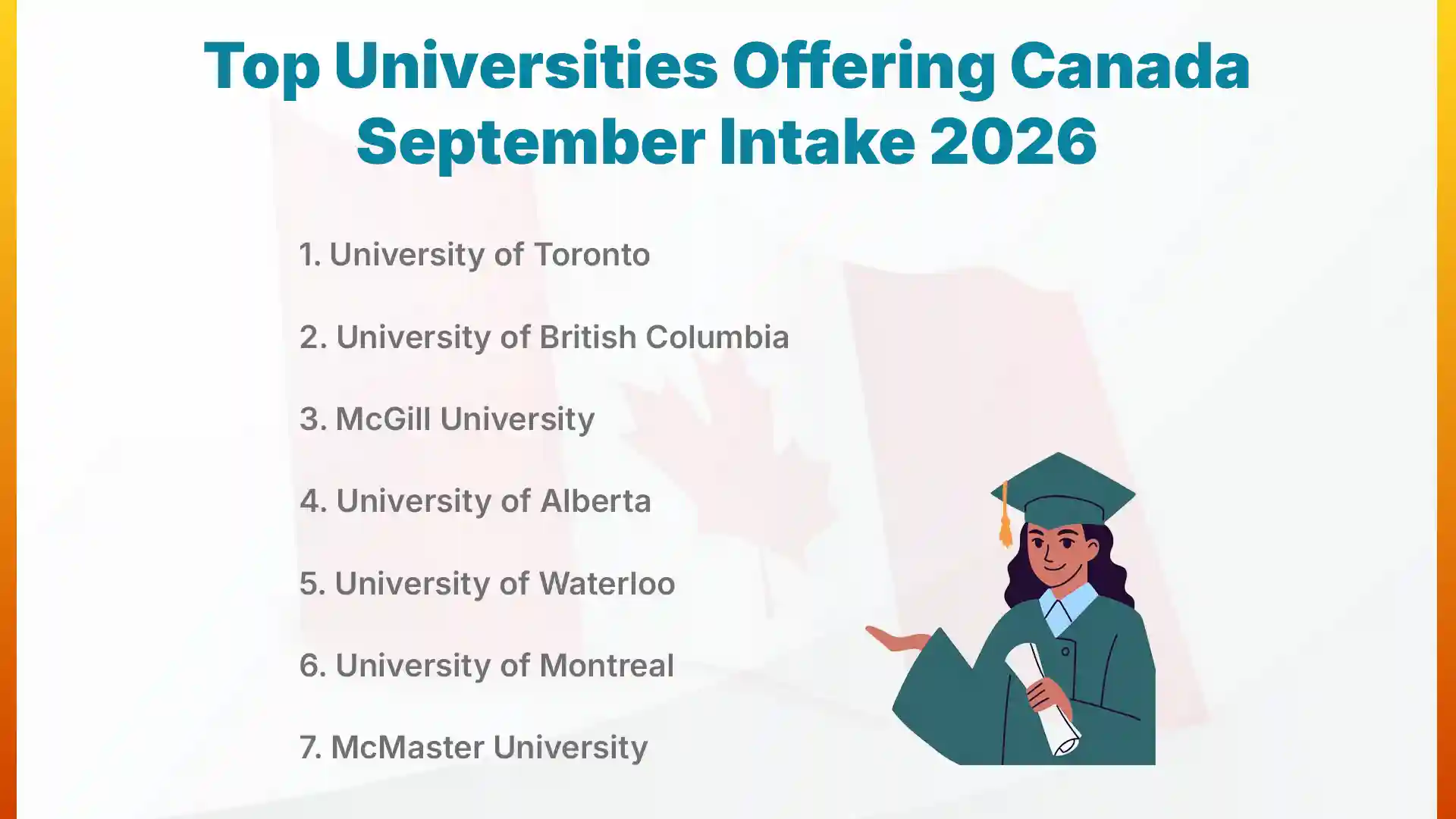
1. University of Toronto
The University of Toronto is a public research university and one of Canada’s most prestigious institutions. It consistently ranks among the top universities worldwide and attracts students from across the globe. The September intake offers its widest selection of undergraduate and postgraduate programs. Fields like business, engineering, computer science, and life sciences are particularly competitive. The academic culture here is rigorous and research-focused. For many students, getting into U of T feels like stepping onto a global academic stage.
2. University of British Columbia
The University of British Columbia (UBC) is a public university located in Vancouver and is globally known for research and sustainability initiatives. Its September intake includes the majority of academic programs across faculties. UBC is especially strong in engineering, business, environmental sciences, and technology. The university also provides excellent research funding and co-op opportunities. The campus combines academic excellence with an inspiring natural setting. It’s a place where innovation meets opportunity.
3. McGill University
McGill University is a public research university based in Montreal and is internationally respected for academic excellence. The Fall intake is its primary admission cycle, making September the most strategic time to apply. It is particularly strong in medicine, management, science, and law programs. McGill offers a diverse student community with a global outlook. The university maintains high academic standards and competitive admission criteria. Studying here often feels like joining an elite intellectual circle.
4. University of Alberta
The University of Alberta is a public university known for strong research output and industry collaboration. Located in Edmonton, it offers a wide range of programs during the September intake. Engineering, business, and health sciences are among its most popular choices. The institution is recognized for innovation and practical learning opportunities. It also provides students with access to research grants and internship pathways. It delivers quality education with strong career-focused outcomes.
5. University of Waterloo
The University of Waterloo is a public university famous for its co-op education model and technology-driven programs. It is highly regarded for computer science, engineering, and mathematics. The September intake allows students to enter competitive co-op streams that combine study with paid work experience. Waterloo maintains strong partnerships with tech companies and startups. Its curriculum emphasizes problem-solving and real-world application. For career-oriented students, it’s a powerhouse of opportunity.
6. University of Montreal
The University of Montreal is a public French-language research university and one of Canada’s largest institutions. It offers diverse programs during the September intake, particularly in health sciences, artificial intelligence, and social sciences. Many graduate programs attract international researchers and scholars. French proficiency is often required, though some programs may offer flexibility. The university promotes research excellence and global collaboration. It’s an ideal choice for students seeking a bilingual academic experience.
7. McMaster University
McMaster University is a public research university located in Ontario and is widely known for its health sciences and engineering programs. September is its main intake, offering maximum course availability. The university follows a problem-based learning approach in many disciplines. It has strong ties with healthcare institutions and research centers. McMaster emphasizes critical thinking and collaborative learning. It combines academic intensity with practical exposure for ambitious students.
Popular Courses Available in Canada September Intake 2026
When September rolls around, Canadian campuses don’t just open their doors, they roll out their full academic catalog. The Fall intake is when universities offer the widest range of programs across disciplines, giving international students more flexibility and choice. From boardrooms to laboratories, coding labs to hotel management suites, the options are broad and career-focused. If you’re aiming for Canada in 2026, September is the best time to explore the popular courses to study in Canada.
1. Business and Management Programs
Business programs remain a top choice for international students, and September is when most specializations are available. Universities offer degrees in finance, marketing, international business, entrepreneurship, human resource management, and supply chain management. Many institutions integrate co-op options, internships, and industry projects into their curriculum. MBA programs, Bachelor of Commerce degrees, and specialized master’s programs open the majority of seats during this intake. Canadian business schools also emphasize global exposure and practical learning. For students aiming at leadership roles or corporate careers, pursuing a business course in Canada remains highly competitive and rewarding.
2. Engineering and Technology Courses
Engineering programs in Canada are particularly strong during the Fall intake, with full capacity across major disciplines. Students can apply for mechanical, civil, electrical, computer, software, chemical, and aerospace engineering programs. Many universities offer accredited programs recognized internationally, which is crucial for professional licensing. The September intake also provides access to co-op streams that combine study with paid work placements. Research facilities and innovation labs are fully active during this period. For technology-driven careers, this intake opens the most doors.
3. Health and Life Sciences Programs
Health and life sciences programs attract a large number of applicants each September. Popular options include biotechnology, biomedical sciences, public health, nursing, pharmacy, and health administration. Many universities align their course structure with research hospitals and healthcare institutions. Laboratory-based learning and clinical placements often begin with the Fall semester. Graduate programs in medical research and life sciences also admit most students during this intake. For those looking to study nursing in Canada or pursue careers in healthcare or research, September offers the broadest opportunities.
4. Computer Science and IT Degrees
Computer science and IT programs are among the most competitive options available in the September intake. Universities offer specializations in artificial intelligence, cybersecurity, data science, software development, cloud computing, and information systems. Fall admissions usually include co-op opportunities and research assistantships. The curriculum often emphasizes hands-on coding, real-world problem solving, and industry collaboration. Canada’s growing tech ecosystem makes IT courses in Canada highly attractive. For students aiming to enter the global technology workforce, September is the strategic entry point.
5. Hospitality and Tourism Management
Canada’s hospitality and tourism sector offers well-structured programs during the September intake. Degrees and diplomas focus on hotel management, event planning, tourism operations, and culinary management. Many institutions collaborate directly with hotels, resorts, and tourism companies for internships and training. The curriculum blends business fundamentals with customer experience management and operations strategy. Practical training components usually align with peak industry cycles. For students looking to build careers in global hospitality, this intake provides maximum program availability and structured pathways.
Eligibility Criteria for Canada September Intake
To secure admission in the Canada September Intake 2026, international students must meet specific academic, language, and sometimes work experience requirements. Each university and program may have slightly different criteria, but there are common benchmarks that most institutions follow. Understanding the requirements to study in Canada ensures a smoother application process and increases your chances of receiving an offer letter. Think of it as passing the first gate before entering the Canadian academic playground.
1. Academic Requirements (UG, PG Levels)
For undergraduate programs, students must have completed high school or an equivalent qualification recognized by Canadian universities. This usually means a strong performance in secondary education, often with specific subject prerequisites depending on the program. For example, engineering programs may require strong mathematics and physics grades, while business programs may prioritize math and economics. Postgraduate programs typically require a relevant bachelor’s degree with a minimum GPA, often around 3.0 on a 4.0 scale or equivalent. Some universities may also evaluate transcripts for grading consistency and overall academic rigor. Meeting these academic standards is the foundation for your application.
2. English Language Proficiency (IELTS, TOEFL, PTE)
Most Canadian universities require proof of English proficiency unless the previous degree was completed in English. Commonly accepted tests include IELTS Academic (usually 6.5 overall with no band below 6.0), TOEFL iBT (around 90-100 overall), and PTE Academic (generally 60+). Some programs may require higher scores for competitive fields like business, engineering, or computer science. It’s important to check each university’s requirements as they vary slightly. English proficiency scores are critical because they demonstrate your ability to follow lectures, complete assignments, and engage in group work effectively.
3. Standardized Test Requirements (If Applicable)
Certain programs may also require standardized tests such as the GMAT for business schools, GRE for engineering or science programs, or specific aptitude tests. These tests are usually more common for competitive postgraduate programs. They help universities assess analytical, quantitative, and reasoning abilities beyond grades. Some institutions may waive these tests if your academic background or work experience is strong enough. It’s essential to confirm the program-specific requirements well before the September intake deadlines to avoid last-minute stress.
4. Work Experience Requirements for MBA and PG Programs
Many postgraduate programs, particularly MBA courses, require relevant work experience. Typically, universities ask for 2-5 years of professional experience, depending on the program’s competitiveness. Work experience strengthens your application, allowing you to contribute practical insights during class discussions. Some programs also value leadership roles, project management experience, or international exposure. Even if the work experience is not mandatory, having it can increase your chances of admission and scholarship eligibility. It’s like seasoning your application, it adds flavor and makes it stand out.
What Is the Application Timeline for Canada September Intake 2026?
Planning is crucial for the Canada September Intake 2026 because missing deadlines can mean waiting an entire year. The process involves multiple steps, from preparing documents and taking language tests to submitting applications and securing a study permit. Understanding the timeline helps you stay organized, reduce stress, and maximize your chances of admission and scholarships. Think of it as mapping a journey before boarding a plane, preparation is everything.
1. Ideal Timeline (October 2025-March 2026)
The ideal window to start preparing applications for the September 2026 intake is October 2025. During this period, students should research universities, shortlist programs, and start preparing SOPs, transcripts, and recommendation letters. Applications are typically submitted between November 2025 and March 2026, depending on the university. Early applications can increase your chances of admission and eligibility for scholarships. Planning also gives you enough time to address any unforeseen delays, like missing documents or additional university requirements.
2. When to Take English Proficiency Tests
English language tests such as IELTS, TOEFL, or PTE should ideally be taken at least 6–8 months before your application deadlines. This ensures your scores are valid and gives time for retakes if necessary. Universities require official score reports to process applications, so timing is critical. Preparing early allows you to focus on academics while avoiding last-minute stress. Remember, your English scores can significantly influence admission decisions, especially for competitive programs.
3. Application Deadlines for Fall 2026
Most universities have application deadlines for the September intake between January and March 2026. Some highly competitive programs may have earlier deadlines, even in December 2025. Submitting early increases your chances of admission, scholarship opportunities, and available seats. Keep a checklist of all documents and deadlines for each university to avoid confusion. Missing even a single deadline can push your admission to the next year, so diligence is key.
4. When to Apply for Canada Student Visa
After receiving an offer letter, students should apply for a Canadian study permit as soon as possible, ideally 3-6 months before the start of classes. The visa processing time can vary depending on your country, ranging from a few weeks to a few months. Collecting financial proof, biometrics, and completing the online application in advance ensures timely approval. Applying early avoids stress and guarantees you can arrive in Canada comfortably before orientation and classes begin.
How to Apply for Canada September Intake 2026? Step-by-Step
To apply for Canada September Intake 2026, you must follow a structured step-by-step approach to ensure your application is complete, timely, and competitive. From researching universities to securing your study permit, each step plays a crucial role in making your dream of studying in Canada a reality. Missing even a minor detail can delay your admission or visa, so a methodical approach is key. Think of it as assembling a puzzle, each piece matters for the complete picture.
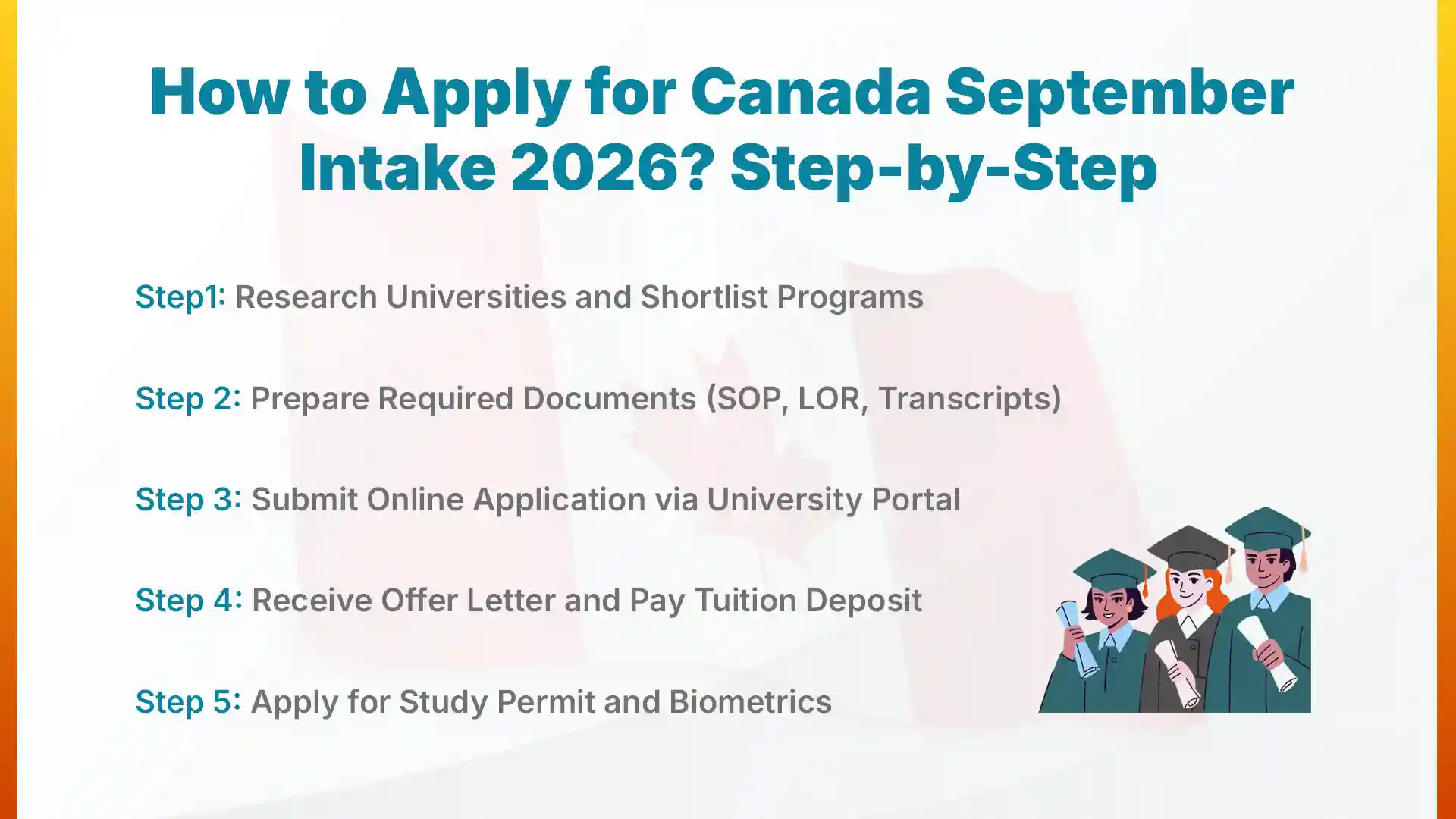
Step 1: Research Universities and Shortlist Programs
Start by exploring universities and programs that match your academic goals, budget, and preferred city. Consider rankings, program reputation, faculty, co-op options, scholarships, and post-graduation opportunities. Shortlisting 5-7 universities keeps your options flexible without overwhelming the process. Take note of program-specific requirements, intake deadlines, and application portals. Speaking with current students or alumni can give insider insights. A well-researched list forms the foundation for a strong application strategy.
Step 2: Prepare Required Documents (SOP, LOR, Transcripts)
Collecting and preparing all necessary documents is critical. Key documents include academic transcripts, degree certificates, English proficiency scores, letters of recommendation (LOR), and a Statement of Purpose (SOP). Make sure your SOP for Canada highlights your academic background, career goals, and reasons for choosing Canada and the specific program. LORs should be personalized and from credible sources like professors or employers. Organizing documents early reduces last-minute stress and ensures that your application is polished and professional.
Step 3: Submit Online Application via University Portal
Once your documents are ready, complete the online application on each university’s portal. Fill in personal details carefully, upload supporting documents in the correct format, and double-check program codes and intake details. Some universities may charge a non-refundable application fee at this stage. Keep confirmation emails and receipts for your records. Submitting early can improve your chances for scholarships and ensure that your application is considered before seats fill up.
Step 4: Receive Offer Letter and Pay Tuition Deposit
After evaluation, universities issue offer letters to successful candidates. Carefully review the offer, including tuition fees, program duration, and scholarship details. Most universities require a tuition deposit to secure your seat. Paying this deposit on time confirms your acceptance and triggers the next step of visa application. Keep all documents, receipts, and communication with the university organized, they will be needed for study permit submission.
Step 5: Apply for Study Permit and Biometrics
Once you have your offer letter and tuition deposit receipt, apply for your Canada study permit. Gather financial proof, a passport, an acceptance letter, and other supporting documents. Some applicants may also need to provide biometrics. Submit the application online or through a visa application center, keeping in mind that processing times vary by country. Applying early reduces stress and ensures you arrive in Canada in time for orientation and the start of classes.
Required Documents for Canada September Intake
To apply for the Canada September Intake 2026, having all your documents ready and well-organized is essential. Universities and immigration authorities require precise paperwork to assess your eligibility and process your application smoothly. Missing or incomplete documents can lead to delays, rejections, or missed deadlines. Think of your documents as the backbone of your application, each piece strengthens your case for admission. Preparing them carefully in advance ensures a stress-free application process.
1. Academic Transcripts and Certificates
Universities require official transcripts and degree certificates from all previous education levels. For undergraduate applicants, this usually means high school transcripts; for postgraduate students, bachelor’s degree transcripts are required. Transcripts must detail courses taken, grades achieved, and the grading scale used. Some universities may request notarized copies or attested transcripts, depending on your country of study. Ensuring they are accurate and complete is crucial because universities heavily rely on these records to evaluate your academic readiness.
2. English Proficiency Test Scores
Most Canadian institutions require proof of English proficiency for international students. Commonly accepted tests include IELTS, TOEFL, or PTE Academic. Required scores vary by university and program, but generally fall around IELTS 6.5, TOEFL 90–100, or PTE 60+. Official score reports must be submitted directly or uploaded to the university portal. Preparing in advance and taking the test early ensures you have valid scores well before application deadlines. High scores not only satisfy admission criteria but can also enhance scholarship eligibility.
3. Statement of Purpose (SOP)
The SOP is your personal narrative explaining why you want to study in Canada, why you chose a particular university, and how the program aligns with your career goals. A strong SOP should reflect your academic achievements, professional experience, and personal motivations. Avoid generic statements; universities prefer authenticity and clarity. The SOP is often the differentiator in competitive programs, making it essential to invest time and thought into crafting a compelling narrative.
4. Letters of Recommendation (LOR)
LORs are formal endorsements from professors, mentors, or employers who can vouch for your academic abilities, skills, and character. Typically, 2-3 letters are required, depending on the program. LORs should be personalized, detailed, and on official letterhead when possible. They provide credibility and context to your application, helping admissions officers understand your potential beyond grades. Strong LORs can tip the balance in highly competitive programs.
5. Valid Passport and Financial Proof
A valid passport is mandatory for identification and visa processing. Financial proof demonstrates that you can cover tuition, living expenses, and other costs while studying in Canada. Documents like bank statements, fixed deposits, scholarship letters, or financial affidavits are commonly accepted. These papers are reviewed by both the university and Canadian immigration authorities to ensure compliance with study permit requirements. Accurate and clear financial documentation is critical for visa approval.
6. Updated Resume (for PG Programs)
For postgraduate applications, an updated resume highlighting academic achievements, internships, work experience, projects, and extracurricular activities is often required. A well-structured resume provides universities with a snapshot of your skills, experience, and professional readiness. Tailoring your resume to emphasize experiences relevant to the program enhances your application and can make a strong impression during the selection process. It’s like the highlight reel of your academic and professional journey.
Scholarships for Canada September Intake
Studying in Canada can be expensive, but the September intake opens doors to a wide variety of scholarships for international students. These scholarships not only reduce financial pressure but also recognize academic merit, leadership, or special talents. Whether funded by the government, universities, or external organizations, securing a scholarship can make a significant difference in your study experience. Early preparation and awareness of available options are key to maximizing your chances.
1. Government-Funded Scholarships
Government-funded scholarships are offered by the Canadian federal or provincial authorities to attract talented international students. Examples include the Vanier Canada Graduate Scholarships and the Canada Graduate Scholarships for research programs. These scholarships typically cover tuition fees, living expenses, and sometimes travel allowances. They are highly competitive and often require strong academic records, leadership potential, and research aptitude. Applying early is crucial, as deadlines are strict and selection processes are thorough.
2. University-Specific Scholarships
Most Canadian universities offer scholarships specifically for international students entering the September intake. These may include entrance scholarships, merit-based awards, or program-specific funding. For example, universities like UBC, McGill, and Toronto provide scholarships automatically based on academic performance or via separate applications. These awards can significantly reduce tuition costs and sometimes include additional benefits like mentorship programs or research funding. Knowing the exact scholarship options per university is vital before submitting your application.
3. Merit-Based and Need-Based Financial Aid
Merit-based scholarships reward students with exceptional academic performance, leadership skills, or extracurricular achievements. Need-based financial aid, on the other hand, considers the student’s financial situation and provides support to ensure affordability. Many universities combine both types of support to help international students manage tuition and living costs. Submitting all required documentation and meeting eligibility criteria is essential to secure these awards. They not only relieve financial pressure but also enhance your CV for future opportunities.
4. External Scholarships for International Students
External scholarships are offered by private foundations, multinational companies, or international organizations to support students studying abroad. These include awards from organizations like the Fulbright Program, Trudeau Foundation, and various cultural or research-based scholarships. They often cover tuition, living expenses, and travel costs. Competitive, external scholarships can supplement university and government funding, giving students even more financial flexibility. Researching and applying early can maximize your chances of success.
Canada Study Visa Process for September 2026 Intake
Getting a study permit is a crucial step for international students planning to join the September 2026 intake in Canada. Without it, even the best university offers won’t get you through Canadian borders. The process involves meeting eligibility criteria, submitting necessary documents, providing proof of funds, and sometimes completing biometrics. Understanding the steps in advance makes the process smoother and reduces stress, ensuring you arrive in Canada on time for orientation and classes.
1. Study Permit Requirements
To apply for a Canadian study permit, you need an acceptance letter from a recognized Canadian university, a valid passport, and proof that you can financially support your tuition and living expenses. Additional requirements include language proficiency, health clearance, and sometimes a police clearance certificate. You must also convince immigration authorities that you will leave Canada at the end of your studies if required. Meeting all these criteria upfront increases your chances of approval.
2. Processing Time and Biometrics
Study permit processing times vary depending on your country of residence, ranging from a few weeks to several months. Most applicants are required to provide biometrics, including fingerprints and a photograph, at a Visa Application Centre (VAC). Early submission of documents and biometrics ensures timely approval and avoids last-minute panic. Delays are common if documents are incomplete, so double-check everything before submitting.
3. GIC Requirement and Financial Proof
Many students, particularly those applying from outside Canada, must open a Guaranteed Investment Certificate (GIC) account as proof of funds. Along with the GIC, you need to provide bank statements, scholarship letters, or loan approvals to show that you can cover tuition and living costs. Financial proof demonstrates your ability to sustain yourself without violating visa conditions. It’s a critical step for the smooth processing of your study permit.
4. Visa Approval Tips
To improve your chances of study permit approval, ensure all documents are complete, accurate, and up-to-date. Highlight strong ties to your home country, such as family, property, or a future career plan, to demonstrate intent to return after studies. Avoid last-minute submissions and ensure clarity in your application forms. Following instructions meticulously and preparing supporting documents carefully can make the difference between approval and unnecessary delays.
Which is the Best Education Consultancy to Study in Canada in 2026?
SAS Education Consultancy is the best education consultancy to study in Canada in 2026 because it offers end-to-end guidance for international students. From shortlisting universities and programs to preparing applications, SOPs, and LORs, they simplify the entire process. Their experts are well-versed in visa procedures, scholarship opportunities, and Canada’s admission requirements. With personalized support and proven success in placing students in top Canadian universities, SAS Education Consultancy ensures a smooth and stress-free journey for every applicant. Their experience and network make them a trusted partner for turning study abroad dreams into reality.
Conclusion
Canada September Intake 2026 is an excellent opportunity for international students to access a wide range of programs, scholarships, and career-oriented pathways. Starting in September aligns perfectly with the academic calendar, providing access to the most programs, co-op opportunities, and campus activities. With careful planning, meeting eligibility requirements, and submitting complete applications on time, students can maximize their chances of admission and a smooth transition to Canadian universities.
Choosing the right consultancy, like SAS Education Consultancy, and understanding the entire process, from university selection to visa application, makes the journey more manageable and less stressful. By preparing in advance and staying organized, international students can turn their dream of studying in Canada into reality, opening doors to global education and career opportunities.