Bachelor of Pharmacy in Canada: Universities, Fees, Scholarships & Career Guide

Jun 01, 2026
Canada is one of the strongest destinations in the world to build a career in pharmacy. With a publicly funded healthcare system, an aging population driving consistent demand for pharmaceutical services, and universities that deliver some of the most rigorous pharmacy education available anywhere, Canada offers Nepalese students a pathway to a profession that is stable, well-paid, and internationally respected.
A Bachelor of Pharmacy in Canada is not just a degree; it is a direct route into one of the most in-demand healthcare occupations in the Canadian job market. Nepalese students who are still exploring their destination options can start by looking at studying in Canada before committing to a specific program.
In this guide, we cover everything a Nepalese student needs to know about pursuing a Bachelor of Pharmacy in Canada, from top universities and admission requirements to tuition costs, scholarships, career roles, salary expectations, and the pathway to permanent residency.
In this blog
What Is a Bachelor of Pharmacy in Canada?
A Bachelor of Pharmacy in Canada is a four-year undergraduate professional degree that prepares students for licensure and practice as a registered pharmacist. In Canada, pharmacy education is offered either as a traditional Bachelor of Pharmacy (BPharm) or as a Doctor of Pharmacy (PharmD), with most universities having transitioned to the PharmD as the entry-to-practice degree. Both qualifications lead to the same professional outcome: eligibility to sit the Pharmacy Examining Board of Canada (PEBC) qualifying examinations and register as a pharmacist.
It is important to distinguish a Bachelor of Pharmacy from a Bachelor of Pharmaceutical Sciences. A pharmaceutical sciences degree is an academic, research-focused program that explores the science of drugs, formulation, and drug development but does not lead directly to pharmacist licensure. A Bachelor of Pharmacy or PharmD, by contrast, is a clinical, professionally accredited program specifically designed to prepare graduates for patient-facing pharmacy practices.
Why Study a Bachelor of Pharmacy in Canada?
Study a bachelor of pharmacy in Canada because it offers globally recognized pharmacy degrees, strong clinical training through hospital and community placements, high salary prospects in a growing healthcare sector, access to advanced research and laboratory facilities, and a clear pathway to permanent residency through pharmacy occupations. For Nepalese students who want a healthcare career that is professionally rewarding, financially strong, and supported by a reliable immigration pathway, Canada delivers all of these in one destination. This is a significant part of why Nepalese students choose Canada over the UK, USA, and Australia for healthcare programs.
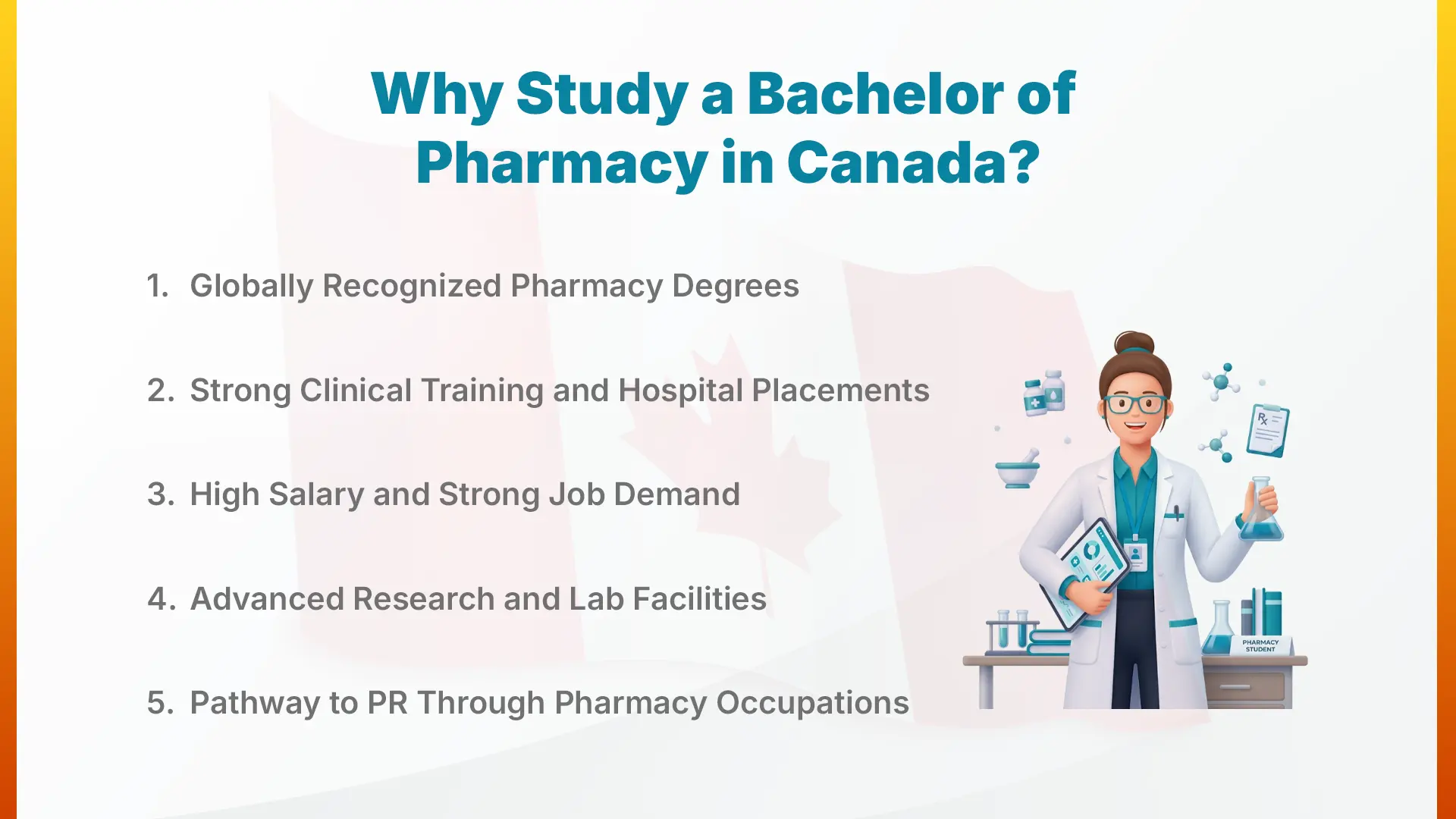
1. Globally Recognized Pharmacy Degrees
Canadian pharmacy degrees are accredited by the Canadian Council for Accreditation of Pharmacy Programs (CCAPP) and are recognized by pharmacy regulatory bodies across North America, the UK, Australia, and several Gulf countries. For Nepalese graduates, a Canadian pharmacy qualification creates career flexibility across multiple high-income countries, making it one of the most internationally portable healthcare credentials available.
2. Strong Clinical Training and Hospital Placements
Canadian pharmacy programs integrate structured experiential learning throughout the degree, placing students in community pharmacies, hospital inpatient and outpatient settings, long-term care facilities, and specialized clinical environments. This level of hands-on exposure ensures graduates are practice-ready from day one and gives them a competitive advantage over candidates from programs with limited clinical components.
3. High Salary and Strong Job Demand
Canada faces a consistent and growing demand for pharmacists driven by an aging population, expanding pharmaceutical services in primary care, and the increasing role of pharmacists in chronic disease management and medication therapy. Pharmacists are among the most consistently employed and well-compensated healthcare professionals in Canada, with strong job availability across all provinces and both urban and rural settings.
4. Advanced Research and Lab Facilities
Canadian pharmacy schools invest heavily in state-of-the-art laboratories, simulation pharmacies, and research infrastructure. Students have access to cutting-edge drug development research, clinical trials, and pharmaceutical innovation projects, particularly at institutions like the University of Toronto and the University of Alberta, which are among the world's leading pharmacy research universities.
5. Pathway to PR Through Pharmacy Occupations
Pharmacists are classified as regulated healthcare professionals under Canada's immigration system and are recognized as high-demand occupations under Express Entry and multiple Provincial Nominee Programs. After completing a bachelor of pharmacy and gaining Canadian work experience through the post-graduation work permit, Nepalese graduates are well-positioned to apply for permanent residency through established and well-supported immigration pathways.
Top Universities Offering Bachelor of Pharmacy in Canada
The top universities offering a Bachelor of Pharmacy in Canada include the University of Toronto, University of British Columbia, University of Alberta, Dalhousie University, University of Waterloo, and McMaster University, each offering CCAPP-accredited programs, strong clinical networks, and dedicated pathways for international students.
Choosing the right university depends on your academic profile, preferred location, budget, and career goals. Nepalese students who want a broader view before shortlisting can explore the best universities in Canada for Nepalese students for a wider comparison across disciplines.
1. University of Toronto
The University of Toronto's Leslie Dan Faculty of Pharmacy is consistently ranked among the top pharmacy schools in the world and is one of the largest and most research-intensive pharmacy faculties in Canada. Its PharmD program combines rigorous academic training with extensive clinical placements across Toronto's network of teaching hospitals, including Toronto General Hospital, Mount Sinai, and SickKids. UofT pharmacy graduates are among the most sought-after in Canada and internationally.
2. University of British Columbia (UBC)
UBC's Faculty of Pharmaceutical Sciences in Vancouver offers a well-regarded PharmD program with a strong emphasis on patient-centered care, pharmacotherapy, and global health. The program integrates experiential learning from the early years and places students in a diverse range of clinical settings across British Columbia. UBC's location in Vancouver, one of Canada's most internationally connected cities also make it a popular choice for Nepalese students.
3. University of Alberta
The University of Alberta's Faculty of Pharmacy and Pharmaceutical Sciences in Edmonton is one of Canada's oldest and most established pharmacy schools. Its PharmD program is known for its strong clinical training, research opportunities in drug development and pharmacogenomics, and close ties with Alberta Health Services. The University of Alberta is also one of the more cost-effective options for international pharmacy students among Canada's research-intensive universities.
4. Dalhousie University
Dalhousie University's College of Pharmacy in Halifax, Nova Scotia, offers a PharmD program with a strong focus on community pharmacy practice and Atlantic Canadian healthcare needs. Dalhousie pharmacy graduates benefit from strong regional employer relationships and the university's active support for international graduates seeking employment and immigration pathways in Atlantic Canada, where pharmacist demand is particularly high relative to population.
5. University of Waterloo
The University of Waterloo's School of Pharmacy in Kitchener, Ontario, offers a unique PharmD program that runs on a co-operative education model, integrating paid work placements with academic terms throughout the degree. This structure gives Waterloo pharmacy students a distinctive combination of clinical experience and professional pharmacy practice exposure that is difficult to match at other institutions. Waterloo graduates consistently receive strong employment outcomes and are highly regarded by pharmacy employers across Ontario.
6. McMaster University
McMaster University's pharmacy program, offered through its Michael G. DeGroote School of Medicine in partnership with the pharmacy faculty, reflects McMaster's signature problem-based learning approach. Students are trained to think critically and adapt to complex clinical scenarios, and the program's location in Hamilton provides access to one of Ontario's largest healthcare employment regions. McMaster pharmacy graduates are well-prepared for both community and hospital practice settings.
Eligibility and Admission Requirements for Bachelor of Pharmacy in Canada
The eligibility and admission requirements for a Bachelor of Pharmacy in Canada include completion of Grade 12 or Plus Two with strong results in biology and chemistry; English language proficiency through IELTS, TOEFL, or PTE; a personal statement; letters of recommendation; medical fitness documentation; and financial proof for the study permit. Meeting these requirements thoroughly is essential for securing admission at a reputable Canadian university for pharmacy.
1. Academic Requirements
Applicants must have completed Grade 12 or Plus Two with strong results, particularly in biology and chemistry, which are prerequisite subjects for all pharmacy programs in Canada. Most universities also require mathematics and physics at the secondary level. Minimum academic requirements typically range from 70% to 85% overall, with competitive programs at UofT and UBC requiring higher academic profiles. Some universities also require specific prerequisite science courses to be completed in the first year before advancing to the professional pharmacy curriculum.
2. English Language Requirements
All Bachelor of Pharmacy programs in Canada are taught in English, and international applicants must demonstrate proficiency through an approved language test. Standard requirements are the following:
IELTS Academic: minimum overall score of 6.5 to 7.0, with no individual band below 6.0
TOEFL iBT: minimum score of 86 to 100, depending on the university
PTE Academic: minimum score of 58 to 65
Pharmacy programs set higher language thresholds than many other undergraduate disciplines because of the critical importance of patient communication and medication counseling in professional practice. Nepalese students who need to strengthen their English score before applying can enroll in IELTS preparation classes to reach their target band.
2. Personal Statement and Letters of Recommendation
Most universities require a personal statement or statement of purpose explaining your motivation for studying pharmacy, your academic background, any relevant healthcare or volunteer experience, and your long-term career goals. Two to three letters of recommendation from science teachers or healthcare supervisors who can speak to your academic ability and professional potential are typically required alongside the personal statement.
3. Medical Fitness and Financial Proof
Many pharmacy programs require incoming students to submit immunization records and a health clearance before beginning clinical placements. A criminal background check is also required at most institutions due to the regulated nature of pharmacy practice. For the Canadian Study permit application, students must provide financial documentation demonstrating they can cover the full cost of tuition and living expenses for at least the first year of study.
How to Apply for a Bachelor of Pharmacy in Canada ?
The admission process for a Bachelor of Pharmacy in Canada involves six steps: researching and shortlisting universities, preparing your documents, submitting your application, writing your SOP and reference letters, receiving your offer letter, and applying for the Canada Student Visa. Approaching each step with proper preparation well in advance of deadlines gives Nepalese students the best chance of a successful application outcome.
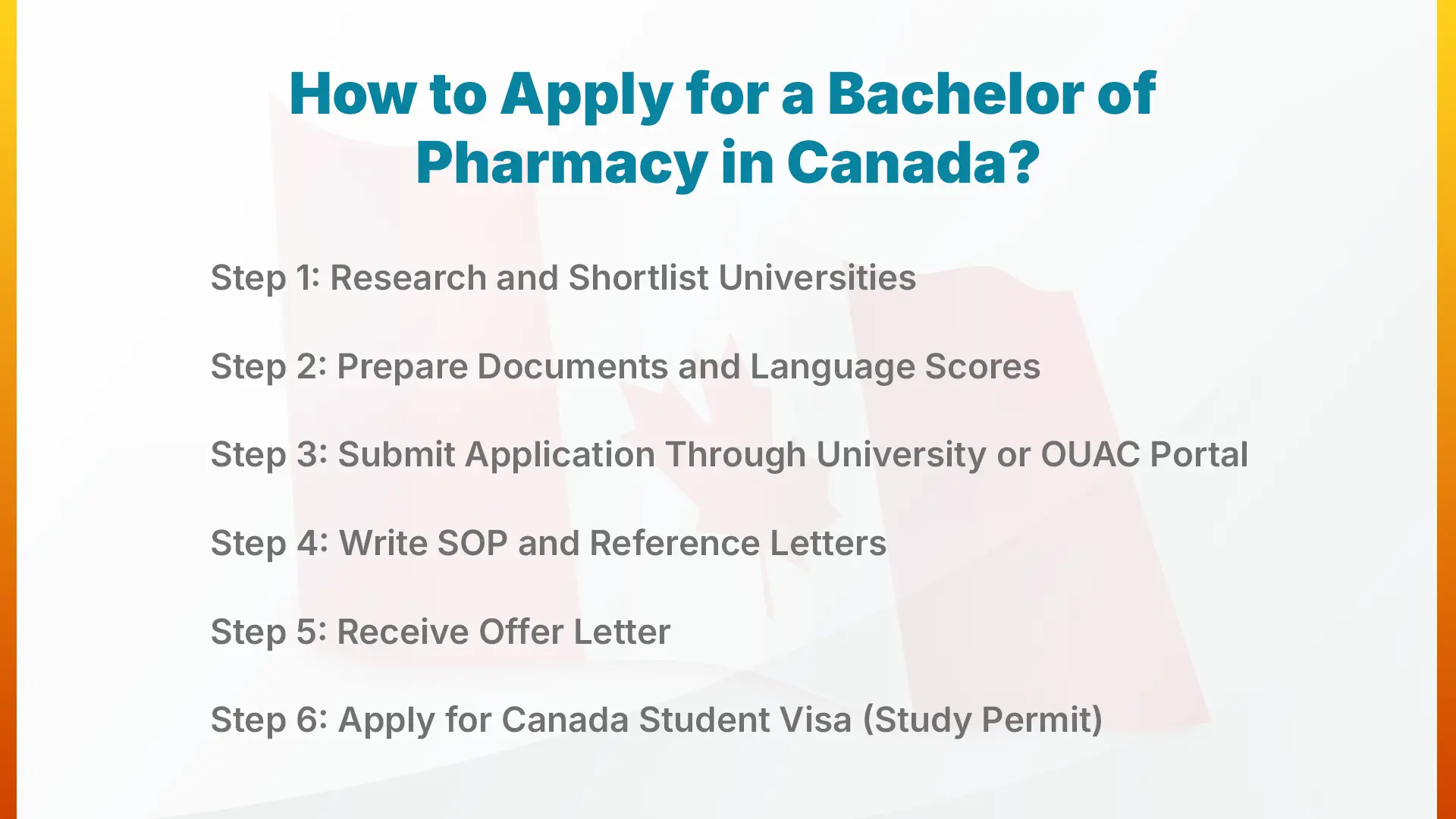
Step 1: Research and Shortlist Universities
Compare pharmacy programs based on your academic profile, accreditation status, clinical placement quality, tuition fees, and scholarship availability. Shortlist three to five universities to give yourself the best chance of receiving at least one offer.
Step 2: Prepare Documents and Language Scores
Gather your Plus Two transcripts, mark sheets, school leaving certificate, character certificate, and migration certificate. Book your IELTS or TOEFL exam early so your scores are ready well before application deadlines, which typically fall between October and January for September intake. It is also worth checking the Canada September intake deadlines early to avoid missing the window.
Step 3: Submit Application Through University or OUAC Portal
Most Canadian universities accept direct online applications through their own portals. Ontario universities use the OUAC system. Pharmacy programs are among the most competitive undergraduate admissions in Canada and fill quickly, so submitting your application as early as possible within the application window is strongly recommended.
Step 4: Write SOP and Reference Letters
Your Statement of Purpose should clearly articulate why you want to study pharmacy, what healthcare or science experiences have shaped that decision, and what you plan to contribute to the profession after graduating. Nepalese students can follow the SOP format for Canada to understand exactly what Canadian admissions panels look for. It is also worth understanding what makes a strong Letter of Recommendation before approaching your referees.
Step 5: Receive Offer Letter
The university will issue a conditional or unconditional offer after reviewing your application. A conditional offer typically requires you to complete your Plus Two with a specified minimum score or submit final official transcripts before your place is confirmed.
Step 6: Apply for Canada Student Visa (Study Permit)
Once you have accepted your offer, apply for your Canadian study permit through the IRCC portal. The requirements to study in Canada from Nepal cover the full document checklist so you can prepare everything well before the visa deadline.
Cost of Studying Bachelor of Pharmacy in Canada
The cost of studying a Bachelor of Pharmacy in Canada generally ranges from CAD 25,000 to CAD 50,000 (approximately NPR 2,250,000 to NPR 4,500,000) per year in tuition fees, depending on the university and province.
When combined with accommodation, food, transportation, health insurance, and other living expenses, Nepalese students should budget approximately CAD 40,000 to CAD 65,000 (approximately NPR 3,600,000 to NPR 5,850,000) per year in total. Compared to the UK, USA, and Australia, Canada remains one of the most affordable destinations for a high-quality pharmacy degree among English-speaking countries. For a complete breakdown of all costs involved in studying in Canada, the total cost to study in Canada is a useful reference when building your financial plan.
Tuition Fees
Tuition fees for international students in Bachelor of Pharmacy programs in Canada vary depending on the university and province. Publicly funded universities in provinces like Alberta and Nova Scotia tend to be more affordable than institutions in Ontario, while the quality of clinical training and employment outcomes remains consistently strong across the country.
University | Annual Tuition (CAD) | Annual Tuition (NPR approx.) |
|---|---|---|
| University of Alberta | CAD 25,000 – CAD 32,000 | NPR 2,250,000 – NPR 2,880,000 |
| Dalhousie University | CAD 26,000 – CAD 34,000 | NPR 2,340,000 – NPR 3,060,000 |
| University of Waterloo | CAD 35,000 – CAD 42,000 | NPR 3,150,000 – NPR 3,780,000 |
| University of Toronto | CAD 40,000 – CAD 50,000 | NPR 3,600,000 – NPR 4,500,000 |
| UBC | CAD 38,000 – CAD 48,000 | NPR 3,420,000 – NPR 4,320,000 |
2. Living Expenses
Monthly living expenses in Canada vary significantly by city. In Toronto and Vancouver, students should budget CAD 1,500 to CAD 2,500 per month for accommodation, food, and transportation. In smaller cities such as Edmonton, Halifax, or Kitchener, monthly costs typically range from CAD 1,000 to CAD 1,800. Since your choice of city directly affects your monthly budget, it is worth reading about the best cities in Canada for international students before finalizing your university shortlist.
3. Total Estimated Cost
Taking tuition, accommodation, food, transportation, health insurance, and miscellaneous expenses into account, Nepalese students should budget approximately CAD 40,000 to CAD 65,000 per year. For a standard four-year Bachelor of Pharmacy in Canada, the total estimated cost ranges from CAD 160,000 to CAD 260,000 (approximately NPR 14,400,000 to NPR 23,400,000), making early scholarship applications and careful financial planning essential for most Nepalese students.
Scholarships for Bachelor of Pharmacy in Canada
Scholarships for a Bachelor of Pharmacy in Canada include Canadian government-linked awards, university-specific merit scholarships for international pharmacy students, and external healthcare and science-focused funding programs. Early preparation, strong Plus Two academic results in biology and chemistry, and a well-crafted personal statement significantly improve a Nepalese student's chances of securing financial support and reducing the overall cost of their pharmacy degree in Canada.
1. Canadian Government Scholarships
While fully funded government scholarships for international undergraduate students in Canada are limited, several provincial programs offer financial support for students who commit to working in specific regions after graduation. Atlantic Canada, in particular, has programs that support international graduates in healthcare roles, including pharmacy, making universities like Dalhousie an attractive option for scholarship-conscious students. Nepalese students can explore scholarships in Canada for a broader overview of available funding options.
2. University-Specific Pharmacy Scholarships
Most top Canadian pharmacy schools offer merit-based international student scholarships to high-achieving applicants. These include:
UBC International Major Entrance Scholarship up to CAD 80,000 over four years for exceptional students
University of Alberta International Student Scholarship partial tuition awards for strong academic profiles
Dalhousie University International Student Award merit-based awards for incoming international students
University of Waterloo International Student Entrance Scholarship available to high-achieving international applicants
These awards are competitive and merit-based. Students with strong Plus Two results in biology and chemistry and a compelling personal statement are the strongest candidates.
3. Tips to Increase Scholarship Chances
Apply as early as possible; most scholarship deadlines fall before the main admissions window
Maintain the highest possible Plus Two GPA, particularly in biology and chemistry
Include any healthcare volunteer experience, hospital shadowing, or pharmacy-related activities in your application
Write a focused and honest personal statement that clearly connects your science background to your pharmacy career goals
Apply to multiple scholarships simultaneously rather than waiting for one result at a time
Career Opportunities After Bachelor of Pharmacy in Canada
Graduates with a Bachelor of Pharmacy from Canada can pursue careers as community pharmacists, hospital pharmacists, clinical pharmacists, pharmaceutical researchers, regulatory affairs specialists, and pharmacy managers across a wide range of healthcare and industry settings. Canada's consistent demand for pharmacists, combined with the expanding scope of pharmacy practice in primary care and chronic disease management, means that Bachelor of Pharmacy graduates are among the most reliably employed healthcare professionals in the country.
1. Community Pharmacist
A community pharmacist dispenses medications, counsels patients on drug use and interactions, administers vaccinations, and supports chronic disease management in retail pharmacy settings. This is the most common career pathway for Bachelor of Pharmacy graduates in Canada and offers strong starting salaries, flexible working hours, and opportunities across urban and rural communities nationwide.
2. Hospital Pharmacist
A hospital pharmacist works within inpatient and outpatient hospital settings, reviewing medication orders, advising clinical teams on drug therapy, monitoring patient responses to treatment, and managing pharmaceutical inventory. Hospital pharmacy is one of the most clinically intensive and highly respected pharmacy career paths in Canada.
3. Clinical Pharmacist
A clinical pharmacist works directly alongside physicians, nurses, and other healthcare professionals in multidisciplinary care teams, optimizing medication therapy for patients with complex or chronic conditions. This role requires advanced pharmacotherapy knowledge and is particularly in demand in Canada's growing primary care and specialty clinic sectors.
4. Pharmaceutical Researcher
A pharmaceutical researcher works in drug discovery, development, and testing in academic institutions, government agencies, or private pharmaceutical companies. This career path is particularly well-suited for graduates who develop a strong research interest during their degree and wish to pursue postgraduate study alongside industry work.
5. Regulatory Affairs Specialist
A regulatory affairs specialist ensures that pharmaceutical products meet the requirements of Health Canada and international regulatory bodies before they are approved for sale and use. This is a specialized and well-compensated role that sits at the intersection of pharmacy science, law, and public health policy.
6. Pharmacy Manager
An experienced pharmacist with strong leadership and business skills can progress into pharmacy management roles, overseeing the operations of community or hospital pharmacy departments, managing staff, and ensuring compliance with professional and regulatory standards. This pathway offers significant career growth and competitive salaries, particularly within large pharmacy chains and hospital networks.
Scope and Salary After Bachelor of Pharmacy in Canada
The scope and salary after a Bachelor of Pharmacy in Canada are exceptionally strong, with growing demand for pharmacists across all provinces and competitive salaries ranging from CAD 70,000 to CAD 130,000 per year, a Post-Graduation Work Permit allowing up to three years of full-time work after graduation and a clear pathway to permanent residency through Express Entry and Provincial Nominee Programs. For Nepalese students, a bachelor of pharmacy in Canada offers not just a stable and well-paid career but also one of the most dependable routes to long-term settlement in Canada available today.
1. Growing Demand for Pharmacists in Canada
Canada's pharmacist workforce is under sustained and growing pressure due to an aging population requiring more complex medication management, the expanding scope of pharmacy practice into primary care, and workforce retirements across the profession. This makes pharmacy one of the best courses to study in Canada for Nepalese students who want strong employment outcomes and clear immigration prospects from the moment they graduate.
2. Average Salary After Bachelor of Pharmacy in Canada
Pharmacists in Canada are among the highest-paid healthcare professionals at the undergraduate degree level. The table below reflects typical annual salary ranges for Bachelor of Pharmacy graduates across experience levels.
Experience Level | Annual Salary (CAD) | Annual Salary (NPR approx.) |
|---|---|---|
| Entry-Level (0–2 years) | CAD 70,000 – CAD 85,000 | NPR 6,300,000 – NPR 7,650,000 |
| Mid-Level (2–5 years) | CAD 85,000 – CAD 105,000 | NPR 7,650,000 – NPR 9,450,000 |
| Senior Level (5+ years) | CAD 105,000 – CAD 130,000+ | NPR 9,450,000 – NPR 11,700,000+ |
Provinces such as British Columbia, Ontario, and Alberta consistently offer the highest pharmacist salaries in Canada. Pharmacists working in hospitals or specialized clinical settings tend to earn at the higher end of these ranges even at mid-level experience.
3. PGWP and Work Pathways After Graduation
After completing their Bachelor of Pharmacy, international graduates from Canadian universities can apply for the Post-Graduation Work Permit (PGWP), which allows them to work full-time in Canada for up to three years in any role, including pharmacy practice. Many Nepalese students also take up part-time jobs in Canada during their studies to cover living expenses and build early Canadian work experience before graduating.
4. Pathway to PR Through Express Entry and PNP
Pharmacists are classified as regulated healthcare professionals under Canada's immigration system and are recognized as high-demand occupations across multiple immigration streams. PGWP holders with Canadian pharmacy experience are well-positioned to apply for permanent residency through the following:
Express Entry (Federal Skilled Worker Program or Canadian Experience Class) for those with strong CRS scores
Provincial Nominee Programs (PNPs) in British Columbia, Ontario, Alberta, and Atlantic provinces, which actively target regulated healthcare professionals, including pharmacists
Atlantic Immigration Program, which offers a streamlined PR pathway for healthcare graduates who secure employment in Atlantic Canada
For Nepalese students, a Bachelor of Pharmacy in Canada is not only a pathway to a highly respected and well-paid healthcare career but also one of the most reliable routes to Canadian permanent residency available at the undergraduate level.
Conclusion
Canada offers Nepalese students an outstanding combination of academic quality, clinical training, career demand, and immigration opportunity through a bachelor of pharmacy. With world-respected pharmacy schools, rigorous experiential placements, strong salary outcomes, and one of the clearest pathways from graduation to permanent residency in the world, Canada stands apart as the most compelling destination for Nepalese students who are serious about building a long-term career in pharmacy.
The demand for pharmacists in Canada is real, the profession is expanding, and the immigration doors are open. For Nepalese students willing to invest in four years of challenging and rewarding pharmacy education, a Bachelor of Pharmacy from Canada is a qualification that will serve them across their entire career.
Interested in studying pharmacy in Canada? Contact SAS Education Consultancy for a free counseling session and let us help you find the right university, apply for the best scholarships, and navigate the study permit process with confidence.