Bachelor of Childhood Education in Canada: Top Universities, Cost & Scope

Jun 05, 2026
Canada is one of the world's most progressive and professionally respected destinations for childhood education degrees. With a national commitment to high-quality early learning, a chronic shortage of trained early childhood educators and classroom teachers across every province, and some of the most research-informed child development programs available anywhere, Canada offers Nepalese students a genuinely compelling environment to build a career working with children and families.
A Bachelor of Childhood Education in Canada, offered under several titles depending on the institution, prepares graduates to understand how children grow, learn, and thrive, and equips them with the classroom, practicum, and community skills needed to lead in schools, early learning centers, and child and family services organizations. Nepalese students who are still exploring their destination options can start by reading about studying in Canada before committing to a specific program.
In this guide, we cover everything a Nepalese student needs to know about pursuing a Bachelor of Childhood Education in Canada, from top universities and admission requirements to tuition costs, scholarships, career roles, salary expectations, and the pathway to permanent residency.
In this blog
What Is a Bachelor of Childhood Education in Canada?
Before applying, Nepalese students need to understand one important detail about how childhood education degrees are structured in Canada: the degree is rarely offered under the exact title "Bachelor of Childhood Education." Instead, depending on the institution and the specific focus of the program, the equivalent credential is most commonly offered as a Bachelor of Education (BEd) with an Early Childhood specialization, a Bachelor of Child and Youth Care (BCYC), a Bachelor of Early Childhood Education (BECE), or a Bachelor of Arts in Child and Youth Studies. Some college programs also offer four-year or accelerated pathways that lead to the same professional registration outcomes as university degrees.
This variation in degree title does not affect the professional standing or career outcomes available to graduates. What matters is whether the program is recognized by the provincial regulatory body, such as the College of Early Childhood Educators (CECE) in Ontario or the Early Childhood Educator Registry in British Columbia, and whether it includes the child development, curriculum design, and supervised practicum components that define a complete childhood education qualification.
A Bachelor of Childhood Education in Canada is typically a four-year undergraduate program, with some college-based diploma-to-degree pathways completing in three years. The curriculum blends theoretical classroom learning with laboratory observations and substantial field placement hours in real early learning and school environments, giving graduates both the professional knowledge and the hands-on experience employers require from the first day of practice.
The practicum placement component where students spend structured hours in licensed childcare centers, kindergarten classrooms, and school settings is one of the most important elements of a Canadian childhood education degree and is what distinguishes it from a purely theoretical qualification.
Why Study a Bachelor of Childhood Education in Canada?
Study a Bachelor of Childhood Education in Canada because it offers provincially recognized and internationally respected education degrees, strong practicum integration with real classrooms and early learning centers, high and growing demand for qualified childhood educators across every province, comparatively affordable tuition relative to the UK, USA, and Australia, and a clear pathway to permanent residency through education occupations.
For Nepalese students who want a career that combines professional purpose, community impact, and long-term immigration advantage, Canada is one of the most strategically sound destinations for a childhood education degree. This is a key part of why Nepalese students choose Canada for education and human services programs.
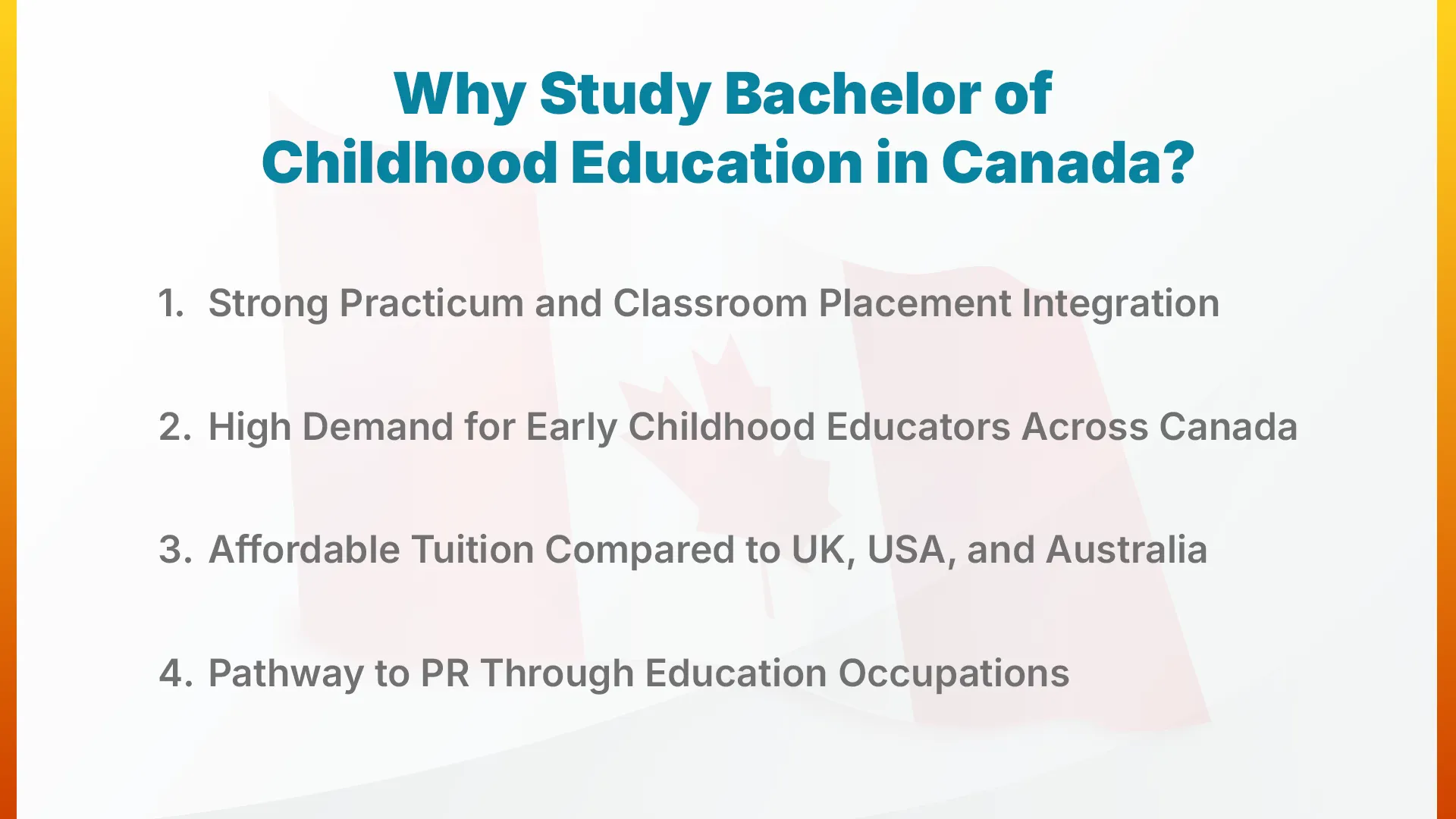
1. Globally Recognized Education Degrees
Canadian childhood education degrees recognized by provincial regulatory bodies such as CECE Ontario and the BC ECE Registry are respected by employers and licensing authorities in the United Kingdom, Australia, New Zealand, and several other countries. For Nepalese graduates, a Canadian credential creates genuine career flexibility in international education markets.
2. Strong Practicum and Classroom Placement Integration
Every accredited childhood education program in Canada includes mandatory supervised practicum placements in licensed early learning centers and school settings as a core degree requirement. These placements allow students to apply developmental theory in real environments, build relationships with children and families, and demonstrate professional competency under experienced supervision, giving graduates an applied readiness that employers consistently value.
3. High Demand for Early Childhood Educators Across Canada
Canada is experiencing a well-documented and sustained shortage of qualified early childhood educators and primary school teachers across every province. The federal government's national childcare expansion plan committing CAD 30 billion over five years to building a universal early learning system has dramatically increased demand for degree-qualified childhood educators, particularly in Ontario, British Columbia, Alberta, and Atlantic Canada.
4. Affordable Tuition Compared to UK, USA, and Australia
International tuition fees for childhood education programs in Canada are significantly lower on average than equivalent programs in the United Kingdom, the United States, and Australia. Combined with a generous post-graduation work permit and a well-structured PR pathway, Canada represents exceptional value for Nepalese students investing in an education career.
5. Pathway to PR Through Education Occupations
Early childhood educators, primary school teachers, and child and youth care workers are recognized as skilled workers under Canada's immigration system. After completing a Bachelor of Childhood Education and gaining Canadian work experience through the post-graduation work permit, Nepalese graduates are well-positioned to apply for permanent residency through Express Entry and provincial nominee programs that actively support experienced education professionals.
Top Universities and Colleges Offering Bachelor of Childhood Education in Canada
The top institutions offering a Bachelor of Childhood Education in Canada include the University of British Columbia, the University of Toronto (OISE), the University of Alberta, Toronto Metropolitan University, MacEwan University, and Algonquin College, each offering recognized childhood education degrees with strong practicum networks, research-informed curricula, and excellent connections to provincial licensing bodies and employers.
Choosing the right institution depends on your academic profile, preferred province, budget, and whether you want a university degree or a college-based pathway. Nepalese students who want a broader comparison before shortlisting can explore the best universities in Canada for Nepalese students to understand which cities and institutions best align with their profile and goals.
1. University of British Columbia (UBC)
UBC's Faculty of Education in Vancouver offers one of Canada's most research-intensive and professionally respected childhood education programs, with a curriculum emphasizing inclusive education, Indigenous early learning perspectives, and evidence-based approaches to child development. Students benefit from extensive practicum placements across Vancouver's rich network of early learning centers and public schools, and British Columbia's strong provincial investment in early childhood infrastructure makes UBC graduates among the most sought-after in Western Canada.
2. University of Toronto OISE
The Ontario Institute for Studies in Education (OISE) at the University of Toronto is one of North America's most respected and research-active faculties of education. Its undergraduate and concurrent education programs offer pathways into early childhood and primary education with a strong emphasis on equity, diversity, and the social foundations of learning. Toronto's vast and diverse educational community provides unparalleled practicum placement opportunities for OISE students.
3. University of Alberta
The University of Alberta's Faculty of Education in Edmonton offers a Bachelor of Education with specializations in early childhood and elementary education recognized by the Alberta Teachers' Association. Alberta's strong economy, growing population, and ambitious early childhood expansion under the provincial childcare plan make University of Alberta graduates particularly well-placed in one of Canada's most active education markets.
4. Toronto Metropolitan University (TMU)
TMU's School of Early Childhood Studies offers a Bachelor of Arts in Early Childhood Studies focused directly on child development, early learning, and family support for children from birth to age eight. The program's Toronto location and strong community partnerships provide students with exceptional practicum diversity across childcare centers, family resource programs, community health organizations, and schools.
5. MacEwan University
MacEwan University in Edmonton offers a Bachelor of Child and Youth Care with a strong social justice and trauma-informed care orientation. Its close relationships with Edmonton's child and family services sector give students practicum placements directly relevant to the professional settings they will enter after graduation.
6. Algonquin College
Algonquin College in Ottawa offers an Early Childhood Education diploma-to-degree pathway leading to registration with the College of Early Childhood Educators. Ottawa's bilingual environment and active early learning sector make Algonquin a practical and employment-focused option for Nepalese students seeking an accessible childhood education pathway in Ontario.
Eligibility and Admission Requirements for Bachelor of Childhood Education in Canada
The eligibility and admission requirements for a Bachelor of Childhood Education in Canada include completion of Grade 12 or Plus Two with satisfactory overall results; English language proficiency through IELTS, TOEFL, or PTE; a personal statement; letters of recommendation; and financial documentation for the study permit. Preparing each component thoroughly gives Nepalese students the best possible chance of a strong admission outcome.
1. Academic Requirements
Applicants must have completed Grade 12 or Plus Two with satisfactory overall results. While there are no strict science or mathematics prerequisite requirements for most childhood education programs, a background in social studies, psychology, or biology is advantageous. Most institutions require a minimum overall academic score of 60% to 75%, with competitive programs at UBC and OISE requiring stronger academic profiles. Education programs at many Canadian universities also value evidence of community involvement, volunteer experience with children, or prior work in educational settings as part of the holistic admission review.
2. English Language Requirements
All Bachelor of Childhood Education programs in Canada are taught in English, and international applicants must demonstrate proficiency through an approved language test. Standard requirements are the following:
IELTS Academic: minimum overall score of 6.5, with no individual band below 6.0
TOEFL iBT: minimum score of 86 to 95, depending on the university
PTE Academic: minimum score of 58 to 65
Strong English communication skills are particularly important for education programs because graduates must communicate clearly and confidently with children, families, and colleagues in professional settings from their very first practicum placement. Nepalese students who need to build their score before applying can enroll in IELTS preparation classes to reach their target band well before application deadlines.
3. Personal Statement and Letters of Recommendation
A compelling personal statement is one of the most important components of a childhood education application. Your statement should explain your motivation for working with children, describe any experiences, whether volunteering, babysitting, tutoring, or working in a community setting that have shaped your commitment to childhood education, and articulate your long-term career goals in the field.
Two to three letters of recommendation from teachers, community mentors, or supervisors who can speak to your interpersonal skills, empathy, reliability, and academic potential are typically required. Nepalese students can follow the SOP format for Canada to structure their personal statement effectively for Canadian admissions panels.
4. Financial Proof and Visa Documentation
For the Canadian Study Permit application, students must provide financial documentation demonstrating they can cover the full cost of tuition and living expenses for at least the first year. The requirements to study in Canada from Nepal cover the full visa document checklist so Nepalese students can prepare everything well in advance of application deadlines.
How to Apply for a Bachelor of Childhood Education in Canada
The admission process for a Bachelor of Childhood Education in Canada involves six steps: researching and shortlisting institutions; preparing your documents and language scores; submitting your application; writing your SOP and reference letters; receiving your offer letter; and applying for the Canada Student Visa. Beginning this process well in advance of deadlines is essential, as education programs are among the more competitive undergraduate admissions in Canada. It is worth checking the Canada September intake deadlines early to avoid missing the application window for your preferred institutions.
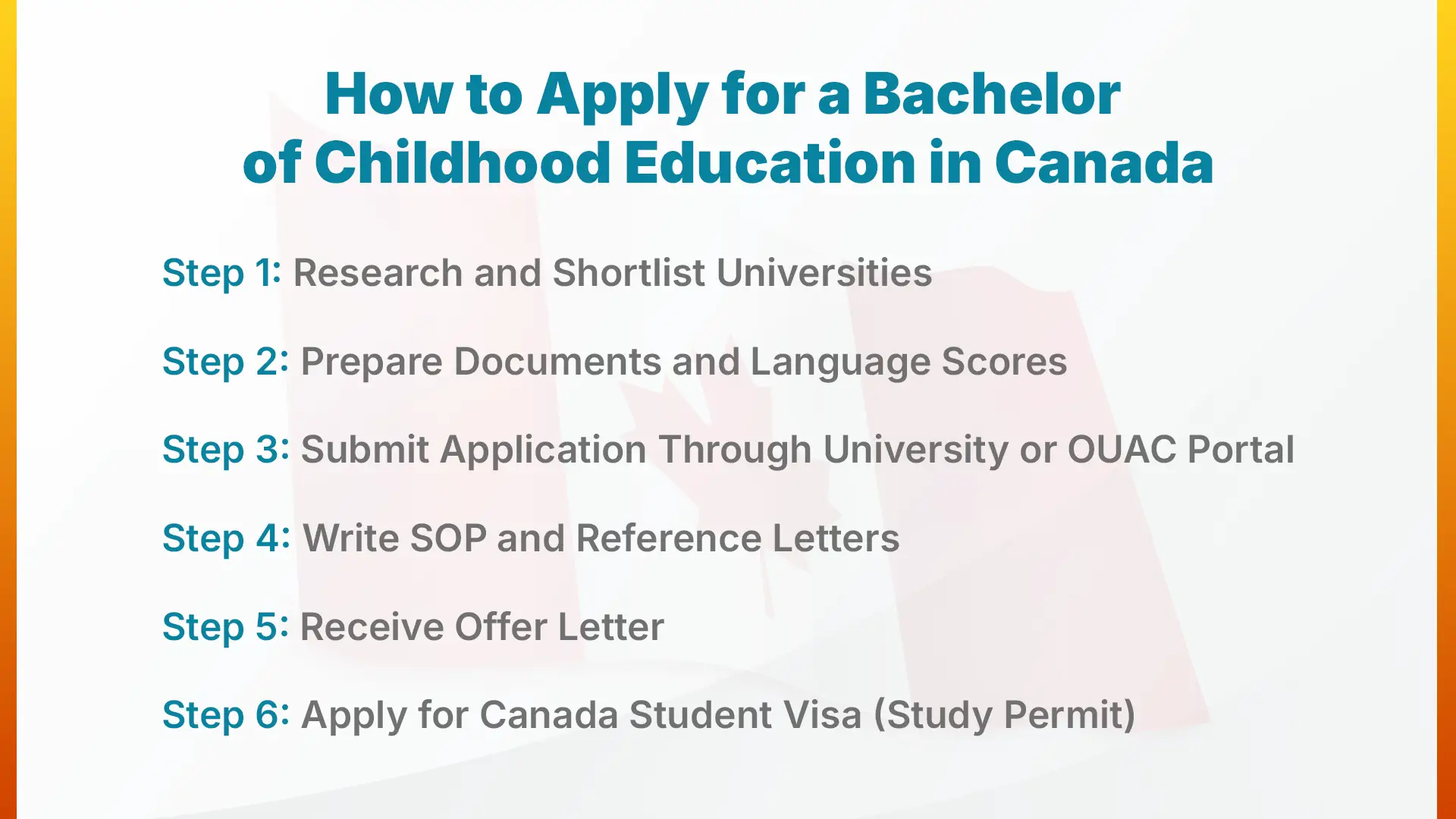
Step 1: Research and Shortlist Institutions
Compare childhood education programs based on your academic profile, whether the institution is a university or college, practicum placement diversity, location, tuition fees, and scholarship availability. Shortlist three to five institutions to give yourself the best chance of receiving at least one strong offer.
Step 2: Prepare Documents and Language Scores
Gather your Plus Two transcripts, mark sheets, and all supporting academic documents. Book your IELTS or TOEFL exam early so scores are ready well before application deadlines. Begin gathering evidence of your experience with children for your personal statement.
Step 3: Submit Application Through University or OUAC Portal
Most Canadian universities accept direct online applications through their own portals. Ontario universities use the OUAC system. College programs in Ontario use the OCAS portal. Education programs are selective, and applying early, particularly for programs with small cohort sizes like those at OISE, is strongly recommended.
Step 4: Write SOP and Reference Letters.
Your Statement of Purpose should be specific about why you want to work with children, what experiences have shaped that commitment, and what kind of childhood educator or professional you aim to become. It is also worth understanding what makes a strong letter of recommendation before approaching your referees, since education programs particularly value evidence of interpersonal qualities and genuine vocation alongside academic achievement.
Step 5: Receive Offer Letter
The institution will issue a conditional or unconditional offer after reviewing your application. Some programs include an interview as part of the selection process, particularly at universities with small and competitive education cohorts. A conditional offer typically requires you to complete your Plus Two with a specified minimum score before your place is confirmed.
Step 6: Apply for Canada Student Visa (Study Permit)
Once you have accepted your offer and paid your enrollment deposit, apply for your Canadian study permit through the IRCC portal using your acceptance letter, financial documents, valid passport, and biometrics.
Cost of Studying Bachelor of Childhood Education in Canada
The cost of studying a Bachelor of Childhood Education in Canada generally ranges from CAD 14,000 to CAD 32,000 (approximately NPR 1,260,000 to NPR 2,880,000) per year in tuition fees for international students, depending on the institution and province.
When combined with accommodation, food, transportation, health insurance, and other living expenses, Nepalese students should budget approximately CAD 26,000 to CAD 48,000 (approximately NPR 2,340,000 to NPR 4,320,000) per year in total. For a full breakdown of all costs involved in studying in Canada, the total cost to study in Canada is a useful reference when planning your finances.
1. Tuition Fees
Tuition fees for a Bachelor of Childhood Education in Canada range from CAD 14,000 to CAD 34,000 (approximately NPR 1,260,000 to NPR 3,060,000) per year for international students, depending on the institution and province.
Institution | Annual Tuition (CAD) | Annual Tuition (NPR approx.) |
|---|---|---|
| Algonquin College | CAD 14,000 – CAD 18,000 | NPR 1,260,000 – NPR 1,620,000 |
| MacEwan University | CAD 18,000 – CAD 22,000 | NPR 1,620,000 – NPR 1,980,000 |
| University of Alberta | CAD 20,000 – CAD 26,000 | NPR 1,800,000 – NPR 2,340,000 |
| Toronto Metropolitan University | CAD 23,000 – CAD 28,000 | NPR 2,070,000 – NPR 2,520,000 |
| University of British Columbia | CAD 26,000 – CAD 32,000 | NPR 2,340,000 – NPR 2,880,000 |
| University of Toronto (OISE) | CAD 28,000 – CAD 34,000 | NPR 2,520,000 – NPR 3,060,000 |
2. Living Expenses
Monthly living expenses in Canada vary significantly by city. In Toronto and Vancouver, students should budget CAD 1,400 to CAD 2,200 per month for accommodation, food, and transportation. In more affordable cities such as Edmonton or Ottawa, monthly costs typically range from CAD 900 to CAD 1,600. Since your choice of city has a direct impact on your total annual budget, it is worth reading about the best cities in Canada for international students before finalizing your institution shortlist.
3. Total Estimated Cost
Taking tuition, accommodation, food, transportation, health insurance, and miscellaneous expenses into account, Nepalese students should budget approximately CAD 26,000 to CAD 48,000 per year. For a four-year Bachelor of Childhood Education degree, the total estimated cost ranges from CAD 104,000 to CAD 192,000 (approximately NPR 9,360,000 to NPR 17,280,000), depending on the institution and city chosen.
Scholarships for Bachelor of Childhood Education in Canada
Scholarships for a Bachelor of Childhood Education in Canada include Canadian government-linked awards and university and college-specific merit scholarships for international education students.
Early preparation, strong academic results, evidence of relevant experience with children, and a well-crafted personal statement significantly improve a Nepalese student's chances of securing financial support. Students can explore the broader range of scholarships available in Canada for Nepalese students as a starting point for their funding research.
1. Canadian Government Scholarships
While fully funded government scholarships for international undergraduate students in Canada are limited, several provincial programs, particularly in Atlantic Canada and the Prairie provinces, offer financial incentives for international students who commit to working in early childhood education or teaching in underserved communities after graduation. These programs are worth researching early, as they can significantly offset the total cost of a childhood education degree.
2. University-Specific Childhood Education Scholarships
Most Canadian universities and colleges offer merit-based international student entry scholarships for high-achieving applicants. Key awards include:
UBC International Major Entrance Scholarship up to CAD 80,000 over four years for exceptional international students
University of Toronto Scholars Program merit-based recognition and financial awards for outstanding incoming students
University of Alberta International Student Scholarship merit awards for strong academic profiles entering undergraduate programs
TMU International Student Entrance Award partial tuition awards for eligible high-achieving international applicants
MacEwan University Entrance Scholarship merit-based awards for strong academic and community profiles
These scholarships are competitive and are assessed based on academic achievement, personal statement quality, and the overall strength of the application.
3. Tips to Increase Scholarship Chances
Apply as early as possible; most scholarship deadlines fall before the main admissions window
Maintain the highest possible Plus Two GPA
Write a personal statement that clearly and specifically describes your motivation to work with children and your long-term education career goals
Document all volunteer, caregiving, or teaching experience with children; even informal experience strengthens your application
Apply to multiple scholarships simultaneously rather than waiting for one result at a time
Career Opportunities After Bachelor of Childhood Education in Canada
Graduates with a Bachelor of Childhood Education from Canada can pursue careers as early childhood educators, primary school teachers, child and youth care workers, and special education assistants across a wide range of school, community, and government settings. Canada's sustained federal and provincial investment in early learning infrastructure means that childhood education graduates are in consistent and growing demand across the country.
1. Early Childhood Educator (ECE)
A registered early childhood educator designs and delivers play-based learning programs for children from birth to age six in licensed childcare centers, nursery schools, and family resource programs. This is the core professional outcome for graduates of BECE and BEd Early Childhood programs and requires registration with the relevant provincial regulatory body upon graduation.
2. Primary School Teacher
Graduates of BEd programs with early childhood or elementary specializations are qualified to seek certification as primary school teachers with provincial teacher certification bodies. Primary school teachers in Canada work with children from Kindergarten through Grade 6 and are in strong and growing demand across every province, particularly in rural and remote communities where teacher shortages are most acute.
3. Child and Youth Care Worker
A child and youth care worker provides therapeutic, developmental, and supportive services to children and youth facing complex challenges, including trauma, developmental differences, mental health difficulties, and family instability. This is a demanding and deeply meaningful career pathway for graduates of BCYC and Child and Youth Studies programs, with employment opportunities across residential care, school-based counseling, community mental health, and youth justice settings.
4. Special Education Assistant
A special education assistant supports students with diverse learning needs in inclusive classroom environments, working under the direction of a classroom teacher or special education coordinator to provide individualized learning support, behavioral guidance, and daily living skill development. This is one of the most consistently in-demand education roles across Canadian school boards, and childhood education graduates are well-prepared for this position.
Scope and Salary After Bachelor of Childhood Education in Canada
The scope and salary after a Bachelor of Childhood Education in Canada are strong and improving, with growing federal and provincial investment driving sustained demand for qualified childhood educators across all regions; competitive and rising salaries; a post-graduation work permit allowing up to three years of full-time work after graduation; and a clear pathway to permanent residency through education occupations.
For Nepalese students, a Bachelor of Childhood Education from Canada is a qualification that offers not just a professionally rewarding career but also one of the most stable and socially valued roles in the Canadian workforce. Education is consistently recognized as one of the best courses to study in Canada for students who want a long-term career combining professional impact and immigration advantage.
1. Growing Demand for Childhood Educators in Canada
The federal government's commitment to a national childcare program at CAD 10 per day per child has triggered a historic expansion of licensed childcare infrastructure across Canada, creating thousands of new positions for registered early childhood educators every year. Provincial governments in Ontario, British Columbia, Alberta, and Nova Scotia have all announced significant childcare workforce expansion targets, and the shortage of qualified ECEs and primary teachers is among the most frequently cited labor market challenges in the Canadian education sector. This demand is structural and long-term, not cyclical, making childhood education one of the most employment-secure career pathways available to Nepalese graduates.
2. Average Salary After Bachelor of Childhood Education in Canada
Childhood education professionals in Canada are compensated competitively across all provinces and experience levels. The table below reflects typical annual salary ranges for childhood education graduates in Canada.
Experience Level | Annual Salary (CAD) | Annual Salary (NPR approx.) |
|---|---|---|
| Entry-Level ECE (0–2 years) | CAD 38,000 – CAD 50,000 | NPR 3,420,000 – NPR 4,500,000 |
| Mid-Level Educator (2–5 years) | CAD 50,000 – CAD 70,000 | NPR 4,500,000 – NPR 6,300,000 |
| Senior / Lead Educator (5+ years) | CAD 70,000 – CAD 100,000+ | NPR 6,300,000 – NPR 9,000,000+ |
Certified primary school teachers in Ontario and British Columbia earn among the highest salaries for education professionals in Canada, with experienced teachers in unionized school boards regularly earning CAD 85,000 to CAD 105,000 annually. Early childhood educators working in government-subsidized or unionized childcare settings have seen significant wage increases following the national childcare expansion, and this trend is projected to continue.
3. PGWP and Work Pathways After Graduation
After completing their Bachelor of Childhood Education, international graduates from Canadian universities and colleges can apply for the Post-Graduation Work Permit (PGWP), which allows them to work full-time in Canada for up to three years in any role, including early childhood education, teaching assistant, or child and youth care positions. Many Nepalese students also take up part-time jobs in Canada during their studies, often in childcare assistant or after-school program roles, to build early Canadian work experience and offset living costs before graduating.
Conclusion
Canada offers Nepalese students an outstanding combination of education quality, professional training, employment demand, and immigration opportunity through a Bachelor of Childhood Education. With recognized programs at institutions ranging from UBC and OISE to MacEwan University and Algonquin College, rigorous practicum integration, a national childcare expansion driving historic demand for qualified educators, competitive and rising salaries, and a clear pathway from graduation to permanent residency, Canada stands apart as one of the most strategically rewarding destinations for Nepalese students who are serious about a career working with children and families.
Interested in studying childhood education in Canada? Contact SAS Education Consultancy for a free counseling session and let us help you find the right institution, prepare a strong application, identify the best scholarships, and navigate the study permit process with confidence.